



When Aditya Birla group announced the launch of Ultravolt on September 3, backed by an investment of ₹1,800 crore, cable and wires stocks took a hit. KEI Industries, Polycab, and RR Kabel fell sharply, reflecting the concerns.
The reaction was understandable. Investors had already seen what happened when the Aditya Birla Group entered another crowded consumer market with Birla Opus. The concern this time is similar: a deep-pocketed conglomerate entering an established industry could mean tougher competition, higher distribution spending, and, eventually, pressure on margins.
But the sell-off also treated the wires and cables industry as one industry. A house-wires maker selling through dealers and electricians faces a very different competitive threat compared to an extra-high-voltage cable manufacturer. That distinction helps to explain why some cable & wires stocks reacted differently to Ultravolt’s entry.
Finolex Cables, Universal Cables, and KSH International were among the relative outliers. The reason becomes clearer when you look at the markets they serve.
What is Ultravolt Exactly Targeting?
The cable & wires business is not one business. There are at least three segments: house wires sold through dealers, high-voltage cables sold through tenders, and industrial inputs like winding wire and optical fibre sold to equipment makers. Ultravolt is primarily targeting the house wires segment. Its product range includes house wires, flexible wires, and cables and conduits.
Ultravolt’s Jhagadia plant in Gujarat started commercial production on September 1, 2026. It has an installed capacity of 10.98 lakh km, which makes Ultravolt the second-largest wires player by capacity from day one.
Aditya Birla group plans to leverage its existing nationwide cement distribution network to grow Ultravolt’s operations. The company is also sourcing copper from Hindalco, another Aditya Birla Group company.
The playbook is familiar. The group used a similar distribution-heavy approach when it entered paints with Birla Opus.
#1. Universal Cables: The tender moat
Universal Cables operates at the far end of the spectrum from Ultravolt’s initial target market. The company manufactures Extra High Voltage (EHV) power cables of up to 400 kV and caters primarily to utilities and project customers. In this segment, buyers do not walk into retail shops; suppliers must clear rigorous approvals, technical qualifications, and complex tender processes before they are even permitted to bid. Therefore, consumer brand, dealer network, and electrician loyalty carry little weight for Universal Cables.
Universal Cables: Financial Performance
| Period | Q1FY26 | Q1FY27 | YoY Growth (%) |
| Revenue From Operations (₹ crore) | 600 | 945 | 57.5% |
| EBITDA (₹ crore) | 60.2 | 94.57 | 57.1% |
| EBITDA Margin | 10.03% | 10.01% | – |
| Net Profit (₹ crore) | 90.6 | 137.87 | 52.17% |
Source: Company Presentation
Revenue from operations for Q1FY27 grew 57.5% YoY to ₹945 crore, and the Earnings Before Interest, Tax, Depreciation and Amortization (EBITDA) margins remained steady at 10%. A big part of the growth is driven by strong exports.
The overseas sales during the period surged by around 187% YoY to ₹120 crore, from ₹41.83 crore in Q1FY26. The segment contributed 12.70% to the company’s total revenue for the quarter. This sharp rise suggests that international technical qualifications are actively converting into confirmed orders.
Strong Order Book
The pending order book as on July 1, 2026 stood at about ₹2,860 crore, which included export orders of around ₹485 crore. To cater to the sustained demand and to expand its range of medium and high voltage power cables, the company has raised its capex spending to ₹617 crore.
Based on the existing order book and expected order inflow, the company is targeting a targeted growth of about 25% in revenue in FY27.
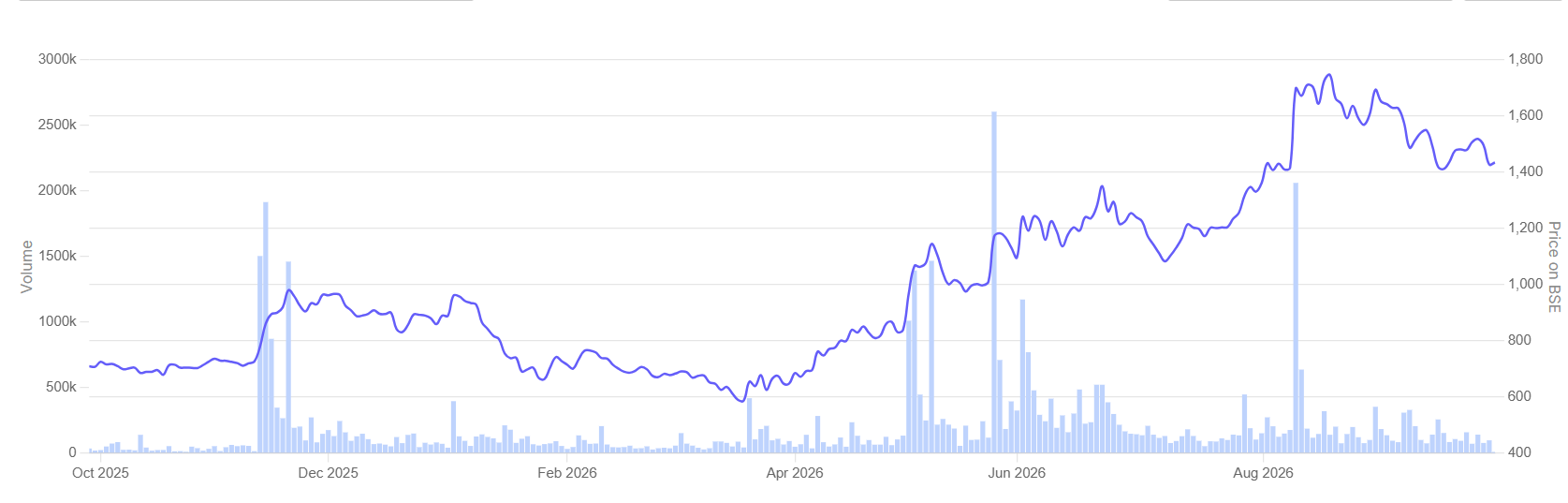
Universal Cables: 1 Year Stock Chart
Source: Screener.in
#2. KSH International: Immune from Ultravolt Story
KSH International sits entirely outside Ultravolt’s consumer-focused target market. The company manufactures specialized magnet winding wire, used in transformers and other electrical equipment. Its key customers are transformer manufacturers, as approximately 75% of its revenue is related to large power transformers.
KSH International: Financial Performance
| Period | Q1FY26 | Q1FY27 | YoY Growth (%) |
| Revenue From Operations (₹ crore) | 559 | 1,164 | 108.4% |
| EBITDA (₹ crore) | 40.2 | 74.4 | 85.1% |
| EBITDA Margin | 7.2% | 6.4% | -80 bps |
| Net Profit (₹ crore) | 22.7 | 42.2 | 85.90% |
Source: Company Presentation
The company’s growth is also being driven by factors that have little to do with the house-wire market. In Q1FY27, revenue from operations more than doubled YoY to ₹1,164 crore. EBITDA margin contracted by 80 bps to 6.4% compared to the year earlier, resulting in profit after tax rising 86% to ₹42.2 crore.
During the period, export revenue grew 76% and contributed around 27% of operating revenue. KSH is benefiting from the broader transmission and distribution opportunity. It recently announced a five-year supply framework agreement with Hitachi Energy.
Why EBITDA per tonne is the key metric
For investors, the key variable to watch in KSH’s business is EBITDA margin. Winding wire is a copper-intensive business, with raw material costs largely passed on to customers. That is why KSH focuses on EBITDA per tonne rather than simply looking at EBITDA margins.
In Q1FY27, EBITDA per tonne reached ₹93,325, helped by a higher contribution from specialised winding wires, stronger exports and favourable pricing from new OEMs. Management expects this to normalise towards around ₹75,000 per tonne for FY27 as standard wire capacity increases in the second half.
For FY27, the management is expecting to sustain the growth momentum and is targeting exports of 40% of total revenue in the long term.
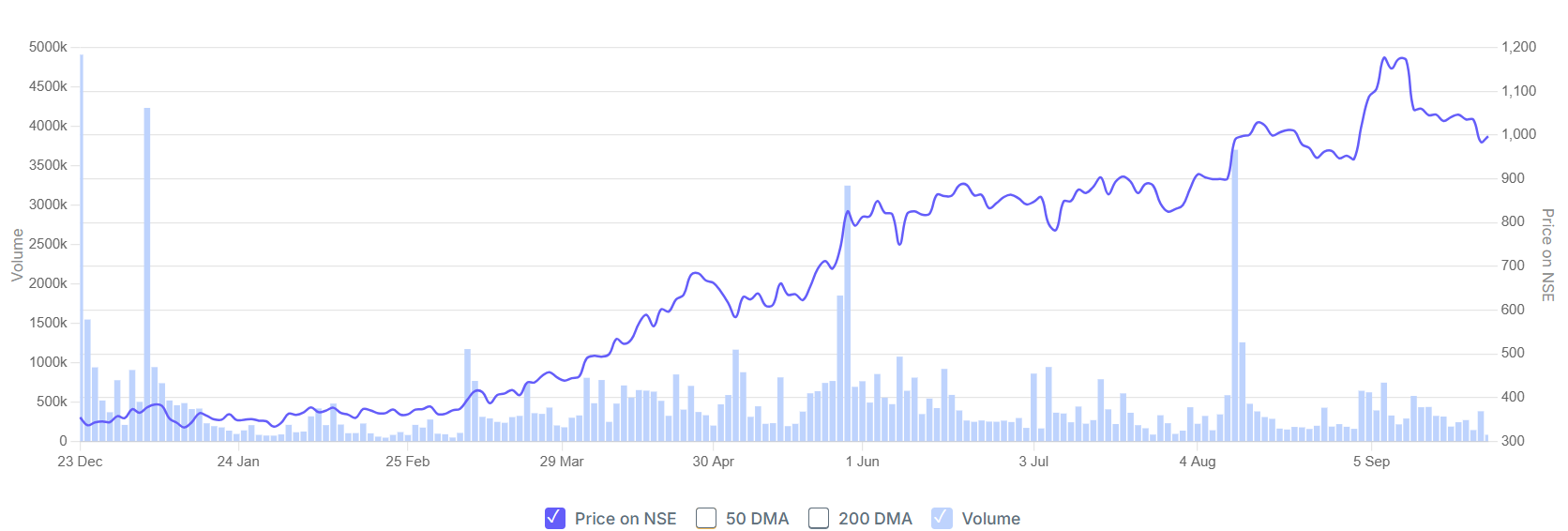
KSH International: 1 Year Stock Chart
Source: Screener.in
#3. Finolex Cables: Exposed, but cushioned by diversification
Finolex is the most interesting of the three because it is the most exposed, yet the impact on the stock is lowest.
The company operates in the same product line that Ultravolt is targeting. A deep dive into Q1FY27 performance reveals that Finolex’s resilience is currently being powered by segments outside of Ultravolt’s immediate crosshairs.
Finolex Cables: Financial Performance
| Period | Q1FY26 | Q1FY27 | YoY Growth (%) |
| Revenue From Operations (₹ crore) | 1,396 | 2,013 | 44.2% |
| EBITDA (₹ crore) | 131 | 248 | 89.3% |
| EBITDA Margin | 9.4% | 12.3% | 290 bps |
| Net Profit (₹ crore) | 139 | 221 | 58.99% |
Source: Company Presentation
In Q1FY27, revenue rose 44% YoY to ₹2,013 crore, while PAT increased 59% to ₹221 crore.
Revenue in the core electrical cable division grew 47% to ₹1,767 crore, but house wires contributed least to the volume momentum. The growth came from non-housing, B2B, and specialized lines. Automotive cables, battery cables, industrial flexibles, solar cables, and agricultural pump cables contributed to the growth. The segment that Ultravolt is not targeting.
Finolex’s communication cables division added another leg to the performance. Revenue jumped 62% to ₹176 crore. The segment delivered an operating margin of nearly 30%, providing a strong lift to overall profitability. As a result, one of the key highlights of Q1FY27 was the 290-basis-point expansion in EBITDA margin to 12.3%.
This diversification gives Finolex some cushion while the building-wire market adjusts to a new competitor. But it does not remove the long-term risk as Ultravolt expands to its dealer network. For now, Finolex’s diversified product mix and strong earnings momentum provide some cushion.
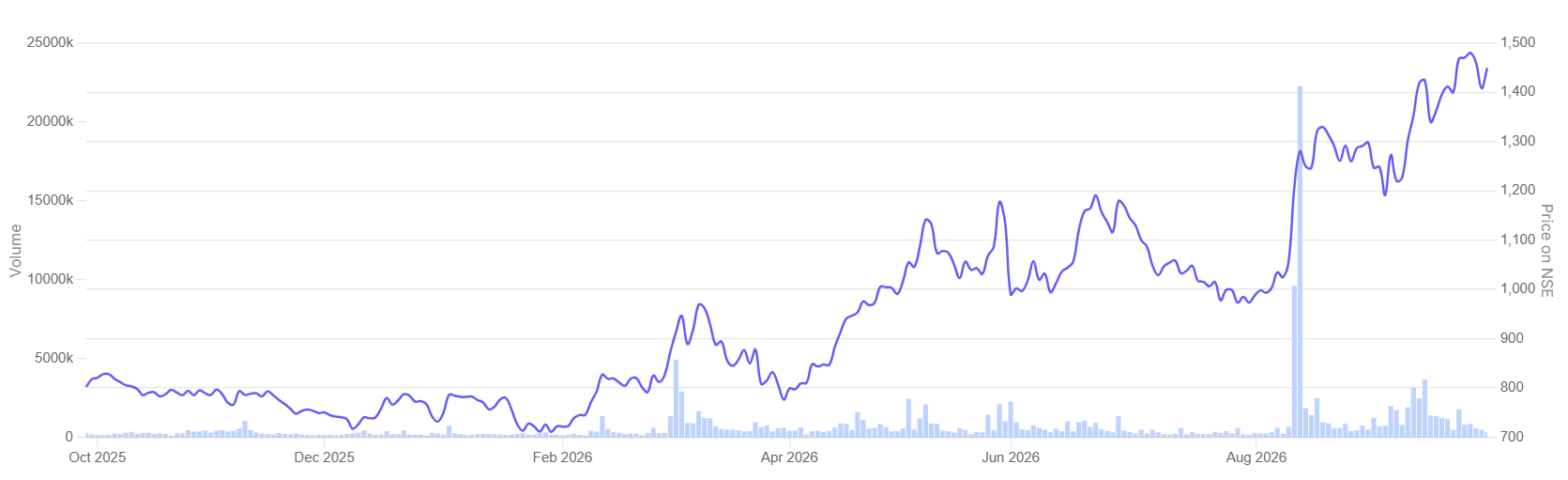
Finolex Cables: 1 Year Stock Chart
Source: Screener.in
Valuation: Not All Cable Stocks are Priced the Same
The valuation gap is significant. Polycab, RR Kabel and KEI trade at 43 – 46x earnings, but all three are below their five-year median P/E. They still command a sizeable premium to the 25.9x industry multiple, reflecting their stronger brands and growth profiles. On the other hand, Universal Cables, KSH International, and Finolex Cables all trade above their five-year median.
Valuation Trend of Cable and Wires Stock
| Companies | P/E | 5-yr Median | Industry PE |
| Universal Cables | 25.3 | 16.8 | 25.9 |
| KSH International | 52.8 | 40.7 | |
| Finolex Cables | 27.9 | 21.1 | |
| Polycab India | 43.2 | 45.7 | |
| RR Kabel | 46.4 | 49.4 | |
| KEI Industries | 43.1 | 47.9 |
Source: Screener.in
The next few quarters will be important in separating the companies directly exposed to Ultravolt from those with less overlap.
For Finolex, Polycab, RR Kabel and KEI, the key question is whether they can defend volumes and margins as Ultravolt builds its dealer and electrician network. For companies such as Universal Cables and KSH, investors will instead be watching whether their lower exposure to the retail wires market translates into continued growth and better capacity utilisation.
Valuation adds another layer of complexity. The higher the multiple, the less room there is for execution to disappoint. So while the competitive impact will take time to show up in earnings, the market may react much faster if growth or margins begin to fall short of expectations.
So, the bigger question is not whether Ultravolt disrupts the entire cable industry. It is which part of the industry is actually within its reach. And which companies have a moat to defend their margins and business that is not easy to replicate. Add these stocks to your watchlist and monitor how they execute their growth plans.
Disclaimer
Note: We have relied on data from www.Screener.in throughout this article. Only in cases where the data was not available, have we used an alternate, but widely used and accepted source of information.
The purpose of this article is only to share interesting charts, data points, and thought-provoking opinions. It is NOT a recommendation. If you wish to consider an investment, you are strongly advised to consult your advisor. This article is strictly for educational purposes only.
Deepan Datta has spent over a decade studying stocks and mutual funds. His passion is to uncover interesting stories in the financial markets and share them through his writings with investors at large. He is focused on delivering clear, easy-to-understand, and research-backed insights. Deepan began his career as a Research Associate at S&P Global, where he developed a strong foundation in financial research and data analysis.
Disclosure: The writer and his dependents do not hold the stocks discussed in this article.
The website managers, their employees (s), and contributors/writers/authors of articles have or may have an outstanding buy or sell position or holding in the securities, options on securities or other related investments of issuers and/or companies discussed therein. The content of the articles and the interpretation of data are solely the personal views of the contributors/ writers/authors. Investors must make their own investment decisions based on their specific objectives, resources and only after consulting such independent advisors as may be necessary.