




While benchmark indices like the Sensex and the Nifty have generated negative returns over the last year, some stocks have performed exceptionally well. One of them is PSU major Bharat Heavy Electricals.
The company’s shares are up a solid 77% in the last one year. At a time when it’s become hard to generate returns amid global headwinds, the BHEL stock has done well, and not without reason.
In this editorial, we will look at some of the factors that could influence the stock over the next five years. This is not a stock recommendation in any form. Before that, let’s tell you a little about BHEL.
About BHEL
Bharat Heavy Electricals Limited (BHEL) is a major PSU and one of India’s leading engineering and power equipment companies.
It operates across thermal, hydro and nuclear power, transmission, transportation, defence, aerospace and industrial sectors.
Its growth prospects are supported by rising power demand, infrastructure spending and opportunities in clean energy and defence.
Key Factors that Would Determine Where the Stock Would Be?
Where the stock is 5 years from now will largely depend on several factors. Let’s examine each.
#1 Order Book and Execution
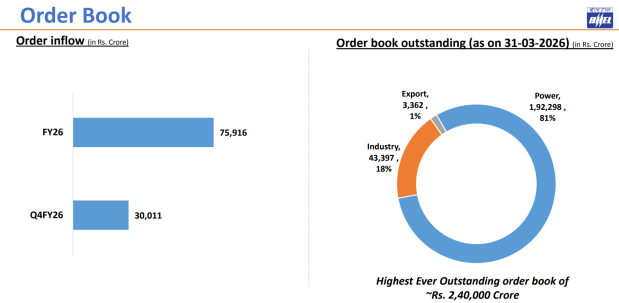
Source: Investor Presentation
The first and single most important thing is the order book. There is absolutely no doubt, looking at the image above, that the order book is solid at Rs 2,400 (bn).
The important question is how quickly these orders move from the order book to actual revenue. Faster execution can improve capacity utilisation and earnings, while delays can lock up working capital and postpone profits.
Remember, at times PSUs may face challenges with swift decision-making and approvals.
#2 Thermal Power Cycle
Thermal power is likely to remain an important part of BHEL’s business for several years. India’s increasing electricity demand and the need for additional dependable generation can support new projects. However, investors should watch whether the thermal opportunity remains strong enough to sustain growth over the entire five-year period.
Power sector orders constituted 81% of the company’s total order book. This means the company depends heavily on the sector, so the thermal power cycle will remain important for BHEL’s prospects over the next 5 years.
#3 Margins Must Sustain
| Year | Operating Margins |
| FY25 | 7.8% |
| FY26 | 12.6% |
Source: Equitymaster
One key reason the stock has generated solid returns is that margins jumped by 480 basis points in FY26 vis-à-vis FY25. This boosted profits and cheered investor sentiment.
The situation could be a little different right now, given that inflation in key commodities has been creeping in. Where the stock would be 5 years from now would depend on sustaining margins.
BHEL may need better project economics, cost control, and operating leverage. If revenue rises while margins remain weak, the benefit to earnings could be limited.
#4 Ability to Diversify
Over the years, BHEL has diversified and reduced dependence solely on thermal power. It can now also supply defense products like Super Rapid Gun Mount (SRGM), Upgraded SRGM, including life time product support, Integrated Platform Management System (IPMS) for naval ships, Heat Exchangers, Cooling Systems & Li-ion Battery for Aerospace application, Li-ion cells/Batteries etc.
It has also moved into energy storage and e-mobility.
The company’s ability to diversify from its traditional business would also be key to where the stock could be in the next five years.
#5 FII Buying
| Sept 25 | 6.23% |
| Dec 25 | 6.28% |
| Mar 26 | 7.23% |
| Jun 26 | 9.52% |
Source: Equitymaster
The last year has seen heavy selling by FIIs in the Indian markets. However, BHEL stock has attracted buying from FIIs for the last 4 quarters in a row. FII buying interest over four successive quarters, while they are selling in the Indian markets overall, suggests the confidence these investors have in BHEL stock.
Sustained institutional interest would also play a crucial role in where the stock could be in the next five years.
Some Valuation Metrics of BHEL
| Current Market Price | Rs 418.80 |
| P/E ratio | 61.4 |
| Price to Book Value | 5.6 |
Source: Equitymaster
BHEL, which commands a P/E of 61 times, is not cheap compared to the BSE 500 average P/E of 23.4 times. We have taken BSE 500 as the company is a part of the index. The Nifty itself is trading at a pe of 19.8 times.
We are living in times when the market is obsessed with growth. Blue-chip stocks of yesterday get stuck in a band or hit 52-week lows when growth is absent. BHEL’s P/E valuation may be driven by expectations of solid future growth.
Where Will BHEL Stock Trade 5 Years from Now?
Where BHEL’s stock trades five years from now will ultimately depend on whether the company can convert its strong order book into sustained revenue and earnings growth. Execution will remain critical, particularly given its high dependence on the power sector.
Equally important will be its ability to protect the margin improvement achieved recently, as higher input costs or execution delays could pressure profitability.
Diversification into defence, aerospace, energy storage and other emerging businesses could provide additional growth engines over time.
Rising foreign institutional ownership is a positive indicator of improving investor participation, but this alone cannot determine long-term returns.
At the current valuation, the stock already reflects significant expectations of future growth. Any disappointment in earnings, margins or execution could therefore lead to valuation pressure. Investors should closely track fundamentals before drawing conclusions.
Investors should evaluate the company’s fundamentals, corporate governance, and valuations of the stock as key factors when conducting due diligence before making investment decisions.
Happy Investing.
Happy investing.
Disclaimer: This article is for information purposes only. It is not a stock recommendation and should not be treated as such. Learn more about our recommendation services here…
The website managers, its employee(s), and contributors/writers/authors of articles have or may have an outstanding buy or sell position or holding in the securities, options on securities or other related investments of issuers and/or companies discussed therein. The content of the articles and the interpretation of data are solely the personal views of the contributors/ writers/authors. Investors must make their own investment decisions based on their specific objectives, resources and only after consulting such independent advisors as may be necessary