



3x in 4 Days – Why the BSE Asked for an Explanation
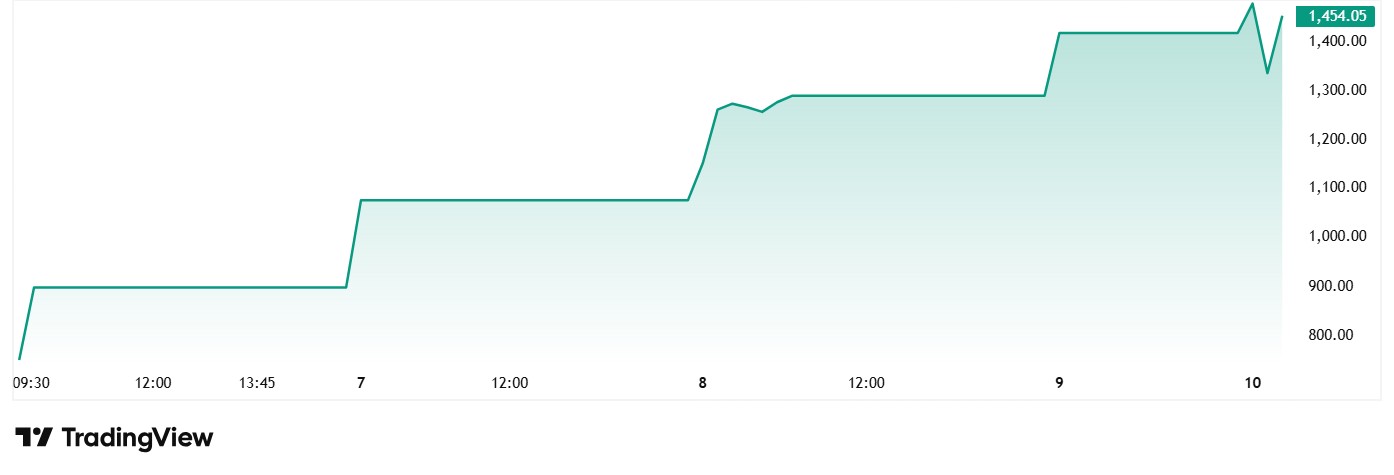
On 9th September 2026, the exchange sent ESDS Software Solution a short and rather pointed question. Why is your share price doing this? The company wrote back the same day to say there was nothing it had failed to disclose. By the close, the stock was locked at its upper circuit for the fourth session running, at Rs 1,438.85. It had listed five days earlier.
Two names have been doing the rounds on every message board since. Mukul Agrawal and Ashish Kacholia both sit on the shareholder list of this Nashik company. The reading has been simple enough. The superstars are in, so the rest of us might want to dig deep into the stock.
What is it about this stock that it caught the attention of two of the most followed super investors of India and why can’t they sell a single stock until March 2027? Time to dive in.
Rs 72,000 Crore Queue That Nobody Could Join
The IPO ran from 28th August to 1st September 2026. A fresh issue of 1,67,83,216 shares at Rs 429 each, raising Rs 720 cr, with no offer for sale. However, not one existing shareholder sold into it.
The demand was extraordinary and the book closed roughly 143 times subscribed, with institutions bidding 275 times their quota, wealthy individuals 203 times and retail investors close to 42 times. In money terms, applicants committed about Rs 72,000 cr chasing an issue of Rs 720 cr. One hundred rupees offered for every rupee available.
The listing on 4th September opened at Rs 746.30 on the BSE, a premium of about 74%, then hit the 20% upper limit the same day. Monday and Tuesday brought two more 20% moves, Wednesday another 10% once the circuit band tightened. From Rs 429 to Rs 1,438.85 is a gain of about 235% in four trading days.
The Rs 1,350 Crore Mirage: Why Superstars Are Locked In
The offer document lists Mukul Mahavir Agrawal with 70,32,960 shares, or 7.03% of the company before the issue. Ashish Kacholia held 2.39%, roughly 23.9 lakh shares. The fresh issue has since diluted both, to about 6.02% and 2.05% of the enlarged capital.
At the issue price, Agrawal’s holding was worth about Rs 302 cr and Kacholia’s about Rs 103 cr. At Wednesday 9th September 2026 close, those same shares are marked at roughly Rs 1,012 cr and Rs 344 cr. Neither of the two put in a rupee to earn the difference.
One thing worth highlighting is that under the rules for a first public issue, pre-listing shares held by anyone who is not a promoter are locked in for six months from allotment. Allotment was finalised on 2nd September, which places the earliest possible exit for both men in early March 2027, whatever the price does in between. Anyone treating the holding as a live signal is reading a photograph, not a decision.
Sticky Government Clients vs. Shrinking Revenue Per User
Incorporated in 2005, ESDS Software runs data centres and sells cloud capacity to Indian customers who want their data kept inside India. The business splits three ways: renting out computing power, running that infrastructure for the client, and software sold on subscription.
The customer base is the interesting bit. Banks, insurers, government departments and public sector undertakings make up much of it, with 104 government clients on the books. That kind of customer is slow to sign and slow to leave. Revenue from relationships older than five years has climbed from 23.3% to 47.8%, and customer count rose from 1,465 in FY24 to 2,501 in FY26.
However, average revenue per customer fell over the same stretch, from about Rs 21 lakh to Rs 19 lakh, because 787 of the accounts added in FY26 were small and early stage. ESDS is adding names faster than revenue per name.
Let us look at the financials to see if we can find a pattern or a reason for the interest from Agrawal or Kacholia.
The Numbers Behind the Machine
| Financial Year | FY21 | FY22 | FY23 | FY24 | FY25 | FY26 | 5-yr CAGR |
| Sales (Rs Cr) | 172 | 195 | 208 | 287 | 361 | 472 | 22% |
| EBITDA (Rs Cr) | 62 | 55 | 47 | 101 | 155 | 234 | 30% |
| Net Profit (Rs Cr) | 5 | -3 | -22 | 14 | 56 | 121 | NM |
EBITDA is operating profit before other income. Net profit CAGR is marked NM or not meaningful, because FY22 and FY23 were loss years.
The sales line is however honest work. Revenue grew from Rs 172 cr in FY21 to Rs 472 cr in FY26, compounding at about 22%. Operating profit did better at about 30%, because margins went from 36% to 50%. Debt came down hard, from Rs 259 cr in FY24 to Rs 96 cr in FY26, and the interest bill fell from Rs 32 cr to Rs 12 cr with it. Return on capital employed reached 30.2%, return on equity 24.9%.
Debunking the Profit Growth Myth
You will see a five-year profit CAGR of 85% to 90% quoted in plenty of places this week. But before you draw a conclusion, you must also note that FY22 and FY23 were both loss years, at minus Rs 3 cr and minus Rs 22 cr, and the FY21 base was a rounding error at Rs 5 cr. A growth rate measured from near zero flatters everything and explains nothing, which is why the table marks it not meaningful.
The useful comparison is shorter. Net profit went from Rs 14 cr in FY24 to Rs 56 cr in FY25 to Rs 121 cr in FY26. A real turnaround, driven by margin rather than volume, and it took two years, not five. Earnings per share is no help either, since the capital was restructured over the period.
The Rs 10,500 Crore Take-or-Pay Catch
One number attached to this company is a contract worth about USD 1,250 million, or roughly Rs 10,500 cr, running five years with an option for two more. At face value, it looks like evidence of an enormous order book.
But once you read the counterparty’s own filings and the direction reverses, things change. Sharon AI, an Australian operator listed on the Nasdaq, is the supplier. ESDS is the customer. Sharon AI will build a cluster of roughly 8,200 Nvidia B300 chips in an Australian data centre, and ESDS has contracted to pay for that capacity. Sharon AI describes the arrangement in its own quarterly filing as a take or pay contract, meaning the money is owed whether or not ESDS finds buyers for it.
Set that against the size of the business. Rs 10,500 cr is about 25 times what ESDS earned in revenue in all of FY26. Spread evenly, the annual commitment is roughly five times last year’s entire turnover. Deployment is targeted for October 2026, with revenue expected from the third quarter of FY27.
The model might just work. ESDS buys compute abroad and resells it here at a margin, and has already collected a large advance to fund the front end. Whether it works at this scale, with this counterparty, is the whole question, and nobody yet has a quarter of evidence either way.
Masking a Rs 1,180 Crore Liability
This is where the balance sheet needs a careful eye. Cash from operating activity in FY26 was Rs 1,368 cr against operating profit of Rs 234 cr. Other liabilities jumped from Rs 112 cr to Rs 1,298 cr in one year. Working capital days swung to minus 806.
None of that is operating strength. It is one very large customer advance, around Rs 1,180 cr, sitting on the books as money received but not yet earned. Strip it out and FY26 operating cash flow is closer to Rs 190 cr, while the net cash pile shrinks from over Rs 1,200 cr to a few tens of crores. Any valuation built on the headline cash number is built on a liability.
Pricing in Perfect AI Execution
The stock now trades at a PE of about 145x, on a market cap of roughly Rs 17,280 cr. The current industry median is 26x.
Normally this is where a ten-year median PE would come in, to show whether today’s multiple is stretched against the company’s own history. That figure does not exist here. ESDS has traded for four sessions.
The only listed peer named in the company’s own offer document is E2E Networks, which carries a multiple near 400 times and a negative return on capital. When the nearest comparison is that odd, it is not telling you much.
At Rs 429, buyers were paying about 41 times FY26 earnings. Four sessions later they are paying 145 times for the same year’s profit. Nothing about the business changed in those four days. Only the price did.
Three Imminent Triggers to Watch
Three things are worth marking on a calendar.
First, the quarter ending September 2026, due around late October. It will be the company’s first set of numbers as a listed business, and the first evidence of whether the AI contract is converting on schedule.
Second, early October, when half the anchor investors’ shares come free of their thirty-day lock-in. The rest follow ninety days after allotment. That is the first real supply the market must absorb.
Third, March 2027, when pre-issue shares held by Agrawal, Kacholia and everyone else outside the promoter group become sellable. What those two do then will be a decision. What they hold today is not.
The business underneath is real. Government customers who stay, margins that have doubled, debt nearly gone, and a position in a corner of the market Indian policy wants to see grow. But the market has priced in a contract that has not started, at a company yet to report a public quarter, on a multiple nearly four times its sector. That is a lot of faith to carry into an October results day.
A sensible approach would be to add the stock to a watchlist and wait for the first set of quarterly numbers rather than the fourth upper circuit.
Disclaimer
Note: We have relied on data from http://www.Screener.in and http://www.trendlyne.com throughout this article. Only in cases where the data was not available, have we used an alternate, but widely used and accepted source of information.
The purpose of this article is only to share interesting charts, data points and thought-provoking opinions. It is NOT a recommendation. If you wish to consider an investment, you are strongly advised to consult your advisor. This article is strictly for educative purposes only.
Suhel Khan has been a passionate follower of the markets for over a decade. During this period, he was an integral part of a leading Equity Research organisation based in Mumbai as the Head of Sales & Marketing. Presently, he is spending most of his time dissecting the investments and strategies of the Super Investors of India.
Disclosure: The writer and his dependents do not hold the stocks discussed in this article. The website managers, its employee(s), and contributors/writers/authors of articles have or may have an outstanding buy or sell position or holding in the securities, options on securities or other related investments of issuers and/or companies discussed therein.