


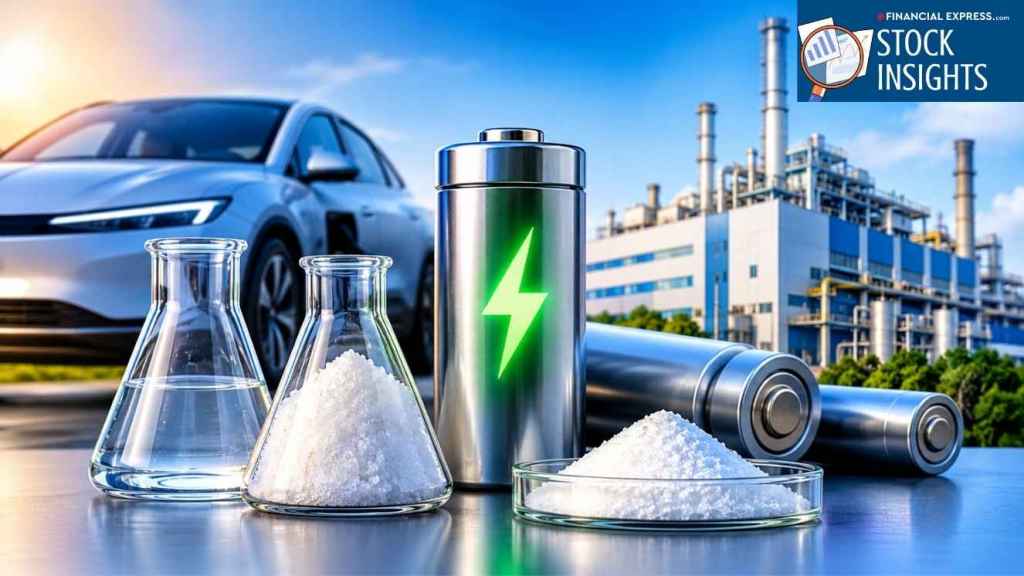

The global shift toward electric vehicles and energy storage systems is driving demand for battery-manufacturing materials. This growth closely tracks rising battery manufacturing capacity worldwide. Global battery requirements are projected to reach 3,500 GWh by 2030, with China accounting for 2,000 GWh and the rest of the world contributing 1,500 GWh.
India’s PLI Scheme and the ₹45,000 Crore Battery Boom
India is also looking to build its domestic battery ecosystem. Through the Advanced Chemistry Cell (ACC) Production Linked Incentive (PLI) scheme, the government aims to encourage local manufacturing. About ₹45,000 crore in direct investment is committed to ACC projects.
Against this backdrop, two Indian chemical companies are looking to tap the opportunity by expanding their presence in the battery materials supply chain. One is building its business around lithium-ion battery electrolytes and lithium salts. The other is setting up manufacturing capacity for battery-grade iron phosphate.
Beyond India, both companies could benefit from the US push to diversify its battery supply chain and reduce dependence on Chinese manufacturers. Capacity expansion and customer approvals are expected to drive their growth in the coming years. However, execution and capacity utilisation will also be equally important.
Let’s take a look at how the projects of these two companies are taking shape as of Q2FY27.
#1 How Neogen Chemicals is building a ₹1,500 Crore battery chemical business
Neogen Chemicals manufactures bromine and lithium-based specialty chemicals. It currently operates in two traditional business segments. Neogen is an early mover in India’s lithium-ion battery materials ecosystem through its wholly owned subsidiary, Neogen Ionics.
Neogen is the first company in India to supply lithium-ion battery electrolytes to a domestic giga-scale battery manufacturing plant on a commercial basis. Its battery chemical business focuses on high-purity battery-grade components essential for Lithium Batteries used in Electric Vehicles and Energy Storage Systems.
The Battery Electrolyte Supply Chain
Electrolyte is the complete, ready-to-use liquid solution inside the battery cell. Neogen manufactures both the raw chemical salt and the finished liquid electrolyte.
- For Finished Electrolytes: Neogen licensed leading technology from MU Ionic Solutions (MUIS, Japan). It is one of the world’s leading providers of electrolyte technology. Neogen projects finished electrolyte demand at 3,500 kilotons globally by 2030. Non-Chinese markets will require 1,125 KT, compared to 2,375 KT in China.
- For Lithium Salts: Neogen partnered with Japan’s Morita Chemical Industry in a joint venture entity (Neogen Morita New Materials).
Neogen sells these products in two distinct ways, serving two different global markets.
US Battery Rules: Exporting Non-FEOC Lithium Salt
Pathway 1: Exporting Raw Lithium Salt to the US & Global Markets:-
- The US Rule: Under the US Inflation Reduction Act, American battery makers get a tax credit ($35 per kilowatt-hour of battery produced). But to qualify, they must stop buying battery raw materials from Chinese suppliers, known as Foreign Entities of Concern (FEOC), by 2027.
- The Opportunity for Neogen: US battery factories produce their liquid electrolyte within the US, but require non-Chinese lithium salt. Neogen complies with non-FEOC sourcing requirements.
- Progress: Neogen has received provisional salt approval from 5 international customers. It has also started commercial supply to 2 international customers.
Neogen Chemicals: Supplying Electrolytes to Domestic Giga-Factories
Pathway 2: Selling Finished Liquid Electrolyte to Indian Factories (Giga-Factories)
- The Domestic Transition: India is building battery factories (owned by companies like Ola Electric, Exide Industries, Tata Group, Reliance Industries, Amara Raja, etc.). The government backs this with its Advanced Chemistry Cell (ACC) PLI Scheme.
- Why Buy Locally? Liquid electrolyte is heavy and hazardous. Shipping it abroad from China is difficult and expensive. This is why Indian battery factories prefer to buy locally prepared liquid electrolyte from Neogen’s nearby plant in Gujarat.
Neogen Chemicals Expansion: Gujarat Plant Capacity and Capex
In a bottle of finished battery electrolyte liquid, the raw lithium salt makes up about 50% of the total raw material cost. If Neogen exports raw salt directly, it receives only the salt price (say, ₹100). Instead, if Neogen converts it into a liquid electrolyte produced in-house, the finished electrolyte solution sells for almost double the price (₹200).
Converting salt into a finished electrolyte doubles the revenue generated per unit of salt used. This is why Neogen’s battery business revenue is projected to scale rapidly from ₹37 crore (FY26) to a guided ₹250-300 crore for FY27 and ₹1,000+ crore in FY28, driven by salt exports.
Management estimates this figure will rise further to ₹1,200-1,500 crore as domestic battery plants increase purchases of finished electrolyte. Neogen Ionics reported revenue of ₹37 crore in Q2FY27, compared to ₹5.4 crore (Q2FY26) and ₹37 crore (FY26). To support this growth, Neogen plans to invest ₹1,795 crore across two sites in Gujarat.
Neogen’s Planned Capacity Expansion
| Plant Location | Target Completion | Planned Electrolyte Capacity | Planned Salt Capacity |
| Dahej SEZ (Phase1)- ₹428 crore | February 2027 | 2,000 MTPA (Fully commissioned) | 2,500 MTPA |
| Pakhajan (Phase-2) ₹1,367 crore | March 2027 | 30,000 MTPA | 3,000 MTPA |
| Total Capacity | Early 2027 | 32,000 MTPA | 5,500 MTPA |
| Source: Investor Presentation, Management Commentary | |||
Neogen Chemicals Q2FY27 Financial Results and EBITDA Targets
Management estimates that at full capacity utilisation by FY29, the total capital deployed (₹2,500- 3,000 crore, including plant costs and working capital) can deliver ₹500+ crore in EBITDA with an annual Return on Capital Employed (ROCE) of 20%+. However, achieving this target depends on demand and execution.
In Q2FY27, the company’s net revenue grew 42% year-on-year to ₹296 crore. Volume growth across speciality chemicals and commercial scaling of the battery materials division drove the increase. EBITDA grew 51% to ₹45.3 crore in Q2FY27, while margins expanded 95 bps to 15.3%. Consequently, net profit grew 144% to ₹8.2 crore.
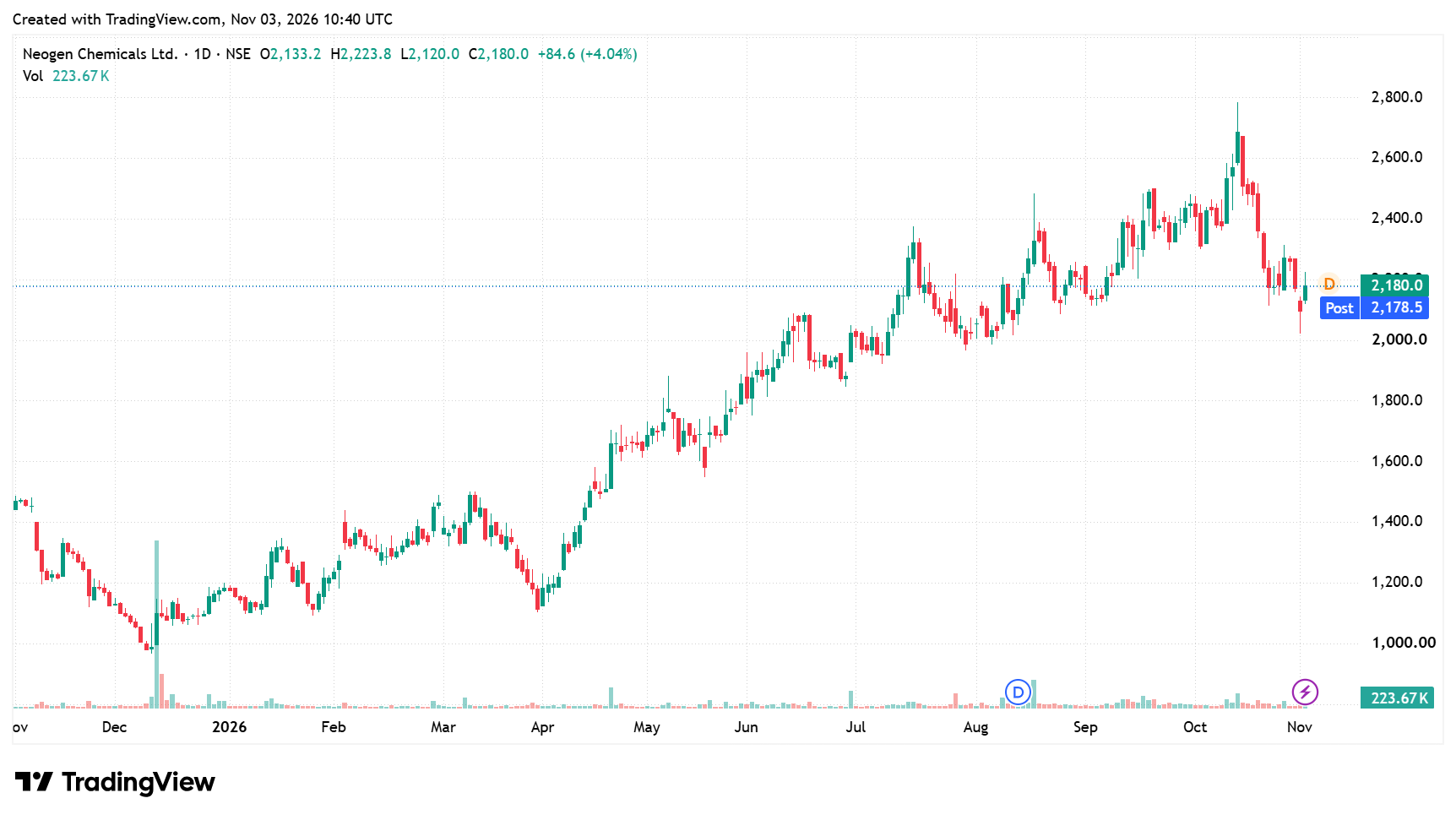
#2 How Sudeep Pharma is scaling its ₹300 crore battery chemical business
Sudeep Pharma produces battery-grade iron phosphate. The material is a precursor for Lithium Iron Phosphate and Lithium Manganese Iron Phosphate battery cells. These batteries power electric vehicles and stationary energy storage systems.
Sudeep is positioning itself as one of the first large-scale manufacturers operating outside China. Notably, the global market for battery chemicals within the Lithium Iron Phosphate (LFP) value chain is projected to grow at a Compound Annual Growth Rate (CAGR) of 41.4% between 2024 and 2030.
Sudeep Pharma’s ₹300 Crore Capex and Lithium Battery Scale-Up
The main manufacturing plant is under construction. The project’s total capex is estimated at ₹300 crore. Management targets an asset turnover of around 3 times at optimal utilisation. It will fund this through internal accruals and debt. Construction is scheduled to be completed by March 2027, with Phase-1 commercial operations starting in April 2027.
Bypassing the FEOC: Sudeep Targets US and European EV Markets
Initially, the focus will be on export markets in South Korea, Europe, and the US. Customer supply contracts are targeted for completion in Q4FY27. Customer plant validation is expected to take 3-6 months following commercialisation. Management estimates commercial revenue to start from H1FY28 onwards.
Ahead of completion, Sudeep has upgraded its existing pharma manufacturing lines to supply 5,000 MT of battery-grade material during the construction phase. This has allowed early customer sampling and product testing. Initial annual production capacity will be 25,000 MT (Phase-1). Annual capacity will be expanded to 105,000 MT (by FY30).
The capacity target is substantial, with commercialisation expected in the near term. However, execution will be key to achieving this growth. The company has completed validations for 28 product approvals.
Sudeep Pharma: Validating Battery-Grade Iron Phosphate for Export
It is allocating capacity to 5-7 major cell and cathode partners across South Korea, Europe, and the US. The supply chain complies with FEOC regulations. This compliance allows its US buyers to claim this credit. Indirectly, Sudeep could charge a price premium. The key raw material for iron phosphate is purified phosphoric acid (PPA).
Sudeep secures non-Chinese PPA from suppliers in India, Morocco, Israel, Vietnam and Mexico. Sudeep has 30 years of experience sourcing phosphoric acid for its pharmaceutical business. This experience helps the company manage price fluctuations and negotiate long-term supply contracts.
Sudeep Pharma Q2FY27 Results: Surging EBITDA and Core Growth
Financially, the company’s consolidated revenue grew 20.9% to ₹196.7 crore in Q2FY27. Volume gains in the core pharmaceutical and food and nutrition division drove growth. Export sales grew 24% to account for 65% of quarterly revenue. EBITDA rose 31.9% to ₹73.2 crore and margin expanded 310 bps to 37.2%. Net profit grew 10.9% to ₹51.8 crore.
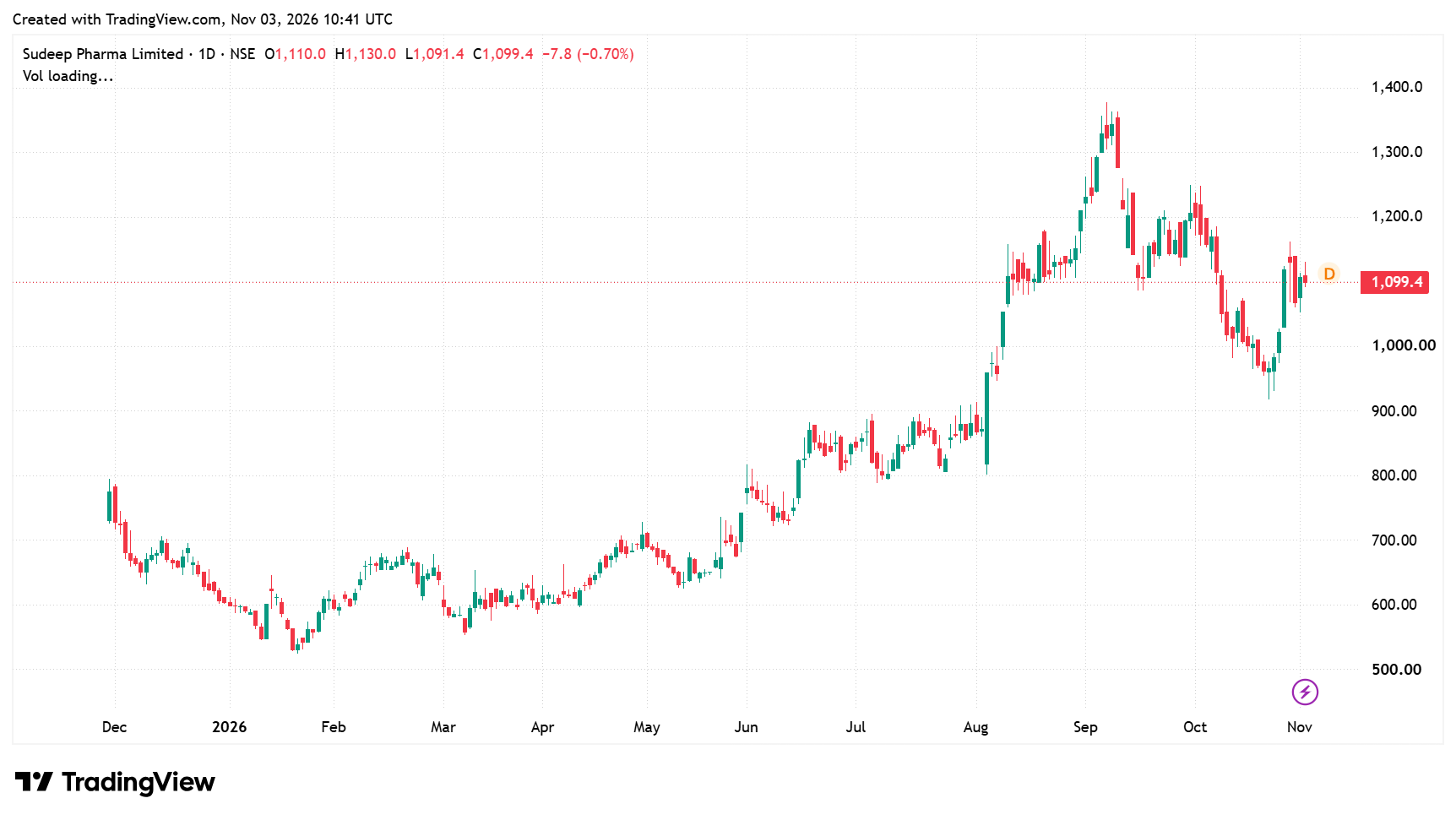
Return Profiles: Why Execution Outweighs Valuation in FY27
Sudeep Pharma has healthy return ratios, reflecting its ability to generate attractive returns on the capital employed. Sudeep Pharma reported a Return On Equity (ROE) of 32.7% and Return on Capital Employed (ROCE) of 25.2%, while Neogen recorded a modest ROE of 3.6% and ROCE of 6.5%.
Neogen’s capital deployment ahead of revenue scaling, along with interest costs from ₹1,095 crore of net debt incurred during expansion, plus depreciation and other overheads, has pressured profitability and return ratios. As capacity utilisation increases, management expects the return ratios to normalise.
From a valuation perspective, Neogen trades at 162.0x earnings, above both the 3-year median (108.5x) and the industry median. Meanwhile, Sudeep Pharma trades at a P/E of 67.0x, which is almost double the industry median P/E (32.7x).
Particulars | Price-to-Earnings Multiple (X) | Return Ratios | |||
| Company | 3Y Median | Industry | ROE (%) | ROCE (%) | |
| Sudeep Pharma | 67.0 | NA | 32.7 | 25.2 | 28.2 |
| Neogen | 162.0 | 108.5 | 25.2 | 3.6 | 6.5 |
| Source: Screener.in (As of November 03, 2026). | |||||
Both Neogen Chemicals and Sudeep Pharma are taking different routes to tap this demand. Neogen is expanding its presence in lithium salts and finished electrolytes, while Sudeep is building capacity for battery-grade iron phosphate.
Both businesses are making progress through customer approvals, commercial supply and capacity expansion. However, the opportunity is still early. Neogen needs to commission its new facilities and scale production, while Sudeep must complete its plant, secure supply contracts and move towards commercial operations.
These companies could be worth keeping on your watchlist.
Disclaimer
Note: Throughout this article, we have relied on data from http://www.Screener.in and the company’s investor presentation. We used an alternative, widely accepted source only when the data were unavailable.
The purpose of this article is only to share interesting charts, data points, and thought-provoking opinions. It is NOT a recommendation. If you wish to consider an investment, we strongly advise you to consult your advisor. This article is strictly for educational purposes only.
About the Author: Madhvendra has been deeply immersed in the equity markets for over seven years, combining his passion for investing with his expertise in financial writing. He simplifies complex concepts and shares honest perspectives on startups, listed Indian companies and macroeconomic trends.
Disclosure: The writer and his dependents do not hold the stocks discussed in this article.
The website managers, their employees (s), and contributors/writers/authors of articles have or may have an outstanding buy or sell position or holding in the securities, options on securities, or other related investments of issuers and/or companies discussed therein. The articles’ content and data interpretation are solely the personal views of the contributors/ writers/authors. Investors must make their own investment decisions based on their specific objectives and resources, and only after consulting any independent advisors as necessary.