



Water is one of those businesses that tends to remain invisible until there is not enough of it. For companies working behind the scenes to treat wastewater, supply drinking water or recycle industrial water, that can make for a surprisingly durable business, particularly when governments and industries have little choice but to keep spending.
The more interesting question is what happens when a company that began by building water projects starts moving into adjacent businesses. That is where Enviro Infra Engineers finds itself today, with a rapidly expanding renewable energy business sitting alongside its traditional water and wastewater operations.
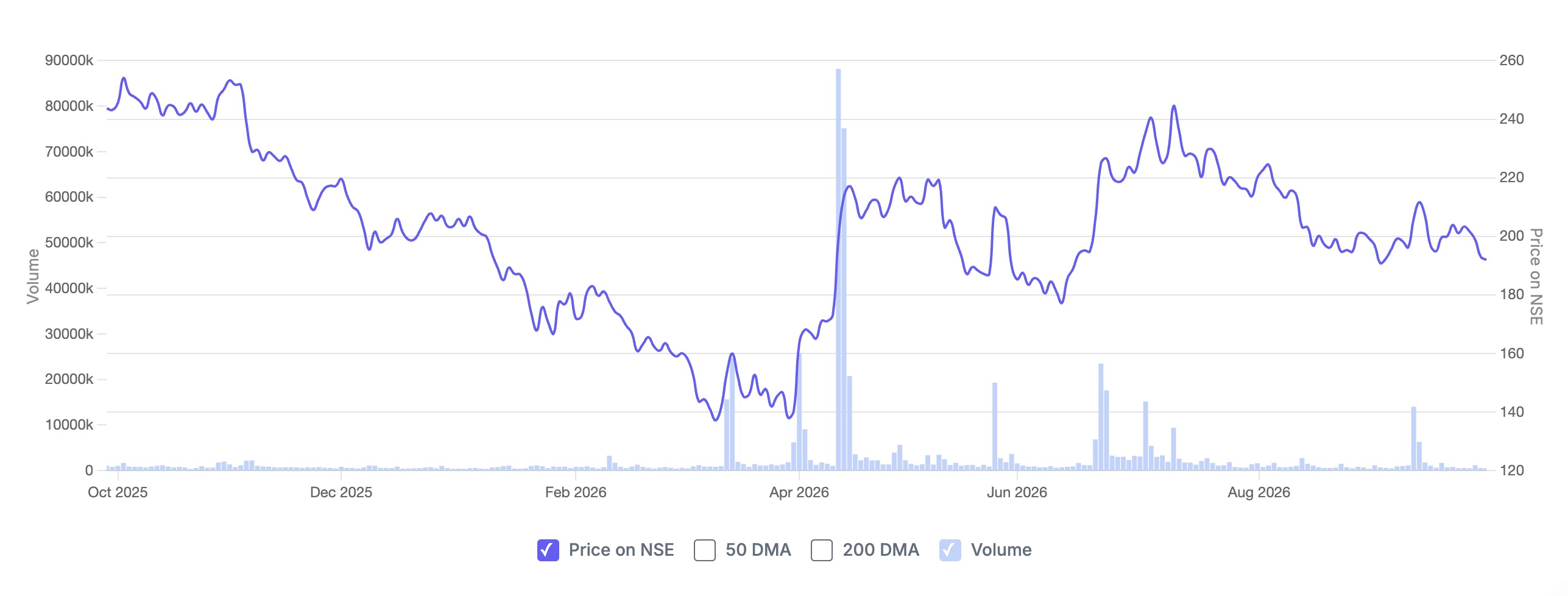
Enviro Infra Engineers 1-Year Share Price Chart
There is a useful example of where such a journey can eventually lead. VA Tech Wabag has built a technology-led water business spanning desalination, wastewater treatment, reuse and resource recovery, with an order book of around Rs 19,400 crore as of Q1 FY27. Enviro is nowhere close to Wabag in scale or geographical reach, but the direction of travel is beginning to look interesting.
The company reported 49% revenue growth in Q1 FY27, but the bigger development was elsewhere. Renewable energy contributed 29% of revenue in the quarter, compared with 11% in FY26, while the company is sitting on an order book of roughly Rs 6,700 crore.
Beyond Water EPC: The Shift to Renewables and BESS
Enviro’s core business is fairly easy to understand. It designs and builds water and wastewater treatment plants and water supply projects, primarily for government agencies and related customers.
The numbers tell us how quickly that business has scaled. Consolidated revenue increased from Rs 108 crore in FY20 to Rs 1,146 crore in FY26. Operating profit rose from Rs 10 crore to Rs 277 crore over the same period, while the operating profit margin improved from 9% to 24%.
But simply extrapolating that history would miss what is changing. The company has expanded into solar, wind and battery energy storage systems (BESS). In other words, it is beginning to build a broader infrastructure platform around water, renewable energy and storage rather than remaining dependent on conventional water projects.
That shift is already visible in the revenue mix. Renewables accounted for 29% of Q1 FY27 revenue, up from 11% in FY26. The renewable business is still much smaller than the core water business, but the speed at which it is becoming relevant is what makes the story worth watching.
This is where the Wabag comparison becomes useful, but only as a reference point. Wabag’s business today is built around specialized water technologies, including desalination, wastewater treatment, reuse and resource recovery, rather than simply building standard treatment plants.
Enviro is at a much earlier stage. But if its new businesses develop into meaningful revenue and profit pools, the company could gradually move away from being seen simply as another water infrastructure contractor.
Why 49% Revenue Growth Pulled Margins Down
The first thing that stands out in Enviro’s numbers is the speed of growth. Consolidated revenue rose 49% year-on-year in Q1 FY27. Meanwhile, the operating profit margin was 21% in Q1 FY27, compared with 27% in the year-ago quarter.
So while revenue is growing rapidly, the incremental rupee of revenue is currently generating less operating profit than it did earlier.
Revenue is growing, but margins have come under pressure
| Metric | Q1 FY27 | Q1 FY26 | YoY change |
| Revenue from operations | Rs 359.2 crore | Rs 240.9 crore | +49.1% |
| EBITDA | Rs 75.7 crore | Rs 64.2 crore | +17.9% |
| EBITDA margin | 21.1% | 26.7% | -558 bps |
Source: Enviro Infra Engineers Q1 FY27 earnings conference call
There are some fairly straightforward reasons for this. The business mix is changing, raw-material costs have put pressure on margins and the company has been investing in people and capabilities as it enters newer businesses.
Management expects water and wastewater projects to generate margins of around 21% to 22%, while renewable projects are expected to generate margins of around 15% to 18%. That makes the direction of the revenue mix important because a larger renewable contribution could pull down the consolidated margin even if the new business grows quickly.
This is not necessarily a bad thing. A company can accept lower margins if the new business has a much larger addressable market, requires less capital over time or creates a longer-duration revenue stream. The problem begins if lower margins are accompanied by higher working capital and higher debt.
That is the trade-off investors need to watch here.
Analyzing the ₹6,700 Crore Order Book and FY27 Revenue Targets
The other part of the story is the order book. At Rs 6,721 crore as of June 30, 2026, it was more than double the roughly Rs 3,000 crore order book reported around the same period last year. The jump gives Enviro Infra considerable revenue visibility for the next couple of years, although the bigger question is how efficiently the company converts that order book into revenue and, eventually, cash.
The mix is also becoming more interesting. Water and wastewater remain the backbone, but renewable energy and BESS have emerged as meaningful components. The company has also been building its wind EPC business through Suyog Urja.
Management has guided for revenue of around Rs 2,000 crore in FY27 and PAT of Rs 260 crore to Rs 270 crore. It has also indicated an order-inflow target of around Rs 2,500 crore for FY27.
What management is targeting for FY27
| Parameter | FY27 management guidance |
| Revenue | ~Rs 2,000 crore |
| PAT | Rs 260-270 crore |
| EBITDA margin | 21-22% |
| Order inflow | ~Rs 2,500 crore |
| Water & wastewater execution order book | >Rs 2,700 crore |
| Renewable execution order book | ~Rs 2,000 crore |
| Renewable O&M / IPP order book | ~Rs 1,000 crore |
Source: Enviro Infra Engineers Q1 FY27 earnings conference call
There is a subtle point here. A large order book is often treated as though it were cash waiting to be collected. It is not. Between an order being awarded and money appearing in the bank account lie procurement, construction, billing, certification and collections.
For Enviro, that distinction matters because the company has already started to consume more working capital as it has grown.
The Free Cash Flow Challenge: Why Working Capital Days Hit 137
This is probably the part of the story that deserves more attention than it gets. Working-capital days increased to 137 days in FY26 from 89 days in FY25. Debtor days were actually better at 53 days, compared with 70 days a year earlier, but the broader working-capital requirement increased because of changes elsewhere in the balance sheet.
The cash-flow statement is even more revealing. Cash from operating activities was negative Rs 63 crore in FY26, while free cash flow was negative Rs 245 crore.
This is not unusual for a rapidly growing infrastructure company. When revenue rises quickly, money can get stuck in projects, receivables and other current assets before it comes back as cash.
But it becomes important when the company is simultaneously increasing debt and investing in new businesses. There is some comfort in the fact that the cash conversion cycle remains negative at 88 days because supplier credit provides a source of financing. Still, working-capital days moving from 89 to 137 in one year is something investors should not brush aside.
The next stage of the story needs to demonstrate that growth can eventually translate into cash rather than simply requiring more balance-sheet funding.
Balance Sheet Risks: Managing Debt During Aggressive Expansion
The balance sheet shows that Enviro is already preparing for a much larger business. Borrowings increased to Rs 422 crore in FY26 from Rs 234 crore a year earlier. On the positive side, debt-to-equity remains moderate at around 0.34 times. Return on capital employed is around 20%, while return on equity is about 17%.
Growth has come with a bigger working-capital burden
| Metric | FY25 | FY26 |
| Debt | Rs 234 crore | Rs 422 crore |
| Debt / equity | 0.24x | 0.34x |
| Working capital days | 89 | 137 |
| Cash from operations | -Rs 59 crore | -Rs 63 crore |
| Free cash flow | -Rs 105 crore | -Rs 245 crore |
| ROCE | 32% | 20% |
Source: Screener
But these numbers need to be viewed alongside the cash-flow statement. A company can have manageable leverage today and still see debt rise quickly if expansion continues to absorb cash.
That is why the balance sheet is not yet a problem, but it is becoming an increasingly important part of the investment story.
Solar, Wind, and Storage: Evaluating the Profitability of the Renewable Bet
The renewable business is what could make Enviro more than just another water EPC company. Solar, wind and BESS are large markets in their own right. More importantly, they are connected to a structural change in India’s power system, where renewable generation needs both transmission infrastructure and storage to become more useful at scale.
Enviro is therefore moving into areas that are considerably larger than its traditional water opportunity. The company has three businesses now: the parent water business, the renewable business and Suyog Urja, where wind EPC projects are being undertaken.
The danger is that investors may value the new businesses before they have demonstrated their economics. Renewable EPC can be a competitive business, and lower margins mean that working-capital discipline becomes even more important.
The opportunity, on the other hand, is that the company is not starting from scratch. It already has project-management capabilities, government relationships and an established water business that can provide the base from which the newer businesses are being developed.
Declining ROCE: The True Cost of Scaling an Infrastructure Platform
The return ratios show why this transition matters. Enviro’s return on capital employed was as high as 64% in FY22 and 59% in FY23. It then moderated to 47% in FY24, 32% in FY25 and around 20% in FY26.
Some of that decline is simply a consequence of becoming a much larger company. The capital employed has increased materially, and the business is investing ahead of growth.
But this is also the test of the diversification strategy. If the new businesses generate lower margins while requiring substantial additional capital, return ratios could continue to decline.
If, instead, revenue scales rapidly and the assets being created generate attractive profits without a corresponding increase in capital intensity, returns could stabilise. That is why revenue growth alone will not tell us whether the next phase is working.
Enviro Infra Engineers Share Price: Is the 18.3x P/E Justified?
At around Rs 192, Enviro Infra trades at about 18.3 times earnings. The stock is well below its 52-week high of Rs 258, even as the company continues to grow and its order book has more than doubled from a year earlier.
The valuation, therefore, sits somewhere in the middle. It is not pricing Enviro like a distressed infrastructure company, but neither does it assume that every part of its renewable-energy expansion will work perfectly.
The real question is whether the Rs 6,700 crore order book can translate into sustained revenue growth without further pressure on margins, working capital and debt. If management delivers its FY27 targets while keeping these metrics under control, the current valuation could look more reasonable. If working capital remains elevated and returns continue to weaken, the market may have less reason to pay up for the growth story.
Smallcap EPC Risks: The Gap Between Order Books and Cash Collection
There is a reason to be particularly careful with smallcap infrastructure companies. The numbers can change quickly because a handful of large projects can have a meaningful impact on revenue, receivables, debt and cash flow.
An order book can also create an illusion of certainty. A company can have several thousand crore of orders and still face delays in billing, collections or project completion.
Enviro’s own numbers demonstrate why this matters. Revenue has grown at a 50% compounded rate over three years, but working-capital days have also risen sharply and free cash flow remains negative.
That does not invalidate the growth story. It simply means that the next phase has to be judged on the conversion of accounting growth into cash.
The Wabag question
There is an obvious temptation to look at Enviro and imagine a smaller version of VA Tech Wabag. Wabag’s journey shows that a water company can eventually build a global business around specialised technology, desalination, reuse, industrial water and long-term operating contracts.
But the comparison should not be taken too far. Wabag has a long history, operations across more than 25 countries and more than 1,500 plants delivered since 1995. Enviro is much younger and is only now attempting to broaden its business.
What makes the comparison interesting is not that Enviro will become Wabag. It is that Enviro is beginning to face the same strategic question: can a company that started with water projects build capabilities around a much larger environmental infrastructure opportunity?
The answer will not come from another order announcement. It will come from the numbers over the next few years.
If Enviro can grow towards its FY27 targets, keep operating margins around 21% to 22%, bring working capital back under control and earn healthy returns on the capital being deployed into renewables and BESS, the business could start looking quite different from the water contractor investors first bought.
If those things do not happen, the Rs 6,700 crore order book will remain just that: a large number on a presentation.
That is ultimately the bet in Enviro Infra Engineers. Not whether India needs more water infrastructure. It clearly does. The question is whether Enviro can turn that need into a larger, more diversified and cash-generating business without sacrificing the economics that made its original business attractive.
Disclaimer
Note: We have relied on data from www.Screener.in throughout this article. Only in cases where the data was not available, have we used an alternate, but widely used and accepted source of information.
The purpose of this article is only to share interesting charts, data points and thought-provoking opinions. It is NOT a recommendation. If you wish to consider an investment, you are strongly advised to consult your advisor. This article is strictly for educative purposes only.
Manvi Aggarwal has been tracking the stock markets for nearly two decades. She spent about eight years as a financial analyst at a value-style fund, managing money for international investors. That’s where she honed her expertise in deep-dive research, looking beyond the obvious to spot value where others didn’t. Now, she brings that same sharp eye to uncovering overlooked and misunderstood investment opportunities in Indian equities. As a columnist for LiveMint and Equitymaster, she breaks down complex financial trends into actionable insights for investors.
Disclosure: The writer and her dependents do not hold the stocks discussed in this article. The website managers, its employee(s) and contributors/writers/authors of articles have or may have an outstanding buy or sell position or holding in the securities, options on securities or other related investments of issuers and/or companies discussed therein. The content of the articles and the interpretation of data are solely the personal views of the contributors/ writers/authors. Investors must make their own investment decisions based on their specific objectives, resources and only after consulting such independent advisors as may be necessary.