



The auto-component industry is changing in a way that is easy to miss when looking only at vehicle sales. The more important shift is happening beneath the surface, as suppliers that once made a single component attempt to become part of several systems inside a vehicle.
Samvardhana Motherson International’s journey offers a useful example. It started with wiring harnesses for the Maruti 800 and gradually expanded into dashboards, mirrors, modules, polymers, interiors and other automotive systems, largely through a combination of customer relationships, technology partnerships and acquisitions.
SPR Auto Technologies, formerly known as Shriram Pistons & Rings, is now taking a similar route. The company is moving beyond its traditional piston and piston-ring business into precision plastics, electric-vehicle components, moulds and tooling, automotive interiors and lighting.
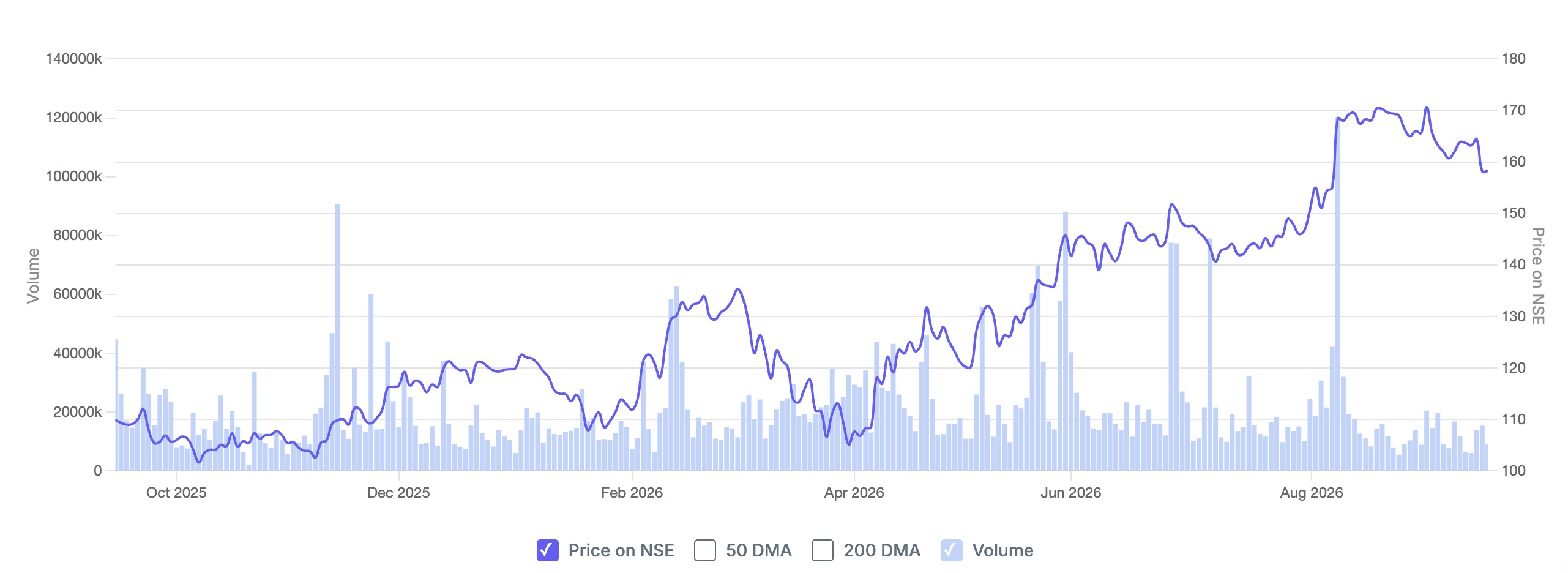
Indo SMC 1-Year Share Price Chart
The acquisition of Grupo Antolin’s Indian operations in January 2026 has accelerated that transition. The question now is whether SPR can use diversification and acquisitions to build a broader auto-component business without diluting the margins and returns of its original business.
The engine is no longer the whole story
For years, SPR was known mainly for what sits inside an internal-combustion engine: pistons, piston rings and engine valves. That remains an important business, and the company continues to supply original equipment manufacturers, export customers and the aftermarket.
But SPR has spent the last few years building businesses around that core. SPR Takahata and TGPEL operate in high-precision injection moulding, Karna Intertech is in moulds and tooling, SPR EMF Innovations makes electric motors and controllers and the Antolin acquisition has added automotive interiors and lighting.
The change is visible in the company’s business mix. Internal-combustion-engine components now sit alongside aftermarket, exports, high-precision plastic engineering, interiors, electronics and lighting, motors and controllers for electric vehicles, and tooling.
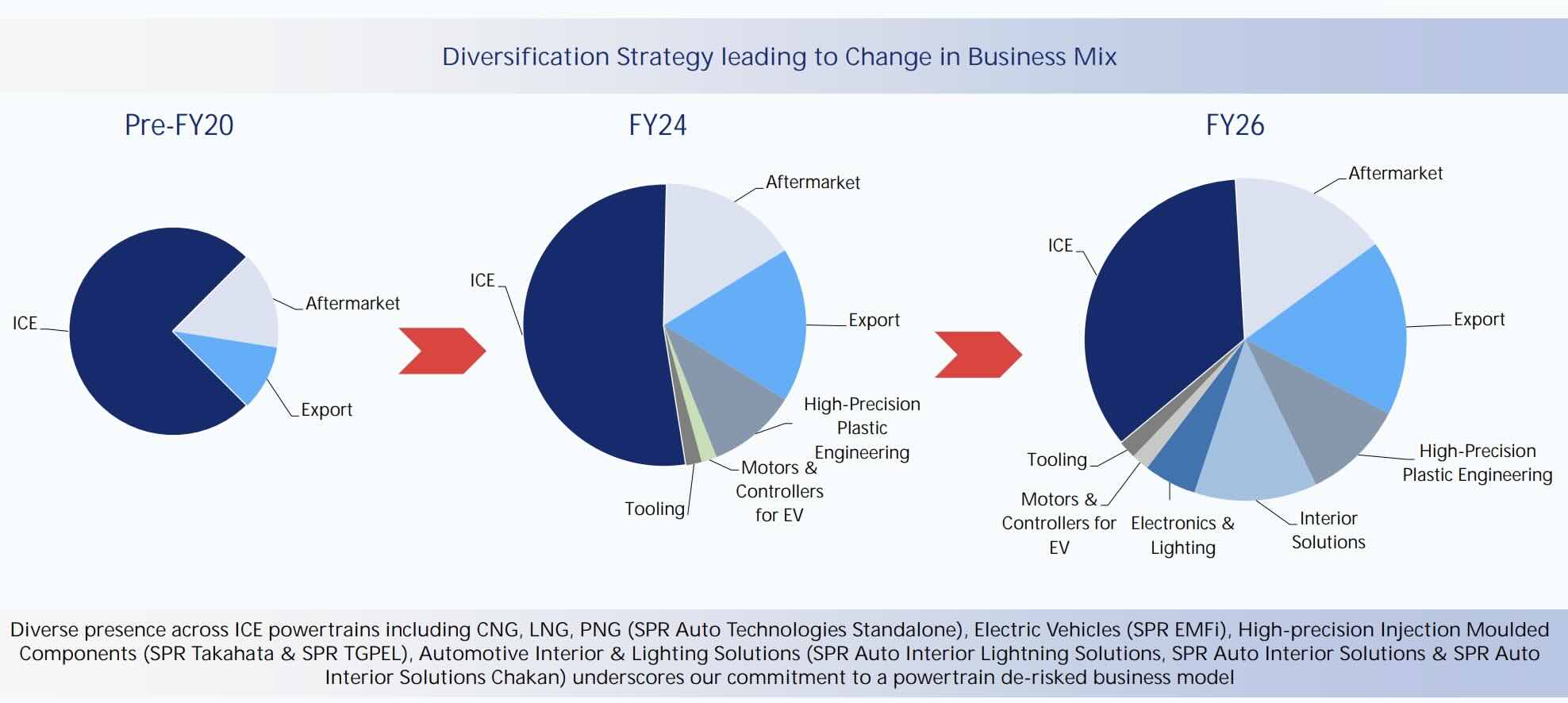
The company says powertrain-agnostic products now contribute more than 35% of consolidated total revenue. These are businesses that are not dependent on whether a vehicle uses a conventional engine, a hybrid system or an electric drivetrain.
That is an important distinction. SPR is not walking away from its legacy business. Instead, it is trying to make the business less dependent on what powers the vehicle.
The revenue mix tells the story
The numbers show why the Motherson comparison is interesting, but also why it is still early. SPR’s standalone business generated Rs 3,526.5 crore of revenue in FY26. OEMs accounted for 53% of this, exports for 16%, aftermarket for 26% and non-auto business for 5%.
So, the traditional business is still the base of the company. The aftermarket is also important because it brings in revenue from vehicles already on the road, not just from new vehicle sales.
The subsidiaries are now starting to make a bigger difference. They generated Rs 932.3 crore of revenue in FY26. This included Rs 65.8 crore from EMFI, Rs 368.9 crore from Takahata and Rs 161.6 crore from TGPEL, with the rest coming largely from the Antolin businesses.
The difference in size is important. EMFI is growing fast, but it is still a small part of SPR. Antolin is already large enough to have a meaningful impact on the group’s revenue and margins.
In Q4FY26, subsidiaries contributed 34.5% of consolidated revenue, compared with 15.5% in Q3FY26 and 13.5% a year earlier. The sharp increase was mainly because of the Antolin acquisition. The Antolin businesses contributed Rs 337 crore of revenue in the quarter, with EBITDA of Rs 32.2 crore and an EBITDA margin of 9.6%.
So, diversification is no longer just about adding new businesses. These businesses are now becoming a much bigger part of SPR.
Revenue is growing. Margins are the bigger question
The financial numbers show the immediate impact of this change in business mix. In FY26, consolidated revenue from operations rose 25.6% to Rs 4,458.7 crore. EBITDA grew 21% to Rs 876.1 crore, while the EBITDA margin fell to 19.6% from 20.4% in FY25.
The same trend was visible in Q1FY27. Consolidated revenue from operations rose 53.1% year-on-year to Rs 1,474.4 crore, while EBITDA increased 26.6% to Rs 282.8 crore. The EBITDA margin fell to 19.2% from 22.5% a year earlier.
Revenue Is Scaling, but Margins Are Under Watch
| Metric | FY26 | 1QFY27 |
| Revenue | Rs 4,458.7 crore | Rs 1,474.4 crore |
| Revenue growth | 25.6% | 53.1% |
| EBITDA | Rs 876.1 crore | Rs 282.8 crore |
| EBITDA growth | 21% | 26.6% |
| EBITDA margin | 19.6% | 19.2% |
Source: Company Filings
The company said supply-chain disruptions and higher commodity costs reduced EBITDA by Rs 30 crore during the quarter. At the same time, the margin was also affected by the growing contribution from subsidiaries, especially the lower-margin Antolin business.
This is where the Motherson comparison becomes relevant. Acquisitions can push up revenue quickly, but the bigger test is whether those businesses can eventually generate healthy returns.
Management has said the margins of the acquired Antolin businesses have improved from the earlier 7–8% range to the early and mid-teens. It is also working on lower costs, changes in the supply chain, more in-house production and synergies between its businesses.
The company has not given a formal consolidated EBITDA margin target for FY27. So, going ahead, the margin trend may tell us more than the headline revenue growth.
The acquisition has changed the balance sheet too
The Antolin deal has also altered SPR’s financial structure. The company raised Rs 1,000 crore through non-convertible debentures to fund the acquisition, pushing consolidated debt-to-equity to 0.62x in FY26 from 0.19x in FY25.
Finance costs rose sharply in Q1FY27 to Rs 34.2 crore from Rs 9 crore in the year-earlier quarter. Management has described this as a temporary effect of acquisition funding and expects it to normalise as the related debt is repaid.
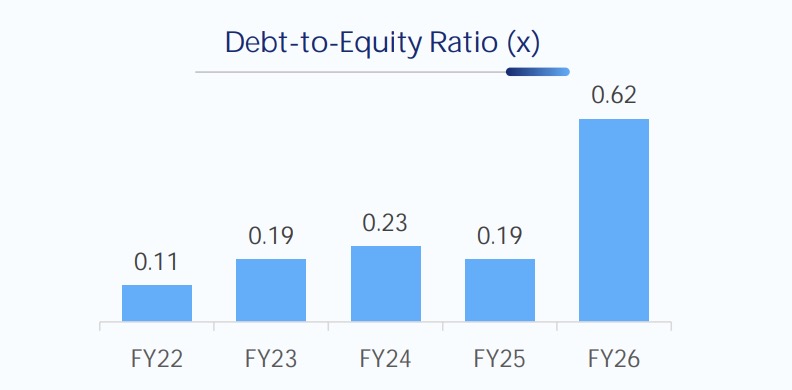
Source: Company Presentation
There was, however, another important development. In August, SPR completed a Rs 1,000 crore qualified institutional placement, allotting 23,36,448 shares at Rs 4,280 each.
The fundraise gives the company more capital to pursue its expansion plans while easing some of the pressure on internal cash flows. The bigger question now is whether the new businesses can generate adequate returns on this capital.
SPR still generates healthy returns despite the higher leverage. Return on equity (ROE) was 20.36% in FY26, compared with 22.82% in FY25, while return on capital employed (ROCE) was 16.20%, down from 21.60% a year earlier.
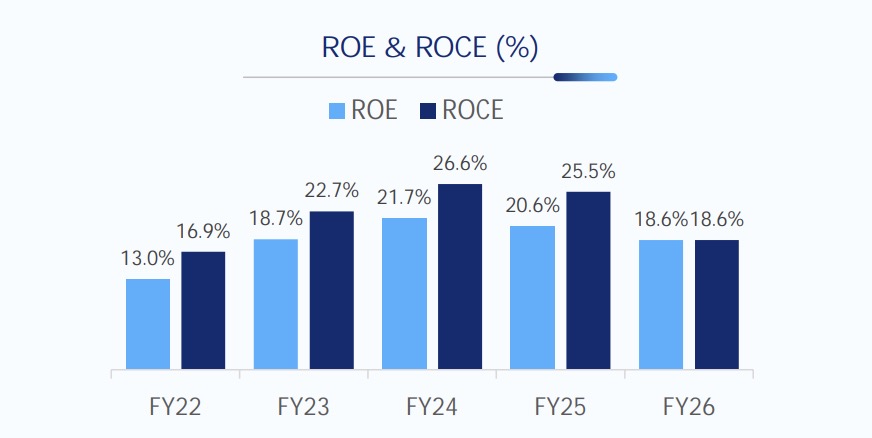
Source: Company Presentation
That is an important metric to watch as SPR moves from a largely established component business to a more diversified group. As acquisitions and newer businesses become a larger part of revenue, maintaining healthy returns while investing in growth will be as important as growing revenue.
Capex will test the strategy
SPR invested close to Rs 200 crore in capacity expansion in FY26. Management said it expects to continue investing at broadly similar levels over the next two to three years, with spending spread across the different businesses.
The investment is going into areas such as precision plastics and new manufacturing capacity. Takahata is setting up a new facility at Neemrana, TGPEL is expanding capacity at Noida, and further capacity additions are under way across the group.
This is also where SPR’s strategy starts to resemble Motherson’s in one important respect. The aim is not simply to manufacture more of the same product, but to use capital to add capabilities that allow the company to participate in more parts of the automobile.
The risk, of course, is that capital expenditure comes ahead of revenue. New plants need to be filled with customer programmes, while acquired businesses need time to improve margins.
The opportunity is moving inside the cabin
The Antolin acquisition gives SPR an entry into a part of the automobile that is becoming increasingly important. The acquired businesses make headliners, sun visors, door panels, centre floor consoles, pillar trims and ambient lighting. SPR also has a long-term technology licensing arrangement with Antolin Global.
Management said the acquired businesses had won important customer programmes and that margins had already improved. The opportunity is therefore not just a theoretical expansion into interiors. The businesses are already contributing revenue, while SPR is trying to improve their profitability through cost measures, supply-chain changes and greater use of its existing capabilities.
There is also a potential cross-selling opportunity. SPR’s precision plastics businesses can potentially supply components to the interiors businesses, allowing the group to retain more of the value within its own manufacturing network.
EMFI is the smaller piece with a longer runway
The electric-vehicle opportunity sits in a different category. SPR EMF Innovations is involved in the design and manufacture of electric motors and controllers, with a research base in Singapore and manufacturing in India. The company has technology agreements with Wuxi Lingbo for controllers and Shenzhen Greatland for motors.
Management said EMFI doubled its turnover last year and that the Coimbatore facility would provide a full-year benefit in FY27. It also said new customers were being added almost every month, with products at various stages of validation across two-wheelers, passenger vehicles, trucks and buses.
Management further said the business had exceeded the targets set at the beginning of FY27, though it did not disclose those targets.
Capacity expansion could drive the next leg of growth
The other subsidiaries provide a more immediate bridge between diversification and earnings. Takahata and TGPEL are already generating meaningful revenue and are expanding capacity. Management said the fourth phase of expansion at Takahata has begun, with revenue from the new business expected early next year. At TGPEL, the second plant has available capacity that is being filled.
This gives SPR several moving parts at the same time. Antolin is being integrated, precision-plastics capacity is expanding and EMFI is moving from development and validation towards commercialisation.
That is also why the next few years could look very different from the past. The standalone business will continue to provide the bulk of the earnings, but an increasing share of incremental growth is expected to come from the subsidiaries.
The risks extend beyond EV adoption
The immediate risk is margin dilution. In Q1FY27, revenue grew 53.1%, while EBITDA grew 26.6%, showing that faster growth is not yet translating into similar profit growth.
Commodity costs and supply-chain disruptions could add further pressure, particularly if higher costs cannot be passed on quickly. The Antolin acquisition also brings integration risk. SPR needs to improve margins and realise the cost and cross-business synergies from the acquired operations.
Debt is another factor to watch. Even after the QIP, SPR needs to balance debt repayment with continued investment in capacity.
The EV opportunity also comes with risks. Motors, controllers and electronics are competitive businesses, and customer wins do not automatically translate into large commercial revenues.
Valuation
Presently, the stock is trading at around 36 times earnings. The valuation reflects more than the traditional piston and piston-ring business. It also reflects the expectation that the acquired interiors business will improve its profitability, that the precision-plastics businesses will continue to grow and that EMFI will scale over time.
The interesting part of the SPR story is not simply that the company is growing faster. It is that the composition of that growth is changing.
Motherson shows what can happen when an auto-component supplier keeps adding products, customers and capabilities around an original business. SPR is now trying to do something similar, moving from pistons into plastics, interiors, lighting and EV components.
Whether that strategy creates lasting value will depend on a fairly simple set of numbers: margins in the acquired businesses, growth and profitability at the subsidiaries, cash flow after capex and the pace at which debt comes down.
That is the real test of whether SPR is merely becoming a bigger auto-component company or becoming a more diversified one in the way Motherson did.
Disclaimer
Note: We have relied on data from www.Screener.in throughout this article. Only in cases where the data was not available, have we used an alternate, but widely used and accepted source of information.
The purpose of this article is only to share interesting charts, data points and thought-provoking opinions. It is NOT a recommendation. If you wish to consider an investment, you are strongly advised to consult your advisor. This article is strictly for educative purposes only.
Manvi Aggarwal has been tracking the stock markets for nearly two decades. She spent about eight years as a financial analyst at a value-style fund, managing money for international investors. That’s where she honed her expertise in deep-dive research, looking beyond the obvious to spot value where others didn’t. Now, she brings that same sharp eye to uncovering overlooked and misunderstood investment opportunities in Indian equities. As a columnist for LiveMint and Equitymaster, she breaks down complex financial trends into actionable insights for investors.
Disclosure: The writer and her dependents do not hold the stocks discussed in this article. The website managers, its employee(s) and contributors/writers/authors of articles have or may have an outstanding buy or sell position or holding in the securities, options on securities or other related investments of issuers and/or companies discussed therein. The content of the articles and the interpretation of data are solely the personal views of the contributors/ writers/authors. Investors must make their own investment decisions based on their specific objectives, resources and only after consulting such independent advisors as may be necessary.