



Two Super Investors, Two Stocks That Have Already Doubled
Every quarter, shareholding filings throw up a few names that make the market sit up. The September 2026 quarter has delivered two, with a twist. The investors behind them are not picking up beaten-down bargains. They are backing stocks that have already more than doubled.
The first is Sunil Singhania, the former Reliance Mutual Fund CIO who now runs Abakkus Asset Manager. His Abakkus Flexi Cap Fund has shown up for the first time with a 1.15% stake in Aether Industries, a Surat-based specialty chemical maker, as per the shareholding pattern filed with BSE. The second is Madhusudan Kela, whose family holds 4.22% of MV Electrosystems, a railway equipment maker that listed only on 6th August 2026.
One stock trades at nearly 100 times its earnings. The other is still losing money and is valued at over 50 times its sales. So, what are two of the most closely tracked investors in India seeing that the price tag does not show? Let us dive in.
#1 Aether Industries: Sunil Singhania’s Rs 266 Crore Bet on an Oil, Gas and AI-Chip Chemical Maker
Incorporated in 2013, Aether Industries makes advanced intermediates and specialty chemicals. It is the only Indian maker of several niche molecules, such as 4MEP and T2E, used in medicines, crop protection, coatings and oilfield chemicals.
With a market cap of Rs 23,152 cr, Aether is no longer the business that listed four years ago. Contract and exclusive manufacturing, where it makes chemicals for global clients under long-term supply deals, made up 46% of FY26 revenue, up from 31% a year earlier. Some of these are take-or-pay contracts with names like Baker Hughes, Saudi Aramco and SEQENS.
As per the September 2026 shareholding disclosures, the Abakkus Flexi Cap Fund now holds 1.15% of the company, a stake worth about Rs 266 cr at the closing price on 8th October 2026. Abakkus built the position through the year below the 1% disclosure line before crossing it this quarter.
What makes the entry interesting is who sits on the other side. SBI Multicap Fund held 9.58% of Aether in September 2025. A year later, that is down to 4.20%. Foreign investors have moved the other way, raising their holding from 4.64% to 8.49% over the same period.
From Pharma Labs to Oil Wells: Where Aether’s Growth Is Coming From
The June 2026 quarter shows where the business is heading. Revenue rose 27% year on year to Rs 327 cr and net profit climbed 33% to Rs 63 cr. On its earnings call on 31st July 2026, the transcript of which is filed with BSE, management said oil and gas made up 31.4% of revenue, crossing Rs 100 cr in a single quarter for the first time. Baker Hughes alone brought in about Rs 70 cr.
There is a newer hook too. Aether is developing low-dielectric monomers, materials that go into 5G and AI hardware, with first sales from its new Magnum site expected this quarter. It has also signed an exclusive research tie-up with Dow Chemical for silicones. These are early bets, but they explain why the market is willing to pay up.
Profits Up 25% a Year, but Cash Keeps Going Out
| Financial Year | FY21 | FY22 | FY23 | FY24 | FY25 | FY26 | 5Y CAGR |
| Sales (Rs cr) | 450 | 590 | 651 | 598 | 841 | 1,160 | 21% |
| EBITDA (Rs cr) | 112 | 168 | 186 | 132 | 243 | 364 | 27% |
| Net Profit (Rs cr) | 71 | 109 | 130 | 82 | 158 | 219 | 25% |
Source: Screener.in
FY21 figures are standalone, as the company had no subsidiary then; FY22 to FY26 are consolidated. EBITDA is operating profit before other income.
Sales grew from Rs 450 cr in FY21 to Rs 1,160 cr in FY26, a compound growth of 21% a year. EBITDA grew 27% a year and net profit 25%. Operating margins widened from 25% to 31%. The FY24 dip followed a November 2023 fire that shut one of its Surat plants for over a year.
The weak spot is cash. Aether has been building plants at a furious pace, so free cash flow has been negative in each of the last five years, at minus Rs 481 cr in FY26 alone. Borrowings more than doubled in FY26, from Rs 200 cr to Rs 458 cr. Inventory sits at around 345 days.
Return on equity is under 10% and has averaged about 8% over three years. On the brighter side, Crisil assigned an AA-/Stable rating to Rs 636 cr of its bank facilities in September, as per a BSE filing.
Valuation Check: Is a 96x PE Justified for Aether?
The share price of Aether Industries was Rs 642 at its IPO in June 2022 and as of closing on 8th October 2026 it was Rs 1,744, a jump of about 172%. Most of that came in the last 12 months, during which the stock rose 131%.
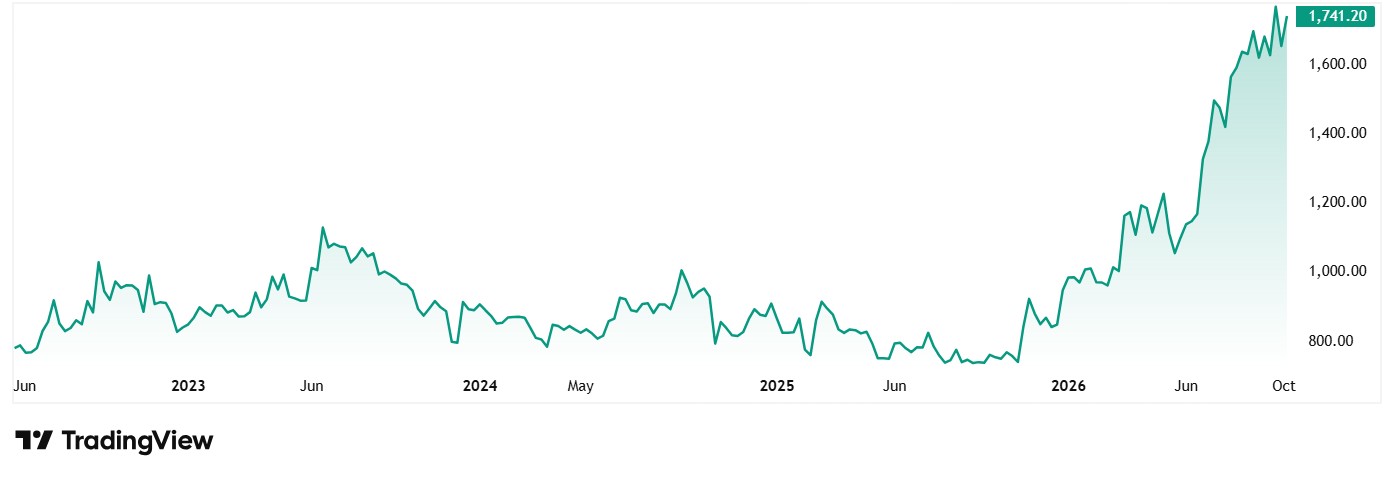
As for valuations, the share trades at a PE of about 97x compared to the current industry median of 28x, and at over 9 times its book value.
Having listed only in 2022, it has no 10-year PE history of its own. The 10-year median PE for the industry is however 30x. The company also pays no dividend.
Promoters hold 74.9%. That figure was above 81% until May 2025, when promoter Purnima Desai sold 6.77% through an offer for sale at a floor price of Rs 700, to bring the holding within the 75% cap allowed under listing rules. Those shares now trade at about two and a half times that price.
#2 MV Electrosystems: Madhusudan Kela’s Railway IPO Bet With an Order Book 20x Its Sales
Incorporated in 2009, MV Electrosystems designs and makes electrical and power electronics equipment for railway rolling stock. Its main product is the IGBT-based 3-phase propulsion system, the electronic heart that drives the motors of an electric locomotive. It also makes switchgear panels and vehicle control systems.
With a market cap of Rs 2,421 cr, the company is barely two months old on the bourses. Its Rs 290 cr IPO, a fully fresh issue priced at Rs 425, was subscribed 188.85 times. The stock listed on 6th August at Rs 520 on NSE, a premium of about 22%.
As per the shareholding pattern filed at listing, Madhusudan Kela’s wife, Madhuri, holds 11.5 lakh shares, or 4.22% of the company. That is worth about Rs 106 cr at the closing price on 8th October 2026. One clarification matters. This was not an open-market purchase. The shares were bought before the IPO, when the holding stood at 5.62%, and the fresh issue diluted it.
The Rs 989 Crore Order Book That Rewrote the Story
When MV Electrosystems filed its draft papers with Sebi in late 2025, its order book stood at Rs 207.5 cr. By 30th June 2026, the company reported an executable order book of Rs 989.32 cr for 564 units of 3-phase propulsion equipment, including a three-year maintenance contract, in its results filed with BSE. On top of that sit developmental orders worth Rs 94.72 cr, including one for EMU and MEMU propulsion.
That order book is about 20 times the company’s FY26 sales of Rs 49 cr. Management has said deliveries would start ramping up from September 2026 and reach a steady monthly pace by January.
Losses Before the Ramp-Up
| Financial Year | FY23 | FY24 | FY25 | FY26 | 3Y CAGR |
| Sales (Rs cr) | 68 | 50 | 63 | 49 | -10% |
| EBITDA (Rs cr) | 6 | 6 | 7 | -10 | NM |
| Net Profit (Rs cr) | 1 | 1 | 1 | -13 | NM |
Source: Screener.in
EBITDA is operating profit before other income. NM: not meaningful.
Public data covers only four years for this new listing, so a 5-year CAGR cannot be worked out, and even the 3-year trend is negative. Sales fell 22% in FY26 to Rs 49 cr, and the company swung to a net loss of Rs 13 cr. The June 2026 quarter was no better, with sales of Rs 12.8 cr and a net loss of Rs 6.9 cr. The company blamed higher staff costs, low factory use and costlier inventory.
The balance sheet shows the strain. Working capital days jumped from 18 to 230 in FY26, and inventory days crossed 700. Operations burned Rs 58 cr of cash during the year. That is why Rs 180 cr of the IPO money has been set aside for working capital.
50x Sales and a Lock-In Expiry on 1st November
The share price of MV Electrosystems was Rs 425 at its IPO and as of closing on 8th October 2026 it was around Rs 920, a jump of about 117% in two months.
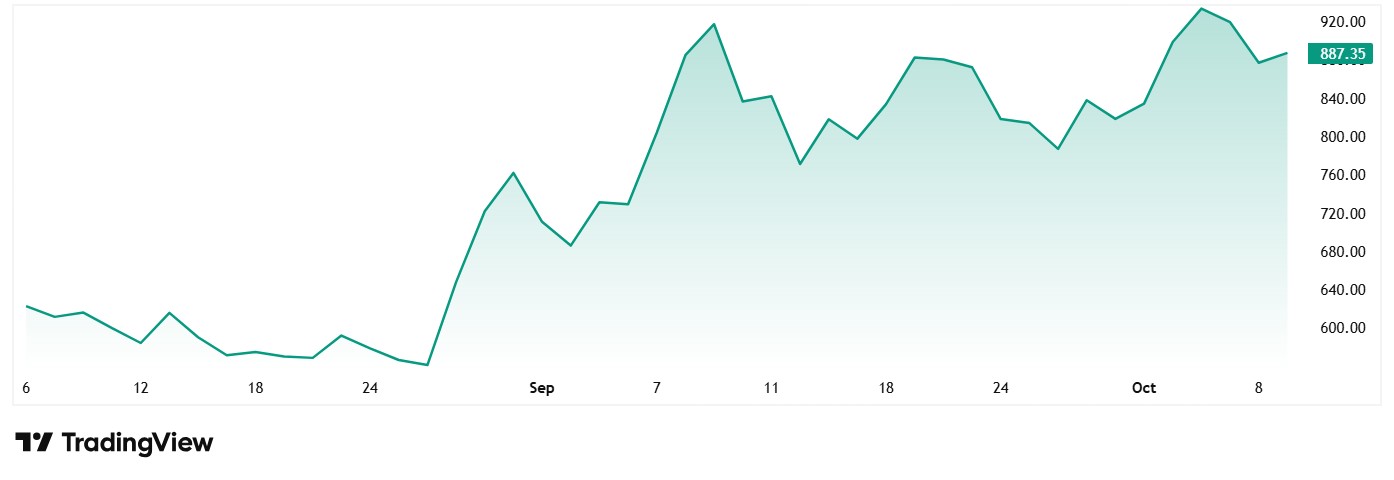
With losses on the books, a PE ratio means little here, and an August listing leaves no 10-year PE history to compare. The other yardsticks are steep. The stock trades at about 50 times FY26 sales and about 7 times book value. The market is also valuing the company at roughly two and a half times its entire order book, which will take several years to deliver.
Two dates matter. The lock-in on the remaining half of the anchor investors’ shares ends around 1st November 2026, which can add supply. And the September quarter results, for which the trading window shut on 1st October, will be the first real test of the promised ramp-up.
Singhania vs Kela: Two Bets on Execution Priced for Perfection?
The two picks by the ace investors are kind of mirror images. Aether is a proven grower with a marquee customer list, priced richly and spending heavily. MV Electrosystems is a scale-up story yet to show a profit, where almost all the value rests on an order book turning into revenue on time.
Entry points differ too. Kela’s family got in before the IPO, far below today’s price. Singhania’s fund has bought into Aether after a big run, which says something about how much growth Abakkus expects from here. A retail investor arriving now pays neither price. They pay today’s.
The next two quarters should settle a lot. Aether has to show its new lines can scale without draining cash. MV Electrosystems has to prove its deliveries are on schedule. A good idea would be to add these stocks to a watchlist and track how both stories play out.
Disclaimer
Note: We have relied on data from www.Screener.in and www.trendlyne.com throughout this article. Only in cases where the data was not available, have we used an alternate, but widely used and accepted source of information, including filings made available on the BSE website.
The purpose of this article is only to share interesting charts, data points and thought-provoking opinions. It is NOT a recommendation. If you wish to consider an investment, you are strongly advised to consult your advisor. This article is strictly for educative purposes only.
Suhel Khan has been a passionate follower of the markets for over a decade. During this period, He was an integral part of a leading Equity Research organisation based in Mumbai as the Head of Sales & Marketing. Presently, he is spending most of his time dissecting the investments and strategies of the Super Investors of India.
Disclosure: The writer and his dependents do not hold the stocks discussed in this article.
The website managers, its employee(s), and contributors/writers/authors of articles have or may have an outstanding buy or sell position or holding in the securities, options on securities or other related investments of issuers and/or companies discussed therein. The content of the articles and the interpretation of data are solely the personal views of the contributors/ writers/authors.