




India’s offshore exploration push is opening a specialised opportunity for Platform Supply Vessels (PSVs), which transport fuel, water, drilling fluids, equipment and deck cargo between shore bases and offshore rigs and production platforms. The global PSV market is estimated at $4.11 billion in 2026, according to DIResearch, and is projected to reach US$4.87 billion by 2033, implying a 2.46% compound annual growth rate (CAGR).
According to a July 2026 MarketsandMarkets report, India’s larger offshore support vessel (OSV) market, which includes PSVs, Anchor Handling Tug Supply (AHTS) vessels and other specialised vessels, was valued at $956.1 million in 2024 and is projected to reach $1.09 billion by 2029.
However, market size is only the starting point. The key question is how much of the offshore spending can translate into higher vessel utilisation, charter revenue and earnings. This puts ABS Marine Services and Shipping Corporation of India (SCI) in focus, with the former offering more direct offshore exposure and the latter providing it within a diversified shipping business.
#1 ABS Marine Services: The Higher-Beta Offshore Vessel Play
ABS Marine Services is a maritime company involved in ship management, ship owning, marine services and port services, with offshore support vessels forming an important part of its owned-fleet strategy. Its ship-owning business covers Platform Supply Vessels, Anchor Handling Tug Supply vessels, Multipurpose Support Vessels and other specialised offshore assets. The company has also expanded its exposure through vessel acquisitions and charter contracts with customers including ONGC, Larsen & Toubro and Schlumberger.
Contracts Turn Fleet Expansion Into Earnings Visibility
ABS Marine secured a ₹26.70-crore L&T contract for a DP2 Platform Supply Vessel, comprising 120 firm days and 56 optional days. The company has also secured a five-year firm charter for ARTEMIS, following its acquisition, with Hardy Exploration & Production (India), acting for itself and its joint-venture partners, ONGC and Invenire Petrodyne. The charter began on 18 June 2026 and carries a firm 1,825-day term, with another 1,825 days of options.
The company’s earlier disclosures also show the value of specialised conversion. Celestial was contracted to Schlumberger Asia for ₹197 crore for well-stimulation operations, with the vessel being converted into a Well Stimulation Vessel for deployment in Indian oil fields.
Contract values must not be confused with annual revenue or cash receipts. The ₹26.70-crore L&T contract covers a defined period and includes optional days, while the ARTEMIS charter includes a firm term and additional options. Readers should distinguish firm commitments from optional extensions and check whether reported contract values include the full charter period.
The investment test is whether the income from new ships being bought will be enough to pay their operating costs and financing costs. Readers should distinguish firm charter commitments from optional extensions and track vessel-level revenue, operating costs and commissioning timelines.
The Offshore Fleet Is Becoming The Earnings Engine
ABS Marine’s consolidated revenue from operations rose to ₹183.09 crore in H2FY26 from ₹136.04 crore in H1FY26, while profit after tax increased to ₹49.46 crore from ₹31.33 crore. More importantly, revenue from owned and existing vessels reached ₹251.09 crore in FY26 versus ₹96.42 crore in FY25.
Celestial generated ₹55.36 crore, Ocean Diamond ₹39.47 crore and Emerald ₹33.72 crore in FY26. Together, these three vessels generated ₹128.55 crore, or roughly 51% of the ₹251.09-crore owned/existing-vessel revenue pool.
Five-Year Financial Track Record Shows the Scale-Up
| Particulars | FY22 | FY23 | FY24 | FY25 | FY26 |
| Sales (₹ in crores) | 72 | 111 | 135 | 180 | 319 |
| Operating Profit (₹ in crores) | 20 | 28 | 45 | 50 | 149 |
| Net Profit (₹ in crores) | 8 | 10 | 25 | 27 | 81 |
Operating profit grew faster than sales in FY26, pointing to a substantial improvement in operating profitability. Readers should assess whether margins remain sustainable as fleet size, depreciation and financing requirements increase.
Growth Comes With A Much Bigger Balance-Sheet Bet
ABS Marine has funded its fleet expansion with substantial borrowing. Consolidated non-current borrowings increased to ₹331.11 crore in March 2026 from ₹138.70 crore a year earlier, while current borrowings rose to ₹46.12 crore from ₹39.71 crore.
At the same time, operating cash flow improved sharply to ₹167.62 crore from ₹44.89 crore, although investing cash outflow reached ₹332.28 crore because of fleet expansion. Financing activities generated ₹161.56 crore, leaving overall net cash flow broadly flat.
The central financial test is whether incremental vessels generate enough cash flow to justify the additional debt. Revenue growth alone will not be sufficient if depreciation, interest costs and maintenance capex absorb a large portion of the operating gains.
As per management, FY27 turnover is expected to grow by 10% with an EBITDA margin of 45-50%, assuming all vessels are operational in H2. It is targeting seven to eight owned vessels over the next two to three years.
Strong Share Price Returns Raise The Valuation Question
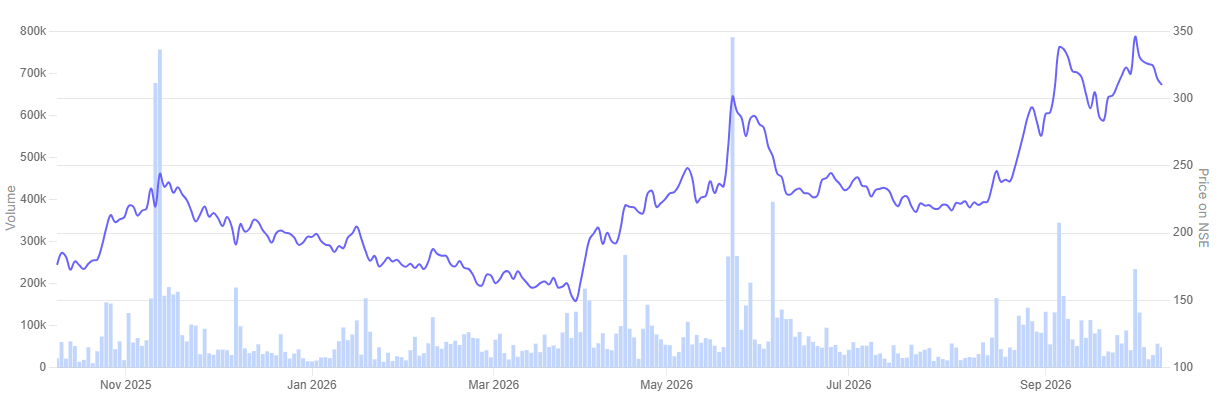
ABS Marine’s share price rose by more than 61% over six months, while its one-year return stood at 76%. However, the stock declined by 7.5% over the preceding 30 days. Its price-to-earnings (P/E) ratio was 9.82.
The P/E ratio needs to be assessed alongside earnings sustainability, debt, cash flow and the capital required for further vessel purchases. The multiple could be a reflection of concerns about cyclical revenue, leverage and the sustainability of current margins, but it could also offer value if earnings are durable.
#2 Shipping Corporation of India: A Diversified Shipping Giant With an Offshore Growth Option
Shipping Corporation of India (SCI) operates across tanker, bulk carrier, liner and offshore shipping services. Its offshore fleet comprises six anchor-handling tug and supply vessels (AHTSVs), two PSVs and two multipurpose support vessels (MPSVs). These vessels support India’s offshore oil industry by transporting supplies, towing and anchoring offshore installations, and providing standby and rescue services.
A New Methanol-Fuelled PSV Adds a Long-Term Fleet Modernisation Angle
In March 2026, SCI signed a contract with Mazagon Dock Shipbuilders (MDL) for the construction of its first 3,000-deadweight-tonne (DWT) methanol dual-fuel diesel-electric PSV. MDL disclosed a contract value of approximately US$39 million. The vessel is intended to use methanol as an alternative fuel and will be constructed under the agreed contractual schedule.
The order supports fleet modernisation with alternative-fuel technology, although the actual fuel savings and emissions benefits of the vessel will need to be established in operation. It is a long-term fleet investment rather than an immediate earnings driver. Revenue contribution will depend on delivery, deployment, charter terms and operating costs, while any improvement in return on capital remains to be established.
SCI’s offshore portfolio also serves strategic government requirements.
Q1FY27 Results Show Strong Earnings, but Tankers Lead the Way
SCI reported consolidated revenue from operations of ₹1,846.56 crore in Q1FY27, up 40.3% year on year and 22% quarter on quarter. PAT increased to ₹619.34 crore, rising 74.9% year on year and 53.08% quarter on quarter.
The tanker segment generated ₹1,295.46 crore in revenue, up 41.85% year on year. Technical & Offshore revenue increased 11.71% year on year to ₹80.80 crore.
Technical & Offshore accounted for approximately 4.4% of consolidated Q1FY27 revenue. This limits how much of SCI’s current results can be attributed to the offshore revival. Moreover, the segment includes offshore activities beyond PSVs, so its revenue cannot be treated as a direct measure of PSV earnings.
Balance Sheet Capacity Enhances Growth, but Capital Allocation Remains Vital
SCI had consolidated borrowings of about ₹2,679 crore as on March 2026. FY26 operating cash flow was around ₹1,341 crore. Investing cash flow was around negative ₹849 crore.
SCI’s group-level cash generation provides a broader funding base for fleet investment, but it is generated across multiple shipping businesses and should not be attributed solely to offshore vessels.
SCI also extended the time charter of its 9,034-TEU container vessel SCI Delhi for a further seven years in August 2026.
Five-Year Financial Track Record Shows the Wider Shipping Cycle
| Particulars | FY22 | FY23 | FY24 | FY25 | FY26 |
| Sales (₹ in crores) | 4,995 | 5,794 | 5,047 | 5,606 | 5,780 |
| Operating Profit (₹ in crores) | 1,530 | 1,557 | 1,423 | 1,765 | 2,186 |
| Net Profit (₹ in crores) | 865 | 870 | 679 | 844 | 1,353 |
The five-year figures provide a broader view of SCI’s financial performance across changing shipping-market conditions. FY26 recorded the highest sales, operating profit and net profit. However, these consolidated figures do not isolate the contribution of PSVs, so the performance of the offshore segment must be assessed separately.
Positive Stock Returns Depend On More Than The PSV Story
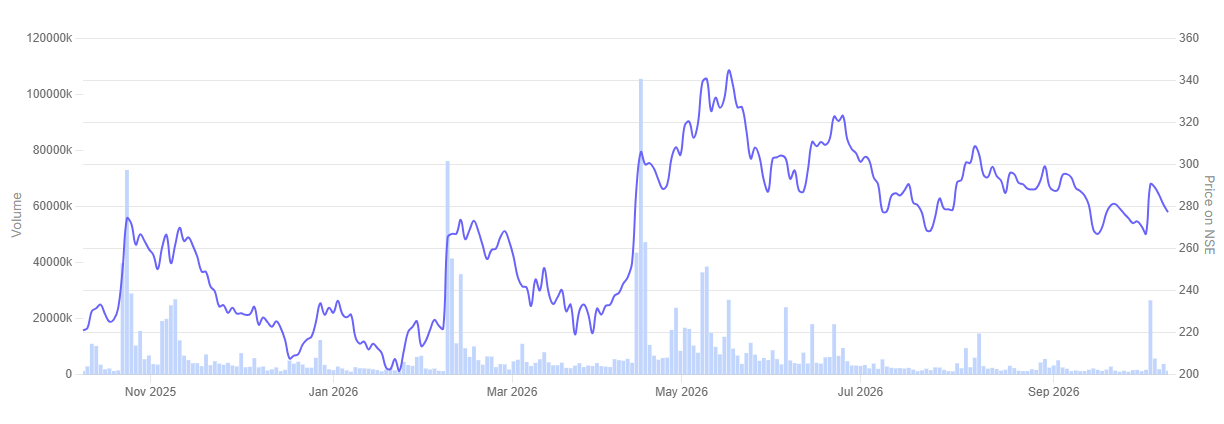
SCI’s share price declined by more than 4% over the preceding 30 days. Its six-month return stood at 17%, while the one-year return was 26%. The stock’s P/E ratio was 8.10.
The positive six-month and one-year returns indicate that shareholders have experienced gains over those periods, despite the recent monthly decline. However, SCI’s diversified earnings base means its valuation also reflects tanker earnings, freight-market conditions, fleet renewal and other shipping businesses.
What Could Keep Offshore Growth From Reaching Shareholders
Deepwater exploration requires vessels with capabilities suited to the operating environment, including dynamic positioning, specialised cargo systems and sufficient deck capacity. As exploration moves into deeper waters, older or less capable vessels may not qualify for every contract. Upgrading or replacing them requires substantial capital, and the investment can become difficult to justify if a long-term charter is not secured before the expenditure.
Charter rates and utilisation also determine whether additional vessels translate into stronger earnings. A vessel can be sitting idle waiting for a contract, or undergoing maintenance, or lose operating days due to dry-docking. A technically sound vessel may still prove to be a disappointing investment if it is not put to work quickly enough or if the agreed daily rate does not cover its running and borrowing costs. Conversely, a long-term fixed-rate charter provides revenue visibility but can limit the owner’s ability to benefit if market rates rise sharply.
Vessel owners must also account for financing costs, depreciation and maintenance expenditure. These can limit the conversion of higher revenue into PAT, particularly when newly acquired vessels take longer than expected to enter service. ABS Marine faces a more direct test of debt-servicing capacity, while SCI must balance offshore investment against the needs of its wider fleet.
Finally, stronger exploration demand does not guarantee that vessel supply will remain tight. New vessel orders, domestic shipbuilding incentives and fleet modernisation can add capacity over time. If supply grows as quickly as demand, utilisation and charter rates may not rise as expected. Investors should therefore assess actual contract awards, fleet availability, vessel delivery schedules and operating performance rather than relying on the offshore revival alone.
Government Support Could Expand Demand and Improve Vessel Economics
The Union Cabinet approved the ₹84,084-crore Samudra Manthan National Offshore Exploration Scheme in August 2026, with implementation planned through FY2030–31. Its components include ₹28,534 crore for modern offshore seismic data acquisition and processing, ₹43,200 crore for drilling 60 deepwater exploration wells, ₹10,000 crore for common offshore infrastructure hubs and ₹2,000 crore for Oil and Gas Manufacturing and Services Zones. Eligible deepwater exploration wells can receive government support of up to 50% of drilling costs, capped at ₹675 crore per well.
For PSV operators, the potential benefit is indirect: increased drilling and offshore infrastructure activity could create demand for supply vessels, but actual benefits depend on project execution and contract awards.
The ₹24,736-crore shipbuilding support package offers a separate route to expanding domestic vessel-building capacity. Under the Shipbuilding Financial Assistance Scheme, specialised vessels can qualify for assistance of 15% on the first ₹100 crore of eligible vessel value and 25% on the value above ₹100 crore, subject to the scheme’s conditions. Full support requires at least 40% domestic content; lower qualifying domestic content can reduce or eliminate assistance.
The benefit is limited to eligible vessels built in Indian shipyards that meet the applicable domestic-content and scheme conditions. It should not be treated as a blanket subsidy for all vessel acquisitions.
The Offshore Windfall Test: Follow the Cash, Not Just the Crude
Three indicators can help readers judge whether offshore expansion is translating into shareholder value.
First, track fresh charter awards, contract extensions and actual vessel deployment days; these provide more direct evidence of demand than government spending announcements. Second, compare operating cash flow with interest payments, scheduled debt repayments and maintenance expenditure to assess how much cash remains available after keeping vessels operational. Third, watch for changes in charter duration and pricing, particularly when contracts expire or vessels return from maintenance.
For ABS Marine Services, the key decision point is whether newly deployed vessels can support expansion without stretching repayment capacity. For Shipping Corporation of India, investors should assess whether offshore operations become a more meaningful contributor to overall performance, rather than assuming gains from its wider shipping business confirm the PSV opportunity.
The practical rule is to look for evidence of contracted demand, cash generation and disciplined capital allocation before increasing exposure, rather than relying solely on policy announcements or past share-price returns.
It may be a good idea to add these stocks to your watchlist and keep track to see how they perform in time to come.
Disclaimer:
Note: We have relied on data from www.Screener.in throughout this article. Only in cases where the data was not available, have we used an alternate, but widely used and accepted source of information.
The purpose of this article is only to share interesting charts, data points and thought-provoking opinions. It is NOT a recommendation. If you wish to consider an investment, you are strongly advised to consult your advisor. This article is strictly for educative purposes only.
Rishabh Sinha is a seasoned financial content creator with over 10 years of experience in BFSI domain. His portfolio spans over 20 of India’s most trusted financial brands. Rishabh brings depth, structure, and a reader-first approach to every piece he crafts.
Disclosure: The writer and his dependents do not hold the stocks discussed in this article.
The website managers, its employee(s), and contributors/writers/authors of articles have or may have an outstanding buy or sell position or holding in the securities, options on securities or other related investments of issuers and/or companies discussed therein. The content of the articles and the interpretation of data are solely the personal views of the contributors/ writers/authors. Investors must make their own investment decisions based on their specific objectives, resources and only after consulting such independent advisors as may be necessary.