


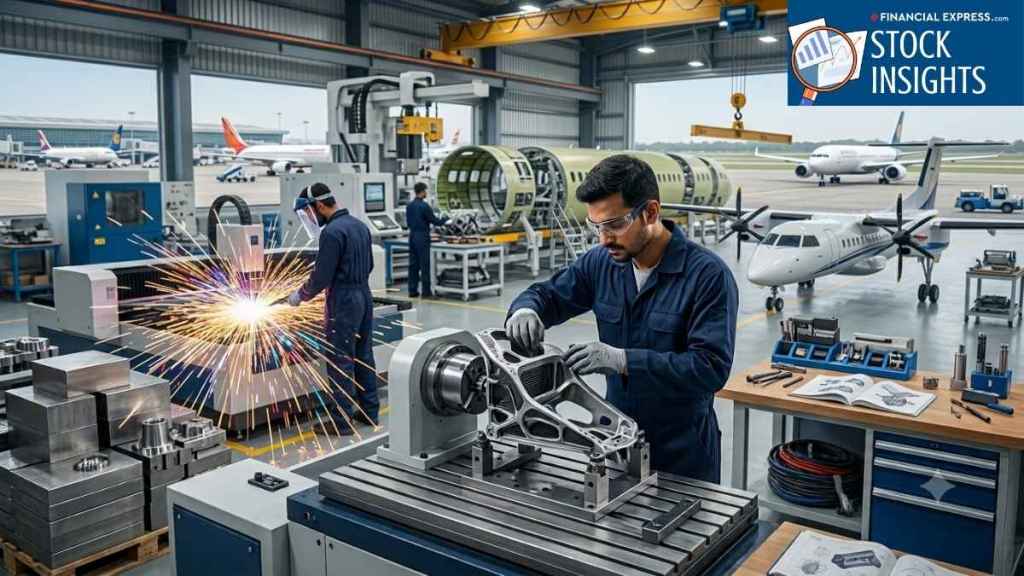

India’s aircraft-component manufacturing opportunity is expanding rapidly even before the country begins producing complete commercial aircraft at scale. A Frost & Sullivan analysis estimates India’s commercial-aircraft manufacturing market at ₹164.21 billion in 2026, up from ₹130.51 billion in 2024. It is projected to reach ₹257.09 billion by 2030, implying an 11.96% Compound Annual Growth Rate (CAGR) during 2024–2030.
The export opportunity is even larger. Ministry of Commerce data cited in an industry report shows India’s exports of aircraft and space parts jumped to ₹588.38 billion in FY25, from ₹269.03 billion in FY24 and ₹119.37 billion in FY19. This indicates a fast expansion of India’s participation in global aerospace supply chains.
India’s expanding airline fleet backs demand. As of June 30, 2025, major Indian airlines had orders for 2,026 aircraft, according to data supplied by the Directorate General of Civil Aviation (DGCA) to Parliament. Of these, 385 aircraft had already been imported by that date, leaving a substantial pipeline of aircraft to be inducted over the coming years. The scale of these orders is expected to support long-term demand across India’s aerospace supply chain, including aerostructures, precision-machined components, electrical systems and assemblies.
This creates a sizable opportunity for specialised suppliers serving global Original Equipment Manufacturers (OEMs) and Tier-1 aerospace companies, including Dynamatic Technologies and Aequs.
#1 Dynamatic Technologies: From Detail Parts to Major Aerostructures
Dynamatic Technologies operates across aerospace, hydraulics, metallurgy and security applications. Its aerospace business is conducted through Dynamatic-Oldland Aerospace and covers detail parts, sub-assemblies, assemblies and major assemblies. The company says its aerospace infrastructure delivers more than 800 aircraft shipsets annually and has manufactured more than 10,000 detail parts.
Its customer base includes Airbus, Boeing, Bell Helicopter, Hindustan Aeronautics Limited (HAL), Dassault Aviation, Deutsche Aircraft and Prestwick Aerosystems, while its United Kingdom (UK) operations also serve Airbus UK, Boeing, GE Aviation, GKN Aerospace, Lockheed Martin, Spirit AeroSystems UK and AgustaWestland.
Q1 FY27 Shows Operating Leverage, but Foreign Exchange (FX) Matters
Dynamatic reported consolidated revenue from operations of ₹424.81 crore in Q1 FY27, up 14.5% year-on-year (YoY) but down 1.9% quarter-on-quarter (QoQ). Earnings before interest, tax, depreciation and amortisation (EBITDA) rose 45.9% YoY to ₹55.11 crore, taking the margin to 13%, while Profit After Tax (PAT) increased 92.9% YoY to ₹20.79 crore.
The company said Q1 FY27 revenue would have grown 3.9% YoY on a constant-currency basis after removing a ₹39.26 crore favourable foreign-exchange impact. Constant-currency EBITDA would have been ₹49.97 crore instead of ₹55.11 crore. This means the underlying operating improvement was still positive, but headline growth overstated the underlying volume and execution momentum.
Aerospace Is the Highest-Margin Business
Aerospace revenue increased 17% YoY to ₹202.25 crore and represented 48% of Q1 FY27 consolidated revenue. Aerospace EBITDA rose 20.5% to ₹48.19 crore, while the EBITDA margin improved to 23.8% from 23.1% a year earlier and 20.7% in Q4 FY26. EBIT margin also increased to 17.8% from 16.8% in Q1 FY26.
The company attributed the growth to execution across commercial aerospace and defence programmes and the ramp-up of detail-part programmes at Dynamatic Manufacturing Limited. The Airbus A220 doors programme also progressed during the quarter.
The Rest of Dynamatic Still Matters
Hydraulics generated ₹116.04 crore in Q1 FY27 revenue, up 9.4% YoY, while EBITDA rose 302.8% to ₹14.46 crore and the margin improved to 12.5% from 3.4%. Management attributed the improvement to product-mix optimisation and benefits from UK restructuring.
Metallurgy generated ₹106.31 crore, up 15.7% YoY, with EBITDA rising 132.7% to ₹3.98 crore and the margin improving to 3.7%.
This diversification changes how readers should view Dynamatic. It is not a pure-play aerospace stock. Aerospace provides the strongest margin profile and the largest revenue contribution, while the improvement in hydraulics and metallurgy is also supporting consolidated earnings. Consequently, future stock performance will depend on both aerospace execution and whether the non-aerospace businesses sustain their margin recovery.
Five-Year Numbers Show Earnings Volatility
| Particulars | FY22 | FY23 | FY24 | FY25 | FY26 |
| Sales (₹ in crores) | 1,253 | 1,316 | 1,429 | 1,404 | 1,621 |
| Operating Profit (₹ in crores) | 172 | 184 | 162 | 161 | 186 |
| Net Profit (₹ in crores) | 15 | 43 | 122 | 43 | 32 |
Over FY22-FY26, revenue grew at a modest 6.7% CAGR, and earnings followed a far less predictable path. The wide swings in net profit show that revenue growth alone has not produced a stable earnings base, making the durability of the recent margin improvement more important than the pace of topline growth.
Debt Is Improving, but It Has Not Disappeared
As of June 30, 2026, Dynamatic’s total debt stood at ₹527.26 crore, compared with ₹479.97 crore a year earlier. Cash and cash equivalents were ₹54.12 crore, resulting in net debt of ₹473.14 crore. Including lease liabilities, overall debt stood at ₹577.42 crore.
Net debt/Last Twelve Months (LTM) EBITDA improved to 2.4x from 2.5x at March 2026 and 2.8x at June 2025, while interest coverage improved to 2.4x.
The improvement is encouraging, but leverage remains relevant because aerospace expansion requires continued investment. It is therefore important to watch whether future EBITDA growth is accompanied by sustained debt reduction rather than allowing higher borrowing to fund every additional capacity requirement.
The Stock Has Already Rerated Sharply
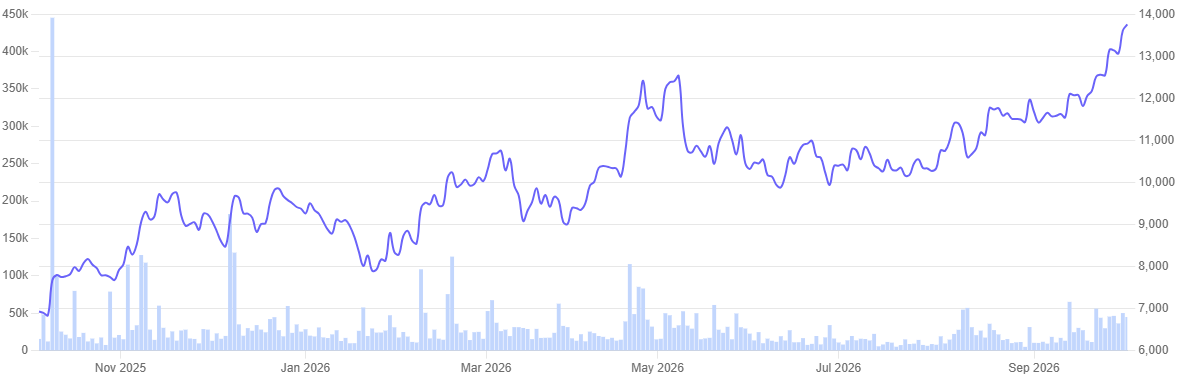
Dynamatic Technologies’ stock delivered more than 47% returns over six months and more than 98% over 52 weeks. The stock’s price-to-earnings (PE) ratio was 159.45x.
ICICI Securities reiterated a Buy rating on 29 September 2026 with a target price of ₹15,340 and an entry price of ₹12,800. The stock closed at ₹13,756 on 1 October 2026, implying around 11.5% upside to the brokerage target.
The stock’s strong re-rating means the future earnings trajectory matters more than the past growth rate. Investors are no longer paying only for the current aerospace business; the valuation reflects expectations of sustained earnings improvement.
#2 Aequs: A Large Order Book Meets A Bigger Capital Requirement
Aequs operates an integrated aerospace manufacturing ecosystem at its Belagavi Special Economic Zone (SEZ) in Karnataka, covering forging, precision machining, surface treatment and aerostructure assembly. It manufactures components for aircraft engine systems, landing systems, cargo and interiors, structures and assemblies.
The company has also expanded into consumer manufacturing, including components for portable computers and smart devices and injection- and blow-moulded products.
Aequs reported Q1 FY27 consolidated revenue of ₹395.5 crore, up 55% YoY and 8% QoQ. The company said the YoY margin comparison was affected because operating costs of its consumer-electronics business were expensed after commercial operations began, whereas comparable costs had been capitalised in Q1 FY26.
Aerospace Growth Is Strong, but Consolidated Profitability Is the Weak Link
Aerospace revenue increased 40% YoY and 6% QoQ to ₹322.2 crore, accounting for roughly 81% of consolidated revenue. Aerospace EBITDA rose 35% YoY to ₹73.1 crore, although it was below ₹101 crore in Q4 FY26. Aerospace capacity utilisation stood at 70% globally and 78% in India.
The combination of given revenue contribution and Indian utilisation makes aerospace the central earnings engine for Aequs. However, the company is still carrying a major profitability burden from the wider group, which means aerospace growth has not yet translated proportionately into consolidated net profit.
The aerospace portfolio comprised 5,740 qualified products across structures, engine systems, actuation, landing systems, interiors and cargo, turnings and assemblies. The company added 86 aerospace parts during Q1 FY27.
The $1 Billion Order Book Changes the Scale of the Story
In Q1 FY27, Aequs’ aerospace order book increased 13% QoQ from $889 million to $1.004 billion. During the quarter, the company signed long-term agreements with two new aerostructures Tier-1 customers and secured its first contract to manufacture fully assembled Airbus A320 wheels for Safran Landing Systems. Management said the wheel programme is covered by a 15-year agreement, is single-source and will involve end-to-end manufacturing in India. The contract value was not disclosed and is expected to enter the reported order book subsequently.
The current order book provides substantial long-term revenue visibility, not near-term. Also, a growing order book without corresponding revenue conversion would indicate that execution capacity, rather than demand, is becoming the constraint.
Capacity Expansion Could Become the Next Earnings Trigger
Aequs’ aerospace manufacturing footprint spans India, the US and France. The top five customer groups contributed 63% of Q1 FY27 revenue, while the three largest customer groups had an average relationship tenure of 15 years. Aequs is expanding into higher-value engine and landing-gear components. Its Belagavi ecosystem combines forging, precision machining, surface treatment and aerospace assembly.
During Q1 FY27, annualised aerospace machining capacity stood at 2.02 million hours, supported by 220 Computer Numerical Control (CNC) machines. Management said machines were being added continuously, effectively around one machine a week.
The company is also developing an integrated aerospace manufacturing ecosystem at Hosur, initially focused on engine and landing-gear components. The first machining facility is expected to commence between September 2027 and March 2028, with revenue expected from FY29. Aequs has committed around ₹1,900 crore over 10 years for the Hosur ecosystem, including investments through joint ventures.
Hosur therefore represents a future growth opportunity rather than an immediate earnings contributor.
Exports Create Opportunity and Currency Exposure
Aequs generated 88% of consolidated Q1 FY27 revenue from exports and 12% from domestic revenue.
The export-heavy model gives Aequs access to global aerospace demand, but it also increases sensitivity to currency movements and overseas customer conditions. The company’s future earnings should therefore be assessed on both operational growth and the quality of its currency-adjusted growth.
Four-Year Financial Record Shows Why Cash and Profit Matter
| Particulars | FY23 | FY24 | FY25 | FY26 |
| Sales (₹ in crores) | 812 | 965 | 925 | 1,230 |
| Operating Profit (₹ in crores) | 40 | 129 | 79 | 92 |
| Net Profit (₹ in crores) | (110) | (14) | (102) | (113) |
Aequs has grown its revenue base, but the bottom line has yet to catch up. The repeated consolidated losses despite positive operating profit show that the central financial issue is not simply the ability to grow revenue, but the ability to retain more of that operating performance at the net-profit level.
Cash Flow Is the Key Test for the Expansion Story
Aequs’ net debt-to-equity ratio improved to 0.34x from 0.88x in Q1 FY26, while finance costs also declined following debt repayments. However, operating cash flow turned negative at ₹41.4 crore in Q1 FY27, compared with positive cash generation a year earlier, as the higher production scale increased working-capital requirements. The company has also guided for around ₹660 crore of FY27 capex, including ₹160 crore for aerospace. This makes working-capital discipline a critical part of the expansion story: the financial benefit of higher production will depend on how much of the additional operating profit can ultimately be converted into cash while the company funds its planned capex.
The Valuation Leaves Little Room for Execution Failure
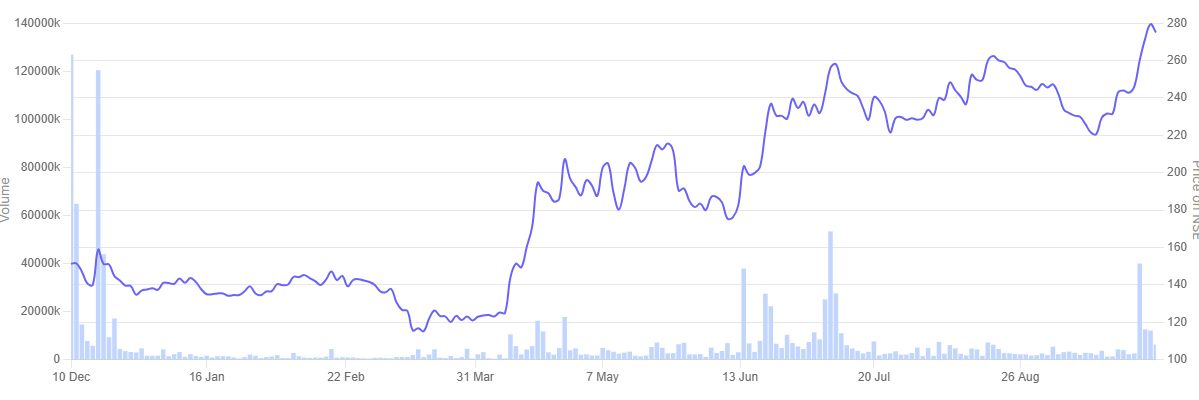
Aequs’ stock gained more than 129% over six months and more than 96% since its listing on 10 December 2025. The stock was trading at 12.4 times book value.
JM Financial downgraded Aequs to Reduce from Buy on 27 May 2026 with a target price of ₹210. Aequs closed at ₹275.05 on 1 October 2026, around 30.9% above that target.
The stock’s strong post-listing performance means the market is already assigning considerable value to future growth. That leaves valuation increasingly dependent on evidence that the expected growth can support a stronger earnings profile. A sustained improvement in profitability would provide the clearest fundamental support for the premium the stock is already commanding
Where the Aerospace Opportunity Can Hit a Wall
India’s aerospace-component opportunity is exposed to supply-chain and execution risks that can directly affect company profitability. Aircraft manufacturers require tightly controlled grades of aluminium, titanium, nickel alloys and advanced composites, and gaps in domestic production of some aerospace-grade materials can leave suppliers dependent on imports. Longer procurement cycles, freight costs and currency movements can therefore increase working-capital requirements and compress margins.
Aircraft-component suppliers are also ultimately exposed to aircraft production rates. Delays caused by engine shortages, supply-chain constraints or certification issues can defer component schedules even after an Indian supplier has expanded capacity. This creates an important operating risk because fixed manufacturing costs continue even when customer production schedules move out.
Quality failures present another direct financial risk. Aerospace components require strict dimensional and certification standards, and a rejected forged blank, machined component or treated part can result in the loss of material and processing costs already incurred. For companies operating at higher utilisation, quality and yield therefore become important margin variables rather than simply compliance issues.
Rapid growth can also create a cash-flow mismatch. Long manufacturing cycles, customer approval procedures, imported raw materials and rising receivables can increase the amount of capital tied up in inventory and working capital. For readers, the risk is that working capital expands faster than earnings during a production ramp-up, forcing companies to fund growth through additional borrowing or internal cash that could otherwise support expansion.
The Aerospace Rally Now Needs Financial Proof
The next phase will be about proof, not promises. Readers should watch whether newly won programmes begin translating into a rising share of higher-value work within the companies’ portfolios, particularly where suppliers move from individual parts towards integrated assemblies. The more important signal will be customer-level deepening: repeat programme awards, additional platforms and longer production commitments can strengthen revenue visibility without relying solely on headline order-book growth.
Readers should also track whether newer capabilities achieve customer qualification quickly enough to prevent capacity from sitting idle after capital has been deployed. Another crucial marker is whether growth becomes less dependent on a handful of large customers. If programme diversification, qualification wins and better asset productivity emerge together, the market could begin treating these businesses as established aerospace platforms rather than high-expectation manufacturing bets.
It may be a good idea to add these stocks to your watchlist and keep track to see how they perform in time to come.
Disclaimer:
Note: We have relied on data from www.Screener.in throughout this article. Only in cases where the data was not available, have we used an alternate, but widely used and accepted source of information.
The purpose of this article is only to share interesting charts, data points and thought-provoking opinions. It is NOT a recommendation. If you wish to consider an investment, you are strongly advised to consult your advisor. This article is strictly for educative purposes only.
Rishabh Sinha is a seasoned financial content creator with over 10 years of experience in BFSI domain. His portfolio spans over 20 of India’s most trusted financial brands. Rishabh brings depth, structure, and a reader-first approach to every piece he crafts.
Disclosure: The writer and his dependents do not hold the stocks discussed in this article.
The website managers, its employee(s), and contributors/writers/authors of articles have or may have an outstanding buy or sell position or holding in the securities, options on securities or other related investments of issuers and/or companies discussed therein. The content of the articles and the interpretation of data are solely the personal views of the contributors/ writers/authors. Investors must make their own investment decisions based on their specific objectives, resources and only after consulting such independent advisors as may be necessary.