


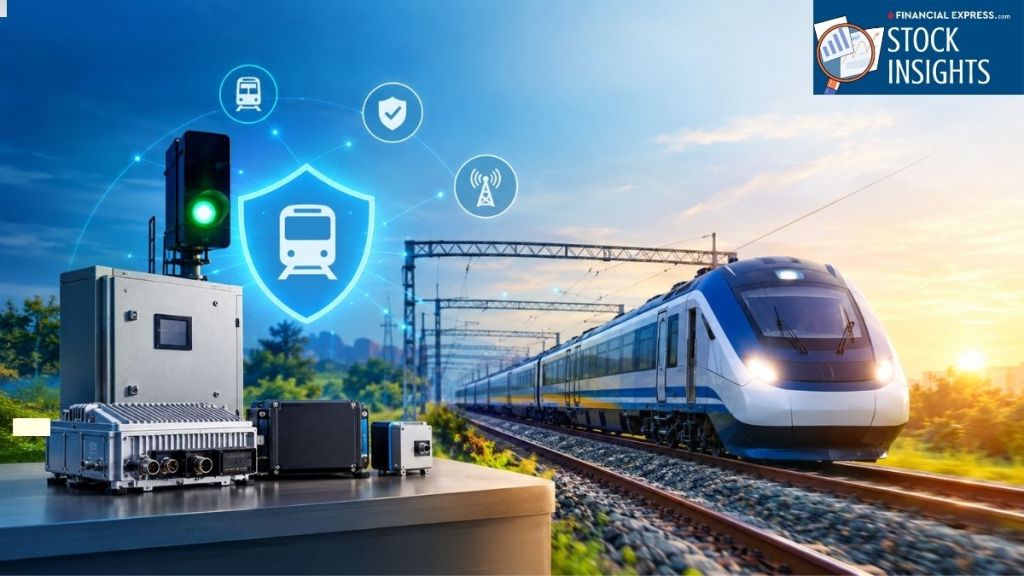

India’s railway safety upgrade could create a sizeable opportunity for companies working on Kavach. The addressable broad-gauge network alone spans 81,000 route kilometres, representing an estimated ₹34,200 crore opportunity.
Another 3,300 route kilometres lie across Dedicated Freight Corridors. But the rollout is far from over. Indian Railways plans to tender Kavach installation across another 41,000 route kilometres between FY27 and FY29. Demand also extends to new locomotives, with regulations requiring every newly manufactured locomotive to be equipped with Kavach before commissioning.
With Indian Railways adding around five locomotives a day, or more than 1,900 a year, this requirement adds another source of demand for Kavach suppliers. Against this backdrop, this article examines two specialised players in rail-technology and safety equipment.
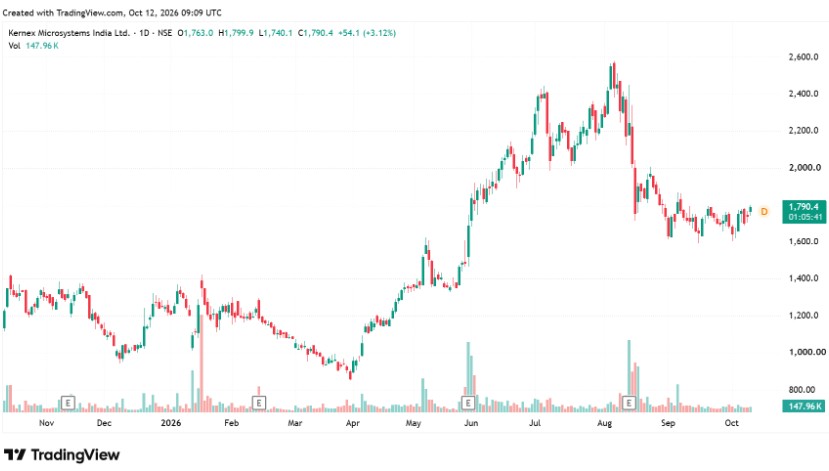
#1 Kernex Microsystems: Riding India’s Kavach Revolution
Kernex Microsystems is a rail-technology and safety systems company. The company designs, develops, and executes safety-critical railway electronics, signalling, and turnkey infrastructure projects. In turnkey projects, it delivers complete project lifecycle execution, from survey and design to installation.
RDSO SIL-4 Certification Drives High-Volume Kavach Rollout
The company can produce 6,000 Loco Kavach units, 1,000 Station Kavach units, 500 Remote Interface Units, and 120 Level Crossing Gates (scalable to 300) annually. Kernex is the first OEM to commercially operate Kavach on Vande Bharat trainsets and the first to interface with four different Electronic Interlocking systems.
₹5,174-Crore Order Book Locks in Visible Revenue Through FY29
Kernex holds a total Kavach contract portfolio of ₹5,174 crore (inclusive of GST). To date, ₹1,687 crore (33%) has been executed, leaving a balance order book of ₹3,487 crore (67%). For the FY27-29 horizon, Kernex’s cumulative executable base builds to ₹6,727 crore. This comprises ₹2,105 crore projected for FY27, ₹2,200 crore for FY28, and ₹2,422 crore for FY29.
An additional ₹2,420 crore from these contract awards is projected to be executed from FY30 onwards. The executable base highlights the monetary value of work scheduled to be executed into revenue over a given financial period. Kernex holds RDSO approval for Kavach Version 4.0 under SIL 4 safety standards, placing it within a limited set of certified suppliers.
Post-Commissioning AMCs: The 37x Recurring Cash Flow Engine
Kavach deployment also offers a multi-decadal recurring income opportunity. Beyond the initial equipment installation, long-term revenue streams are generated through software upgrades, hardware modifications, and Annual Maintenance Contracts (AMCs). Management projects the AMC revenues alone to grow from ₹5 crore in FY27 to ₹185 crore in FY29.
Non-Rail Diversification and ₹150-Crore Global Pipeline Take Shape
To expand beyond the core business of railway signalling, Kernex is diversifying into adjacent critical-infrastructure sectors. These comprise Yard Management Systems, Intelligent Traffic Management, Data Centres & Disaster Recovery, and Simulators. Internationally, the company is targeting a ₹150 crore export opportunity over the next two years.
Q1 Operating Margins Expand to 32.3% as Operating Leverage Kicks In
Financially, consolidated revenue surged to ₹504 crore in Q1FY27, up from ₹56 crore in Q1FY26. EBITDA (Earnings Before Interest, Tax, Depreciation, and Amortisation) rose to ₹163 crore from ₹10 crore in Q1FY26, while margin stood at 32.3%. Net profit surged to ₹110 crore, up from ₹7 crore in Q1FY26. Order book execution remains the key going ahead. Q1FY27 earnings are yet to be announced.
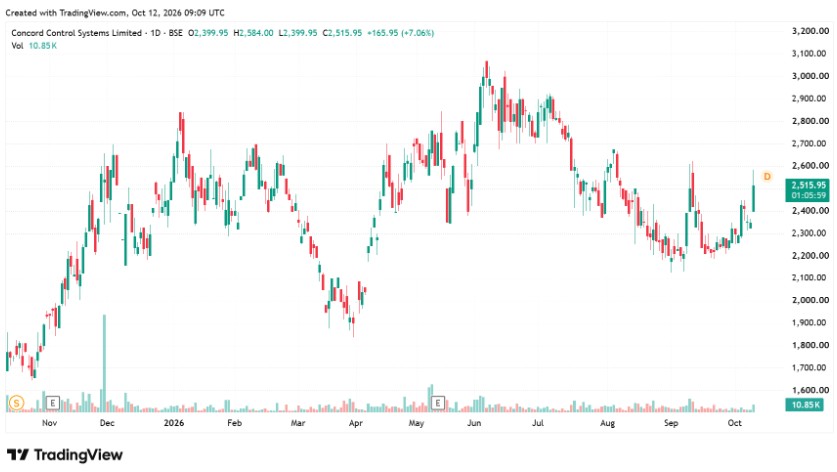
#2 Concord Control Systems: Beyond Kavach, Building the Future of Rail Safety
Concord Control Systems is a railway technology platform company. It develops mission-critical electronics, safety systems, propulsion technologies, and diagnostic solutions. It is an approved OEM and vendor for Indian Railways bodies, including the RDSO, Chittaranjan Locomotive Works, and Integral Coach Factory.
RDSO Vendor Status and Vertical Supply Chain Integration
Concord participates in the Kavach program through Progota, in which it holds a 46.5% stake. It operates as an indigenous R&D player developing proprietary technology in-house. Through its backward integration with Fusion Electronics (PCBs and box-build solutions) and Advanced Rail Controls, it benefits from cost efficiencies and vertical integration for its Kavach hardware.
Concord’s Kavach suite includes both onboard locomotive hardware and control infrastructure. Concord secured ₹258.3 crore in total Kavach orders during FY26. This includes major contract wins of ₹185.1 crore and ₹53.7 crore for on-board Kavach 4.0 equipment. The execution timeline is 12 months.
₹697-Crore Order Book Underpins 3.3x Revenue Visibility
Concord closed FY26 with an executable order book of ₹697 crore, up 228% year-on-year. This order provides 3.3x revenue visibility relative to FY26 revenue of ₹210 crore. Following its 80% acquisition, Fusion Electronics is expected to become a direct revenue contributor in FY27.
The Kavach platform yields 25-30% EBITDA margins and generates long-term recurring revenue through 15-year maintenance contracts. Looking ahead, management is guiding for a 40% to 50% revenue CAGR over the coming years. Management maintains a sustainable baseline target of 22% to 25% EBITDA margins.
Expanding Into 15-Year Maintenance and Digital Signalling Assets
By FY30, management aims to shift a significant portion of its revenue from one-off equipment manufacturing to high-margin, annuity-based streams. This includes AMCs, software licenses, diagnostics analytics, and IP royalties. Concord is actively executing field trials and working to finalise Independent Safety Assessor (ISA) approvals within FY27.
The Multi-Section Digital Axle Counter (MSDAC) line targets an incremental ₹2,000 crore addressable opportunity through FY30 under technology transfer agreements. MSDAC is an advanced, software-driven trackside signalling and safety system designed with microcontrollers to monitor rail track occupancy.
Fusion’s flexible PCB and box-build facilities currently support up to ₹200 crore in annual revenue at full capacity. Management states that there is room to double capacity to support ₹400+ crore in potential top line. It also provides full backward integration for Concord’s internal safety and locomotive electronics.
Operating Margins Expand to 29.5% as FY26 Earnings Double
Financially, revenue from operations increased 69.1% year-on-year to ₹210.5 crore in FY26. EBITDA increased 109.2% to ₹62.1 crore, and margins expanded to 29.5%. Net profit surged 88.3% to ₹42.7 crore. The company reports half-yearly results, and H1FY27 earnings are yet to be announced.
Valuation Friction: Premium Multiples vs. Execution Realities
Both companies have strong return ratios. Kernex’s Return on Capital Employed (ROCE) and Return on Equity (ROE) are significantly higher than Concord’s because Kernex’s profitability has grown much faster.
From a valuation perspective, Concord is trading at a premium compared to both the industry median and its own 5-year historical median multiple. Meanwhile, Kernex trades at a discount to both.
| Peer Comparison (X) | |||||
Company | Price-to-Earnings Multiple | Return Ratios | |||
| Company | 5Y Median | Industry | ROCE (%) | ROE (%) | |
| Kernex | 15.7 | 38.3 | 38.9 | 47.8 | 43.5 |
| Concord | 60.1 | 53.1 | 35.3 | 31.2 | 25.6 |
| Source: Screener.in (Data as of October 12 2026) | |||||
The Kavach rollout presents two different growth paths within India’s railway safety ecosystem. Kernex Microsystems has a ₹3,487 crore unexecuted Kavach order book, with ₹6,727 crore in cumulative executable work projected through FY29.
Concord Control Systems, meanwhile, is expanding beyond onboard Kavach equipment into digital signalling, integrated electronics and long-term maintenance services. The next phase will depend on execution timelines, the conversion of orders into revenue and the growth of recurring income.
While Kernex is targeting a larger near-term execution pipeline, Concord is working to broaden its portfolio and revenue streams. You can keep these names on your watchlist to track their execution.
Disclaimer
Note: Throughout this article, we have relied on data from http://www.Screener.in and the company’s investor presentation. Only when the data was unavailable did we use an alternative, widely used and accepted source of information.
The purpose of this article is only to share interesting charts, data points, and thought-provoking opinions. It is NOT a recommendation. If you wish to consider an investment, you are strongly advised to consult your advisor. This article is strictly for educational purposes only.
About the Author: Madhvendra has been deeply immersed in the equity markets for over seven years, combining his passion for investing with his expertise in financial writing. With a knack for simplifying complex concepts, he enjoys sharing his honest perspectives on startups, listed Indian companies, and macroeconomic trends.
A dedicated reader and storyteller, Madhvendra thrives on uncovering insights that inspire his audience to deepen their understanding of the financial world.
Disclosure: The writer and his dependents do not hold the stocks discussed in this article.
The website managers, its employee(s), and contributors/writers/authors of articles have or may have an outstanding buy or sell position or holding in the securities, options on securities or other related investments of issuers and/or companies discussed therein. The articles’ content and data interpretation are solely the personal views of the contributors/ writers/authors. Investors must make their own investment decisions based on their specific objectives, resources, and only after consulting such independent advisors as may be necessary.