



India is building a larger and more capable missile arsenal, with procurement moving from development to production at scale. In March, the Defense Acquisition Council cleared a record ₹2.38 lakh crore of defense procurement proposals. Just a few months later, another ₹52,000 crore package was approved, covering the Medium Range Surface-to-Air Missile, Very Short Range Air Defense System and Man Portable Anti-Tank Guided Missile systems.
This spending comes as India expands programs such as the Akash Missile System, BrahMos Missile and Quick Reaction Surface-to-Air Missile. The shift is also reaching deeper into the manufacturing chain. Defense Research and Development Organization-developed technologies are now open to domestic industry for conventional missile systems, creating more room for Indian companies to participate in production.
As missile production gathers pace, the focus is shifting from the weapons themselves to the companies building the systems, electronics, and other components behind them. A growing list of listed defense companies is now positioned across this expanding missile ecosystem. Let’s take a look at these players…
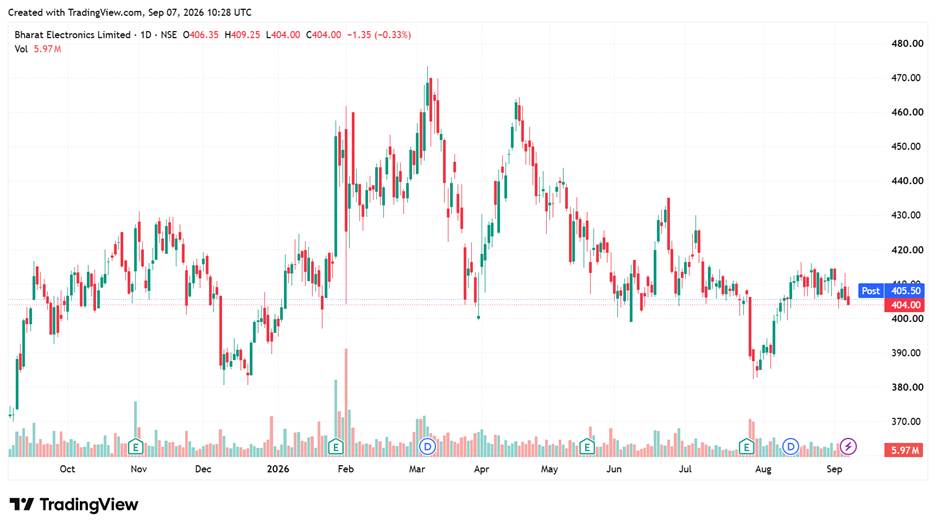
#1 Bharat Electronics: How Missile Electronics Drive an 88% Defense Dominance
Bharat Electronics (BEL), a Navratna defense public sector undertaking (PSU), is a major supplier of advanced systems to the Indian Armed Forces. The defense segment accounts for 88% of its total revenue. The non-defense segment accounts for the remaining 12%. Indigenous products accounted for 84% of the company’s revenue.
The ₹30,000-Crore QRSAM Catalyst and BEL’s Seven-Year Execution Runway
Instead of building complete missiles, its main focus is on the complex electronic systems inside them. The company supplies subsystems like radars, seekers, and control centers for various military programs. The company is involved in several missile programs like Quick Reaction Surface-to-Air Missile (QRSAM), Long Range SAM, Project Kusha, and the Akash missile.
QRSAM is a joint Army and Air Force program. The order book is expected to be ₹30,000 crore. This is a key order for BEL to achieve FY27 total order inflow guidance of ₹55,000+ crore. The company is waiting for final government approval to begin. The first order for this system is expected to take seven to eight years to execute because of the detailed testing phases.
LRSAM remains the largest active component of BEL’s order book. From the original ₹9,200 crore contract signed in FY19, a backlog of around ₹3,000 crore remains. BEL plans to deliver most of this backlog in FY27. The Defense Research and Development Organization (DRDO) leads Project Kusha. BEL provides subsystems and communication centers.
BEL expects the business volume for this project to be in the range of ₹40,000+ crore. However, this is a long-term opportunity. Orders are expected no earlier than FY28-29. The company also continues to supply systems for the Akash missile program. The company expects to generate ₹1,200 crore in revenue from the Akash Army program in FY27.
De-risking the Backlog: Tri-Service Parity Across a ₹72,258-Crore Order Book
As of July 2026, BEL’s total order book stands at ₹72,258 crore. Roughly 90% of the order book is dedicated to Defense, with Non-Defense making up the remaining 10%. Within the defense segment, the order book is split equally among the Army, Navy, and Air Force (30% each). BEL is targeting an annual order inflow of ₹55,000+ crore (including QRSAM) for FY27.
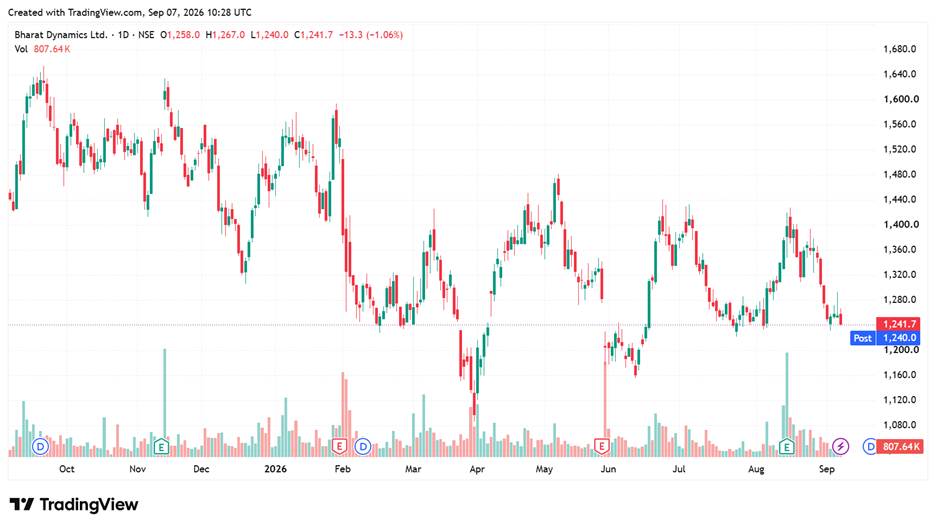
#2 Bharat Dynamics: Anchoring India’s Surface-to-Air Missile Arsenal
Bharat Dynamics (BDL) is one of India’s leading weapon systems integrators, specializing in manufacturing and developing guided missiles. The company is the production agency for multiple DRDO-developed missile programs. Its current order book stands at ₹26,500 crore, which is 9.6x its trailing twelve-month revenue.
BDL completed the First-Off Production Model of the Improved Akash Weapon System. The company received the bulk production clearance for this upgraded version on 27 March 2026. The company also successfully carried out First-Off Production Material trials of the Astra Mk-I air-to-air missile.
Beyond Akash: Propelling Astra Mk-I and Amogha-III Into Series Production
Additionally, several capital procurement contracts for medium-range SAM systems are in advanced stages of finalization. Amogha-III (Anti-Tank Guided Missiles) is ITS in-house 3rd-generation, Man-Portable, Fire-and-Forget ATGM system. BDL successfully test-fired it on 15 April 2026.
The company also has a partnership with Israel’s Rafael Advanced Defense Systems for the Spike LR2 missile. BDL has commissioned a dedicated manufacturing line for the project. Other missile projects include Konkurs-M, INVAR & NAG, Helina, VSHORAD. During FY26, BDL secured fresh orders worth around ₹5,400 crore across anti-tank and air defense missile systems.
These orders strengthen BDL’s position in India’s missile ecosystem and provide exposure to modernization across the Army’s mechanized, armored, and infantry segments. With several missile programs moving into higher production rates, revenue recognition could improve from FY27. This should also provide better operating leverage and support margins and earnings.
Targeting ₹25,000 Crore in Fresh Inflows While Navigating FY26 Execution Bottlenecks
The QRSAM program remains one of BDL’s biggest upcoming opportunities. BDL is estimated to receive nearly ₹9,000 crore of missile manufacturing orders from the program. BDL is targeting around ₹5,000 crore of fresh orders in FY27. For BDL, the key risk is execution, as delays in client inspections and acceptances impacted its FY26 performance.
Beyond the current order book, BDL expects major programs to add around ₹25,000 crore of fresh orders over the next two to three years. For FY27, the near-term pipeline is estimated at around ₹15,000 crore, mainly driven by programs such as Helina and Dhruvastra. The company is also working on the indigenous development of the Akash-NG RF seeker.
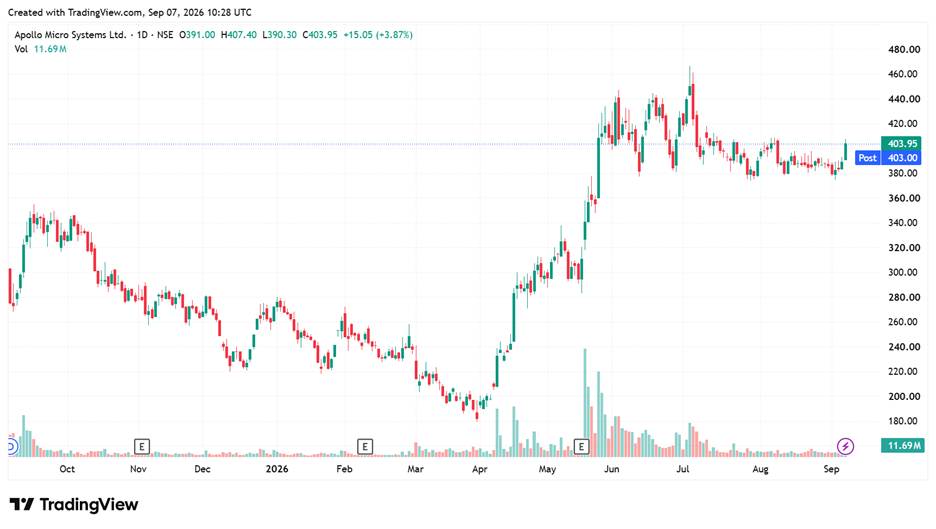
#3 Apollo Micro Systems: AMS Secures High-Value Footprint Across Nine Missile Classes
Apollo Micro Systems (AMS) is deeply integrated into the defense ecosystem, with a presence across all indigenized missile programs. AMS supplies critical electronics and subsystems across nine major categories of indigenized Indian missile programs.
This includes surface-to-air missiles (AKASH, QRSAM, and Kusha), cruise missiles (BrahMos), anti-tank missiles, air-to-surface and anti-radiation missiles, ballistic and nuclear missiles, and anti-ship and anti-submarine missiles. AMS’s active participation spans these platforms. For individual programs, AMS provides high-value, highly technical subsystems.
For example, in the QRSAM program, AMS provides the complete guidance system, onboard computer, and front-end/rear actuation systems. In total, AMS manufactures approximately five subsystems for the QRSAM. The cost of the components supplied by AMS is estimated to exceed ₹1 crore per missile.
To pivot from a subsystem provider to an integrated defense platform company, AMS acquired Premier Explosives. This acquisition gives AMS a presence across the entire missile and guided weapon value chain. The company aims to manufacture complete weapons in-house without any external interdependencies.
For AMS, several proprietary technologies are entering bulk production. Its consolidated order book stood at ₹1,704 crore. The company expects to receive a single order worth ₹2,500 to ₹3,000 crore by the end of FY27. If successful, this could lift the group order book to ₹3,500 to ₹4,000+ crore.
Scaling for 40% Growth: Unpacking AMS’s 12x Capacity Expansion by March 2027
Management has maintained a continued revenue growth guidance of 40% to 45%. To achieve the targeted growth, Apollo Micro Systems is scaling its operational capacity by 12x. The facility is expected to be fully ready by March 2027.
Decoding the Valuation Premium: High Growth at a Steep Price
BEL has a higher return on capital employed (ROCE) and return on equity (ROE) than Apollo Micro and Bharat Dynamics. This highlights BEL’s stronger capital efficiency and its ability to generate higher returns from the capital invested in the business.
From a valuation perspective, Apollo Micro Systems and BDL are now trading at a significant premium to both the industry median and the 3-year historical median. BEL, by contrast, trades at a discount to both.
| Peer Comparison (X) | ||||
| Company | Price-to-Earnings Multiple | Return Ratios | ||
| Company | 3Y Median | ROCE (%) | ROE (%) | |
| Bharat Electronics | 48.2 | 49.4 | 36.4 | 27.4 |
| Apollo Micro | 124.0 | 95.2 | 14.5 | 11.8 |
| Bharat Dynamics | 87.7 | 83.6 | 13.8 | 10.2 |
| Industry | 83.7 | 14.5 | 11.7 | |
India’s missile opportunity is no longer just about the size of the order pipeline. BEL offers scale, stronger return ratios and a ₹72,258 crore order book, while BDL provides more direct exposure to missile manufacturing. Apollo Micro Systems offers a different play, with exposure to critical missile electronics and a planned 12x capacity expansion.
The valuation gap, however, cannot be ignored. BEL trades at a lower multiple than its three-year median, while Apollo and BDL trade at significant premiums. This makes execution increasingly important. That said, you could keep these names on your watchlist to track execution.
Disclaimer
Note: Throughout this article, we have relied on data from http://www.Screener.in and the company’s investor presentation. We used an alternative, widely used, and accepted source of information only when the data was unavailable.
The purpose of this article is only to share interesting charts, data points, and thought-provoking opinions. It is NOT a recommendation. If you wish to consider an investment, you are strongly advised to consult your advisor. This article is strictly for educational purposes only.
About the Author: Madhvendra has been deeply immersed in the equity markets for over seven years, combining his passion for investing with his expertise in financial writing. With a knack for simplifying complex concepts, he enjoys sharing his honest perspectives on startups, listed Indian companies, and macroeconomic trends.
A dedicated reader and storyteller, Madhvendra thrives on uncovering insights that inspire his audience to deepen their understanding of the financial world.
Disclosure: The writer and his dependents do not hold the stocks discussed in this article.
The website managers, its employee(s), and contributors/writers/authors of articles have or may have an outstanding buy or sell position or holding in the securities, options on securities, or other related investments of issuers and/or companies discussed therein. The articles’ content and data interpretation are solely the personal views of the contributors/ writers/authors. Investors must make their own investment decisions based on their specific objectives and resources, and only after consulting any independent advisors as necessary.