




India’s defence indigenisation push and naval expansion are creating a multi-year opportunity for domestic shipbuilders and component suppliers. The government aims to increase domestic defence production to ₹3 lakh crore and defence exports to ₹50,000 crore by FY29.
Meanwhile, the Indian Navy plans to expand its fleet from 132 warships to 200 by 2035. It already has 68 warships and vessels on order, worth around ₹2 lakh crore. Additionally, anticipated shipbuilding orders of ₹2.35 lakh crore in FY27 could create sustained demand for marine engines, propulsion systems, electrical equipment and other critical ship components.
This creates an opportunity for companies supplying critical ship components, specialised naval equipment and indigenous marine technologies. Those with established defence relationships and expanding product portfolios could be well placed to capture a larger share of India’s shipbuilding capex.
Against this backdrop, we look at two companies in the shipbuilding value chain.
#1 Krishna Defence: Specialised Steel Products Powering Naval Indigenisation
Krishna Defence and Allied Industries (KDAIL) manufactures engineered products for defence and dairy applications. The company started with dairy equipment in 1997 and expanded into defence manufacturing around 2006. It supplies components to the Indian Navy, Indian Army, DRDO, and shipyards across India.
From Naval Hull Stiffeners to T-90 Tanks: Revenue Split and Moat Analysis
The company produces steel bulb bars used as hull stiffeners for naval warships. These sections offer a high strength-to-weight ratio, reducing vessel weight. It manufactures special steel alloy welding wires and electrodes for surface ships and underwater vessels. Further, it supplies specialised steel profiles used in the chassis fabrication of military tanks, such as the T-90.
Shipbuilding Steel Sections (Bulb Bars) account for roughly 60% of total revenue. Armoured Platform contributes 15% of revenue. KDAIL supplies special Russian-grade steel profiles to the Heavy Vehicles Factory (HVF) at Chennai for the chassis fabrication of T-90 military tanks. KDAIL expanded its supplied profile range from 17 to 26 distinct profile types.
Special Steel Alloy Weld Consumables comprise 15% of total revenue. The remaining 10% comes from other items/dairy/specialized naval products. KDAIL manufactures specialised welding wires and electrodes with precise titanium, nitrogen, and nickel metallurgy for critical surface and submarine platforms. These consumables were previously imported from Russia.
To broaden its addressable market, KDAIL has entered higher-margin technology segments. This includes composite doors and hatches for naval warships, Autonomous Underwater Vehicles, Smart Ammunition and Defence Electronics. With these extensive capabilities, KDAIL is well positioned to capitalise on opportunities in the defence sector.
Riding a ₹2.35 Lakh Crore Capex Wave: Capacity Expansion at Halol
Management expects Indian shipyards to receive ₹2.35 lakh crore in new vessel orders across FY26 and FY27. Major shipbuilders like Mazagon Dock, Cochin Shipyard and Garden Reach Shipbuilders and Engineers are also expanding their yard capacities. This naval expansion increases demand for shipbuilding steel, welding wires, and structural components.
The company is well prepared to capture the opportunity going forward. In April 2025, it doubled its annual bulb bar production capacity from 2,000-2,500 tons to 4,000-4,500 tons. Management purchased an adjoining plot in Halol for future factory expansion. Management projects ongoing upgrades to infrastructure can support ₹400-500 crore in peak revenue.
KDAIL Order Dynamics: Assessing ₹117 Crore Backlog Against Upcoming Naval Tenders
As of June 30, 2026, KDAIL maintained an unexecuted order book of ₹117 crore. The active pipeline stands at ₹289 crore. Upcoming bidding opportunities include major naval programs such as Next-Generation Corvettes, Landing Platform Docks, Multi-Purpose Vessels, and Mine Countermeasure Vessels.
Margin Expansion vs Topline Contraction: Deconstructing the Q1FY27 Outlier
Between FY22 and FY26, KDAIL delivered a revenue CAGR of 52.8%, an EBITDA (Earnings Before Interest, Tax, Depreciation, and Amortisation) CAGR of 67.4%, and a Net Profit CAGR of 102.4%. In Q1FY27, revenue from operations declined 15.2% year-on-year to ₹57.6 crore. However, EBITDA grew 20.3% to ₹15.2 crore as margin expanded by 776 bps to 26.3%.
Lower cost of goods sold and other expenses helped expand margins despite a fall in revenue. The improvement in margins was also supported by an increased proportion of higher-value products such as armoured platform profiles and specialised weld consumables. As a result, net profit rose 32.9% to ₹11.7 crore, driven in part by higher other income and lower finance costs.
Looking ahead, KDAIL aims to sustain a 30%+ CAGR revenue growth trajectory over the next 3 to 5 years. Management expects margins to maintain or incrementally exceed FY26 levels of 21.3%.
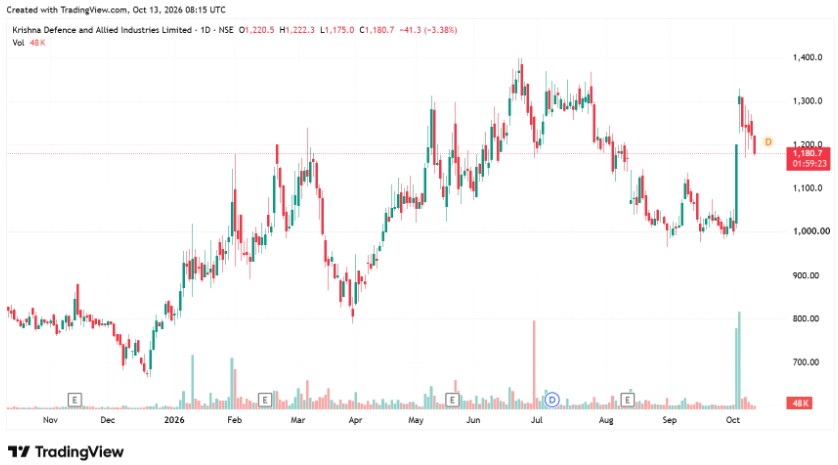
#2 Lloyds Engineering Works: Expanding Naval Engineering Through Indigenous Technologies
Lloyds Engineering Works (LEWL), a group company of Lloyds Metals and Energy, has a robust presence in shipbuilding, naval defence, and marine engineering. The company is evolving from a mechanical component supplier into a multi-domain defence engineering platform spanning Air, Sea and Sensors.
Shipyard Synergies: Achieving 95% Local Sourcing Across 116 Warships
LEWL supplies to defence shipyards across India, including Mazagon Dock Shipbuilders, GRSE, Goa Shipyard and Cochin Shipyard. LEWL also performs maintenance and refurbishment for shipyards. LEWL achieved 95% domestic sourcing of components and over 75% indigenous product content in its defence manufacturing line during FY26.
LEWL possesses over 35 years of engineering experience in specialised naval equipment. It has supplied critical systems to 116+ Indian Navy vessels as well as Indian Coast Guard platforms. Historically, its core naval offerings centered around Steering Gear Systems and Fin Stabiliser Systems.
Indigenous Warship Tech: European Partnerships Unlock a 5x Addressable Market
They provide critical vessel manoeuvrability, roll suppression, and platform control under demanding sea conditions. LEWL focuses on local production rather than imports for Indian defence platforms. The company has partnered with Fincantieri (Italy), one of the world’s leading shipbuilders.
Its portfolio now includes the joint manufacturing of ‘controllable pitch propeller systems (CPP)’ and ‘shafting systems,’ as well as ‘azimuthal’ and ‘transversal tunnel thrusters.’ This partnership also includes collaboration with Kliver Polska (Poland) on mechanical systems designed for sub-surface and underwater operations.
LEWL plans to develop next-generation radar, surveillance, and sensing technologies for coastal security and drone platforms in collaboration with Virtualabs (Italy). FlyFocus (Poland) has granted LEWL exclusive Indian rights for Defender SIGINT UAVs and First Person View combat drones.
LEWL is also collaborating with FlyFocus, Zoid, and Virtualabs on the Reusable Offboard Missile Decoy program for the Indian Navy. This has completed its critical design phase in FY26. Previously, LEWL’s Steering Gear and Fin Stabiliser portfolio offered an addressable value of ₹8-10 crore per ship.
Adding Fincantieri’s CPP and Shafting Systems increases the addressable opportunity per ship to ₹40-50 crore. LEWL estimates a standalone addressable market of nearly ₹20,000 crore for naval equipment over the coming decade.
Order Book Multipliers: Defence Pipeline Expands from ₹7.4 Crore to ₹7,900 Crore Visibility
The defence order book expanded from ₹7.4 crore in FY22 to ₹144 crore in FY26. Naval Systems Division has 2-year sales pipeline visibility of ₹1,900 crore, with projected order inflows of ₹300 crore. Aerospace & Strategic Systems Division holds a 3-year sales visibility of ₹6,000 crore, with projected order inflows of ₹2,000 crore.
Q1FY27 Financial Outlier: 228% PAT Growth Against 97 bps Margin Compression
In Q1FY27, the company’s revenue rose 143% year-on-year to ₹527.2 crore. EBITDA grew 124% to ₹79.2 crore while margin shrank by 97 bps to 14.7%. Net profit grew 228% to ₹55.1 crore. The company has a consolidated order book of ₹8,856.9 crore across group entities, deepening multi-year revenue visibility.
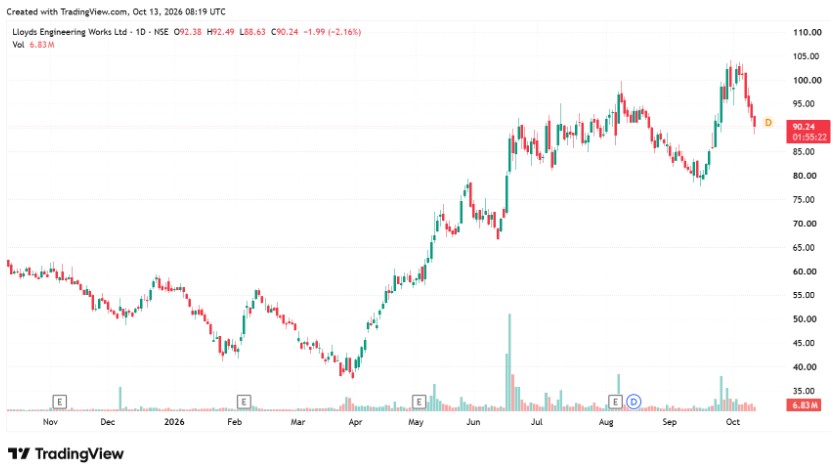
Lloyds Engineering Share Price
Valuation Metrics: Premium Multiples vs ROCE & Return Realities
Krishna Defence has stronger return ratios, includingReturn on Capital Employed (ROCE) and Return on Equity (ROE), than Lloyds Engineering. From a valuation perspective, Lloyds Engineering is trading at a premium compared to both the industry median and its own 5-year historical median multiple.
Meanwhile, Krishna Defence trades at a discount to both. However, Krishna Defence trades at a premium to GRSE (30.4x) and Mazagon Dock (29.8x).
| Peer Comparison (X) | |||||
Company | Price-to-Earnings Multiple | Return Ratios | |||
| Company | 5Y Median | Industry | ROCE (%) | ROE (%) | |
| Lloyds Engineering | 62.6 | 55.4 | 35.5 | 16.1 | 15.1 |
| Krishna Defence | 43.3 | 56.6 | 81.1 | 31.1 | 23.7 |
| Source: Screener.in (Data as of October 12 2026) | |||||
The two companies offer different ways to play India’s naval expansion. Krishna Defence and Allied Industries brings established expertise in specialised steel sections and defence consumables. However, the valuation is at a relatively higher multiple in comparison to larger peers.
Lloyds Engineering, meanwhile, is expanding into propulsion systems, underwater technologies and aerospace, supported by a much larger order pipeline. The key differentiator will be how efficiently they convert these opportunities into revenue and earnings growth, particularly at current valuations.
You can keep these names on your watchlist to track their execution.
Disclaimer
Note: Throughout this article, we have relied on data from http://www.Screener.in and the company’s investor presentation. Only when the data was unavailable did we use an alternative, widely used and accepted source of information.
The purpose of this article is only to share interesting charts, data points, and thought-provoking opinions. It is NOT a recommendation. If you wish to consider an investment, you are strongly advised to consult your advisor. This article is strictly for educational purposes only.
About the Author: Madhvendra has been deeply immersed in the equity markets for over seven years, combining his passion for investing with his expertise in financial writing. With a knack for simplifying complex concepts, he enjoys sharing his honest perspectives on startups, listed Indian companies, and macroeconomic trends.
A dedicated reader and storyteller, Madhvendra thrives on uncovering insights that inspire his audience to deepen their understanding of the financial world.
Disclosure: The writer and his dependents do not hold the stocks discussed in this article.
The website managers, its employee(s), and contributors/writers/authors of articles have or may have an outstanding buy or sell position or holding in the securities, options on securities or other related investments of issuers and/or companies discussed therein. The articles’ content and data interpretation are solely the personal views of the contributors/ writers/authors. Investors must make their own investment decisions based on their specific objectives, resources, and only after consulting such independent advisors as may be necessary.