



India’s manufacturing goals are often evaluated in factories: electronics assembly lines, defence facilities, semiconductor plants, data centres, and new industrial capacity. But every new manufacturing asset adds to a structure that must produce and transfer even more electricity.
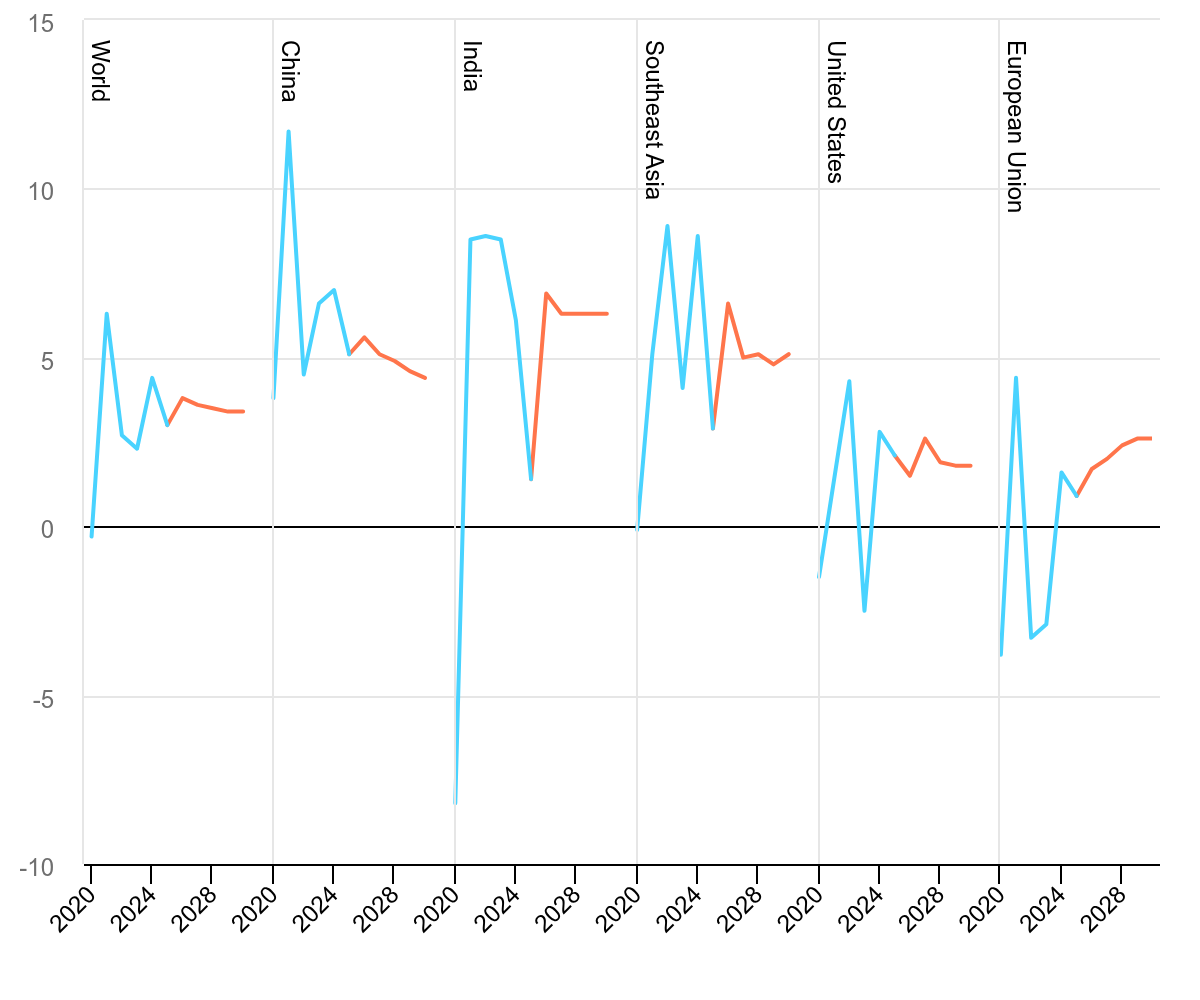
The International Energy Agency (IEA) believes India’s electricity demand will surge 6.4% each year between 2026 and 2030, adding over 570 TWh of annual consumption, with industry making up for a third of the increase. Peak demand has increased from 162 GW in 2017 to 250 GW in 2024.
Year-on-year percent changes in electricity demand in selected regions, 2020-2030
Source: IEA 2026
The challenge is becoming more complex because much of the new generation will come from solar and wind, which are not necessarily located where demand is growing.
The IEA expects varying renewable energy generation to make up 24% of India’s total generation by 2030, up from 14% in 2025. So, the manufacturing investment cycle has a less visible first layer.
It needs generation equipment. And transmission infrastructure to carry more electricity, over longer distances and through existing corridors. That creates two different ways to participate in the build-out.
TD Power Systems makes generators while APAR Industries supplies conductors and more. Neither is a direct proxy for factory construction. That is what makes the two businesses interesting.
TD Power Systems: A generator maker riding a global power cycle
TD Power Systems makes generators for the equipment that sits behind electricity generation. That distinction matters because its demand is not tied to a single source of power investment.
Its engineering machines are used across steam and gas turbine applications, hydro projects, captive power and industrial installations, while its customer base spans domestic users and global OEMs.
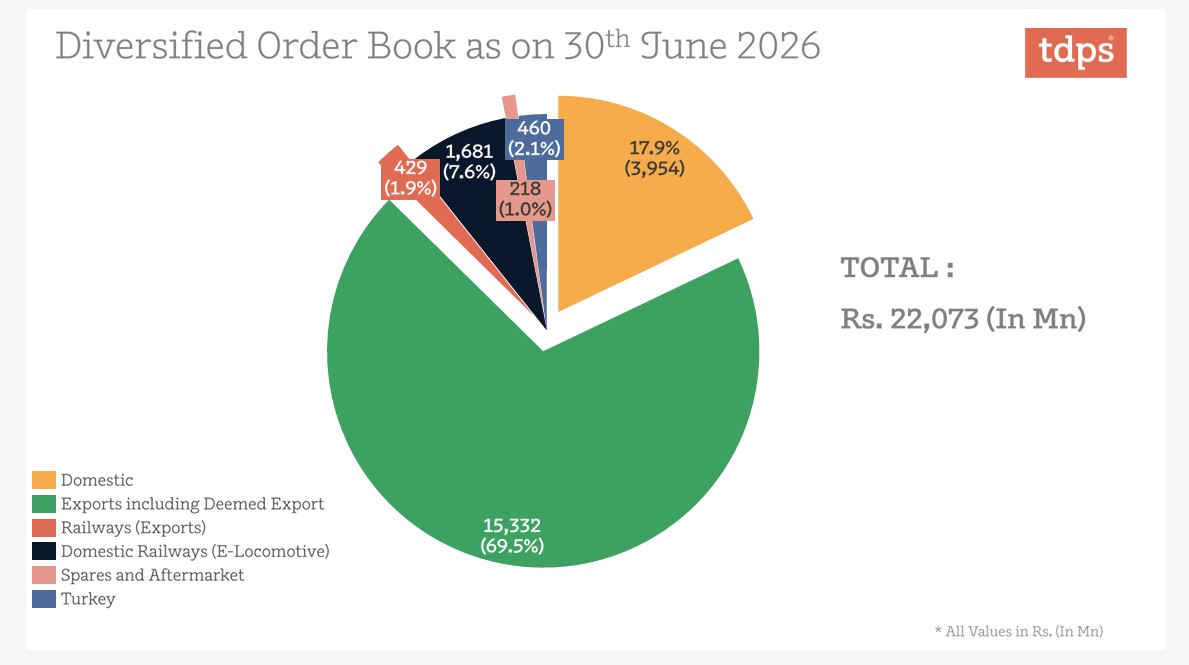
The order book shows how broad that demand has become. In Q1 FY27, TD Power received ₹734.1 crore of orders, up 87% year on year, with 93% coming from exports and deemed exports. Its order book stood at ₹2,207 crore at the end of June, of which 69.5% was exports and deemed exports
Order Book June 2026
Source: August 2026 Investor Presentation
Orders during the quarter included generators for steel, cement and sugar plants, captive power projects, hydro, waste-heat applications and gas engines. The company also received repeat orders linked to data centres in the US and large orders from European and US OEMs.
That mix changes the nature of the growth story. TD Power is not simply riding an Indian capital-expenditure cycle. It is increasingly supplying equipment across several generation and industrial markets, giving the same manufacturing base access to a wider pool of demand.
Revenue is scaling, but margins are not doing the heavy lifting
The numbers show how quickly that business has expanded. Consolidated revenue rose to ₹1,870 crore in FY26 from ₹595 crore in FY21, while operating profit grew from ₹67 crore to ₹343 crore. Net profit was ₹236 crore compared to ₹44 crore in FY21. Revenue grew at a compounded annual rate of 26%, while operating profit rose 39% between FY21 and FY26.
What has driven that growth? The operating margin was 18.8% in FY25 but fell to 18.3% in FY26. Simply put, the growth did not rely on a significant margin improvement.
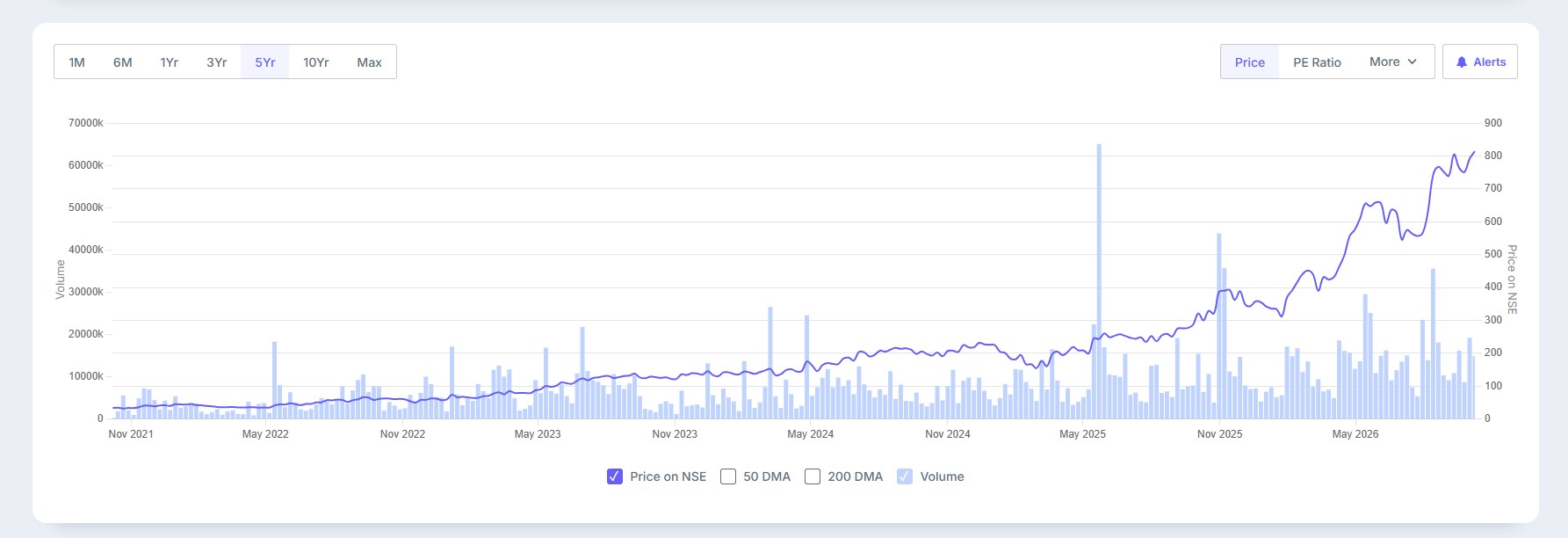
Q1 FY27 continued that trajectory. Revenue rose 71% YoY to ₹640 crore, while the net profit grew 72% YoY to ₹86 crore. The same trend is reflected in the stock price, which surged at an 89% CAGR over five years, per Screener.
TD Power 5-Year Share Price Trend
Source: Screener.in as of 6th October 2026
That makes the growth easier to read. The key variable is how much equipment TD Power can make and deliver, rather than whether it can quickly raise margins on every order.
The execution question is about size, not demand
That is becoming visible in management’s commentary. The company said its current order inflow rate has crossed ₹700 crore a quarter, creating pressure on execution. It expects to deliver close to that level, but the gap between orders received and orders converted into revenue is becoming an increasingly important part of the story.
The company has been investing in automation and robotics to improve accuracy, consistency and lead times. Its manufacturing footprint and capabilities have also expanded into larger generators and specialised applications.
This creates a different kind of constraint from the one that existed when demand was the primary concern. If orders continue arriving at the current rate, the question becomes whether capacity, working capital, and execution can expand quickly enough without weakening the business’s economics.
What the valuation is assuming
TD Power’s valuation has moved well ahead of its earlier business profile. As of October 6, Screener showed a market capitalisation of ₹25,632 crore and a P/E of ~93x, trading at a premium compared to the sectoral median of ~34x. Return on capital employed (ROCE) is 34% and return on equity (ROE) is 24.7%.
The valuation implies that investors are placing substantial weight on continued earnings growth. The evidence for that outlook is visible in the order book, the high level of export and deemed-export orders, and the company’s ability to maintain revenue growth without relying on a major expansion in margins.
The test from here is then performance: converting a larger order pipeline into revenue and profit while increasing capacity fast enough to support the growth already reflected in the valuation.
That difference matters for the broader power equation. More generation equipment can add capacity, but that electricity still must travel from where it is produced to where new industrial demand is emerging. And that’s where APAR Industries comes into play.
APAR Industries: The transmission network is the next bottleneck
Generation is only half the problem. More electricity generation does not solve the manufacturing power balance unless that electricity reaches where it is needed. India’s increasing renewable capacity makes that harder.
Solar and wind projects are often located far from key demand centres, while the current transmission paths can themselves become constrained. That possibility creates two openings: building new transmission infrastructure and increasing the capacity of existing lines. APAR has exposure to both.
Its conductor business offers direct exposure to transmission financing. In Q1 FY27, the division made ₹3,338 crore of revenue, up 19.9% YoY. More importantly, its pending order book stood at ₹10,190 crore, with exports accounting for 56.8% at the end of June.
New orders during the quarter rose over ₹5,000 crore, of which 65.8% were exports. The size and geographical mix of that order book provide visibility beyond India’s transmission spending alone.
Conductors: The core transmission bet
This is where APAR’s main infrastructure play is most visible. In Q1 FY27, though conductor volumes fell 6.7% YoY to 53,279 MT, the revenue grew 19.9% to ₹3,338 crore. Operating profit rose 14% YoY to ₹285 crore, while earnings before interest, tax, depreciation and amortisation (EBITDA) per MT increased 22.3% YoY to ₹53,418. The premium product mix surged from 43.7% a year earlier to 50.3%.
This is crucial, as it shows APAR is not relying only on building more transmission lines. It is also increasing the value of the products going into them. Moreover, as the power network grows and existing infrastructure requires more carrying capacity, the conductor business will grow.
And the order pipeline reflects that trend. The pending order book stood at ₹10,190 crore at the end of June, while Q1 new orders were ₹5,245 crore, including two overseas electric utilities orders for ₹2,800 crore.
Oils: The earnings stabiliser
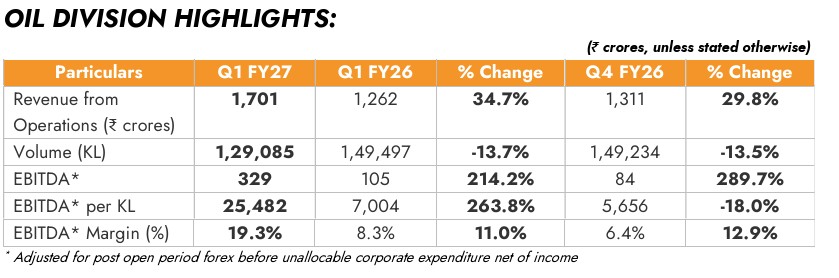
The oil business tells a very different story. Revenue grew 34.7% to ₹1,701 crore in Q1 FY27, but profitability jumped higher. EBITDA rose to ₹329 crore from ₹105 crore, taking the operating margin from 8.3% to 19.3%.
Source: Q1FY27 Earnings Call Update
However, the oil volumes declined 13.7% YoY. The Middle East crisis and the closure of Hamriyah port affected the UAE facility. Also, low allocation by oil suppliers impacted volumes in April before being restored.
So, the oil division’s contribution to APAR is unlike conductors. It offers another source of earnings growth when product margins and market conditions are positive. That is crucial as it changes how consolidated earnings should be read.
Cables: A second lever into power infrastructure
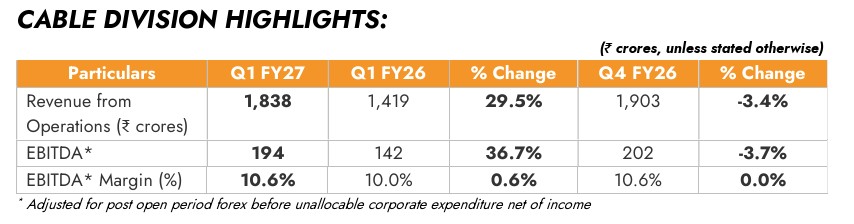
Cables bring APAR closer to the point where electricity is connected and distributed. The business generated ₹1,838 crore of revenue in Q1 FY27, up 29.5% YoY. EBITDA grew 36.7% to ₹194 crore, and the margin improved from 10% to 10.6%.
Source: Q1 FY27 Earnings Call Update
More importantly, the pending order book reached ₹1,925 crore, compared with ₹1,653 crore a year earlier. Domestic revenue increased 59.9%, while the US revenue grew 2.5%.
This gives APAR a second growth avenue within the power-infrastructure industry. The conductor business benefits when transmission capacity must expand; cables benefit from the overall need to connect and distribute that electricity. Together, they make APAR’s transmission exposure larger than before.
And that is why the consolidated numbers need to be read carefully: Q1 FY27 revenue was ₹6,591 crore, rising 29.1% YoY. EBITDA rose 62.7% to ₹814 crore and net profit increased 77.7% to ₹467 crore, but these gains came from three businesses with very different underlying drivers.
Apar Industries Revenue Mix & Growth
| Division | Q1 FY26 Revenue | Q1 FY27 Revenue | YoY Growth | Order Book Q1 FY27 |
| Conductors | ₹2,785 cr | ₹3,338 cr | 19.9% | ₹10,190 cr |
| Oils | ₹1,262 cr | ₹1,701 cr | 34.7% | NA |
| Cables | ₹1,419 cr | ₹1,838 cr | 29.5% | ₹1,925 crore |
Source: July 2026 Earnings Call
What the valuation is assuming
As of October 6, Screener showed a market capitalisation of ₹74,007 crore and a P/E of 61.5x, higher than the sectoral median of ~27.26x. The ROCE is 31.8%, and ROE is 20.3%.
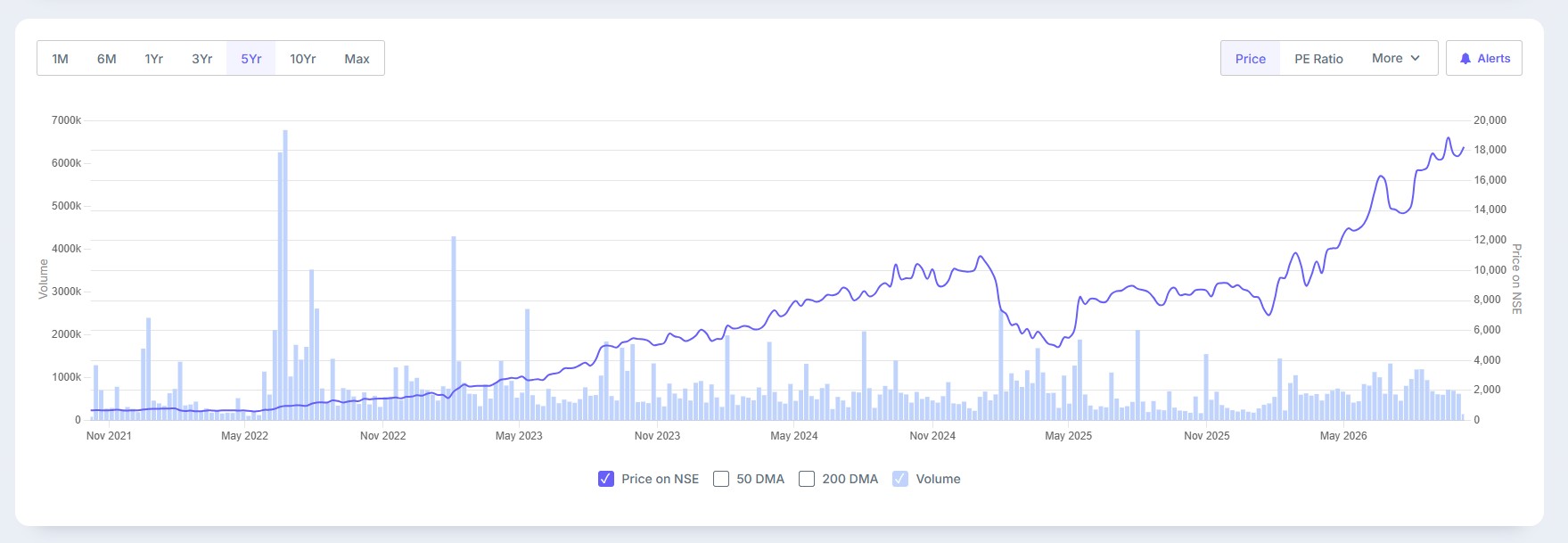
The valuation means investors are putting substantial weight on persistent earnings growth. Evidence supporting that expectation is visible in the ₹10,190 crore conductor order book, ₹5,245 crore of new conductor orders in Q1, the rising premium product mix, and the contribution from cables and oils. The same is reflected in the share price, which grew at a CAGR of 94% over the last 5 years.
APAR Industries 5-Year Share Price Trend
Source: Screener.in
The test from here is implementation: turning the order pipeline into revenue and profit while holding product economics amid changes in metal prices, volumes, and business mix.
Together, TD Power Systems and APAR Industries capture two different layers of the same industrial lineup. TD Power supplies equipment that adds generation capacity. APAR supplies infrastructure so that electricity moves through the system and reaches the factories, data centres, and other users driving the next phase of power demand.
The bigger opportunity is what comes next
Building India’s manufacturing capacity requires far more than adding generators and transmission lines. It requires an industrial ecosystem able to make every unit of power, every machine, and every production asset work harder.
That is where the opportunity becomes more than just building capacity. Once the factories, grids, and machines are in place, the next question becomes harder: how efficiently can they run?
Because the next generation of industrial winners may not be the companies supplying the hardware that expands India’s manufacturing base. They could be the ones helping that hardware provide more with superior precision, higher reliability, and less waste.
That is a different part of the manufacturing story. And it may be where the economics get even more interesting.
Disclaimer
Note: We have relied on data from the Q1 FY27 investor presentation, www.Screener.in, throughout this article. Only in cases where the data was not available have we used an alternate but widely used and accepted source of information.
The purpose of this article is only to share interesting charts, data points, and thought-provoking opinions. It is NOT a recommendation. If you wish to consider an investment, you are strongly advised to consult your advisor. This article is strictly for educational purposes only.
Archana Chettiar is a writer with over a decade of experience in storytelling and, in particular, investor education. In a previous assignment at Equentis Wealth Advisory, she led innovation and communication initiatives. Here, she focused her writing on stocks and other investment avenues that could empower her readers to make potentially better investment decisions.
Disclosure: The writer and her dependents do not hold the stocks discussed in this article.
The website managers, their employees (s), and contributors/writers/authors of articles have or may have an outstanding buy or sell position or holding in the securities, options on securities, or other related investments of issuers and/or companies discussed therein. The content of the articles and the interpretation of data are solely the personal views of the contributors/ writers/authors. Investors must make their own investment decisions based on their specific objectives, resources, and only after consulting such independent advisors as may be necessary.