



Demand for computing power is rising as businesses adopt Artificial Intelligence (AI) across training, inference and other workloads. Graphics Processing Units are becoming central to this shift. However, demand for computing capacity continues to outpace available supply in several markets, creating opportunities for specialised computing infrastructure providers.
In India, the opportunity goes beyond AI. Government initiatives such as the IndiaAI Mission are supporting domestic computing infrastructure. At the same time, demand for private cloud, data localisation and high-performance computing is opening up new growth avenues.
The Q2FY27 earnings of two computing infrastructure players offered a glimpse into the pace of growth as demand for AI and high-performance computing rises. One company turned profitable during the quarter, while the other reported a 334.8% year-on-year increase in net profit.
Both companies are expanding their computing capabilities to meet demand for GPU infrastructure, data centre systems and enterprise workloads. The key question is whether they can sustain this growth as they scale up capacity and convert rising demand into consistent earnings. Let’s take a look…
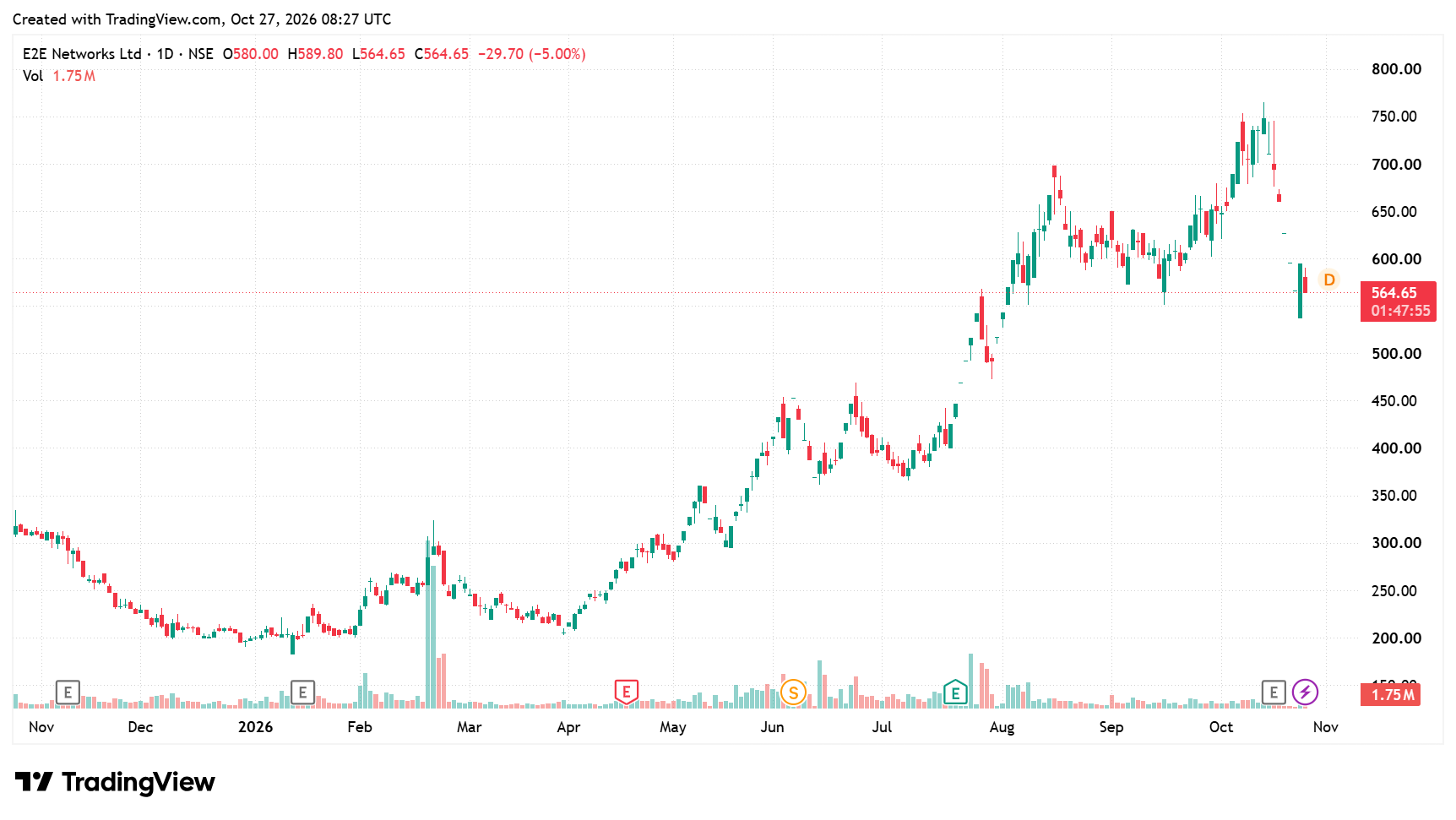
#1 E2E Networks
E2E Networks provides cloud infrastructure. The company operates data centres in Delhi NCR and Chennai. The live fleet includes approximately 5,100 cloud GPUs, including approximately 3,000 NVIDIA Hopper GPUs and 1,024 NVIDIA Blackwell B200 GPUs. Another set of 1,024 NVIDIA B200 GPUs is currently being deployed.
Infrastructure Blueprint: Blackwell B200 Deployment and Fleet Scaling
The company also plans future deployments of the NVIDIA B300 and Vera Rubin architectures. The company also offers TIR, a public platform for AI model training and inference. It also operates Jarvislabs.ai, a platform that lets developers launch GPU instances using code or command-line tools.
Earnings Turnaround: How Blackwell Monetisation Drove 76.6% EBITDA Margins
For regulated industries, E2E Networks provides private cloud setups with isolated networking options. In Q2FY27, E2E recorded ₹223.8 crore in revenue, up 410.8% year-on-year. Revenue is supported by clients under the India AI Mission (13% to 15% of Q2 revenue) and international accounts (20% to 25% of Q2 revenue).
EBITDA (Earnings Before Interest, Tax, Depreciation, and Amortisation) rose from ₹18 crore in Q2FY26 to ₹171.5 crore in Q2FY27, while margin expanded by 35.5 percentage points to 76.6%. As a result, the company recovered from a ₹13 crore loss in Q2FY26 to a net profit of ₹73 crore during the quarter.
EBITDA margin increased due to monetisation of high-capacity NVIDIA Blackwell (B200) GPUs, higher utilisation in live infrastructure, strong average realisation rates and operating leverage. Management expects EBITDA margins to remain in the 70%+ range over the medium to long term. Total live GPU fleet expanded to 5,100 GPUs in Q2FY27, up from 3,900 in FY26 and 1,900 in FY25.
Long-Term Visibility: The ₹1,000-Crore Sovereign AI Revenue Moat
A second tranche of 1,024+ B200 GPUs is scheduled to go live in Q3FY27. It also secured a ₹1,000 crore binding agreement with an Indian sovereign AI company. This effectively converts pay-as-you-go capacity into locked-in revenue through June 2029. Growth will be supported by a shift from raw compute rental to a full-stack software platform through TIR and Jarvislabs.ai.
#2 Netweb Technologies
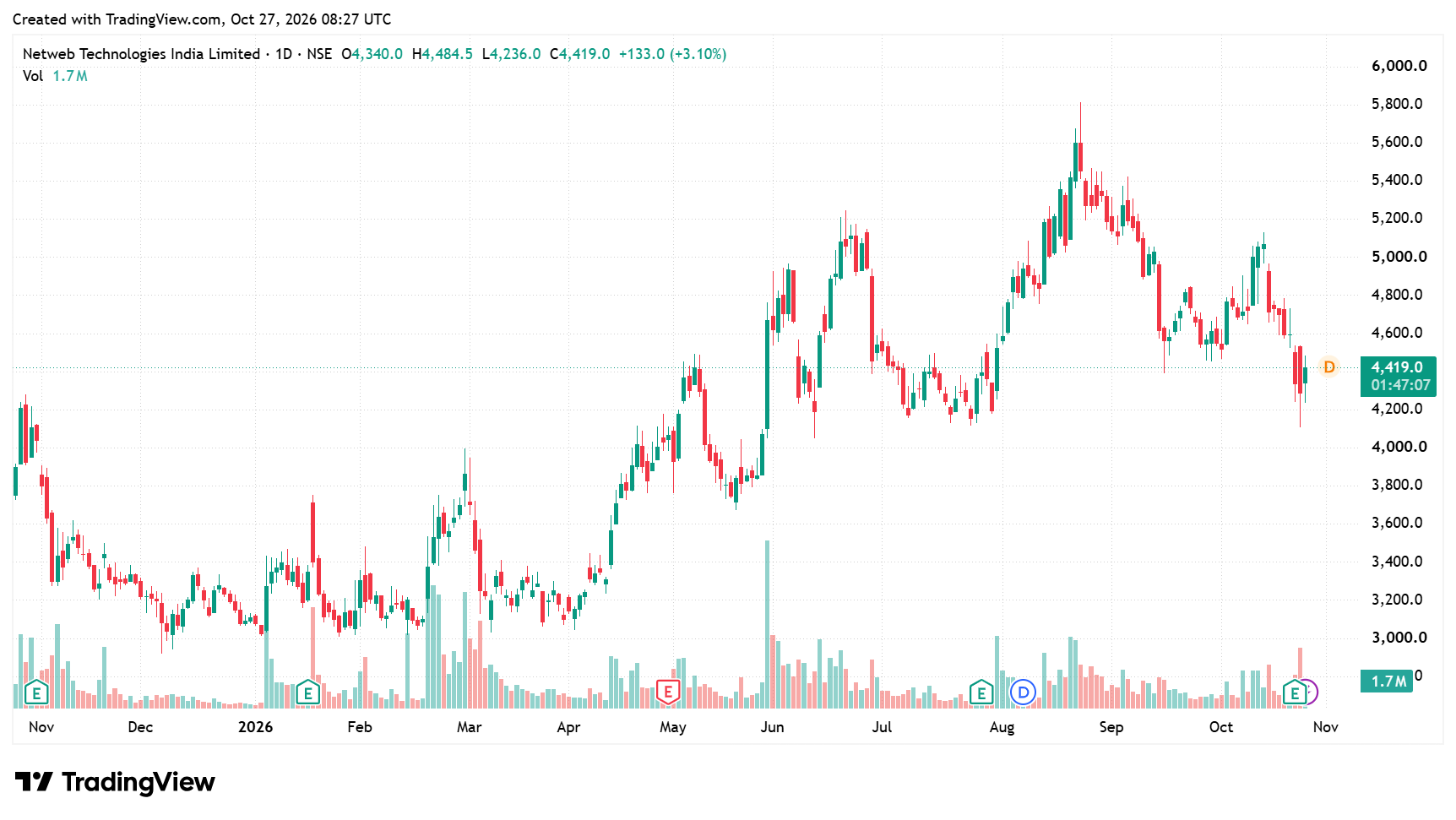
Netweb Technologies is an Original Equipment Manufacturer operating in the Computing Solutions (HCS) domain. The company specialises in building computing infrastructure for data centres, research institutions, and enterprise environments. It develops hardware architectures, interconnect systems, storage solutions and cloud software stacks in-house.
Core Competencies: High-Performance Computing and The 5 Pillar Model
The company maintains a chip-agnostic design framework. This aligns with India’s Make-in-India initiative. Netweb concentrates strictly on enterprise and data centre computing infrastructure. It avoids consumer client markets such as personal computers and laptops. Netweb categorises its business operations into five primary technology pillars.
- AI Systems: Netweb designs and manufactures GPU systems for artificial intelligence training and inference. It maintains OEM partnerships with technology vendors including NVIDIA and AMD to produce generative AI architectures in India.
- High-Performance Computing: The company designs supercomputing hardware, cluster management software, and middleware for mathematical and scientific algorithms. It has deployed more than 600 supercomputing systems. Three of its supercomputers have been listed 17 times on the global Top500 supercomputing rankings.
- Private Cloud and Hyperconverged Infrastructure: Netweb builds converged computing, networking, and storage stacks. This includes its proprietary Tyrone Skylus platform designed as an alternative to public cloud environments. The company has completed over 60 private cloud and HCI deployments.
- High-Performance Storage: Netweb supplies enterprise storage platforms supporting block, file, object, and parallel file system architectures.
- Data Centre Servers: Netweb builds customised enterprise servers designed to handle heavy server workloads in modern data centres.
In addition to hardware, Netweb also provides cloud design and deployment, software licensing, and managed IT services. Netweb serves a wide range of government organisations, academic centres, defence agencies, financial firms and corporations. Notable public sector clients include the Ministry of Defence, RailTel and the Central Economic Intelligence Bureau.
Pipeline Visibility: Converting ₹11,152-Cr Pipeline into FY27 Guidance
Management has targeted revenue of ₹4,000 crore for FY27. Netweb aims to maintain a growth rate of 30% to 40% annually over the next two to three years. Revenue in the coming quarters will be supported by a confirmed order book of ₹2,629 crore and an L1 position of ₹652.5 crore.
The active order pipeline is ₹11,151.8 crore. Netweb already converts approximately 60% of the pipeline into orders. Orders typically have a standard execution cycle of 10 to 16 weeks. This lets active orders convert into reported revenue much faster. The mandate to source computing infrastructure locally is increasing demand for locally built GPU systems.
Additionally, the expansion of GPU data centres across India to meet training and inference needs is also supporting demand. The National Supercomputing Mission 2.0 supercomputing initiative is shifting its focus from imports to domestic design and manufacturing. NetWeb is targeting more than half of the total program expenditure.
Netweb is developing systems based on NVIDIA’s Vera Rubin GPU architecture. The commercial deployment is planned for January 2027. Netweb reported strong financial results for Q2FY27, driven by high demand for artificial intelligence systems and enterprise computing infrastructure.
Financial Performance: AI Architecture Drives 336% Topline Expansion
Revenue grew 335.7% year-on-year to ₹1,323.3 crore in Q2FY27. AI systems generated 58.4% of Q2 revenue, with revenue growing 1,068.1%. Operating EBITDA rose 334% to ₹197.3 crore, while the margin stayed stable at 14.9%. The company maintained margins despite rising component prices. Net profit grew 334.8% to ₹136.7 crore.
Valuation Divergence: 46x Multiples Meet Contrasting Capital Return Ratios
Both E2E and Netweb trade at a significant premium to their respective three-year median EV/EBITDA multiples. However, their return ratios highlight a notable difference in profitability and capital efficiency. E2E trades at 27.1 times EV/EBITDA, compared with its three-year median of 20 times.
Despite this premium, the company reports negative Returns on Capital Employed (0.5%) and equity (1%) due to higher capex and lower profitability. Netweb, meanwhile, trades at 46.4x EV/EBITDA, significantly above its three-year median of 10.7x. The premium reflects stronger operating performance, with ROCE at 37.5% and ROE at 32.8%. Improving profitability will be the key to justify the valuations of both companies.
| Valuation Comparison (X) | |||||
Particulars | EV/EBITDA Multiple | Return Ratios | |||
| Company | Industry | 3Y Median | ROCE (%) | ROE (%) | |
| E2E | 27.1 | 20.0 | 37.2 | -0.5 | -1.0 |
| Netweb | 46.4 | 10.7 | 98.3 | 37.5 | 32.8 |
| Source: Screener.in (Data as of October 26 2026) | |||||
E2E and Netweb are approaching the AI infrastructure opportunity from different ends. E2E is focused on monetising its GPU fleet. It is deploying additional B200 GPUs, and its ₹1,000 crore sovereign AI agreement is providing revenue outlook.
Netweb, meanwhile, has a broader computing portfolio. AI systems are driving a sharp increase in quarterly revenue, and a ₹2,629 crore confirmed order book supports near-term visibility. The next phase will test whether E2E can sustain its unusually high EBITDA margins as capacity expands, and whether Netweb can maintain its growth while managing rising component costs.
But their valuations leave limited room for execution setbacks. Keep these stocks on your watchlist to see how they scale up their businesses.
Disclaimer
Note: Throughout this article, we have relied on data from http://www.Screener.in and the company’s investor presentation. We used an alternative, widely accepted and widely used source of information only when the data were unavailable.
This article is meant only to share interesting charts, data points, and thought-provoking opinions. It is NOT a recommendation. If you wish to consider an investment, you are strongly advised to consult your advisor. This article is strictly for educational purposes only.
About the Author: Madhvendra has been deeply immersed in the equity markets for over seven years, combining his passion for investing with his expertise in financial writing. He simplifies complex concepts and shares honest perspectives on startups, listed Indian companies, and macroeconomic trends.
A dedicated reader and storyteller, Madhvendra thrives on uncovering insights that inspire his audience to deepen their understanding of the financial world.
Disclosure: The writer and his dependents do not hold the stocks discussed in this article.
The website managers, its employee(s), and contributors/writers/authors of articles have or may have an outstanding buy or sell position or holding in the securities, options on securities, or other related investments of issuers and/or companies discussed therein. The articles’ content and data interpretation are solely the personal views of the contributors/ writers/authors. Investors must make their own investment decisions based on their specific objectives, resources, and only after consulting such independent advisors as may be necessary.