


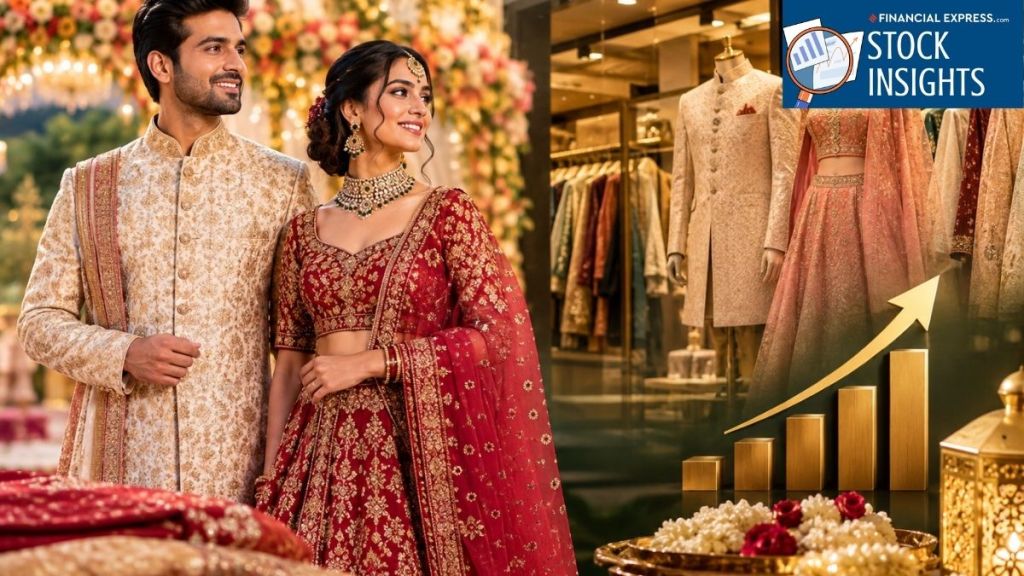

The wedding industry ranks among India’s biggest consumption-led sectors. According to the Confederation of All India Traders (CAIT) and industry reports, India’s wedding industry is estimated to be worth over ₹10 lakh crore annually. Another report estimated that during the peak October to December 2025 wedding season alone, nearly 4.8 million weddings were expected to generate business worth about ₹6 trillion (₹6 lac crores).
Wedding expenses in India are spread across jewellery, venues, catering, décor, travel and clothing. Of these, Apparel accounts for the largest expense category. Families generally set aside 10%–20% of their budgets to bridal and groom attire, especially in metro and Tier-2 cities.
When you look at the numbers, India’s bridal wear market was valued at about USD 2.1 billion–2.3 billion in 2025 and is forecast to grow at around a 6% CAGR through 2034. The trend is being fuelled by growing interest in designer lehengas, premium sherwanis and celebrity-inspired outfits.
Globally, the wedding wear market is significantly larger. Grand View Research estimates the global wedding wear market at USD 87.9 billion in 2025, and it is expected to cross USD 109 billion by 2030.
With this potential, three stocks worth tracking are Vedant Fashions, Aditya Birla Fashion and Siyaram Silk Mills.
Wedding Season Could Be a Trigger for These Textile Stocks
Vedant Fashions: The High-Margin Category Leader
Vedant Fashions‘ roots go back to the launch of Manyavar in 1999 and the incorporation of Vedant Fashions in 2002. Its flagship, Manyavar, is the category leader in branded Indian wedding and celebration wear for men. The brand portfolio includes kurta sets, Indo-western sets, sherwanis, jackets, Jodhpuri and accessories for men, alongside kurta sets, jacket sets, Indo-western outfits and accessories for boys. Manyavar is distributed through exclusive brand outlets (EBOs), multi-brand outlets, large-format stores and e-commerce. The company follows a distinctive no-discount or end-of-season-sale approach for the brand.
Over the years, Vedant Fashions has built a broader wedding ecosystem rather than operating a single-brand model. In 2015, the company launched Mohey, which is a women-focused Indian wedding and celebration-wear brand. In 2017, the company launched Mebaz to build a strong presence in southern India, particularly in Andhra Pradesh and Telangana.
At the premium end, the company launched Twamev in 2019, which targets both men and women. Vedant positions Twamev between Manyavar and luxury boutique brands. In 2024, it added another brand to its offerings under the name Diwas.
As of June 30, 2026, the company had 651 Exclusive Brand Outlets (EBOs), including 136 Shop-in-Shops (SIS) and 14 international EBOs. Internationally, Vedant Fashions has a presence in the UAE, the USA, Canada, the UK and Nepal. Its flagship brand Manyavar also reaches customers through retail chains such as Lifestyle, Ethnicity, Lulu Hypermarket, Reliance Centro and V-Mart. Vedant Fashions further extends its reach through its online store.
Vedant’s Q1 FY27 Margin Reality Check
Turning to the financials, Vedant Fashions Limited reported revenue from operations of around ₹301 crore, compared with ₹281 crore a year earlier. Profit after tax surged to ₹81 crore versus ₹70 crore in Q1 FY26, a growth of around 14.7%, with the net profit margin improving to 26.7% from 25.0%. On a sequential basis, Q1 FY27 was materially lower because Q4 is seasonally much stronger. Revenue from operations declined by 24.5% from ₹399 crore in Q4 FY26. Net profit declined by 29.5% from ₹114 crore in Q4 FY26, and the net profit margin fell from 28.6% to 26.7%.
Vedant Fashions Limited 5-Year Financial Performance
| Particulars | FY22 | FY23 | FY24 | FY25 | FY26 |
| Sales (₹ in crores) | 1,009 | 1,326 | 1,368 | 1,386 | 1,435 |
| Operating Profit (₹ in crores) | 480 | 658 | 658 | 643 | 628 |
| Net Profit (₹ in crores) | 308 | 423 | 414 | 388 | 376 |
| EPS (₹) | 12.70 | 17.42 | 17.05 | 15.99 | 15.46 |
When it comes to share price, Vedant Fashions has started to show improvement. Over the span of one month, its stock price surged by over 10%, while the six-month return stood at over 66%. However, over the last 52 weeks, the absolute return stood at 20.36%.
Following Vedant Fashions’ Q1 FY27 results, Motilal Oswal Financial Services maintained its ‘Neutral’ rating on the stock but raised its target price to ₹460 from ₹440. The brokerage firm remained cautious because demand recovery and earnings growth have yet to show sustained improvement.
Aditya Birla Fashion (ABFRL): The Debt-Heavy Portfolio Play
Established in 2015, Aditya Birla Fashion & Retail (ABFRL) has become a noted name in the apparel business. The company was formed after consolidating the businesses of Aditya Birla Nuvo and Pantaloons Fashion & Retail.
Its key retail formats include Pantaloons, one of India’s largest fashion department store chains. Another name in this segment is OWND!.
The company also has a strong presence in the digital-first fashion segment under the name TMRW. Noted brands in this segment include Bewakoof, Wrogn, The Indian Garage Co., Nobero, Urbano, Veirdo, and Juneberry.
ABFRL has built a decent portfolio in India’s wedding and occasion wear market. Its popular brands include:
- Sabyasachi: Luxury bridal couture label
- Tarun Tahiliani: Contemporary bridal and occasion wear
- Shantnu & Nikhil: Specialises in modern Indian wedding fashion for both men and women
- House of Masaba: Caters to festive and contemporary ethnic fashion
- Jaypore: Focuses on handcrafted ethnic apparel
- Tasva: A premium men’s ethnic wear brand
The company has expanded its operations to tap into India’s growing wedding market. As of June 30, 2026, ABFRL had a total footprint of 7.9 million square feet through its 1,286 stores, including 672 dedicated to ethnic and wedding wear. Of the total store additions, five new stores came from Tasva in the June quarter, and more than 15 came from Jaypore over the last 15 months.
The Profitability Drag: Capex vs. Returns
Moving to the financials, ABFRL revenue stood at ₹2,026 crore in Q1FY27, up 11% year-on-year (YoY) basis. Of total revenue, the ethnic wear segment contributed ₹454 crore, up 4% from ₹436 crore a year ago. The nominal growth is due to a shortened wedding season.
Breaking down the ethnic wear segment, Sabyasachi’s sales reached over ₹100 crore in Q1 FY27. Tarun Tahiliani saw double-digit YoY growth in its sales. Similarly, Tasva and Jaypore’s revenue grew 35% and 30%, respectively, YoY. Shantanu Nikhil also saw single-digit YoY revenue growth.
However, despite decent revenue growth, the company reported a consolidated net loss of ₹249 crore in the June quarter of FY27, compared to a net loss of ₹234 crore in the same quarter of the previous financial year.
The main reason was higher costs linked to the company’s ongoing store expansion. ABFRL said higher depreciation and finance costs from new store openings pressured its bottom line. Depreciation and amortisation expenses also remained substantial, while finance costs increased year on year.
Lower other income and continued investment in newer businesses further affected profitability.
Last May, ABFRL restructured after demerging its Madura business into Aditya Birla Lifestyle Brands Limited. After this corporate event, the remaining ABFRL business switched focused on ethnic wear, luxury, and emerging brands. Most of these categories are still in the investment phase and are yet to reach optimal profitability.
Aditya Birla Fashion & Retail Limited 5-Year Financial Performance
| Particulars | FY22 | FY23 | FY24 | FY25 | FY26 |
| Sales (₹ in crores) | 8,136 | 12,418 | 6,441 | 7,351 | 8,177 |
| Operating Profit (₹ in crores) | 1,138 | 1,557 | 408 | 699 | 657 |
| Net Profit (₹ in crores) | (118) | (59) | (736) | (456) | (830) |
| EPS (₹) | (1.16) | (0.38) | (6.19) | (3.08) | (6.36) |
ABFRL has not been impressive on D-Street. Over the span of a month, its stock fell by more than 17%, while over the last six months, the share price has plunged by 20.80%.
Despite the net loss, Motilal Oswal Financial Services retained its ‘Neutral’ rating on ABFRL following the Q1 FY27 results and kept its target price unchanged at ₹60. Emkay Global Financial Services retained its ‘Add’ recommendation but lowered its target price to ₹70 from ₹80 after the results.
Siyaram Silk Mills: Navigating the Adhik Maas Slump
Siyaram Silk Mills, established in 1978, operates across fabrics and apparel, with its current portfolio extending into men’s ethnic and occasion wear. Its wedding-focused business is led by Devo, an ethnic occasion-wear brand launched in 2024. Devo is positioned around men’s wedding and celebration dressing.
Devo’s portfolio includes sherwanis, Indo-Western ensembles, Jodhpuri suits, kurta-pyjamas, tuxedos and accessories. Another brand under Siyaram is Cavalero. The brand draws on Italian-inspired design and offers premium Western wedding dressing.
The company also contributes to the wedding economy through its gift boxes, which contain ready-to-gift combinations such as three-piece ensembles, matched shirting-and-trouser sets, Jodhpuri suits, kurta-pyjamas and blazers. The gift-box variants include Galaxy, Pyara Rasam, Glorious and Khushi, and the collection is sold exclusively through Siyaram’s dealer outlets rather than online.
The company also offers customers the following brand options for pre-wedding functions, occasional, or office wear:
- J Hamstead
- Mistair
- Velardi
- Evita
- Moretti
- Cadini
- Ethnair
Working on expansion, Devo’s total store count at the end of Q1FY27 stood at 19. Zecode, one of its retail segments, operates through 30 physical stores.
Zecode-Devo Expansion: Siyaram’s ₹160 Crore Retail Gamble
Turning to the financials, Siyaram Silk reported standalone revenue from operations of ₹445 crore in Q1FY27, up from ₹389 crore in the same quarter of the previous financial year. Net profit in the latest June quarter surged by around 120% to ₹11 crore, compared with ₹5 crore in the year-ago period. Profit margin for Q1FY27 stood at 2.5%.
Fabrics remained Siyaram Silk Mills’ largest business in Q1 FY27. It contributed 71% of the company’s revenue mix. Garments accounted for 19%, while Yarn & Others contributed 10%.
However, despite YoY growth, the company’s performance was average sequentially. Total revenue declined by 47% in Q1FY27 when compared to the March quarter of FY26. Net profit fell by 89% for the same comparison period.
One reason behind the sharp sequential decline is moderation in wedding and occasion-led consumption because of the Adhik Maas period. Other reasons include inflationary pressure on input costs and cautious consumer spending.
The company also continues to invest in growing its retail presence through the combined ZECODE-DEVO retail effort. The business is in the investment and scale-up phase, and management said it spent around ₹80 crore in FY26 and expects to spend around ₹160 crore in FY27. But the expansion is also expected to put some pressure on profitability in the near term, with the company indicating that the retail initiative could lower the consolidated earnings before interest, taxes, depreciation and amortisation (EBITDA) margin by about 150 basis points per year.
This investment-led expansion is also reflected in the company’s FY27 capital expenditure plans. Siyaram Silk Mills has budgeted around ₹100 crore of capex for the year, of which approximately ₹40–50 crore is earmarked for the retail project. The company is currently funding this expansion through internal accruals.
Siyaram Silk Mills Limited 5-Year Financial Performance
| Particulars | FY22 | FY23 | FY24 | FY25 | FY26 |
| Sales (₹ in crores) | 1,905 | 2,233 | 2,092 | 2,222 | 2,572 |
| Operating Profit (₹ in crores) | 54 | 333 | 368 | 286 | 276 |
| Net Profit (₹ in crores) | 216 | 251 | 185 | 197 | 231 |
| EPS (₹) | 46.14 | 53.55 | 40.72 | 43.45 | 50.89 |
On the price chart, Siyaram Silk Mills has not fared well. Over the last month, the stock price fell by 15.40%. The six-month performance stood in the green, with 7.63% returns, but again, over the last 52 weeks, the share price declined by 20.47%.
On the shareholding pattern, foreign institutional investors (FIIs) reduced their stake to 1.96% in the June quarter of FY27 from 2.25% in the March quarter, while domestic institutional investors (DIIs) increased their stake by 0.5 percentage points to 2.51% in the June quarter. Promoters’ holdings remain unchanged at 67.45%.
Aditya Birla Fashion vs Siyaram Silk Mills vs Others
| Company | P/E | Dividend Yield (%) | ROCE (%) |
| Vedant Fashions | 36.80 | 1.32 | 23.55 |
| Aditya Birla Fashion | NM | 0.00 | (3.76) |
| Siyaram Silk Mills | 10.23 | 2.21 | 18.82 |
| Raymond Lifestyle | 28.32 | 0.15 | 3.52 |
Siyaram Silk Mills is more balanced, with positive return on capital employed and a modest valuation. That means its core business is generating reasonable returns without demanding a premium valuation. Vedant Fashions has a much higher valuation backed by better capital efficiency, which means the market has higher expectations for profitability and brand strength. Raymond Lifestyle sits between the two on valuation, but its capital efficiency is comparatively weak. Of these, ABFRL is the weakest given the losses it is incurring and the heavy investment phase it is going through.
Navigating Unorganised Sector Fragmentation & Margin Pressures
While the wedding apparel opportunity is sizeable, listed companies also face several structural and operational challenges that can limit how much of this growth ultimately translates into revenue, margins and shareholder returns.
- Multi-level supply chain: It is rare that a wedding outfit is put together in one place. It goes through multiple processes like sourcing of fabric, dyeing, embroidery, stitching, finishing and alterations. The quality can suffer at the end if vendors are not working together.
- Skilled-worker shortage: Bridal and occasion wear depends heavily on skills such as hand embroidery, zari work, tailoring, draping and detailed finishing. The problem is that experienced workers are becoming harder to find and retain. For listed companies, that means higher labour costs and delays in getting orders out.
- Customised Outfit: Buyers increasingly prefer designs that have a personal touch and fit their cultural and wedding setting. They are also experimenting with trends like draped lehengas, jackets, capes, unusual colours and heritage-inspired craftsmanship. For listed companies, offering this level of choice can be difficult because more customisation usually means more design, production time and cost.
- Unorganised Sector: In India, thousands of local boutiques, tailors, and family-run wedding wear businesses operate outside the organised retail ecosystem. This makes it hard for listed companies to match their pricing flexibility.
- Waste Generation: Textile cutting and garment manufacturing generate significant fabric waste. Industry studies indicate that cutting and stitching processes can result in material losses of 15% to 25%, affecting both profitability and sustainability goals.
The Final Verdict: Separating Core Earners from Thematic Hype
Investors should differentiate between wedding demand growth and company-level earnings quality rather than treating all textile stocks as a single theme. Siyaram Silk Mills appears better placed for now, supported by positive capital returns, reasonable valuation and strong profit growth, but investors should watch whether Devo-ZECODE expansion delivers sales without the projected margin drag becoming excessive.
ABFRL warrants greater caution: its ethnic portfolio is gaining traction, but persistent losses, rising depreciation and finance costs, and continued investment mean revenue growth has yet to translate into shareholder returns. Vedant Fashions remains the quality benchmark, but its premium valuation leaves less room for execution disappointments. Raymond Lifestyle needs closer monitoring of capital efficiency. Across the sector, investors should track margins, store productivity, wedding-season recovery and cash-funded expansion before increasing exposure.
It may be a good idea to add these stocks to your watchlist and keep track to see how they perform in time to come.
Disclaimer:
Note: We have relied on data from www.Screener.in throughout this article. Only in cases where the data was not available, have we used an alternate, but widely used and accepted source of information.
The purpose of this article is only to share interesting charts, data points and thought-provoking opinions. It is NOT a recommendation. If you wish to consider an investment, you are strongly advised to consult your advisor. This article is strictly for educative purposes only.
Rishabh Sinha is a seasoned financial content creator with over 10 years of experience in BFSI domain. His portfolio spans over 20 of India’s most trusted financial brands. Rishabh brings depth, structure, and a reader-first approach to every piece he crafts.
Disclosure: The writer and his dependents do not hold the stocks discussed in this article.
The website managers, its employee(s), and contributors/writers/authors of articles have or may have an outstanding buy or sell position or holding in the securities, options on securities or other related investments of issuers and/or companies discussed therein. The content of the articles and the interpretation of data are solely the personal views of the contributors/ writers/authors. Investors must make their own investment decisions based on their specific objectives, resources and only after consulting such independent advisors as may be necessary.