



India’s rising power demand is creating a need for higher investment in transmission infrastructure. Industrial growth, urbanisation, data centres and electric vehicles are increasing electricity consumption. Peak power demand has already touched 270.8 GW and is projected to reach 500 GW and beyond by 2036.
To meet this demand, state utilities and private developers are investing in transmission lines, substations, and power evacuation infrastructure. Government programmes such as the Green Energy Corridor, with a ₹1.86 lakh crore outlay for intrastate transmission, are adding to the investment pipeline. India plans to invest around ₹9 lakh crore in power transmission by 2032.
As the grid expands, demand for high-voltage transformers, which play a critical role in transmitting electricity, is expected to rise as well. The industry is currently dominated by large and established players such as Hitachi Energy India, CG Power, Siemens Energy India and Transformers and Rectifiers. These companies have diverse business capabilities across the power value chain, from transmission to High Voltage Direct Current.
Alongside these established names, companies such as Atlanta Electricals and Voltamp Transformers bring a more concentrated presence in the transformer market. Likewise, this article covers two lesser-discussed small-cap transformer companies that are also positioning themselves to benefit from this investment cycle.
#1 Kanohar Electricals: Moving Up the Voltage Ladder, Targeting Higher Margins
Kanohar Electricals (market cap: 8,309 crore) manufactures equipment for power transmission utilities, Indian Railways, and renewable energy infrastructure. Its main product lines include power transformers up to 500 MVA and 400 kV, Scott-connected traction transformers for railways, and shunt reactors.
The company operates two production units in Meerut, at Gangol and Rithani, with a combined annual capacity of 19,200 MVA. Capacity utilisation stood at 29.7% in FY25 and 46.0% in FY26, before reaching 36% in Q1FY27. Management expects the existing manufacturing capacity to support operations through FY28.
Navigating Seasonal Lulls and Capacity
Typically, transformer deliveries are lower in the first quarter, with the majority occurring in H2 and peaking in Q4. This is the reason for the low capacity utilisation in Q1FY27. Transformer manufacturing accounts for about 85% of revenue. Engineering, Procurement, and Construction (EPC) projects for substations and transmission lines make up around 15%.
The company is focusing more on higher-margin, high-voltage transformers like 400 kV and 765 kV. Products in the 400 kV category accounted for roughly 70% of manufacturing revenue in Q1FY27. Management is also developing the capability to manufacture 765 kV transformers for future extra-high-voltage projects.
The 765 kV Shift and a ₹20,000 Crore Railway Opportunity
It will take 3 to 4 years to achieve commercial qualification for 765 kV tenders. Further, ongoing railway modernisations, high-speed rail lines and dedicated freight corridors require specialised Scott-connected traction transformers. Traction transformers are used in railway electrification to supply power to electric trains.
Management estimates this market represents a potential opportunity of around ₹20,000 crore over the next 5 to 10 years. The company is adding 18,000 MVA of incremental capacity at the Gangol facility. This plant is designed to manufacture 765 kV extra-high-voltage transformers. The new capacity is scheduled to serve demand starting in FY29.
For FY27, the management has set a target of ₹950 crore in consolidated revenue. The company expects the EBITDA margin to remain at the same level as in FY26. Growth will primarily be driven by higher manufacturing volumes and a product mix focused on the 400 kV segment.
Order Book Visibility and Margin Expansion
As of June 30, 2026, the company’s total order book stood at ₹2,026.0 crore. This order book has an execution timeline of 18-24 months, providing strong revenue visibility. Government entities account for 88.4% of the order book, while private sector clients make up 11.6%. This extends the working capital cycle to roughly 120 days.
The company aims to maintain its revenue growth (45%) momentum into FY28. At 45% growth on the ₹950 crore expected revenue in FY27, revenue could reach approximately ₹1,350 crore to ₹1,400 crore. At a realisation rate of over ₹6.1 lakh per MVA, the projected volumes support the company’s targeted revenue of approximately ₹1,350-₹1,400 crore.
In Q1FY27, the company’s revenue from operations rose by 103.5% year-on-year to ₹137.1 crore. EBITDA (earnings before interest, taxes, depreciation, and amortisation) increased by 152.2% to ₹38.8 crore, while the margin expanded by 550 bps to 28.3%.
Net profit grew by 140% to ₹27.3 crore. The margin expanded due to higher manufacturing volumes and a shift toward higher-margin 400 kV equipment. The historical track record is robust. Over the last three years ending FY26, revenue has grown at 28% CAGR while net profit has grown at 80% CAGR.
#2 Indo Tech Transformers: Expanding Capacity to Capture Rising Transformer Demand
Indo Tech Transformers (market cap: 3,437 crore) manufactures a broad array of transformer equipment serving power grid infrastructure and industrial sectors. Products include distribution transformers, power and large power transformers, special applications (inverter, converter) and renewable applications. Across its operating history, Indo-Tech has manufactured over 66,000 transformers.
Scaling Capacity for Extra-High-Voltage Demand
Indo-Tech supplies state distribution companies, transmission utilities, power generators like NTPC, renewable energy developers and data centres. The company currently boasts a capacity of 14,000 MVA. The plant currently operates at 80% to 90% utilisation. The company makes transformers up to 315 MVA and in the 400 kV class.
The company’s capacity has expanded from 9,000 MVA in FY25 to 12,000 MVA in FY26, reaching 14,000 MVA by June 2026. The board approved a total capital expenditure of ₹495 crore to scale manufacturing capacity to 50,000 MVA by FY29 across four phases. This will be financed using internal cash accruals and term loans without equity dilution.
This would enable higher production volume in Extra High Voltage (EHV) segments up to 400 kV. The rise of Battery Energy Storage Systems (BESS) creates new demand. Indo-Tech is qualified for the 400 kV transformer segment in NTPC’s BESS projects. This gives the company entry into Extra-High-Voltage applications beyond its earlier 220 kV limit.
The company now designs and manufactures power transformers capable of handling up to 315 MVA capacity in the 400 kV class, positioning it to handle high-voltage grid interconnections. This qualification for 400 kV BESS transformers opens opportunities to bid for large-scale public and private utility projects.
Order Book Visibility and Capital Efficiency
Indo-Tech maintains an executable order book valued at ₹1,318 crore as of Q1FY27. This order provides revenue visibility for 1.7 years, based on FY26 revenue of ₹782 crore. In addition to active contracts, it tracks an open pipeline of over ₹10,000 crore. The company’s revenue has grown from ₹280 crore in FY22 to ₹782 crore in FY26.
Over the same period, net profit expanded from ₹12 crore to ₹93 crore. The net working capital cycle for Indo Tech also stands at around 135 days. Management focuses on reducing debtor collection times and improving inventory turnover. This operational efficiency was reflected in the Q1FY27 earnings.
Q1FY27: Sustained Top-Line Growth
Revenue from operations grew 39% year-on-year to ₹227 crore in Q1FY27. Higher capacity utilisation drove the growth. Operating profit rose 33.3% to ₹32 crore while margin declined by 50 bps to 14.1%. Still, net profit grew 36.8% to ₹26 crore.
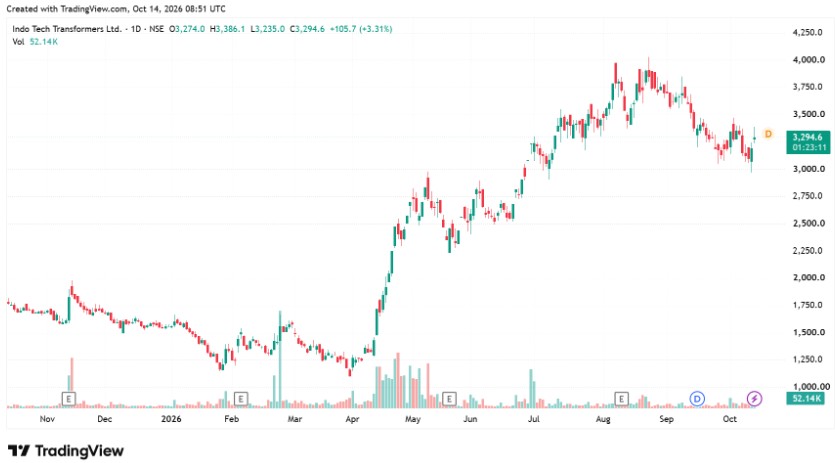
Indo Tech Transformers Share Price
Here is a brief comparison of the two companies:
| Parameter | Kanohar Electricals | Indo Tech Transformers |
| Transformer voltage range | Up to 400 kV | Up to 400 kV |
| Current installed capacity | 19,200 MVA | 14,000 MVA |
| Planned capacity addition | 18,000 MVA | 36,000 MVA |
| Target Capacity | 37,200 MVA | 50,000 MVA |
| Capacity expansion | 1.9X | 3.6X |
| Order book | ₹2,026 crore | ₹1,318 crore |
| Q1FY27 revenue growth | 103.5% | 38.0% |
| Q1FY27 profit growth | 140.0% | 36.8% |
| Key growth trigger | Entry into 765 kV transformers | ₹495 crore expansion programme |
Kanohar Electricals has a larger installed capacity and order book, along with stronger revenue and profit growth in Q1FY27. Its next growth phase includes developing capabilities in 765 kV transformers. Indo Tech Transformers, meanwhile, plans to expand its capacity from 14,000 MVA to 50,000 MVA by FY29. Both companies manufacture transformers up to 400 kV.
Valuation Metrics: Premium Multiples vs ROCE & Return Realities
Kanohar Electricals reports stronger return ratios, including Return on Capital Employed (ROCE) and Return on Equity (ROE), than Indo Tech and the industry median. This reflects its ability to generate higher returns on the capital employed in its business and the shareholders’ equity invested in it.
From a valuation perspective, Indo Tech is trading at a premium compared to its historical median multiple over the past five years and is on par with the industry median. Kanohar is a recently listed company, and therefore it has a limited price history. Nonetheless, the company trades at a premium to both Kanohar and the industry.
| Peer Comparison (X) | ||||
Company | Price-to-Earnings Multiple | Return Ratios | ||
| Company | 5Y Median | ROCE (%) | ROE (%) | |
| Kanohar | 57.4 | NA | 54.3 | 42.2 |
| Indo Tech | 35.0 | 21.0 | 40.4 | 28.4 |
| Industry | 35.0 | 23.5 | 20.0 | |
| Source: Screener.in (Data as of October 14 2026) | ||||
India’s expanding power transmission network is creating a long-term opportunity for transformer manufacturers. Kanohar Electricals offers exposure to higher-voltage transformers, with a planned entry into the 765 kV segment and strong recent earnings growth.
Indo Tech Transformers, meanwhile, has an established manufacturing base, a sizeable order book, and an ambitious capacity expansion plan targeting 50,000 MVA by FY29. Both companies have strong return ratios, although Kanohar is ahead in this regard. However, both face execution risks as they increase capacity and execute their orders.
You can keep these names on your watchlist to track their execution.
Disclaimer
Note: Throughout this article, we have relied on data from http://www.Screener.in and the company’s investor presentation. Only when the data was unavailable did we use an alternative, widely used and accepted source of information.
The purpose of this article is only to share interesting charts, data points, and thought-provoking opinions. It is NOT a recommendation. If you wish to consider an investment, you are strongly advised to consult your advisor. This article is strictly for educational purposes only.
About the Author: Madhvendra has been deeply immersed in the equity markets for over seven years, combining his passion for investing with his expertise in financial writing. With a knack for simplifying complex concepts, he enjoys sharing his honest perspectives on startups, listed Indian companies, and macroeconomic trends.
A dedicated reader and storyteller, Madhvendra thrives on uncovering insights that inspire his audience to deepen their understanding of the financial world.
Disclosure: The writer and his dependents do not hold the stocks discussed in this article.
The website managers, its employee(s), and contributors/writers/authors of articles have or may have an outstanding buy or sell position or holding in the securities, options on securities or other related investments of issuers and/or companies discussed therein. The articles’ content and data interpretation are solely the personal views of the contributors/ writers/authors. Investors must make their own investment decisions based on their specific objectives, resources, and only after consulting such independent advisors as may be necessary.