




A stock trading near its all-time high might look expensive at first sight. However, the stock can still have room to grow if its earnings are rising fast enough to support its valuation.
A strong share-price run does not necessarily mean a stock has become expensive relative to its growth. This is where the price-earnings to growth (PEG) ratio offers a different way of looking at companies that have already delivered a strong market performance.
The idea is to find businesses where the market is already rewarding the stock, but where the earnings growth story has not been completely priced out. Companies with capacity expansion, new businesses or other identifiable growth drivers can continue to see earnings improve even after their stocks have moved sharply higher.
To identify such companies, we screened stocks where the current price, after allowing for a 10% upside, was still above the all-time high, with a market capitalisation of more than Rs 5,000 crore and a positive PEG ratio. We then sorted the stocks in ascending order of PEG ratio. Banks and financial companies were excluded, along with recently listed stocks and businesses without clear growth plans. We also dropped companies where a one-time gain had sharply lifted June-quarter profit and could have made the PEG ratio look artificially low.
We then zeroed in on three stocks from varied industries where the common thread is not just that they are trading near record highs or have low PEG ratios, but that there are identifiable business factors that could support their earnings growth going ahead.
#1 Aegis Vopak Terminals: Capacity Expansion Supports Long-Term Growth Outlook
Aegis Vopak Terminals Ltd. is a third-party storage and handling company operating across both the liquid and gas segments. It has 22 operating terminals across six ports, with existing liquid storage capacity of about 1.7 million cubic metres and static LPG capacity of 2,25,800 MT.
The company handles petroleum products, chemicals, lubricants, vegetable oils and LPG, with its terminals connected to ports through pipelines and supported by road and rail evacuation infrastructure.
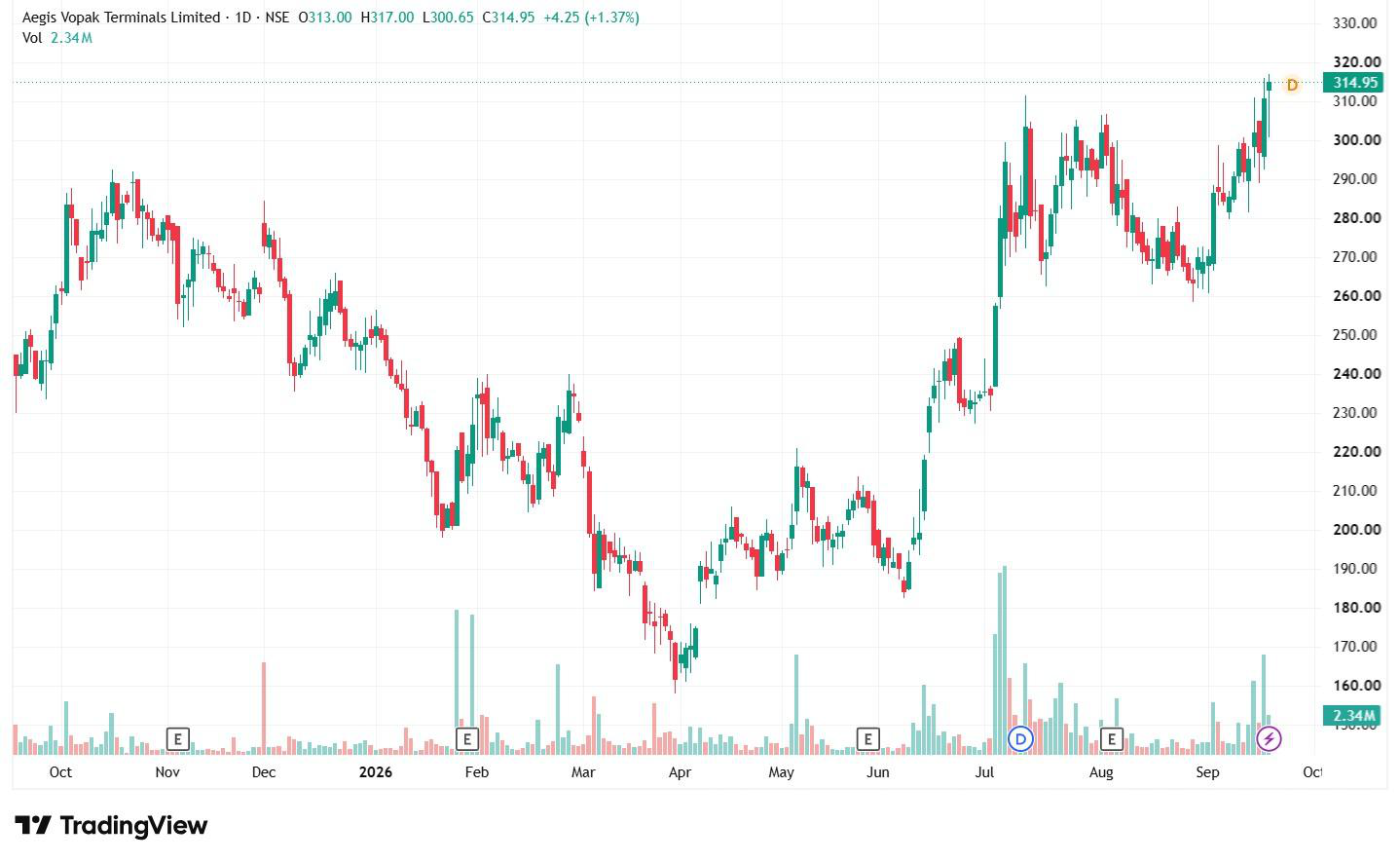
The stock is trading at Rs 314.95, close to its all-time high of Rs 317. Its price-earnings (P/E) ratio stands at 128.86x, compared with the industry median of 71.4x.
However, the PEG ratio is at 0.09x, lower than the industry median of 2.02x, reflecting the strong earnings growth delivered by the business and the growth expected from its expanding capacity.
1-Year Share Price Chart of Aegis Vopak Terminals Ltd.
JNPA Expansion Is A Major Growth Driver
The biggest ongoing expansion is at Jawaharlal Nehru Port Authority (JNPA), where the company currently has around 1,01,900 cubic metres of liquid storage. It is adding another 3,18,100 cubic metres of liquid storage, 77,236 metric tons (MT) of LPG capacity, and a 35,000 MT per year LPG bottling plant. The total investment is Rs 1,675 crore. The first phase, involving around 100,000 cubic metres, is expected to start in the third quarter of FY27.
The company has also approved another 52,000 MT refrigerated double-wall steel LPG storage tank at JNPA. Management said the expansion will help it serve rising LPG demand in the region. JNPA is also strategically important as the port caters to markets across Maharashtra, Hyderabad, Silvassa and Gujarat.
Ammonia Adds A New Growth Area
Aegis Vopak has also entered ammonia storage through its Pipavav facility. The company has a 36,000 MT specialised ammonia terminal, supported by a 15-year agreement with Hindustan Zinc for part of the capacity for its upcoming DAP plant. The company said the facility will serve demand from fertiliser, industrial and emerging energy-transition businesses.
Furthermore, towards the end of August 2026, the company said its subsidiary Aegis Terminal Pipavav had signed an agreement to acquire the 36,000 MT ammonia terminal from promoter Aegis Logistics for Rs 525 crore. The company said the addition would help expand its ammonia storage and handling business and create a new growth area.
More Capacity And Better Connectivity
There are several other projects under way. At Kandla, a new liquid terminal will add around 94,148 cubic metres of capacity. At Kochi, the company has approved another 49,577 cubic metres, taking total liquid storage there to 1,32,122 cubic metres. At Mangalore, the company is developing an LPG rail loading facility and bottling infrastructure, while evaluating another 60,000 cubic metres of liquid storage.
The company is also adding pipelines and rail links to move products more efficiently. The Jamnagar-Loni LPG pipeline is already operational, while the Kandla-Gorakhpur and Haldia-Panagarh connections are expected to come up during the year. At Pipavav, a new liquid rail gantry and a new jetty are also being developed. The company has a 15-year agreement for petroleum product handling at Pipavav, with committed volumes of more than 0.5 million tonnes a year.
Apart from this, the company is also expecting rising demand for LPG, chemicals and ammonia as key markets for the company. Its LPG capacity has expanded significantly in recent years, while its Haldia acquisition added 25,000 MT of LPG capacity and gave it an exclusive terminaling agreement with Hindustan Petroleum Corporation Limited (HPCL) until 2038.
Large Capex Plan To Support Growth
The overall capex that the company has outlined for its long-term investment programme is around $5 billion by 2030-31, out of which management expects to invest around $1.2 billion of capex by next year. The capex is expected to be funded mainly with internal accruals and minimal use of debt, with the company maintaining a disciplined approach to leverage.
Mixed Financial Performance
During the quarter ended on 30 June 2026, revenue of the company grew by 12.4% YoY to Rs 233.8 crore. Liquid terminaling revenue increased 30.6% YoY to Rs 126.5 crore, while gas terminaling revenue stood at Rs 107.2 crore. Earnings before interest, tax, depreciation and amortisation (EBTDA) grew 15.6% to Rs 179.4 crore, while the EBITDA margin rose to 76.7%, marginally up from 74.65% a year ago.
Profit for the period, however, declined by 11.9% YoY to Rs 69.14 crore, down from Rs 78.8 crore in Q1FY26.
#2 Strides Pharma Science: US Portfolio, Ex-US Growth Support Long-Term Outlook
Strides Pharma Science Ltd. is a global pharmaceutical company supplying pharma products to more than 100 countries across the US, Africa, APAC, MENA, and LATAM, and other institutional markets. The manufacturing facilities are present in India, Italy, Kenya, and the US. Its portfolio includes generics, controlled substances, nasal sprays, transdermal patches, and films.
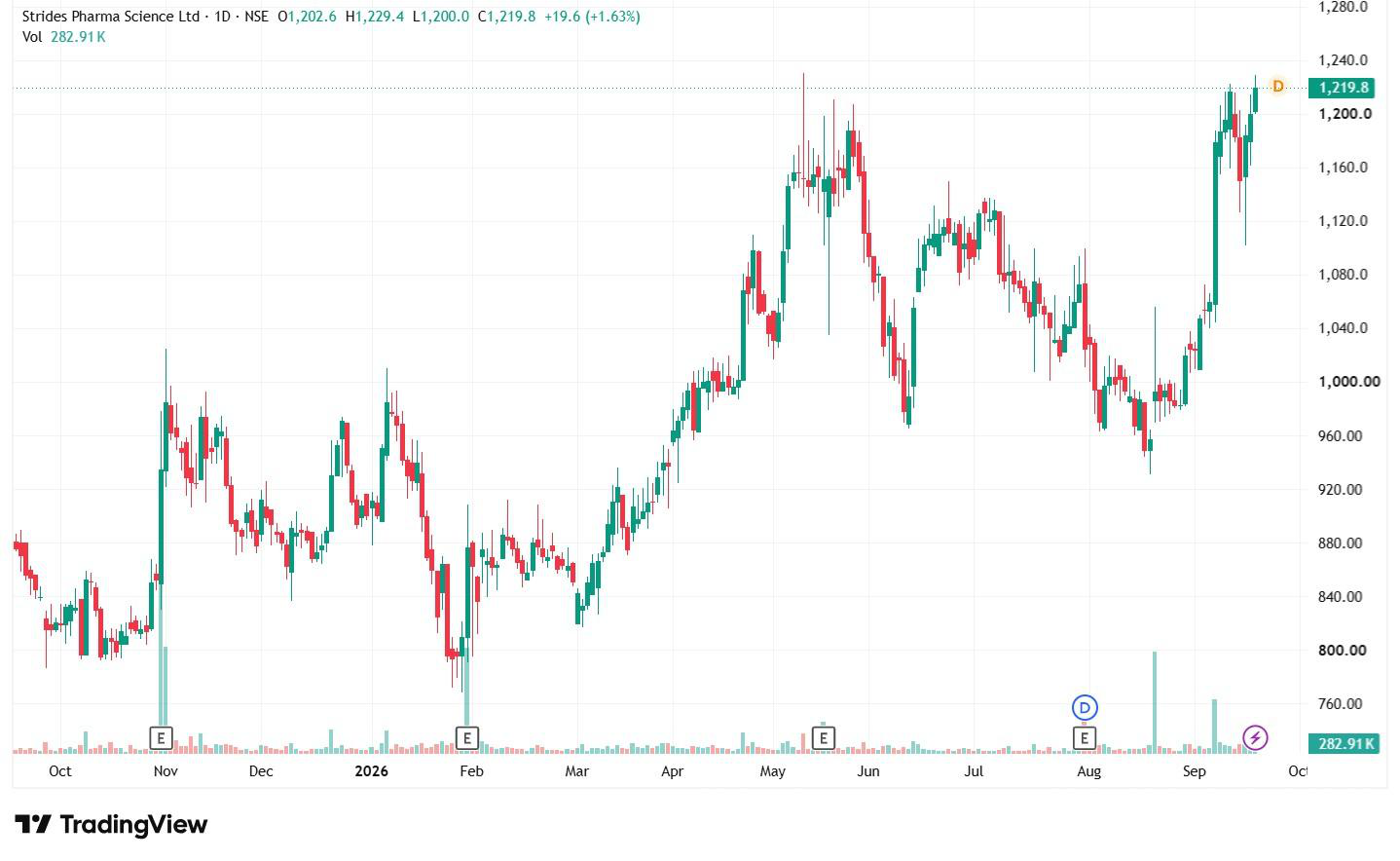
The stock is trading at Rs 1,219.80, close to its all-time high of Rs 1,231.45. Its P/E ratio stands at 19.41x, compared with the industry median of 31.73x, while the PEG ratio is at 0.27x, lower than the industry median of 0.95x, indicating that the stock is relatively cheaper than its peers, especially with the company’s growth plans centred on new product launches, expansion in Ex-US markets and investments in specialised pharmaceutical platforms.
1-Year Share Price Chart of Strides Pharma Science Ltd.
US Portfolio Is A Key Growth Driver
The US business remains an important part of Strides’ growth plans, with revenue of Rs 628.2 crore in the April-June quarter. The company has 72 commercialised products in the US and holds top-three positions in 37 products, which contribute about 70% of its US revenue. It launched two products during the quarter, while additional approvals and launches are expected to support growth in the second half of FY27.
Strides is targeting North America revenue of about $375 million (approx Rs 3,598 crore) by FY28. The growth plan includes new launches, controlled substances, OTC products, specialty channels, and partnerships in Canada and other markets. The company also has more than 100 products yet to be launched and is working towards around 10 launches through March 2027.
The company is also building a longer-term portfolio in controlled substances, nasal sprays, transdermal patches and films. It has filed two nasal spray products and is working on five to six nasal spray programmes over the next 12 to 18 months. Additional filings across these product categories are expected to support growth beyond the FY28 target.
Ex-US Markets Add Another Growth Engine
While the US is generating steady revenue for the pharma company, the growth is mainly witnessed across the Ex-US market. Over the years, Strides has expanded its presence across Europe, the UK, Nordics, Africa, Australia and other emerging markets, and during the April-June quarter, revenue from the ex-US market grew 17% YoY to Rs 587.5 crore.
The company is adding new customers in Europe, expanding its product portfolio and increasing regulatory filings across different markets. Its Africa business, led by the Brands business, also recorded strong growth. Further opportunities are being developed across LATAM, MENA and APAC, with new regulatory filings expected to contribute from FY28 and FY29.
The company is also working towards adding the Sandoz-related business to its Ex-US operations, with the contribution expected in the second half of FY27, subject to the required approvals.
Capex To Support Product And Capacity Expansion
Strides plans to spend around Rs 250 to Rs 300 crore annually across maintenance capex, R&D and hard capex. The current focus is on its existing manufacturing facilities and high-impact projects rather than setting up new greenfield plants.
The company is also expanding manufacturing capabilities at the Chestnut Ridge site, which generates nearly one-third of its US revenue. The facility is being used for key growth platforms, including controlled substances, nasal sprays, transdermal patches and films.
Modest Business Growth
Revenue grew 13% YoY to Rs 1,265.4 crore in Q1FY27, up from Rs 1,119.7 crore in Q1FY26. EBITDA grew 5.4% YoY to Rs 229.8 crore. However, EBITDA margin dropped marginally to 18.2%, compared to 19.5% a year ago, as higher operating and freight costs weighed on margins. Profit for the period increased 8% YoY to Rs 123.1 crore, from Rs 114 crore a year ago.
#3 Privi Speciality Chemicals: Capacity Expansion, New Products Drive Growth Outlook
Privi Speciality Chemicals Ltd. is a manufacturer of aroma and speciality chemicals, with more than 75 products and production capacity of 48,000 MT across seven manufacturing facilities. One of the strategic benefits that this company has is its strategic location, which is near JNPT Port and Ankleshwar Dry Port.
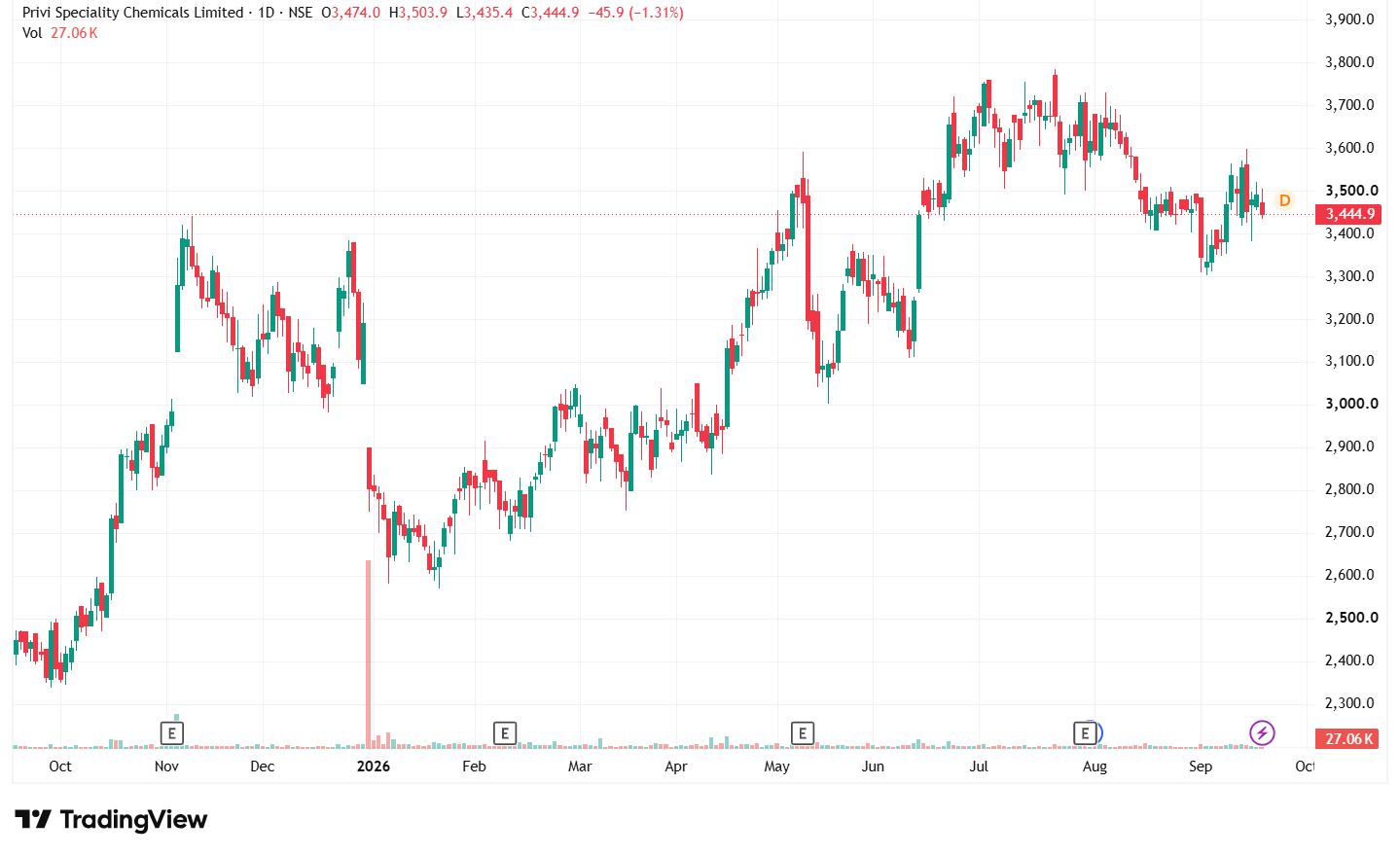
The stock is trading at Rs 3,444.90, close to its all-time high of Rs 3,785.30, with a P/E ratio of 38.5x, compared with the industry median of 28.8x. The PEG ratio is 0.27x, at par with the industry median.
1-Year Share Price Chart of Privi Speciality Chemicals Ltd.
Capacity Expansion To Drive Volumes
Privi is expanding its manufacturing capacity to cater to strong demand across its existing product portfolio. The company has planned to increase the capacity from the current 48,000 MT to 54,000 MT in the first phase, while the second phase will add another 12,000 MT, taking capacity to 66,000 MT by September 2027. The company is currently operating at around 90% capacity utilisation.
New Products Open Another Growth Avenue
Apart from capacity expansion, Privi is also building a portfolio of higher-value speciality products, which includes Maltol, Ethyl Maltol, renewable Cyclopentanone, Musk T and around 10 other speciality molecules which are part of its phase 2 and phase 3 expansion plan as well.
A key part of this strategy is furfural-based chemistry. Privi is planning to integrate the process from corn cob to furfural and then to products such as Maltol, Ethyl Maltol and Cyclopentanone. Management expects this vertical to contribute Rs 1,000 crore or more in revenue. Maltol and Ethyl Maltol are also part of the company’s China-plus-One strategy.
PRIGIV, Merger Adds to Growth Plans
The PRIGIV joint venture with Givaudan is expanding as well, and together they have invested an additional Rs 50 crore in equity for the next phase of growth.
On the other hand, the planned merger of Privi Fine Sciences and Privi Biotechnologies with the parent company is in progress. This merger is expected to add another 6,000 MT of capacity and create operational synergies.
Rs 850–900 Crore Capex Planned
Privi has outlined capex of around Rs 850 crore to Rs 900 crore over the current year and the following two years, mainly for its Phase 2 and Phase 3 expansion. The company expects to fund the investment largely through internal accruals, while keeping borrowing as an option if required.
Management said that they are targeting Rs 5,000 crore of revenue and over Rs 1,000 crore of EBITDA by FY30, and expecting EBITDA margins to remain above 20%.
43.9% Jump in Profits
During Q1FY27, revenue rose 20% YoY to Rs 681.42 crore while EBITDA increased 18.73% YoY to Rs 167.47 crore. However, EBITDA margin marginally declined to 24.6% from 24.8% a year ago.
Having said that, profit surged by 43.9% YoY to Rs 82.8 crore from Rs 57.6 crore a year earlier.
What Could Drive The Next Leg Of Growth?
Stocks trading near record highs often leave investors with a simple question – ‘what comes next?’ In the case of these three companies, the answer may lie in how much of their identified growth opportunity is still ahead rather than how far their shares have already moved.
The next phase will therefore be less about the past rally and more about the earnings that these businesses can build from here. The coming quarters could show whether the growth opportunities are large enough to support a fresh leg of earnings expansion and to track the same, you need to add these stocks to your watchlist.
Disclaimer:
We have relied on data from www.Screener.in throughout this article. Only in cases where the data was not available have we used an alternate, but widely used and accepted source of information.
The purpose of this article is only to share interesting charts, data points, and thought-provoking opinions. It is NOT a recommendation. If you wish to consider an investment, you are strongly advised to consult your advisor. This article is strictly for educational purposes only.
Maumita Mitra is a seasoned writer specializing in demystifying the world of investment for a broad audience. She has a keen eye for detail and a knack for explaining complex financial concepts in the simplest manner possible.
Disclosure: The writer and her dependents do not hold the stocks discussed in this article.
The website managers, its employee(s), and contributors/writers/authors of articles have or may have an outstanding buy or sell position or holding in the securities, options on securities, or other related investments of issuers and/or companies discussed therein. The content of the articles and the interpretation of data are solely the personal views of the contributors/ writers/authors. Investors must make their own investment decisions based on their specific objectives and resources, and only after consulting such independent advisors as may be necessary.