




DMart has an online strategy that is significantly different from other competitors. This gives the company an edge in key metrics. While most of the quick commerce companies are looking to scale up their dark warehouses rapidly, DMart Ready is looking for profitability and sustainability. We should remember that the retail sector is never a sprint race and the fastest company to scale operations could actually end up behind in the long run.
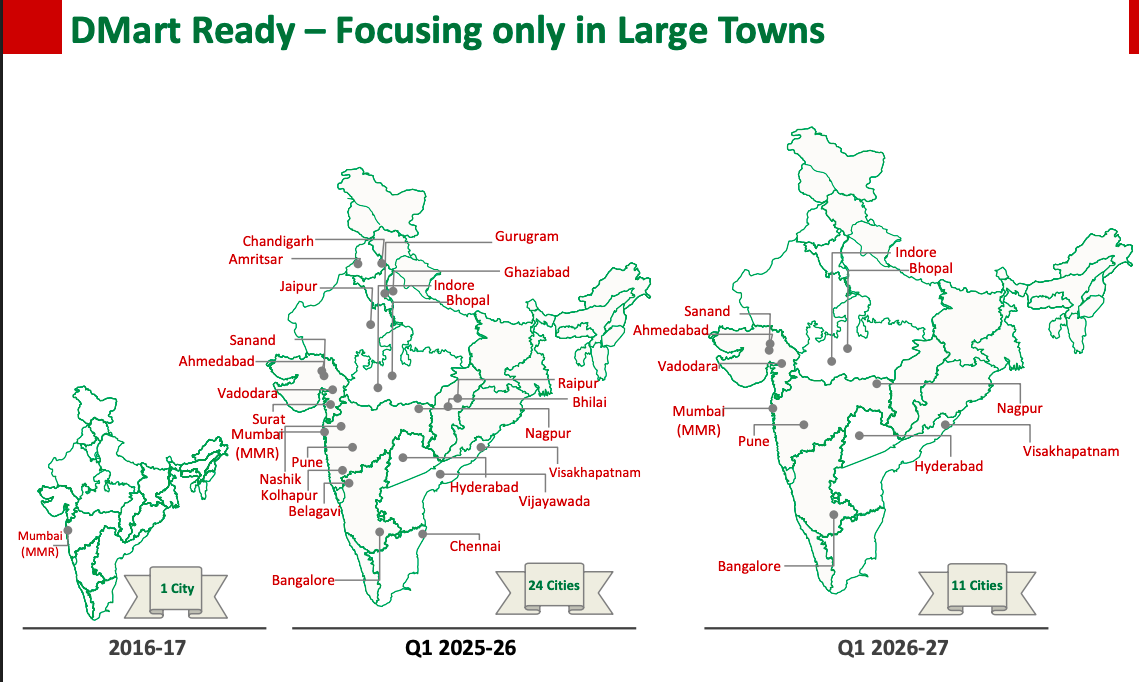
Eternal’s Blinkit is operating in over 300 cities, Swiggy’s Instamart is operating in close to 200 cities, while Zepto is also operating in more than 80 cities. On the other hand, DMart Ready, DMart’s answer to quick commerce, has actually scaled down the operations from 24 cities in Q1 2025-26 to 11 cities in Q1 2026-27. This is a deliberate choice to focus more on cities that can deliver profitable operations for the company.
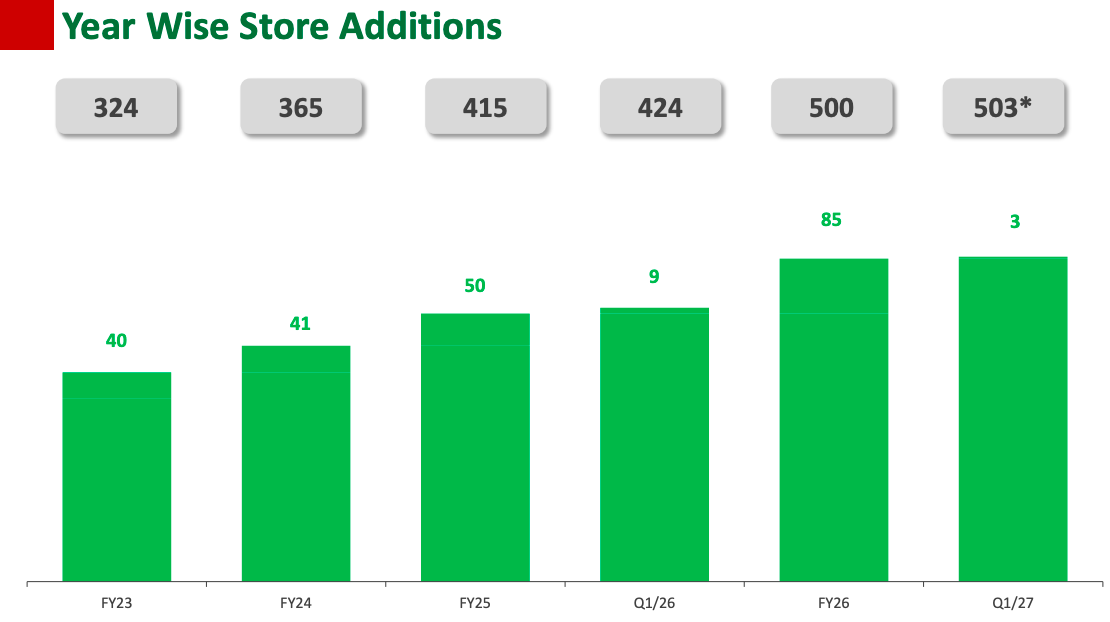
At the same time, DMart’s store additions continue at a blistering pace. The company has recently announced reaching over 500 stores after adding 85 stores in the recent quarter. In the future, the management is projecting a 15% YoY store count growth in the next few years. This should take the total store count to 1,000 stores by 2030. These of course are hypermarkets, which is the mainstay of DMart’s business.
In comparison, Blinkit has over 2,200 warehouses currently, and Instamart operates with over 1,100 warehouses.
It should be noted that these warehouses operate from a much smaller retail space. Both Blinkit and Instamart have reported average warehouse retail space in the range of 1,500-4,000 sq ft, while DMart operates with over 30,000 sq ft hypermarkets.
Since we are focusing on quick commerce, let’s circle back to DMart Ready and how that strategy is panning out.
DMart Ready is showing three key advantages over other competitors:
#1 Strong balance sheet can outlast other competitors
The quick commerce space has seen massive investment in supply chain, discounts, warehouses, and delivery. There are currently over half a dozen serious players in this field. This has increased the cash burn rate in this industry. DMart Ready has also been reporting losses for the last few years.
In the recent fiscal year, DMart Ready had a turnover of Rs 4,093.61 cr and a consolidated loss of Rs 306.53 cr. Back in FY 2021-2022, DMart Ready reported revenue of Rs 1,667.21 cr and an approximate loss of Rs 142 cr.
Over the last five years, DMart Ready’s revenue Compound Annual Growth Rate (CAGR) was 25% while its losses have increased at a CAGR of 21%. However, DMart Ready’s Profit before tax (PBT) margin has improved from -8.52% in FY 2021-2022 to -7.49% in FY 2025-2026. This is quite good considering that we have seen a massive growth of new quick commerce operations during this time.
DMart Ready Financials
| Fiscal year | Total revenue/Turnover (Rs cr) | Net loss (PBT) (Rs cr) | PBT margin (%) |
| FY 2021-2022 | 1,667.21 | 142 | -8.52% |
| FY 2022-2023 | 2,203.03 | 194 | -8.81% |
| FY 2023-2024 | 2,899.20 | 174 | -6.00% |
| FY 2024- 2025 | 3,502.42 | 247.37 | -7.06% |
| FY 2025-2026 | 4,093.61 | 306.53 | -7.49% |
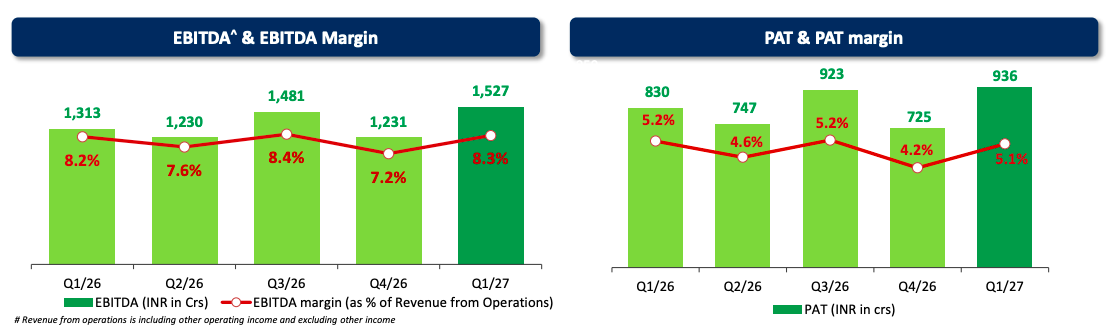
DMart Ready has a strong backing from its parent DMart, which allows it to absorb these losses. DMart’s consolidated Earnings before interest, taxes, depreciation & amortization (EBITDA) in the recent quarter – Q1FY27, was Rs 1,527 cr with a margin of 8.3%. Its Profit after tax (PAT) was Rs 936 cr with a PAT margin of 5.1%.
EBITDA and PAT margin of DMart
#2 DMart Ready is laser-focused on profitable regions
Many quick commerce players are expanding rapidly in Tier-2, Tier-3 cities in order to gain an early mover advantage and to expand their addressable market. However, DMart Ready has chosen a more calculated approach by focusing on cities where its business model can deliver margins.
The company has recently reduced the footprint of its DMart Ready operations from 24 cities in FY 2025-2026 to 11 in Q1 FY 2026-27. The management mentioned that these 11 cities contribute the majority of its online revenue base, and by focusing on these cities, the company should be able to improve margins faster. This follows the similar cluster approach used by DMart in expanding its physical store base.
DMart’s higher average retail space of 40,000 sq ft
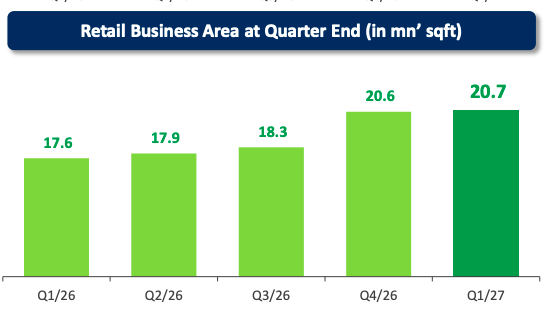
In the recent filing, DMart reported that its retail business has reached 20.7 million sq ft, up from 17.6 million sq ft in the year-ago quarter. With a store count of 500, the average retail space of DMart is over 40,000 sq ft, which is much higher than the average 1,500-4,000 sq ft of warehouse space for most quick commerce companies.
#3 Delivery cost burden for DMart is lower than peers
The quick commerce segment has seen recent growth on the back of convenience and impulse purchases. However, these impulse purchases come at a high cost. A recent study showed that the average delivery cost burden of Blinkit on a small basket of Rs 200 could be as high as 15%. Zepto’s delivery burden is at 12%, and Instamart’s delivery burden is at 14%.
However, DMart Ready’s delivery burden on an order base of Rs 2,000 is estimated to be only 1.5%. This gives DMart Ready a big edge for intentional buying orders, which usually have a bigger ticket size. Customers looking to make bigger monthly purchases for their household could find better value at DMart Ready. Despite a longer delivery time, the greater value by DMart Ready with a lower delivery burden could allow the company to gain an edge over competitors.
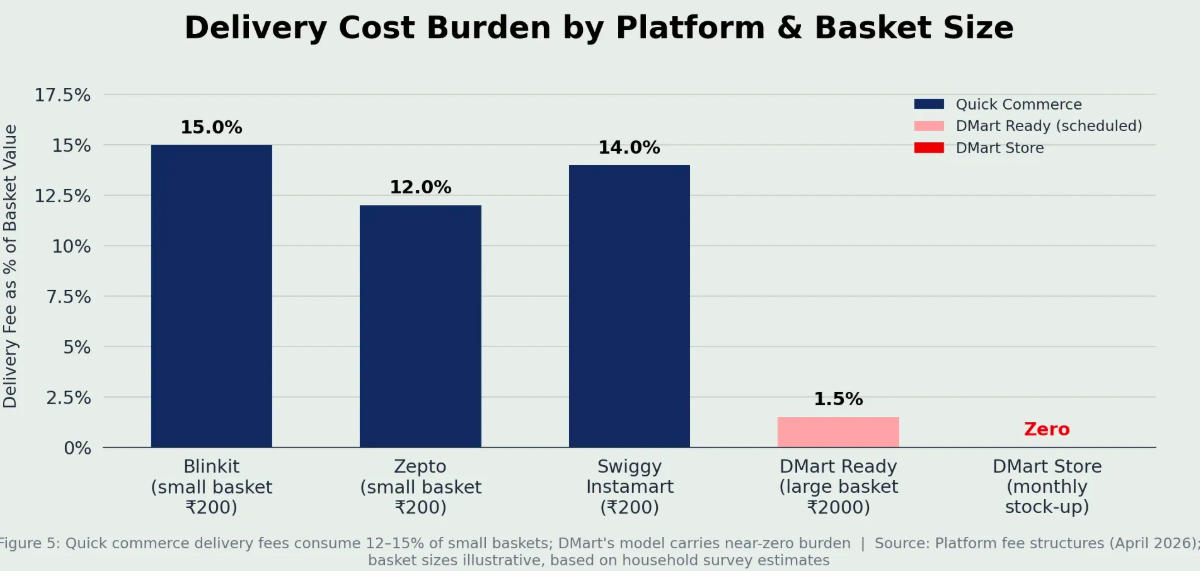
We could soon see the cash burn rate of many of these quick commerce players reduce as they focus on profitability. They will be forced to pass on more of the delivery costs to customers in order to break even. This should be a tailwind for DMart Ready which already has a more value-oriented approach.
Let’s look deeper into the valuation metrics of Swiggy and DMart
#1 Swiggy
Swiggy has reported revenue of Rs 6,812 cr in the recent quarter, which is 37.3% YoY growth. Its PAT margin was -11.6%. Over the last few quarters, Swiggy’s YoY revenue growth has reduced significantly from 54.0% in Q1FY26 to 37.3% in Q1FY27.
1-year price chart of Swiggy
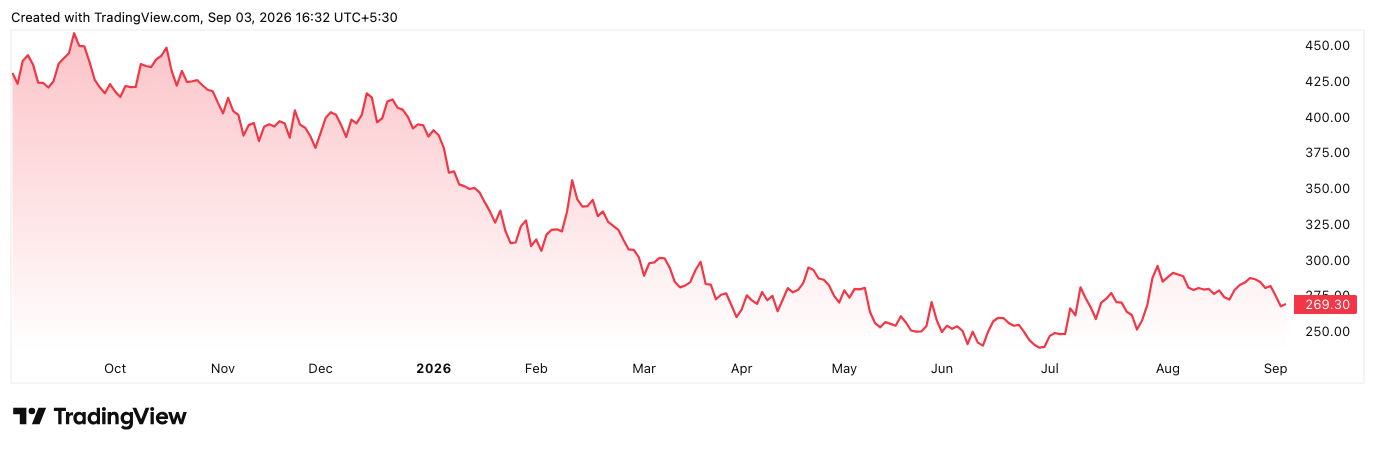
This is due to the company focusing more on margins, and to some extent on the larger base effect. We have seen the PBT margin improve from -24.1% in Q1FY26 to -11.6% in the recent quarter. There has been a steady PBT margin improvement in the last few quarters. This shows that the competitive field is changing as quick commerce players move away from massive cash burn to more judicious resource allocation.
| Period | Q1FY26 | Q2FY26 | Q3FY26 | Q4FY26 | Q1FY27 |
| Revenue (Rs Cr) | 4,961 | 5,561 | 6,148 | 6,383 | 6,812 |
| YoY Revenue Growth (%) | 54.0% | 54.4% | 53.9% | 45.0% | 37.3% |
| PBT margin (%) | -24.1% | -16.2% | -14.9% | -12.5% | -11.6% |
On the other hand, DMart Ready reported a PBT loss of Rs 306.53 cr in the recent fiscal year on revenue of Rs 4,093.61 cr which gives it a PBT margin of -7.49%. While Swiggy’s YoY revenue growth is still higher than DMart Ready, its PBT margin is significantly below that of DMart Ready.
1-year price chart of DMart
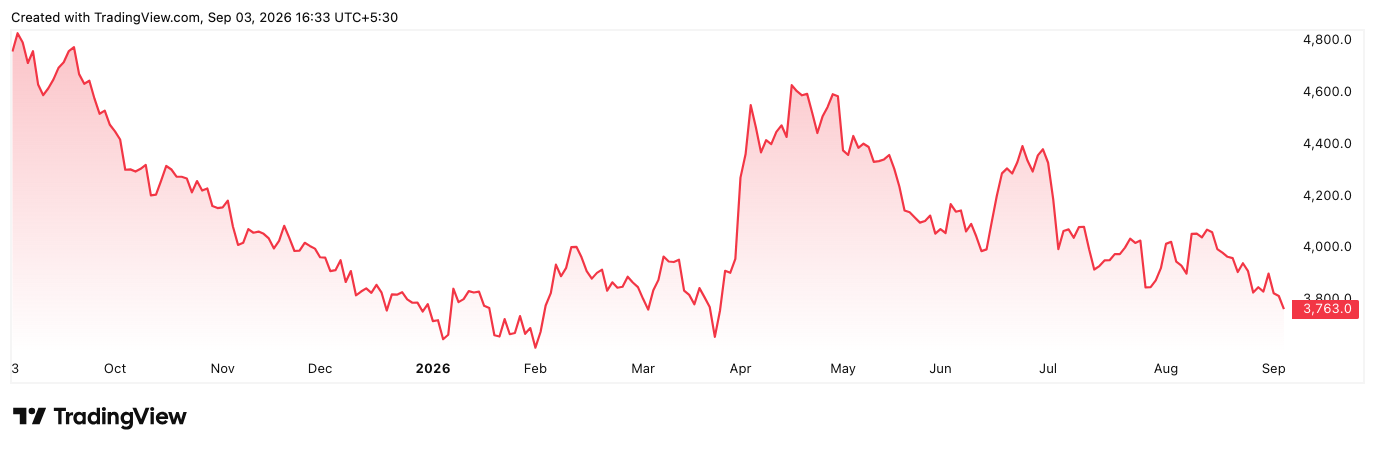
On a consolidated basis, DMart has an EV/EBITDA multiple of 45.80 compared to -32.81 for Swiggy. DMart’s Return on Capital Employed (ROCE) is 17.18% compared to -24.08% for Swiggy. DMart’s Return on Equity (ROE) is 12.94% compared to -29.07% for Swiggy.
We can clearly see in this comparison that DMart’s return metrics are much better.
| Company Name | EV/EBITDA | ROCE (%) | ROE (%) |
| Avenue Supermarket | 45.80 | 17.18 | 12.94 |
| Swiggy | -32.81 | -24.08 | -29.07 |
DMart Ready still faces some challenges. One of the biggest is the delivery schedule, which can take much longer than the 10-15 minutes guaranteed by competitors. It will not be easy to reduce this delivery gap due to the operational requirements of its physical stores. DMart Ready’s presence will also be limited to its store base compared to the massive rollout by other quick commerce companies. This reduces the addressable market for DMart Ready.
However, we have already seen DMart Ready deliver relatively better margins than competitors. It can certainly sustain these losses over a longer period and wait for the intense competition to subside.
Whether the stock delivers from here on, only time will tell. It may be a good idea to add DMart to your watchlist.
Disclaimer:
Note: Throughout this article, we have relied on data from http://www.Screener.in and the company’s investor presentation. Only in cases where the data was unavailable have we used an alternative, widely used, and accepted source of information
The purpose of this article is only to share interesting charts, data points, and thought-provoking opinions. It is NOT a recommendation. If you wish to consider an investment, you are strongly advised to consult your advisor. This article is strictly for educational purposes only.
About the Author: Rohit is a seasoned financial writer with over a decade of experience covering Indian and international stocks. He specializes in converting complex financial data into actionable insights that can help readers make better calls. He covers macroeconomic trends globally, which gives a better analysis of the growth runway for companies in key sectors.
Disclosure: The writer and his dependents do not hold the stocks discussed in this article. The website managers, its employee(s), and contributors/writers/authors of articles have or may have an outstanding buy or sell position or holding in the securities, options on securities, or other related investments of issuers and/or companies discussed therein. The articles’ content and data interpretation are solely the personal views of the contributors/ writers/authors. Investors must make their own investment decisions based on their specific objectives, resources, and only after consulting such independent advisors as may be necessary.