




India’s logistics market is already a ₹21-23 lakh crore industry, but the bigger opportunity lies in digital commerce. Online retail accounted for only about 7-8% of total retail in FY26, leaving significant room to expand as e-commerce adoption spreads beyond major cities.
Macro Tailwinds: How E-Commerce and Quick Commerce Expand 3PL Volumes
This growth is translating into higher logistics volumes. India’s online retail gross merchandise value is expected to grow at 20-25% annually between FY25-30. Meanwhile, parcel volumes are expected to grow at a mid-to-high teens rate.
Direct-to-consumer (D2C) and small and medium enterprise (SME) shipments are also growing faster than traditional e-commerce, creating demand for technology-led logistics platforms. The opportunity is expanding beyond e-commerce. Quick commerce is growing at around 50-62% annually and already accounts for 20-22% of India’s e-retail GMV.
At the same time, organised third-party logistics players handled around 40-42% of e-commerce shipments in FY26. With rising online consumption, higher shipment volumes and greater 3PL penetration, India’s digital logistics market is entering a period of structural expansion.
Against this backdrop, two players are building businesses across different parts of this growing ecosystem.
#1 ShadowFax: Scaling asset-light logistics across India’s digital commerce
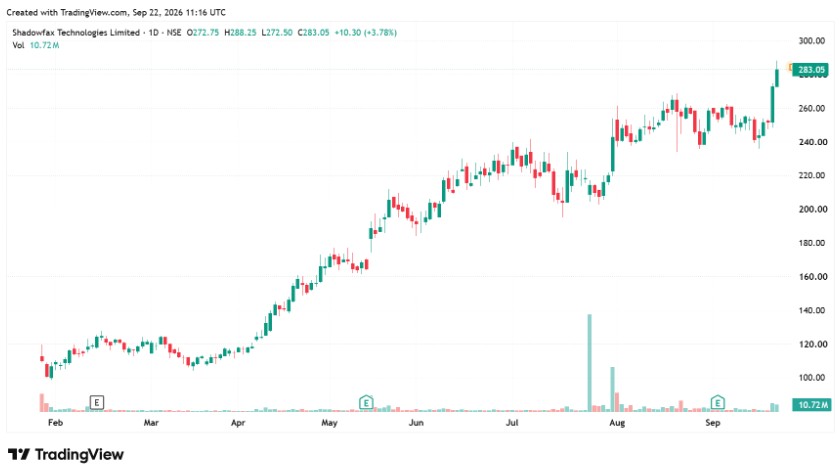
Shadowfax Technologies is a third-party logistics (3PL) company in India. It offers integrated logistics solutions across three main verticals: Express, Hyperlocal and other logistics services. Its reach spans 16,372 PIN codes and 5,095 touchpoints. Shadowfax plans to have national coverage by FY28.
The Asset-Light Logistics Play: Footprint, Fleets, and 30% Market Share
It operates an asset-light strategy, deploying 3,500+ trucks daily through variable-cost partner relationships rather than owning vehicles directly. Around 70% of total expenses are variable. It holds an estimated 28-30% market share in the Indian 3PL Express Segment.
Quick Commerce & D2C Expansion: Capturing 50% Outsourcing Demand
Shadowfax is capturing market share from both horizontal e-commerce platforms and direct-to-consumer (D2C) brands amid volume consolidation. D2C brand revenue surged over 170% year-on-year in Q1FY27, pushing D2C market share above 12%. This was driven by the launch of a self-serve, zero-touch onboarding platform.
The platform offers flat-rate pricing for small sellers and D2C brands. It targets India’s 15-16 lakh online sellers. Shadowfax also holds 50%+ market share in the quick commerce 3PL outsourcing segment. The company currently has 47 dark stores. The company is targeting 100+ dark stores in FY27.
It is also entering vertical quick commerce, including fashion, pet care, gourmet, childcare, and spare parts. Vertical quick commerce is projected to reach 20-25% of the total quick commerce market. The company is also handling volumes for Amazon Now. Moreover, the company has also ventured into end-to-end supply chain capabilities for large/heavy items.
Management states that e-commerce and quick commerce platforms are outsourcing 12-15% (and up to 20-25%) of their order volume to specialized 3PL players. This helps them optimise last-mile capacity and manage peak demand efficiently. This shift gives multi-category 3PL operators more addressable volume during peak consumption cycles.
Financial Turnaround: Net Profit Jumps to ₹65 Cr as Margins Double
In Q1FY27, revenue grew 65% year on year to ₹1,358 crore. Consequently, management raised FY27 revenue guidance from 27-30% to 38-40%. The fixed-to-variable cost structure (70% variable costs through crowdsourced fleets) helps the company to benefit from operating leverage.
The company’s EBITDA increased to ₹92 crore from ₹25 crore in Q1FY26, while margins more than doubled to 6.8% from 3.1% in Q1FY26. Net profit grew to ₹65 crore from a low base of ₹8 crore in Q1FY26, reflecting the operating leverage of its variable delivery network. Management expects margin expansion of 100 to 200 bps (1% to 2%) over FY26 levels.
#2 Shiprocket: Building the technology layer for digital commerce
Shiprocket Limited is India’s largest e-commerce enablement platform by revenue. It serves direct-to-consumer (D2C) brands, small and medium enterprises, and social or conversational commerce merchants selling outside traditional marketplaces. Operating on a strictly asset-light model, as the company owns zero trucks, warehouses, delivery executives, or bikes.
The Asset-Light Aggregator: Inside Shiprocket’s Merchant & Tech Footprint
It earns revenue by providing an end-to-end e-commerce platform. The company’s core business is shipping and logistics. It offers multi-courier aggregation by connecting merchants to over 250 ecosystem partners and 42 courier partners. It also offers value-added tech solutions such as Delivery Boost, Early COD, Secure, and Brand Boost.
Checkout and MarTech are emerging businesses. These businesses offer a one-click checkout, single sign-on, automated address pre-fill, and suite additions like Quikpay, AI Assist, and the AI Ads Platform. The offerings also include omnichannel and B2B cargo. Overall, Shiprocket boasts 214,314 active merchants.
Q1 Financial Scorecard: Operational Scale vs 0.47% EBITDA Reality
Its reach spans over 15.5 crore consumers across 19,000+ PIN codes in India. The company processed over ₹32,772 crore in Gross Merchandise Value (GMV) and 20.2 crore transactions in FY26. Consolidated revenue from operations grew 34% year-on-year to ₹592.1 crore.
This was driven by 36% more transactions, a 31% increase in GMV to ₹34,661.8 crore, 14% more active merchants and an 18% increase in average revenue per user. However, EBITDA (Earnings Before Interest, Tax, Depreciation, and Amortisation) stood at ₹2.8 crore, with margins at 0.47%.
Consolidated contribution margin grew 43% to ₹115.1 crore in Q1FY27, while margin grew 124 bps to 19.4%. Contribution Margin measures the gross operating profit per transaction before paying for fixed corporate expenses like head-office overheads, corporate employee salaries, and core R&D.
Segmental Economics: Core Logistics Delivers 24% contribution Lift
However, the business is scaling well. Revenue from the Core segment grew 22% to ₹411.7 crore in Q1FY27. Core transaction volume grew 31%. Management stated that larger D2C merchants delivered stronger retention and order volumes, giving Shiprocket a larger footprint. But contribution margin expanded 24% to ₹87.4 crore.
Because contribution profit grew much faster than overall revenue, Shiprocket is retaining more rupees from every order processed on the platform. Meanwhile, the Emerging segment grew 70% to ₹180.4 crore in Q1FY27. As a result, Emerging offerings expanded their share of total revenue from 24% to 30%.
The Emerging Bet: Cross-Selling High-Margin MarTech
Shiprocket is also cross-selling to its existing merchants. The share of Core business merchants using Emerging products rose 150 bps year-on-year to 8.8% in Q1FY27. Total merchants served via Emerging solutions reached 48,406, up 57% from 30,826.
Valuation Realities: Price-to-Sales Multiples and Unit Economics Compared
Shadowfax has a higher Return on Equity (ROE) and Return on Capital Employed (ROCE) than Shiprocket, which is currently loss-making. So, we have used the Price-to-Sales multiple for valuation assessment. Accordingly, Shadowfax and Shiprocket both trade at a premium to their respective industry median valuation. Relatively, Shadowfax trades at a discount to Shiprocket.
Particulars | Price-to-Sales Multiple (X) | Return Ratios | ||
| Company | Industry | ROE (%) | ROCE (%) | |
| Shadowfax | 3.6 | 0.9 | 10.7 | 10.3 |
| Shiprocket | 4.6 | 4.5 | NA | NA |
| Source: Screener.in (As of 22 September 2026) | ||||
The Indian digital logistics opportunity is supported by rising e-commerce penetration, growing shipment volumes and increasing outsourcing to organised 3PL players. Shiprocket and Shadowfax are approaching this opportunity differently. Shiprocket has a larger e-commerce enablement model, with its emerging technology business contributing significantly.
Shadowfax, by contrast, is more directly involved in logistics volumes across e-commerce, direct-to-consumer (D2C), and quick commerce. The financial profiles also reflect this difference. Shadowfax has delivered stronger recent revenue and EBITDA growth, while Shiprocket is still operating at a very thin EBITDA margin.
At the same time, Shiprocket’s broader merchant and technology ecosystem offers another route to monetise growth in digital commerce. You can keep these companies on your watchlist to track how operational leverage translates into bottom-line resilience as parcel volumes scale.
Disclaimer
Note: Throughout this article, we relied on data from http://www.Screener.in and the companies’ investor presentations. We used an alternative, widely accepted source only when the data were unavailable.
The purpose of this article is only to share interesting charts, data points, and thought-provoking opinions. It is NOT a recommendation. If you wish to consider an investment, we strongly advise you to consult your advisor. This article is strictly for educational purposes only.
About the Author: Madhvendra has been deeply immersed in the equity markets for over seven years, combining his passion for investing with his expertise in financial writing. With a knack for simplifying complex concepts, he enjoys sharing his honest perspectives on startups, listed Indian companies, and macroeconomic trends.
A dedicated reader and storyteller, Madhvendra thrives on uncovering insights that inspire his audience to deepen their understanding of the financial world.
Disclosure: The writer and his dependents do not hold the stocks discussed in this article.
The website managers, their employees (s), and contributors/writers/authors of articles have or may have an outstanding buy or sell position or holding in the securities, options on securities, or other related investments of issuers and/or companies discussed therein. The articles’ content and data interpretation are solely the personal views of the contributors/ writers/authors. Investors must make their own investment decisions based on their specific objectives and resources, and only after consulting any independent advisors as necessary.