



India is adding solar panels and wind turbines at a fast pace. But there is another part of the renewable energy story that often gets less attention. The power still has to reach the consumer. A solar plant can generate electricity in Rajasthan or Gujarat. A wind project can come up far from the major demand centres.
Without enough transmission lines, substations and grid capacity, this power cannot move efficiently across the country. This is where the government’s latest transmission push becomes important. The Centre has approved Green Energy Corridor Phase-III with a total project outlay of ₹1.86 lakh crore.
Of this, ₹1.36 lakh crore is earmarked for intra-state transmission systems. The scheme aims to support the evacuation of up to 135 gigawatts (GW) of renewable energy by FY33. For the power transmission industry, this creates a long-term pipeline of work.
Transmission lines will need to be built. Substations will need to be expanded. Transformers, conductors and other grid equipment will be required. Against this backdrop, this article lists three infrastructure companies with a significant presence in the transmission sector.
#1 KEC International
KEC International is a company of the RPG Group. Transmission & Distribution (T&D) is the company’s core flagship business. KEC operates as a global turnkey Engineering, Procurement, and Construction (EPC) player and manufacturer. Its end-to-end activities include overhead transmission lines, substations, and underground cabling.
T&D Order Book Tops ₹25,000 Crore Amid Entry into Data Centre Power Line Projects
This broad presence positions KEC well to benefit from the T&D opportunity. The T&D revenue grew by 2% year-on-year to ₹3,217 crore in Q1FY27, representing 64% of total sales. The T&D order book plus L1 position stands at over ₹25,000 crore. T&D accounts for 62% of KEC’s total order book of ₹37,697 crore.
In Q1FY27, the business secured ₹3,600 crore in new orders across India, the Middle East, Africa and the Americas. The company also secured its first transmission line order for power evacuation to a data centre in Western India from a private developer. KEC is actively pursuing similar power supply opportunities with hyperscalers and private developers.
The order pipeline is also strong. T&D accounts for ₹1 lakh crore of the tender pipeline, which is over ₹2 lakh crore. Management expects multi-year growth supported by accelerating renewable integration, grid expansion and modernisation, and power evacuation for data centres.
Margins Under Pressure: Q1 Profit Drops 42% Despite Sturdy Execution Pipeline
Financially, consolidated revenue remained flat at ₹5,024 crore (excluding ₹219 crore of internal transactions) in Q1FY27. Of this, non-T&D segments’ revenue grew 2% to ₹2,026 crore. However, EBITDA (Earnings Before Interest, Tax, Depreciation, and Amortisation) fell 17% to ₹291 crore as margin fell 120 bps to 5.8%. As a result, net profit fell 42% to ₹73 crore.
Management expects 12% to 15% consolidated revenue growth for full-year FY27. Execution is expected to ramp up in Q3 and Q4 of FY27. The company targets new order inflows of ₹30,000 crore in FY27. The T&D business is expected to contribute 60-70% of the order inflow. Management has laid out a clear strategy to improve cash flows.
Management Targets ₹1,200 Crore Debt Reduction by FY27
The company targets a debt reduction of ₹1,200 crore. This would bring the net debt down to ₹5,500 crore by March 31, 2027. The company also plans to reduce Net Working Capital from 134 days (Q1 FY27) to 120 days by September 2026 and 110 days by March 2027.
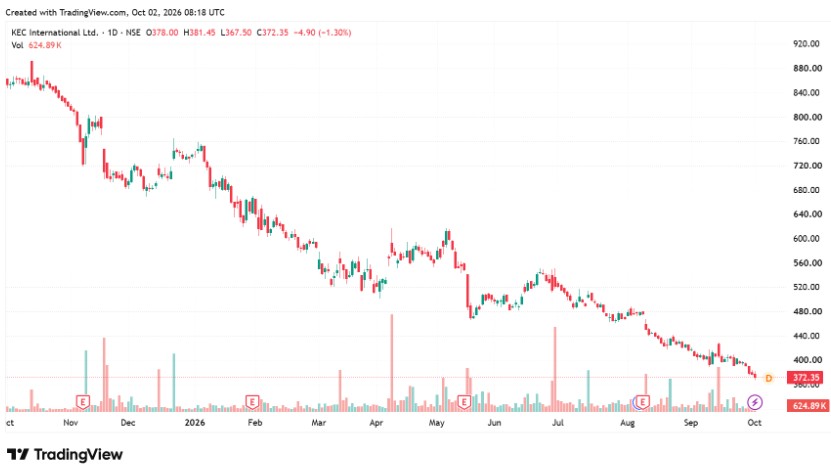
KEC shares have more than halved over the last year due to alleged governance issues and high valuations. First, in March 2025, it faced a bribery charge. Later, Power Grid Corporation of India banned the company from fresh tenders starting November 18, 2025, for nine months. PGCIL fully restored KEC’s eligibility to bid on fresh tenders on June 26, 2026. The stock, however, has yet to recover.
KEC’s valuation had surged to reach a price-to-earnings multiple of 76x by the end of 2025. But it has now reverted to 16.5x, below its 10-year median of 22.6x.
#2 Power Grid Corporation of India
Power Grid Corporation of India is India’s largest power transmission utility. The transmission business is the core of the company’s revenue and operational footprint, spanning an extensive inter-state transmission system and expanding intra-state networks. As of June 2026, it reported gross fixed assets of ₹3.25 lakh crore and 1,86,595 circuit kilometres (ckm) of transmission lines.
Capex Deployment Hits ₹7,765 Crore as FY27 Capitalisation Targets ₹30,000 Crore
During Q1FY27, the company accelerated project commissioning and capital deployment. It commissioned 1,635 ckm of transmission lines and 10,500 MVA of transformation capacity. The company’s capex stood at ₹7,765 crore in Q1FY27. Management has guided for ₹37,000 crore of capital expenditure in FY27.
Moreover, the company capitalised ₹5,277 crore in Q1FY27. Management aims to capitalise ₹30,000 crore of capex in FY27. Currently, the total value of active projects on hand stands at ₹1.75 lakh crore. Of this, work worth ₹50,419 crore falls under ‘Capital Work-in-Progress’ (i.e., capital projects currently underway).
For a transmission utility like Power Grid, capitalisation is the key trigger that unlocks earnings. A transmission asset cannot earn revenue while under construction. Capitalisation allows Power Grid to start billing power grid users for capacity charges (annual transmission tariffs).
Shift to Competitive Bidding: TBCB Projects Now Comprise 83% of Active Portfolio
Among these, tariff-based competitive bidding projects accounted for 83% of the active projects. Projects operating under the traditional regulated tariff mechanism contributed 14%. The remaining 3% share comes from smart metering, data centres, and battery energy storage systems. The company is primarily shifting towards competitive bidding.
The company maintains a total market share of around 47% in annual tariff across all inter-state transmission system tariff-based competitive bidding projects awarded since inception. Power Grid funds all tariff-based competitive bidding projects through internal cash accruals.
Financial Health: 82% Operating Margin Anchors Balance Sheet with 1.4x Leverage
On the financial side, consolidated transmission charges for Q1FY27 grew 3% year-on-year to ₹10,905 crore. Outstanding receivable days decreased to 12.1 days compared to 19.4 days in Q1 FY26, indicating improved recovery. The bidding pipeline is strong at ₹73,875 crore across 25 projects.
On a consolidated basis, the company’s total income grew 2.7% year-on-year to ₹11,497 crore. Operating profit grew 3.6% to ₹9,430 crore while margin expanded by 100 bps to 82%. Net profit fell by 1% to ₹3,598 crore. Its debt stood at ₹1,45,586 crore with a debt-to-equity ratio of 1.4x.
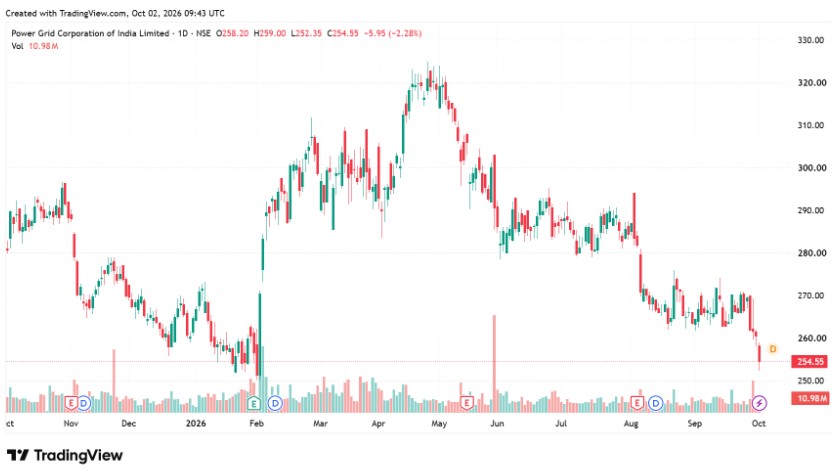
Power Grid shares have fallen 21.5% from its high of ₹325 to current levels amid a broader market sell-off and stagnant financials.
#3 Kalpataru Projects International
The T&D business vertical is Kalpataru Projects International (KPIL) largest segment. KPIL provides EPC services across power transmission, substations, and energy transition projects. It has extensive experience completing transmission contracts spanning over 38,000 kilometres.
Margins Expand to 8.8% as Net Profit Jumps 46% to ₹312 Crore
In Q1FY27, T&D revenue (excluding the Brazilian subsidiary) rose by 10% year-on-year to ₹2,924 crore. Reported revenue grew 4% year-on-year to ₹6,408 crore. This revenue increase was driven by improved project execution and a robust order backlog. EBITDA grew 7% to ₹562 crore while the margin expanded by 30 bps to 8.8%. Net profit grew 46% to ₹312 crore.
Backlog Crosses ₹66,600 Crore: Average Project Size Jumps 2.5x to ₹500 Crore
KPIL secured ₹4,163 crore in T&D orders during Q1FY27, representing 54% of total consolidated order inflows. T&D represents 44% (₹29,609 crore) of the company’s total ₹66,607 crore order book. Additionally, KPIL holds the L1 position in pipeline bids valued at more than ₹5,000 crore.
In total, KPIL received orders worth ₹7,668 crore in Q1FY27. KPIL is also favourably placed (L1) in additional project bids worth ₹7,300+ crore. KPIL is actively strengthening its market position in High Voltage Direct Current power transmission and design-build contracts. This integrated business makes Kalpataru well-positioned to benefit from the Green Energy Corridor expansion.
Net Debt-to-Equity Drops to 0.1x with 80-Day Working Capital
Due to these integrated capabilities, KPIL’s average project size has surged 2.5x to ₹500 crore per project. Its net debt-to-equity stands at 0.1x. Net Working Capital cycle improved to 80 days in Q1FY27, down from 91 days in Q1FY26.
Execution Reality: Profit Compression Behind the Volume Surge
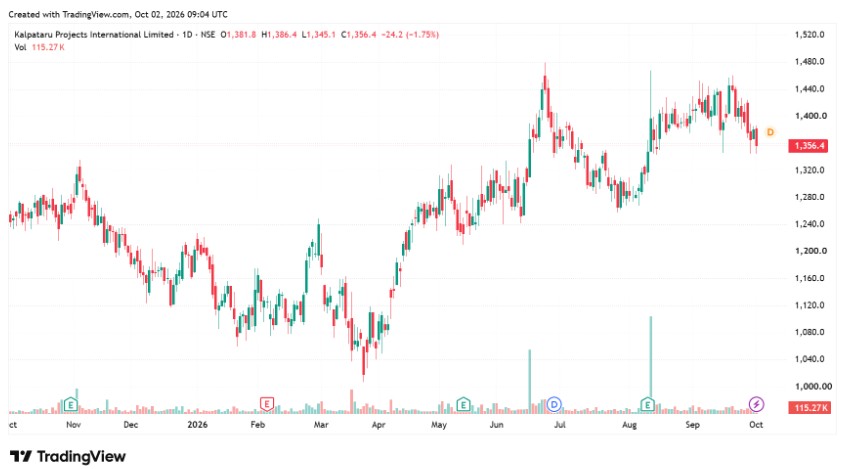
Kalpataru Projects has a higher Return on Capital Employed (ROCE) than KEC and Power Grid, while Power Grid leads in Return on Equity (ROE). Valuation-wise, KEC and Kalpataru trade at a discount to their respective 10-year median price-to-earnings (P/E) multiple, while Power Grid trades at a slight premium. Relative to the industry median, KEC and Kalpataru trade at a premium, while Power Grid trades at a discount.
| Peer Comparison (X) | |||||
| Company | Price-to-Earnings Multiple | Return Ratios | |||
| Company | 10Y Median | Industry | ROCE (%) | ROE (%) | |
| KEC International | 16.5 | 22.6 | 15.5 | 16.5 | 11.4 |
| Kalpataru | 20.8 | 23.1 | 15.5 | 18.3 | 13.7 |
| Power Grid | 14.9 | 14.3 | 24.6 | 9.1 | 15.3 |
| Source: Screener.in (Data as of October 01 2026) | |||||
The ₹1.36 lakh crore allocation for intra-state transmission creates a visible pipeline for grid expansion through FY33. For the three companies discussed, the opportunity is visible through their existing order books and project pipelines. KEC International has the largest T&D exposure within its order book, while Power Grid combines a large active project portfolio with a sizeable bidding pipeline.
Kalpataru Projects, meanwhile, enters this cycle with a strong T&D backlog and a relatively low net debt-to-equity ratio. However, the opportunity will depend on execution. KEC is working to improve margins, cash flows and working capital, while Power Grid needs to convert its project pipeline into commissioned assets.
Kalpataru has reported stronger profitability, but working capital and project execution remain important factors to track. You can keep these names on your watchlist to track their execution.
Disclaimer
Note: Throughout this article, we have relied on data from http://www.Screener.in and the company’s investor presentation. Only in cases where the data was unavailable have we used an alternative, widely used and accepted source of information.
The purpose of this article is only to share interesting charts, data points, and thought-provoking opinions. It is NOT a recommendation. If you wish to consider an investment, you are strongly advised to consult your advisor. This article is strictly for educational purposes only.
About the Author: Madhvendra has been deeply immersed in the equity markets for over seven years, combining his passion for investing with his expertise in financial writing. With a knack for simplifying complex concepts, he enjoys sharing his honest perspectives on startups, listed Indian companies, and macroeconomic trends.
A dedicated reader and storyteller, Madhvendra thrives on uncovering insights that inspire his audience to deepen their understanding of the financial world.
Disclosure: The writer and his dependents do not hold the stocks discussed in this article.
The website managers, its employee(s), and contributors/writers/authors of articles have or may have an outstanding buy or sell position or holding in the securities, options on securities, or other related investments of issuers and/or companies discussed therein. The articles’ content and data interpretation are solely the personal views of the contributors/ writers/authors. Investors must make their own investment decisions based on their specific objectives, resources, and only after consulting such independent advisors as may be necessary.