




The Blind Spot in Portfolio Trackers
Portfolio trackers work off exchange filings. That is their strength and their blind spot. A name appears, the tracker marks it new, and the assumption spreads that somebody just went out and bought it.
Sometimes nothing of the sort happens. On 7th September 2026, the company behind luxury fashion platform Pernia’s Pop-Up Shop, listed on the BSE and NSE. Mukul Agrawal appeared on the shareholder list that day. He did not buy anything that morning. He had been a shareholder since a private funding round in June 2022, and put in more in April 2023. Listing simply made a four-year-old private position visible to the rest of us.
The second move is a real market transaction, and far smaller than the headlines suggest. An SME board listed marketing agency, in which his disclosed holding went from 1.43% in March 2026 to 1.87% in August 2026. That is roughly 94,000 shares, worth about Rs 1.2 cr. The stock jumped nearly 9% on 3rd September when the disclosure did the rounds.
Let us dive into both stocks to see if we can find a pattern.
#1 Purple Style Labs: The Pre-IPO Long Term Conviction Bet
Incorporated in August 2015, Purple Style Labs runs Pernia’s Pop-Up Shop, a multi-brand luxury platform selling designer womenswear, menswear, jewellery and accessories, most of it aimed at weddings. It sells online and through physical Experience Centres, with new ones planned on Linking Road in Mumbai and in New York.
The Rs 680cr issue was entirely fresh capital. No early investor sold a share, so Agrawal did not take money off the table either. His position, disclosed in the offer document at 1.37% on a fully diluted pre-issue basis, was diluted by the new shares rather than sold. At the 8th September price of Rs 543, it is worth roughly Rs 59 cr.
The market’s verdict was lukewarm. The issue was subscribed 1.29 times, and the grey market premium had collapsed to zero by 3rd September. Anchor investors, who took 45% of the issue, put in Rs 306 cr on 28th August. The shares opened at Rs 535 on the NSE against an issue price of Rs 575, fell to Rs 516, recovered near the issue price, then slipped to Rs 543 the next session. As on 9th September 2026, the price was Rs 563.
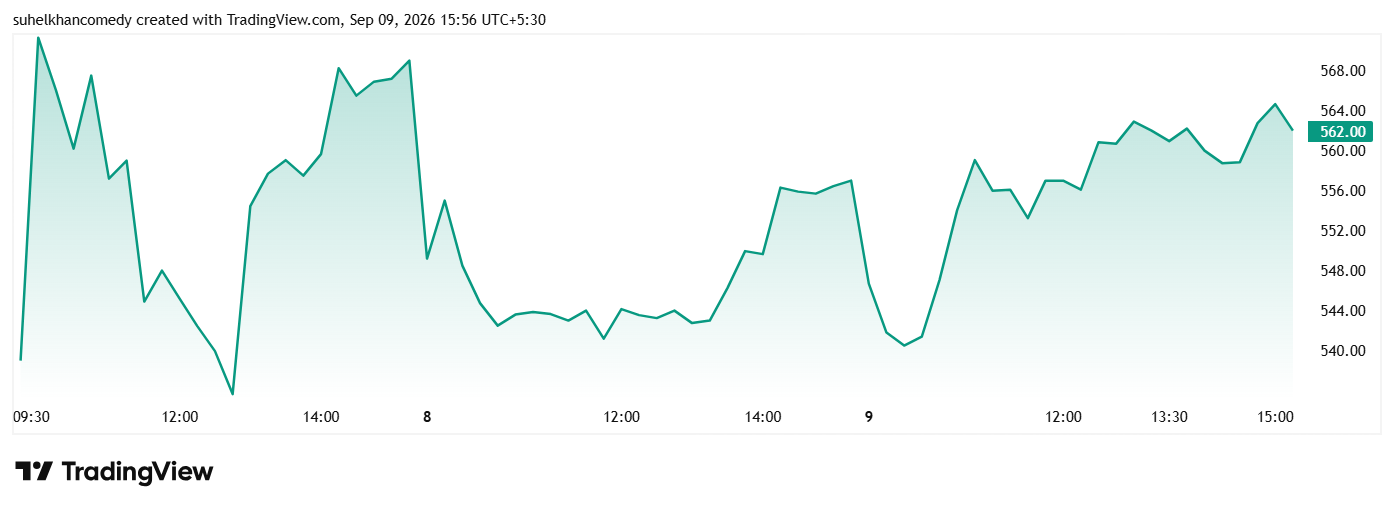
A Luxury Listing Without the Luster
I usually add a five-year sales, operating profit and net profit CAGR for every stock we cover, plus a ten-year median PE against the industry. Here I cannot, because the consolidated accounts run only four years, and the company was private until last week. There is no PE, because there are no profits, and no ten-year price history, because the stock is two days old.
Here are the four years that exist.
| Financial Year | FY23 | FY24 | FY25 | FY26 |
| Sales (Rs cr) | 369 | 504 | 490 | 558 |
| EBITDA (Rs cr) | 0 | 26 | 38 | 21 |
| Net Profit (Rs cr) | -41 | -48 | -188 | -285 |
EBITDA here means operating profit before other income. Sales have compounded at about 15% over three years, respectable but not spectacular for a company valued near eight times revenue. Note FY25, when sales fell 2.8%. Operating profit went backwards in FY26 even as sales grew, and the margin dropped from 8% to 3.8%.
The losses need to be spoken about, because they are not all operating losses. Interest of Rs 97 cr and depreciation of Rs 101 cr in FY26 came to Rs 198 cr against an operating profit of Rs 21 cr, and much of that depreciation reflects store leases.
On top sits a negative other income line of Rs 109 cr in FY26 and Rs 119 cr in FY25, the entry that appears when pre-IPO instruments are marked to fair value. That is not a cash cost. The interest bill is.
The Pre-IPO Cash Burn Reality
Borrowings climbed from Rs 287 cr in FY25 to Rs 784 cr in FY26. Reserves turned negative at Rs 121 cr, leaving negative net worth of about Rs 53 cr at the year end. Cash from operations has been negative in all four disclosed years, adding up to Rs 155 cr. Free cash flow over the same stretch was negative Rs 249 cr. Inventory sits on the books for 171 days.
Every one of those figures is pre-IPO. The Rs 680 cr of fresh money lands on top and changes the picture materially, which is why the next set of results matters so much. Until then, readers are looking at a company that has burned cash every year of its disclosed history, carrying a market value of Rs 4,345 cr on Rs 558 cr of sales.
#2 Yaap Digital: Buying the 38% Dip
Incorporated in 2016, Yaap Digital is a digital marketing, content and technology agency running campaigns, influencer work, performance marketing and analytics, with a hard push into AI-led tools. It has eight offices and over 400 people. India brings 76.42% of income, the UAE 19.24% and Singapore 4.12%.
Agrawal came in before the listing. In February 2026, Intelliquity Ventures bought 7,20,400 shares from promoters Sudhir Menon and Subodh Menon, about 4.68% of pre-issue capital. Sunil Singhania’s India Ahead Venture Fund took a matching block from promoter Atul Hegde.
The IPO, Rs 80.11 cr of fresh shares at Rs 145, was subscribed 4.26 times, then listed on 5th March 2026 at Rs 127, a 12.41% discount. The stock later ran to Rs 214 and has fallen back to Rs 132, down more than 38% from that high and still 9% below its issue price. The August addition was made into that fall.
The Receivables Trap: Where Did the Cash Go?
| Financial Year | FY21 | FY22 | FY23 | FY24 | FY25 | FY26 | 5Y CAGR |
| Sales (Rs cr) | 37 | 72 | 67 | 113 | 153 | 185 | 38% |
| EBITDA (Rs cr) | -2 | 9 | 4 | 6 | 16 | 28 | NM |
| Net Profit (Rs cr) | -2 | 6 | 3 | 3 | 12 | 22 | NM |
EBITDA here means operating profit before other income. The 38% sales CAGR is real and is recomputed from the annual figures. The profit CAGRs are marked NM (Not Meaningful) for a simple reason: FY21 was a loss year, and you cannot compound out of a negative number.
A five-year profit growth figure near 60% is doing the rounds on data screens. Ignore it. Measured from FY22, the first profitable year, operating profit compounded at about 33% and net profit at about 38%. Those are the honest numbers, and still very good.
Operating margin has climbed from 5% in FY24 to 15% in FY26. Other income of Rs 4 cr was 14% of pre-tax profit, so these are largely operating earnings. ROCE is 30.9% and ROE 28.2%. The stock trades at 14.9 times earnings against a median near 12.6 times for listed advertising and media agencies.
Now the problem. Cash from operations was negative Rs 35 cr in FY26 and negative Rs 5 cr in FY25, after being strongly positive in FY23 and FY24. Debtor days have gone from 33 in FY24 to 156. Working capital days swung from negative 64 to positive 62. Profit is being reported. Cash is not yet arriving behind it.
Profit on Paper, Missing Cash
Data screens flag a warning that promoter holding fell 1.22 percentage points, from 59.02% in March to 57.80% in August. That looks like promoters selling into the rally. It is not.
Yaap issued new shares as part of the Gozoop deal, lifting the share count about 2.2%. Apply that dilution to the March holding and you get an expected 57.76%, against an actual 57.80%. The promoters did not sell a share. The same test tells a different story about foreign investors, whose expected figure was 9.29% against an actual 7.61%. FIIs did sell, and meaningfully.
That deal is the other thing to understand. On 30th March 2026, Yaap bought 60.20% of Gozoop Online for Rs 36.96 cr in cash, part of a first tranche worth Rs 56.62 cr. The board approved buying all of Gozoop in three tranches over three years, with later prices tied to FY26 and FY27 performance.
Gozoop is now a subsidiary, and shareholders are being asked at the 29th September AGM to approve related party transactions with it of up to Rs 100 cr. On 7th September the company said it had won the digital and media mandate for Parle’s candy business.
The Gozoop Deal and Forward Outlook
The share price of Yaap Digital post listing was about Rs 133 and as on 9th September 2026 I was Rs 132.
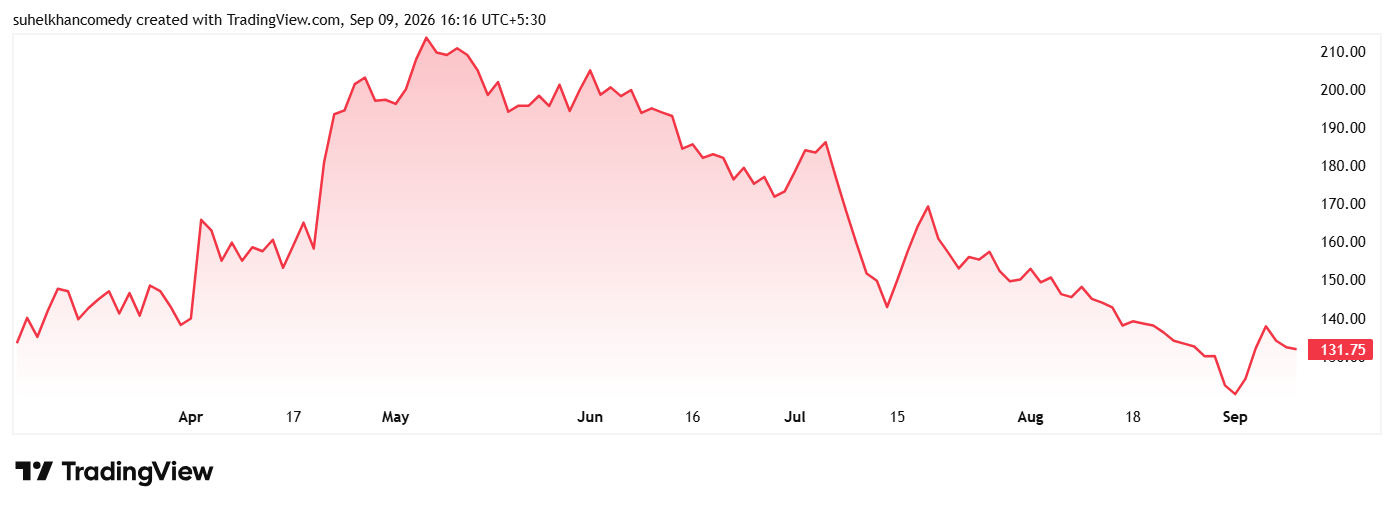
The stock is trading at a PE of 15x currently which is the same as the industry median. A long term median would not be of use here as the stock was listed recently, but the 10-year industry median is 19x.
The SME Board Liquidity Trap
Yaap trades on NSE Emerge, and the platform works differently from the main board in ways that matter.
The minimum trade is one lot of 1,000 shares, about Rs 1.32 lakh at the current price. There is no buying a token quantity. Results come half-yearly, so a bad six months can pass with no interim disclosure. Shareholding patterns follow a lighter calendar too, which is why the last update is dated August rather than a quarter end. SME firms also get exemptions from several governance rules that bind main board companies.
Liquidity is the sharpest risk. Yaap had 430 shareholders in August, up from 350 in March. That is an extraordinarily narrow base. Both the 9% jump on the stake news and the 38% fall from the high are what a thin register does to a price. Pre-IPO holders, including the February blocks, come out of lock-in on a set calendar, and selling into a register this small moves the price hard.
The Early Advantage Gap
Side by side, these are not two versions of the same trade. One is a venture position from 2022 just repriced by a public market that was distinctly unenthusiastic. The other is a modest addition to a profitable small company after its stock had already fallen 38%.
The common thread is that Agrawal was early in both, before either had a ticker, at prices the rest of us never saw. Anyone reading the filings today buys at Rs 543 and Rs 132. That is the gap the trackers never show.
What comes next is at least knowable. Purple Style Labs must show what Rs 680 cr does to a balance sheet carrying negative net worth and Rs 784 cr of borrowings. Yaap must show that Gozoop converts reported profit into collected cash.
A sensible way to follow either is to add them to a watchlist and let the numbers do the talking.
Disclaimer:
Note: We have relied on data from http://www.Screener.in and http://www.trendlyne.com throughout this article. Only in cases where the data was not available, have we used an alternate, but widely used and accepted source of information.
The purpose of this article is only to share interesting charts, data points and thought-provoking opinions. It is NOT a recommendation. If you wish to consider an investment, you are strongly advised to consult your advisor. This article is strictly for educative purposes only.
Suhel Khan has been a passionate follower of the markets for over a decade. During this period, he was an integral part of a leading Equity Research organisation based in Mumbai as the Head of Sales & Marketing. Presently, he is spending most of his time dissecting the investments and strategies of the Super Investors of India.
Disclosure: The writer and his dependents do not hold the stocks discussed in this article. The website managers, its employee(s), and contributors/writers/authors of articles have or may have an outstanding buy or sell position or holding in the securities, options on securities or other related investments of issuers and/or companies discussed therein.