



The Jindal Paradox: When the Crown Jewel Rallies and the Holdcos Sink
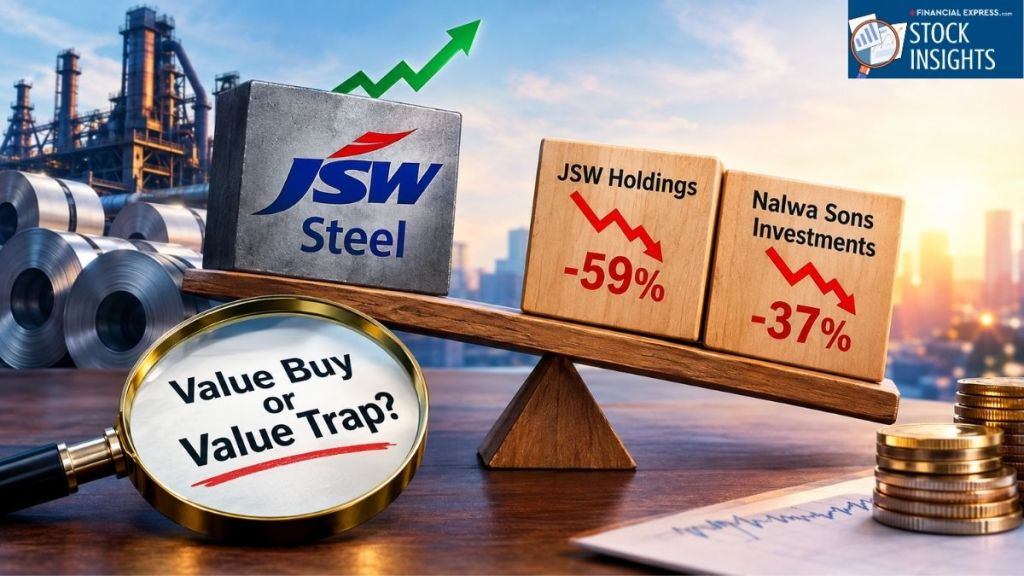
JSW Steel was trading at Rs 1,280 on the morning of 21st September 2026, not too far from its 52-week high of Rs 1,351. You would expect the companies that own large chunks of it to be in good shape too. But two investment companies of the O.P. Jindal family, which carry no meaningful debt, are not.
These are companies that have made patient shareholders plenty of money, with five-year gains in triple digits. Yet one of them sits about 59% below its 52-week high while the other is 45% below its November 2024 peak.
The market values each company at roughly half of what its JSW Steel shares alone are worth. Gaps like that excite value hunters. They can also last for decades. So, is this a mispricing waiting to close, or a discount with good reasons behind it? Let us dig in.
#1 JSW Holdings: The 0-Debt Giant Trading at a 54% Discount to Its Core Stake
Incorporated in 2001 as Jindal South West Holdings, JSW Holdings is the investment arm of Sajjan Jindal’s JSW group. It sells no product. Its job is to hold shares in group companies, collect dividends, and lend money within the group.
Its crown jewel is its holding in JSW Steel.. As of March 2026, it owned about 18.14 cr shares, or 7.42% of the steelmaker. At the closing price of 18th September 2026, that single block is worth about Rs 23,150 cr. JSW Holdings itself had a market cap of Rs 12,523 cr that day.
The market is valuing the whole company at about 54% of its JSW Steel stake. Its other group holdings and its growing loan book are, in effect, thrown in for free.
Shareholders’ funds stood at close to Rs 31,980 cr at the end of FY26, so the stock trades at about 0.39 times book value. Borrowings are nil and have been for at least twelve years.
Why JSW Holdings is Morphing into a Group Lender
Its income is mostly dividends and interest, so profit tracks what group companies pay out, not steel demand.
5-Year Financials for JSW Holdings
| Financial Year | FY21 | FY22 | FY23 | FY24 | FY25 | FY26 | 5Y CAGR |
| Revenue (Rs cr) | 93 | 186 | 407 | 170 | 248 | 179 | 14% |
| Operating Profit (Rs cr) | 88 | 180 | 401 | 157 | 234 | 165 | 13% |
| Net Profit (Rs cr) | 66 | 135 | 300 | 119 | 175 | 122 | 13% |
Source: Screener.in (Standalone)
Operating profit here is profit before other income, the closest match to EBITDA for a holding company. On paper, revenue grew at 14% a year and profit at 13%. But FY21 is a soft base, when revenue dipped to Rs 93 cr from Rs 121 cr a year earlier. FY23 was an outlier at Rs 407 cr.
According to the company’s investor update, interest made up about 61% of revenue in the nine months to December 2025, up from about 42% in FY25. Dividends fell to about 35% from 54%. JSW Holdings is becoming as much a group lender as a group shareholder.
In the June 2026 quarter, revenue rose about 15% year on year to Rs 35 cr, and net profit about 9% to Rs 21 cr.
The SEBI Call Auction Effect: Dissecting the 59% Crash from 2025 Highs
The share price of JSW Holdings was around Rs 4,750 in September 2021 and as on 21st September 2026 it was Rs 11,175, a gain of about 140% in 5 years.
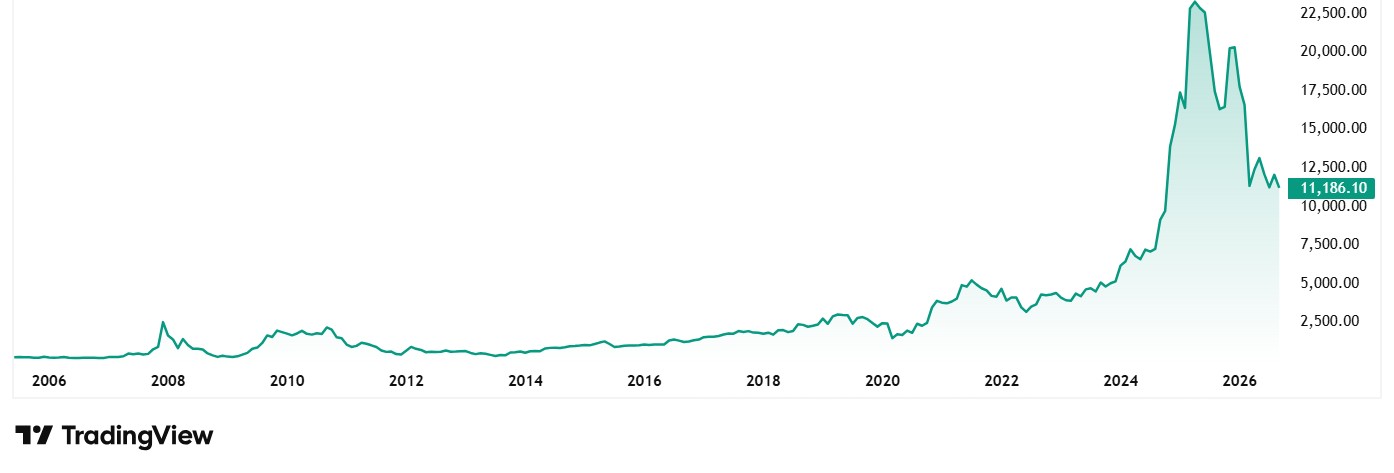
The ride has been a roller coaster. SEBI’s June 2024 framework for special call auctions, meant to help holding companies find a fair price, sparked a rush into holding companies. JSW Holdings hit a record Rs 27,740 on 21st April 2025. It has since lost about 59%, and its 52-week high of Rs 22,839 is roughly double today’s price.
As for valuation, the stock trades at a PE of about 99x against the current industry median of 25x. The 10-year median PE for the company is 36x while the industry median for the same period is 21x. But PE is a weak yardstick here, since earnings are a thin stream of dividends and interest. Price to book, at 0.39x, matters more.
The Rs 2,000 Crore Catalyst: Pledged Shares and the Wait for Value Unlocking
The big question is, what went wrong? JSW Holdings has not paid a dividend in any of the last twelve years, so minority shareholders see little of the cash its holdings throw off. The promoter group owns 66.28% and has every reason to keep the JSW Steel block for control, so a sale that would release that value looks unlikely.
Then there is the loan book. At its annual general meeting on 6th August 2026, shareholders approved related party deals that allow the company to lend up to Rs 2,000 cr to JSW group firms and to pledge up to 10 cr JSW Steel shares as security for loans taken by them. That is more than half of its JSW Steel holding. The promoter group abstained, and the resolutions still passed.
Group lending is not new here; the company sought a similar Rs 2,500 cr approval back in 2014. But anyone buying the stock for its JSW Steel stake should know that much of that stake can back other companies’ loans.
Retail investors do not seem put off. Shareholder numbers rose from 22,550 in March 2025 to 28,192 in June 2026 as the price slid. And on 16th September 2026, when the exchanges asked about a spike in trading volume, the company told BSE the move was market-driven.
#2 Nalwa Sons Investments: The Mid-Cap Holdco Offering JSW Steel at Half Price
Incorporated in 1970 as Jindal Strips, Nalwa Sons Investments took its present name in 2005 after its manufacturing business was reorganised. Today, it is a mid-sized, RBI-registered non-banking finance company. It holds strategic stakes mainly in O.P. Jindal group firms, including JSW Steel, Jindal Steel (13,10,000 shares worth Rs 149 cr) and Jindal Stainless (50,35,975 shares worth Rs 374 cr) and lends to group companies.
With a market cap of Rs 2,840 cr, it is less than a quarter the size of JSW Holdings. But its discount is deeper. Nalwa Sons owns about 4.55 cr JSW Steel shares, roughly 1.86% of the company. At Rs 1,276 a share, that stake alone is worth about Rs 5,800 cr, or more than twice its market cap.
You pay less than Rs 49 for every Rs 100 of JSW Steel inside it, and nothing for the rest of the portfolio. Shareholders’ funds were about Rs 15,170 cr at the end of FY26, putting the stock at around 0.19 times book. Borrowings were just Rs 3 cr in FY26, so it is effectively debt-free.
Shrinking Investment Books and Slower Net Profit Growth
Growth here has been slower and bumpier.
| Financial Year | FY21 | FY22 | FY23 | FY24 | FY25 | FY26 | 5Y CAGR |
| Revenue (Rs cr) | 67 | 97 | 134 | 89 | 125 | 101 | 9% |
| Operating Profit (Rs cr) | 46 | 80 | 125 | 75 | 64 | 76 | 11% |
| Net Profit (Rs cr) | 43 | 66 | 93 | 56 | 46 | 57 | 6% |
Source: Screener.in (Consolidated)
Operating profit is profit before other income. Revenue grew at about 9% a year over five years and net profit at about 6%. Profit peaked at Rs 93 cr in FY23, and the March 2025 quarter swung to a loss of Rs 26 cr after expenses jumped to Rs 43 cr. FY26 recovered to Rs 57 cr. In the June 2026 quarter, net profit was Rs 27 cr, up about 3% from a year ago, even as revenue slipped about 7%.
The investment book also shrank in FY26, from about Rs 18,510 cr to Rs 16,740 cr, pulling reserves down by roughly Rs 1,500 cr.
The 37% Correction: Why Nalwa Sons Cooled Off After the November 2024 Peak
The share price of Nalwa Sons has compounded at about 26% a year over five years, which means it has roughly tripled. As on 21st September 2026, it stood at Rs 5,526.
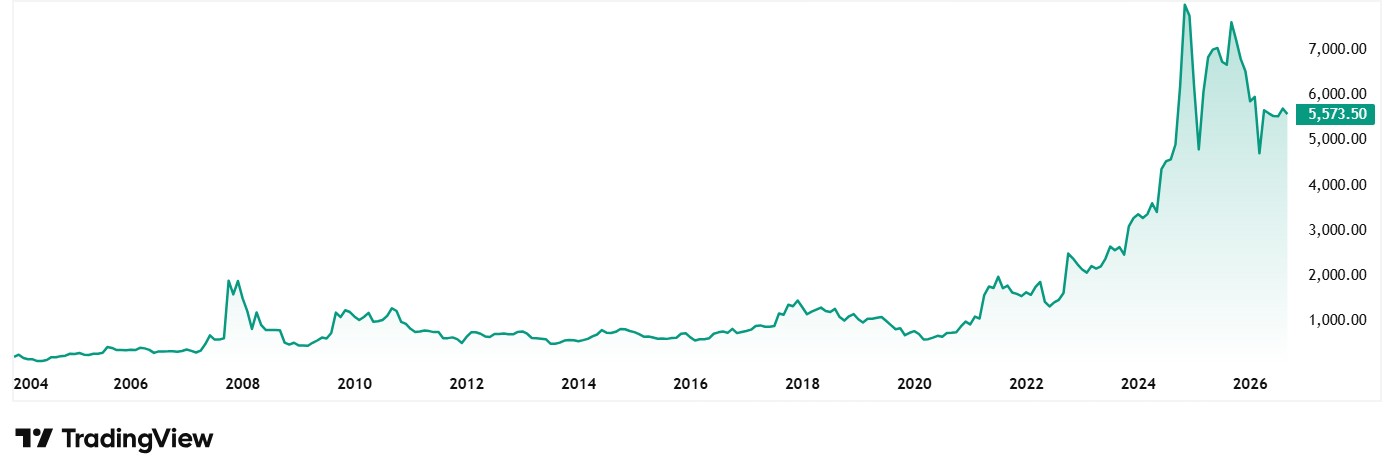
Nalwa Sons was among the holding companies swept up in the call auction rally, and it hit a record Rs 9,950 on the BSE on 19th November 2024. It was also eligible for the October 2025 call auction session, touching its 52-week high of Rs 8,777.60 on 17th October 2025, less than two weeks before that session. Since then, the price has fallen 37%.
On valuation, the stock trades at a PE of about 51x against the current industry median of 25x. The 10-year median PE for the company is 24x, compared with an industry median of 21x for the same period. Here too, price to book says more.
Thin Liquidity, Zero Dividends, and the 55th AGM
Nalwa Sons holds its 55th annual general meeting on 30th September 2026, according to its BSE filing, with the reappointment of whole-time director Mahender Kumar Goel on the agenda. Like JSW Holdings, it has paid no dividend in any of the last twelve years.
Trading is thin. Promoters own 55.61%, foreign investors 6.20% and domestic institutions just 0.16%, so a handful of orders can move the price sharply. Shareholder numbers jumped from about 24,100 in March 2024 to 38,400 a year later as retail money chased the holdco trade, before easing to 35,859.
Holdco Trap or Deep Value? Key Triggers to Watch
Side by side, the pattern is clear. Both own JSW Steel shares worth about twice their own market value. Both are debt-free and have rewarded five-year holders well. And both have handed back much of those gains as the holdco frenzy cooled.
JSW Holdings is bigger, trades more, has foreign investors holding 22.28%, and is turning into a group lender, with approval to pledge more than half of its crown jewel. Nalwa Sons is smaller, cheaper on book value, slower growing and far thinner in trading.
Holding company discounts are an old puzzle. They tend to close only when something forces the issue: a steady dividend, a buyback, a merger, a delisting, or a sale of the underlying stake. Neither company has announced any of these. Until one does, the discount may be less a mistake by the market than a fair price for wealth that minority shareholders cannot easily reach.
The practical move is to add both stocks to a watchlist and track three things: any change in dividend policy, how the Rs 2,000 cr lending approval is used, and whether the next call auction window brings buyers back.
Disclaimer
Note: We have relied on data from www.Screener.in and www.trendlyne.com throughout this article. Only in cases where the data was not available, have we used an alternate, but widely used and accepted source of information, including filings made available on the BSE website.
The purpose of this article is only to share interesting charts, data points and thought-provoking opinions. It is NOT a recommendation. If you wish to consider an investment, you are strongly advised to consult your advisor. This article is strictly for educative purposes only.
Suhel Khan has been a passionate follower of the markets for over a decade. During this period, He was an integral part of a leading Equity Research organisation based in Mumbai as the Head of Sales & Marketing. Presently, he is spending most of his time dissecting the investments and strategies of the Super Investors of India.
Disclosure: The writer and his dependents do not hold the stocks discussed in this article.
The website managers, its employee(s), and contributors/writers/authors of articles have or may have an outstanding buy or sell position or holding in the securities, options on securities or other related investments of issuers and/or companies discussed therein. The content of the articles and the interpretation of data are solely the personal views of the contributors/ writers/authors.