



India’s telecom equipment industry is entering a major growth phase. A recent KPMG report projects that India’s telecom equipment market could double from $25 billion in FY25 to $50 billion by FY32.
The opportunity goes beyond expanding telecom networks. India is also strengthening its position as a manufacturing hub for 5G equipment.
The shift is already visible. At India Mobile Congress 2026, Ericsson announced that its Indian manufacturing ecosystem had produced over 15,000 antennas and 25 million components since July 2025. India-made antennas are also being exported to Europe and other global markets.
This raises an important question for investors. Which listed Indian companies are directly involved in manufacturing the equipment that powers 5G networks?
To identify them, we examined 17 telecom-related listed companies. However, not every company benefiting from telecom expansion qualifies as a 5G equipment manufacturer.
Several companies primarily manufacture optical fibre, cables and general networking infrastructure. While these products support telecom expansion, they do not necessarily represent direct exposure to 5G-specific equipment manufacturing.
For this article, we have focused on three larger, mainboard-listed companies and excluded SME stocks. These companies have identifiable involvement in manufacturing 5G devices, radio equipment and networking solutions. Their operations also offer exposure to domestic manufacturing growth and international demand.
The selection is not based on financial strength alone. It focuses on direct participation in the 5G equipment manufacturing value chain. These three offer different types of exposure to the opportunity. They also differ significantly in operating scale, growth and profitability.
However, a growing market does not guarantee stronger earnings. Some of these companies are already reporting healthy growth, while others face declining revenue or continuing losses. Execution, competition and profitability remain important risks.
Can these four companies capitalise on India’s growing 5G manufacturing opportunity while navigating their individual challenges?
Let’s take a closer look at their businesses, financial performance and growth prospects.
#1 HFCL: Over 8 Lakh 5G Devices Delivered, FY26 Profit Rises 90%
HFCL (Himachal Futuristic Communications) is a diverse telecom infrastructure enabler with active interest spanning telecom infrastructure development, system integration, and manufacture and supply of high end telecom equipment, Optical Fiber and Optic Fiber Cable (OFC).
Commercial 5G Deliveries Strengthen Manufacturing Exposure
According to its FY26 annual report HFCL has supplied over 8 lakh indigenously developed 5G fixed wireless access (FWA) devices to a leading Indian telecom operator. These devices enable high-speed broadband connections over 5G networks.
The company also manufactures IP/MPLS routers designed for 5G backhaul networks. It delivered approximately 17,000 routers during FY26, supporting broadband infrastructure projects, including BharatNet.
Global Orders and Manufacturing Expansion Support Growth
Exports contributed 41.36% of FY26 revenue, compared with 12.2% in FY25. HFCL’s total order book reached Rs 26,665 crore by June 2026.
During Q2 FY27, HFCL secured a Rs 2,329 crore overseas optical fibre cable agreement in September. According to a BSE filing it also approved additional capital expenditure of Rs 820 crore, taking planned manufacturing investments to Rs 1,800 crore.
Annual optical fibre and cable capacities are targeted to reach 43.1 million and 62 million fibre kilometres, respectively, by July 2028. A 600-tonne annual preform facility is expected by October 2028.
In FY26, HFCL’s consolidated revenue increased 21.77% YoY to Rs 4,949.3 crore. Net profit rose 90.14% YoY to Rs 329.44 crore. The improvement was supported by a growing share of product sales, higher exports and better operating leverage. Products contributed around 62% of revenue, while exports accounted for approximately 41%
HFCL has yet to announce its Q2 FY27 results. While its 5G equipment deliveries demonstrate commercial traction, much of its expansion targets broader connectivity demand. The company does not separately disclose 5G revenue. Timely capacity expansion, export demand and order execution remain important factors.
HFCL Financial Performance
| Metric | FY26 |
| Revenue | Rs 4,949.3 crore |
| Revenue growth | 21.8% YoY |
| Net profit | Rs 329.4 crore |
| Profit growth | 90.14% YoY |
Source: HFCL FY26 Annual Report
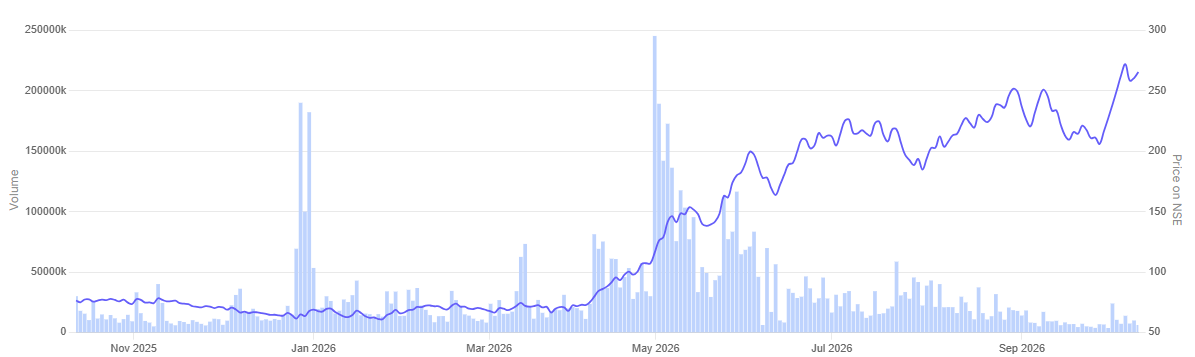
In the past year, the share price of HFCL rallied 248%.
HFCL 1-Year Share Price Chart
Source: Screener.in
#2 Tejas Networks: Global 5G Orders Amid 87.6% Revenue Decline
Incorporated in 2000, Tejas Networks designs and manufactures wireline and wireless networking products, with a focus on technology, innovation and R&D. Its carrier-class products are used by telecom service providers, utilities, governments, and defence networks in 75+ countries. It is currently a part of the Tata group.
Indigenous 5G Equipment Supports the Growth Opportunity
The company’s FY26 annual report highlights its development of 5G Massive MIMO radios and a converged 4G/5G core. These products support higher network capacity and faster data transmission.
Tejas has also deployed 5G RAN equipment in private networks and railway safety applications. Its involvement in BSNL’s indigenous 4G network demonstrates its ability to execute large telecom projects. However, the BSNL deployment primarily relates to 4G, rather than commercial 5G services.
Global 5G Orders Accompany Fresh Domestic Business
In its July earnings call, Tejas reported 5G radio shipments to Europe through its NEC partnership. It also secured its first end-to-end 5G network order in South America, covering radio, baseband and core equipment. Its partnership with Rakuten Symphony supports international expansion through Open RAN solutions.
During Q2 FY27, Tejas received a Rs 1,537 crore letter of intent from TCS for equipment covering 18,685 BSNL 4G sites. The detailed purchase order was awaited at the time of disclosure.
On October 8, Tejas demonstrated 6G sensing technology with Qualcomm, using its existing 5G base station. However, this remains a technology demonstration rather than a commercial order.
FY26 consolidated revenue declined 87.6% YoY to Rs 1,103.3 crore. Net profit fell 303.5% YoY, resulting in a loss of Rs 908.9 crore against a profit of Rs 446.5 crore in FY25. The decline followed the completion of major BSNL equipment supplies and delays in new project awards.
Tejas has yet to declare its Q2 FY27 results. Its FY26 net debt of Rs 3,531 crore remains a concern. While overseas 5G orders create growth opportunities, profitability depends on timely execution, fresh orders and improved working capital management.
Tejas Networks Financial Performance
| Metric | FY26 |
| Revenue | Rs 1,103.3 crore |
| Revenue growth | -87.6% YoY |
| Net profit/(loss) | Rs -908.9 crore |
| Profit growth | -303.5% YoY |
Source: Tejas Networks FY26 Annual Report
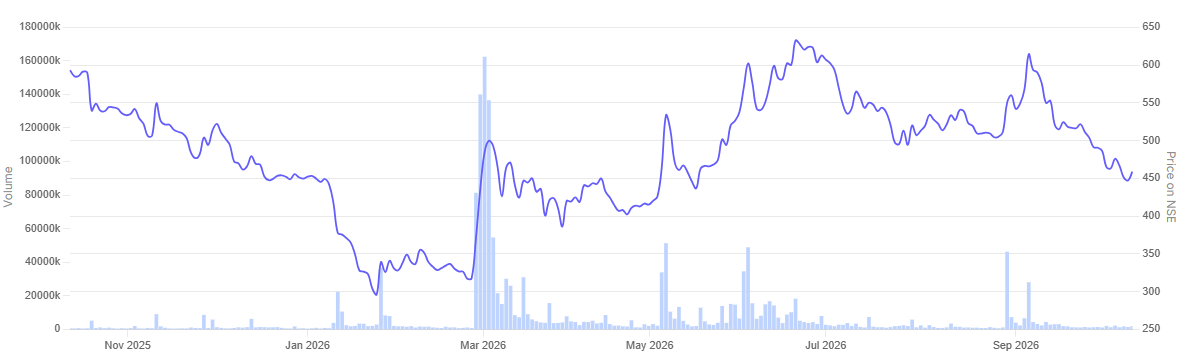
In the past year, the share price of Tejas Networks is down 22.5%.
Tejas Networks 1-Year Share Price Chart
Source: Screener.in
#3 Dixon Technologies: 5G Equipment Manufacturing Backed by 25.8% Revenue Growth
Dixon Technologies (India), incorporated in 1993, is an electronic manufacturing services (EMS) company with operations in the electronic products vertical such as consumer electronics, lighting, home appliance, closed-circuit television cameras (CCTVs), and mobile phones.
It also undertakes reverse logistics operations. Additionaly, it manufactures security surveillance equipment, wearables & audibles, AC-PCBs. Recently, it has entered a JV with Imagine Marketing for designing and manufacturing wireless audio solutions in India.
5G Equipment Manufacturing Supports Telecom Growth
The company’s FY26 annual report identifies telecom and networking as a key growth business. Through Dixon Electro Appliances, its 51% subsidiary, it manufactures 5G FWA devices, routers, broadband equipment and microwave backhaul radios.
The telecom division has an annual installed capacity of 22 million units across product categories. Dixon is expanding beyond customer-premise equipment into higher-value network infrastructure. This includes equipment supporting 5G connectivity and network backhaul.
Global Partnerships Expand Manufacturing Opportunities
During Q2 FY27, Dixon’s subsidiary signed an intellectual property licensing agreement with Aviat Networks on September 30. The agreement permits local manufacturing and sale of specified microwave radios.
Following the quarter-end, Dixon signed a 60:40 joint venture agreement with Taiwan’s Gemtek on October 7. The venture will manufacture optical transceivers and related telecom components. These products support high-speed connectivity across telecom networks and data centres.
FY26 consolidated operating revenue increased 25.8% YoY to Rs 48,872.8 crore. Reported net profit attributable to shareholders rose 31.3% to Rs 1,438.6 crore. However, adjusted profit after minority interest increased 20% to Rs 845 crore, excluding non-operating gains.
Dixon has yet to declare its Q2 FY27 results. Although its telecom manufacturing business is expanding, smartphones remain its largest revenue contributor. The company does not separately disclose 5G equipment revenue. Growth will depend on order execution, scaling new partnerships and managing input costs.
Dixon Technologies Financial Performance
| Metric | FY26 |
| Revenue | Rs 48,872.8 crore |
| Revenue growth | 25.8% YoY |
| Reported net profit* | Rs 1,438.6 crore |
| Profit growth | 31.3% YoY |
| Adjusted net profit* | Rs 845 crore |
| Adjusted profit growth | 20% YoY |
*After minority interest. Source: Dixon FY26 Annual Report and FY26 Earnings Presentation.
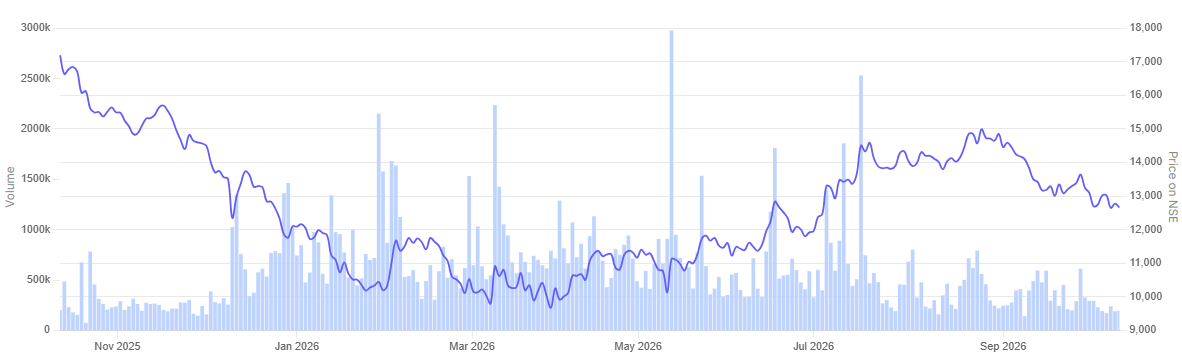
In the past year, the share price of Dixon Technologies is down 26.4%.
Dixon Technologies 1-Year Share Price Chart
Source: Screener.in
What Should Investors Watch?
India’s expanding 5G manufacturing ecosystem presents opportunities for domestic equipment makers. However, the ability to benefit from this growth differs across companies.
HFCL has demonstrated commercial traction in 5G equipment and is expanding its manufacturing capacity. Tejas Networks has developed indigenous 5G technology and secured international orders, but its financial performance remains under pressure. Dixon Technologies brings manufacturing scale and global partnerships, although 5G equipment represents only part of its wider business.
The next phase of growth will depend on how effectively these companies convert opportunities into revenue and profits. Timely order execution, export growth, capacity utilisation and operating margins will be important indicators.
Investors should also consider valuations, competition from global equipment makers and the capital required for expansion. A growing 5G market does not automatically translate into stronger earnings or higher stock returns.
You can track how these are progressing by adding stocks to your watchlist.
Disclaimer
Note: We have relied on data from www.Screener.in throughout this article. Only in cases where the data was not available, have we used an alternate, but widely used and accepted source of information.
The purpose of this article is only to share interesting charts, data points and thought-provoking opinions. It is NOT a recommendation. If you wish to consider an investment, you are strongly advised to consult your advisor. This article is strictly for educative purposes only.
Ekta Sonecha Desai has a passion for writing and a deep interest in the equity markets. Combined with an analytical approach, she likes to deep dive into the world of companies, studying their performance, and uncovering insights that bring value to her readers.
Disclosure: The writer and her dependents do not hold the stocks discussed in this article.
The website managers, its employee(s), and contributors/writers/authors of articles have or may have an outstanding buy or sell position or holding in the securities, options on securities or other related investments of issuers and/or companies discussed therein. The content of the articles and the interpretation of data are solely the personal views of the contributors/ writers/authors. Investors must make their own investment decisions based on their specific objectives, resources and only after consulting such independent advisors as may be necessary.