



India’s semiconductor ambitions are moving beyond chip fabrication. The government’s ₹76,000 crore India Semiconductor Mission (ISM 1.0) has already laid the foundation for building a domestic semiconductor ecosystem.
Meanwhile, the ₹1.27 lakh crore ISM 2.0 has focused on chip design, advanced packaging, semiconductor equipment, materials, chemicals and other essential inputs. This matters because India’s dependence on imports extends well beyond semiconductors themselves.
Several materials and precision-engineered components used in electronics and semiconductor manufacturing are still sourced from overseas. For instance, more than 90% of India’s estimated ₹5,000 crore copper-clad laminate demand is currently met through imports.
The Broader Ecosystem: Beyond Chip Fabrication
As semiconductor and electronics manufacturing capacity expands in India, the opportunity is shifting towards companies that can supply these critical components locally. Copper-clad laminates form the base material for printed circuit boards. In contrast, precision-engineered components are used across semiconductor equipment and electronic devices.
Two engineering companies are positioning themselves in these emerging segments. One is building a copper-clad laminate facility aimed at import substitution. The other is expanding its precision manufacturing capabilities across electronics and semiconductor applications. Let’s take a look.
#1 Ratnaveer Precision: Targeting a ₹5,000 Crore Base Material Gap
Ratnaveer Precision Engineering (RPEL) manufactures stainless steel engineering products. RPEL is India’s largest exporter of stainless steel washers, offering over 3,300 washer SKU variants and producing more than 180 crore units annually. Its fastener lineup includes nuts, bolts, and specialised solar mounting hooks.
The product portfolio also encompasses stainless steel tubes, pipes, finishing line sheets, and custom sheet metal components. The business is fully integrated, transforming stainless steel scrap through in-house melting and rolling divisions to produce raw coils, sheets and wires for finished products.
Q1FY27 Performance: Stable Margins and Double-Digit Profit Surge
Its products support critical industries such as railways, defence, aerospace, pharmaceuticals, and chemical engineering. Consolidated revenue from operations grew 18.9% year-on-year to ₹314.6 crore in Q1FY27. EBITDA (Earnings Before Interest, Tax, Depreciation, and Amortisation) rose 31.7% to ₹35.9 crore, with margins at 11.4%. Net profit surged 22% to ₹18.2 crore.
The Import-Substitution Play: India’s First Integrated CCL Facility
The company is setting up India’s first integrated FR-4 Copper-Clad Laminate (CCL) facility in Gujarat, aimed at reducing the country’s dependence on imports. CCL is an electronics-grade base material that serves as the core substrate in every Printed Circuit Board (PCB). PCB is the core of semiconductor and electronic components.
Currently, more than 90% of India’s ₹5,000 crore domestic demand is met through imports. The domestic CCL market is projected to reach ₹29,880 crore by 2031. Commercial production is targeted for November 2026. The plant has 5 lines with an aggregate annual capacity of 79.2 lakh sheets, representing 1.8% of Indian market demand.
Management Guidance: Targeting ₹2,500 Crore Consolidated Revenue
RPEL has partnered with a Chinese technology firm for equipment, installation, formulations, and 18-24 months of post-commissioning customer approval support. Management estimates the CCL division will generate revenue of ₹750 crore, with an estimated EBITDA margin of 20% and a PAT margin of 11-13%.
In addition to CCL, the company estimates the revenue of the core stainless steel business to grow at 25% CAGR to ₹1,800 crore. Consolidated revenue is projected to reach ₹2,500 crore (up from ₹1,069 crore in FY26) within 2.5 to 3 years with a 13-13.5% EBITDA margin and a 9.7-10.5% net profit margin.
#2 INDO-MIM: Leveraging a 33% Margin in Precision Hardware
INDO-MIM is a global precision engineering components manufacturer offering end-to-end component solutions. It holds the world’s largest installed Metal Injection Molding capacity and leads the global industry with a 6.8% market share in CY25.
The company provides turnkey manufacturing solutions, from product design and mold tooling to material selection, secondary finishing, assembly, and packaging. INDO-MIM supplies components across a broad range of sectors: Automotive, Medical, Aerospace, Defence, Consumer Products and Industrial.
In addition to maintaining the largest MIM plant, INDO-MIM is driving growth by expanding into allied technologies. This includes ceramic injection molding, precision investment casting, precision machining, additive manufacturing/3D printing, and powder manufacturing.
Global Scale and Allied Technology Expansion
Moreover, providing complete end-to-end solutions unlocks market segments unavailable to pure-play MIM manufacturers. INDO-MIM has 15 manufacturing facilities globally, including 6 in India, 6 in the US, 2 in the United Kingdom and 1 in Mexico. An additional iron powder manufacturing facility is under development at Gowribidanur, Karnataka.
Sector Diversification and the Semiconductor Catalyst
Its revenues are spread across multiple end-use industries, including Automotive (24.6%), Defence (18.7%), Medical (18.1%), Consumer Products (10.8%) and Aerospace (11.9%). In the semiconductor industry, it manufactures essential hardware components that surround, protect, and cool semiconductor devices.
INDO-MIM’s manufacturing capabilities include electronic component manufacturing and sub-assembly services. The company also notes tailwinds from ISM 1.0 and ISM 2.0.
The company also supplies precision-engineered components for the broader electronics ecosystem. Its portfolio includes precision connectors, interface shells, cooling fan parts, camera stands and smartphone hinges used in computing and wearable devices.
Q1FY27 Financials: 400 bps Margin Expansion
Coming to its Q1FY27 financials, revenue from operations grew by 9.4% year-on-year to ₹1,219 crore. Operating profit rose 24.5% to ₹407 crore as margin expanded by 400 bps to 33%. Net profit surged 31.9% to ₹240 crore. Management targets a 10-15% annual revenue (FY26: ₹4,129.9 crore) growth trajectory over a 5-year horizon with stable margins.
Valuation Realities: Price-to-Sales Multiples and Unit Economics Compared
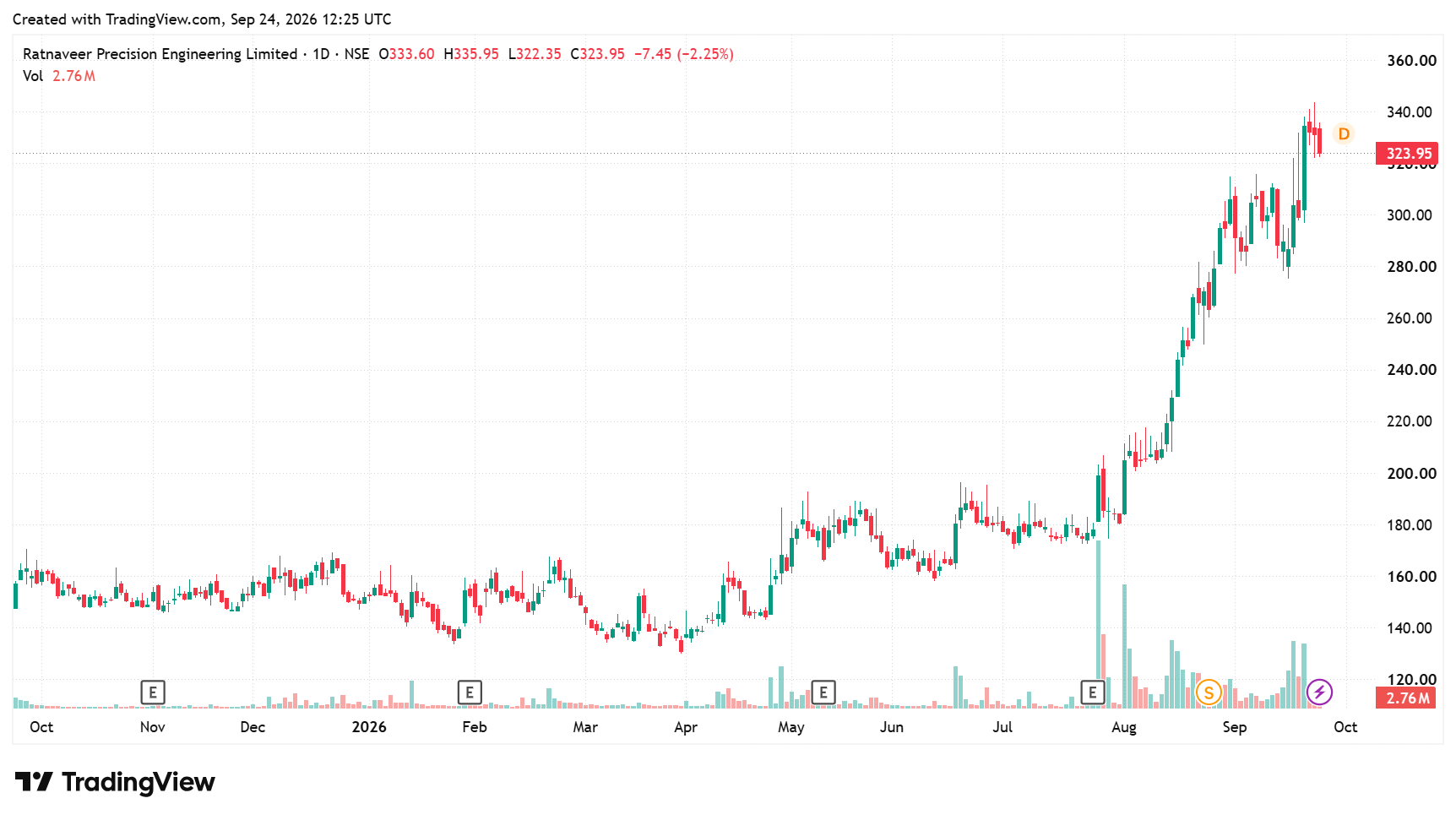
INDO-MIM has a higher Return on Equity (ROE) and Return on Capital Employed (ROCE). Ratnaveer, however, boasts moderate return ratios. Valuation-wise, both companies have recently rallied significantly and now trade at a premium to industry price-to-earnings multiples.
Meanwhile, Ratnaveer also trades at a premium to its historical 3-year median valuation. INDO-MIM is a recently listed company and thus lacks a historical benchmark.
Particulars | Price-to-Earnings Multiple (X) | Return Ratios | |||
| Company | 3Y Median | Industry | ROE (%) | ROCE (%) | |
| INDO-MIM | 100 | NA | 37.0 | 23.4 | 15.0 |
| Ratnaveer | 40.3 | 19.4 | 23.8 | 12.4 | 12.3 |
| Source: Screener.in (As of 24 September 2026) | |||||
India’s semiconductor story is gradually moving beyond fabs and chip manufacturing. For Ratnaveer, the key opportunity lies in its planned CCL facility and the potential to capture part of India’s import-dependent market.
The company’s management targets ₹750 crore of revenue from the CCL business. This could become a meaningful contributor if commercial production and customer approvals progress as planned. INDO-MIM, meanwhile, offers a more diversified precision-engineering play.
Its exposure spans diverse sectors, while its expansion into allied technologies could widen its addressable market. You can keep these companies on your watchlist.
Disclaimer:
Note: Throughout this article, we relied on data from http://www.Screener.in and the companies’ investor presentations. We used an alternative, widely accepted source only when the data were unavailable.
The purpose of this article is only to share interesting charts, data points, and thought-provoking opinions. It is NOT a recommendation. If you wish to consider an investment, we strongly advise you to consult your advisor. This article is strictly for educational purposes only.
About the Author: Madhvendra has been deeply immersed in the equity markets for over seven years, combining his passion for investing with his expertise in financial writing. With a knack for simplifying complex concepts, he enjoys sharing his honest perspectives on startups, listed Indian companies, and macroeconomic trends.
A dedicated reader and storyteller, Madhvendra thrives on uncovering insights that inspire his audience to deepen their understanding of the financial world.
Disclosure: The writer and his dependents do not hold the stocks discussed in this article.
The website managers, their employees (s), and contributors/writers/authors of articles have or may have an outstanding buy or sell position or holding in the securities, options on securities, or other related investments of issuers and/or companies discussed therein. The articles’ content and data interpretation are solely the personal views of the contributors/ writers/authors. Investors must make their own investment decisions based on their specific objectives and resources, and only after consulting any independent advisors as necessary.