


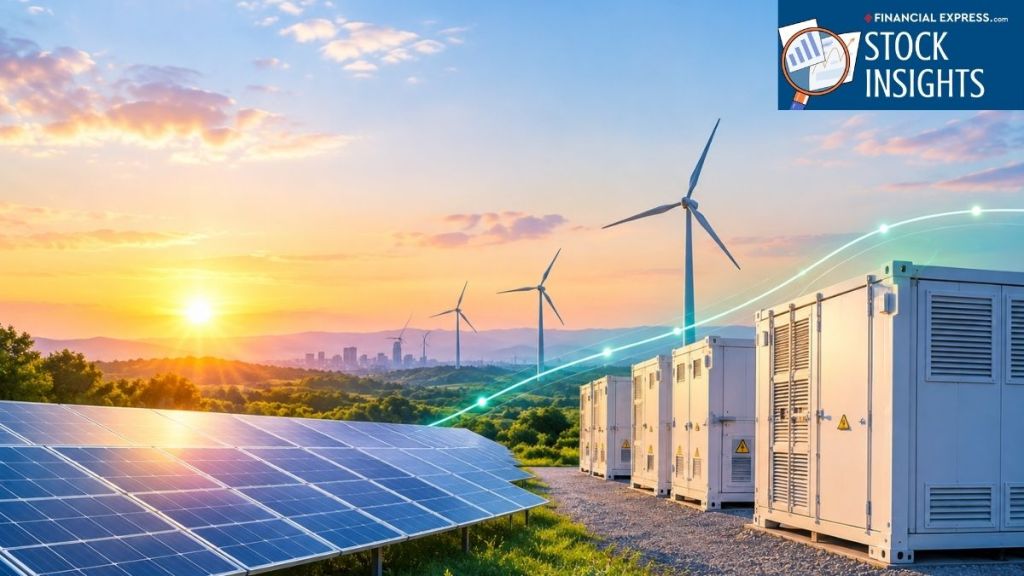

India’s power mix is changing as solar capacity rises, but the next challenge is when that power is available. Solar generation peaks during the day, while demand often rises in the evening. This is where Battery Energy Storage Systems (BESS) come in. They store electricity when power is cheaper and supply it when demand and tariffs are higher.
The shift is also showing up in new tenders. India now requires a minimum two-hour Energy Storage System in utility-scale solar photovoltaic (PV) tenders. Crisil Ratings estimates that India could commission 45-50 gigawatt-hours (GWh) of BESS capacity in FY27-28.
Meanwhile, the Central Electricity Authority estimates that cumulative storage requirements could reach 411 GWh by FY32. The opportunity extends beyond the power sector. Data centre expansion could create 15-20 GW of additional demand for combined solar-plus-BESS installations.
At the same time, policy support through Viability Gap Funding, Production Linked Incentives (PLI) for Advanced Chemistry Cells, and transmission reforms is helping build the market. In this environment, we’re taking a look at three renewable energy companies that are building the largest BESS capacity.
#1 Waaree Energies: Monopolising the Non-Chinese BESS Supply Chain
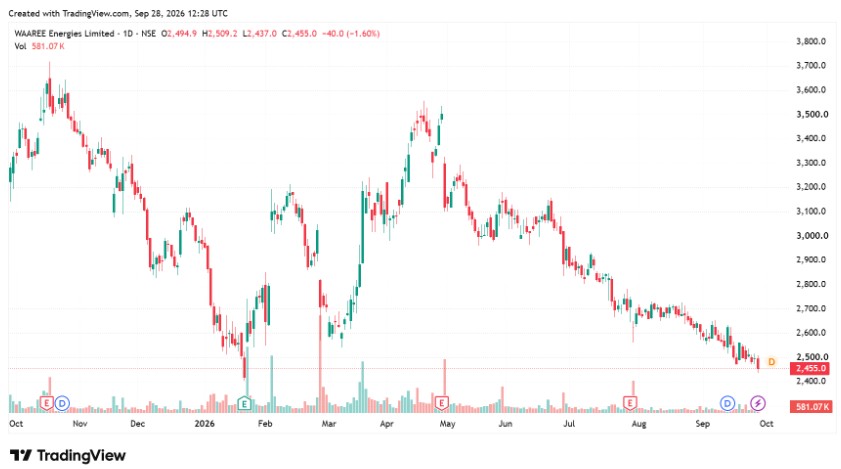
Waaree Energies Limited is the largest non-Chinese solar module manufacturer globally. It operates a clean energy manufacturing platform spanning solar PV modules, solar cells, BESS, power electronics, and engineering, procurement, and construction (EPC) services.
Scaling Capacity: Expanding the 28 GW Module and 15.4 GW Cell Ecosystem
The company’s combined solar module capacity in India (24.2 GW) and the US (3.8 GW) stands at 28 GW. Its solar cell production capacity is 5.4 GW and will increase by 10 GW to reach 15.4 GW over the next six months. This capacity will position Waaree Energies as the largest cell manufacturer outside China.
Waaree is building deep backward integration with a 10 GW ingot and wafer facility in Nagpur, Maharashtra. In addition, the company is constructing a 2,500 tons/day solar glass plant. The company is building an automated container production capacity of 5.15 GWh with an integrated 3.5 GWh BESS cell facility.
It is establishing end-to-end manufacturing capabilities for LFP (Lithium Iron Phosphate) cells, battery packs, and enclosed containers. The company is operationalising 3.5 GWh of BESS cell capacity (phase I). An additional 16.5 GWh (phase II) is under construction, bringing total cell, pack and container capacity to 20 GWh.
Capex Deployment & The FEOC Export Arbitrage
The company has allocated ₹10,000 crore specifically for BESS infrastructure. BESS represents 32% of Waaree’s overall asset allocation. About ₹1,398 crore has been deployed as of June 30, 2026. The remaining ₹8,602 crore is scheduled to be deployed through FY29. Waaree is executing a dual-market commercial strategy.
The company supplies BESS containers and packs for utility-scale solar projects, commercial and industrial customers, data centres, telecom, aerospace, defence and rooftop solar (such as PM Surya Ghar). Waaree is focusing on the US and Europe, where there is demand for storage supply chains that are non-Chinese and compliant with FEOC (Foreign Entity of Concern).
FEOC-compliant BESS cells command a price premium (US$ 75-80/kWh versus Chinese cells at US$ 50-55/kWh), making exports margin-accretive. On the order side, its subsidiary ‘Waaree Renewable Technologies’ secured a 1.52 GWh BESS EPC order.
Q1 Financials: Topline Expands 79% as Margin Pressures Mount
In financial terms, revenue from operations for Q1 FY27 rose by 79.2% year-on-year to ₹7,931.8 crore. Operating EBITDA (earnings before interest, taxes, depreciation, and amortisation) increased by 44.4% to ₹1,439.9 crore. However, the EBITDA margin declined from 22.5% in Q1 FY26 to 18.2% due to rising raw material costs and a drop in exports.
Meanwhile, net profit grew 15.4% to ₹891.9 crore. The order book reached a record ₹61,500 crore as of July 28, 2026. It expects ₹7,000-7,700 crore EBITDA in FY27. Management is building toward a ₹1 lakh crore revenue vision within 4 to 5 years.
#2 Adani Green Energy: Utility-Scale Scale and 15-Year Cash Flow De-risking
Adani Green Energy is India’s largest pure-play renewable energy independent power producer (IPP) and ranks among the top 10 renewable IPPs globally. The company develops, owns, and operates utility-scale grid-connected solar, wind, hybrid, BESS, and Pumped Storage Projects.
Scaling Beyond 20 GW: The Khavda Expansion and FY30 Roadmap
AGEL’s operational capacity crossed the 20 GW milestone during Q1FY27, reaching 20.1 GW as of June 30, 2026. It is building a 30 GW renewable energy hub at Khavda, Gujarat, targeted for completion by 2029. Overall, the company’s long-term goal is to reach 50 GW of operational renewable energy and 50 GWh of BESS capacity by FY30.
Capitalising on Storage: India’s 50% BESS Dominance and 15-Year PPA De-risking
AGEL operationalised 1.9 GWh of BESS capacity at Khavda, Gujarat, during Q1FY27. This brought its total installed BESS capacity to 3,551 MWh (3.5 GWh) as of June 30, 2026. AGEL accounts for roughly 50% of India’s total operational BESS capacity. It expects to expand this share to over two-thirds by the end of FY27.
Why Related-Party PPAs Protect Adani’s BESS Margins
The company is on track to reach 10+ GWh of cumulative installed BESS capacity by the end of FY27. Facilities are already in place for approximately 2 GWh of BESS capacity currently under construction. To eliminate merchant power market risk and secure predictable cash flows, AGEL has contracted its C&I BESS portfolio with Adani Energy Solutions Limited (a related party).
The PPA with AESL is structured as a fixed-price agreement for a 15-year term. The contract pricing is set on an arm’s-length benchmark basis aligned with AGEL’s equity hurdle IRR of 15-16%. For FY27, management expects an EBITDA contribution of ₹25 lakh to ₹30 lakh per MWh, based on asset capitalisation.
From a financial perspective, AGEL’s revenue from operations grew 16.6% year-on-year to ₹4,431 crore in Q1FY27. Operating profit surged 31% to ₹3,985 crore. Consequently, net profit grew 19.3% to ₹983 crore. Operational portfolio run-rate EBITDA is projected to expand from around ₹17,000 crore currently to ₹21,000 crore by the end of FY27.
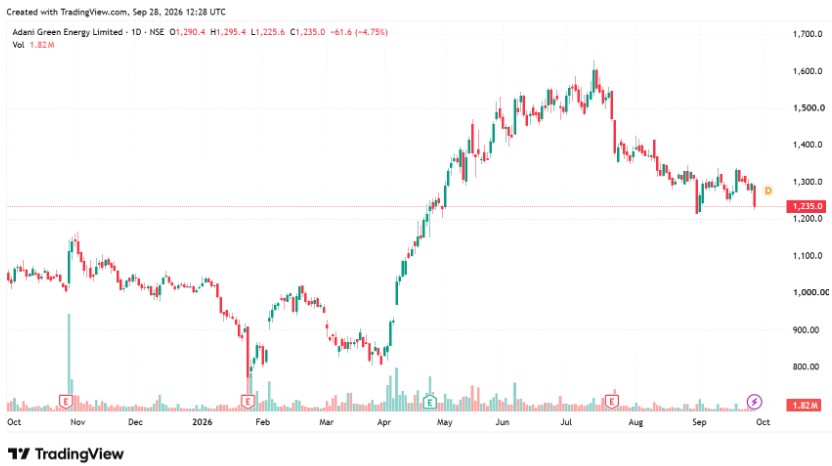
Adani Green Energy Share Price
#3 ACME Solar Holdings: High-Margin Merchant Arbitrage & Central PPAs
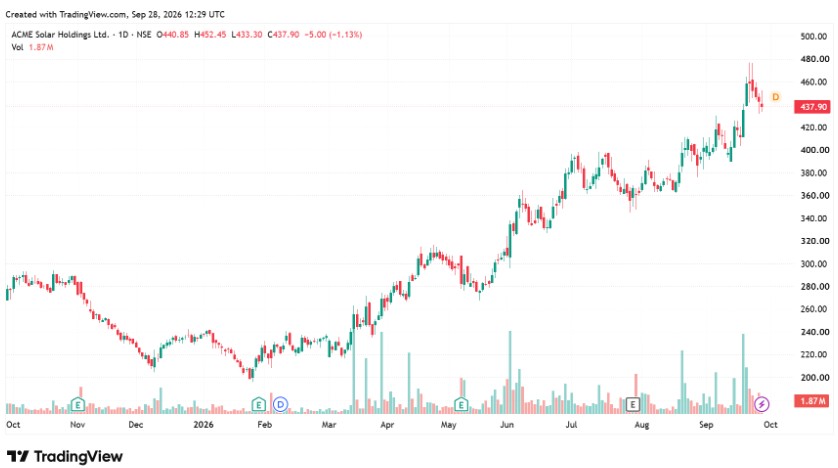
ACME Solar Holdings is one of the largest renewable energy Independent Power Producers (IPPs) in India. The company develops, builds, owns and operates utility-scale renewable energy projects across solar, wind, hybrid, Firm and Dispatchable Renewable Energy and BESS. Its total portfolio stands at 8.1 GW, integrated with 20 GWh of planned BESS capacity.
Portfolio Breakdown: Expanding the 8.1 GW Asset Base Across India
Of this, about 3.0 GW of renewable power generation capacity and 3.6 GWh of BESS capacity are operational. Its under-construction pipeline totals 5.1 GW, including around 3.9 GW with signed Power Purchase Agreements and 1.2 GW backed by awarded Letters of Award.
About 84% of the portfolio is contracted with central government-backed entities, including SECI, NTPC, SJVN, and NHPC. Acme secures the projects through 25-year Power Purchase Agreements at fixed tariffs. In BESS, Acme accounts for approximately 40% of India’s cumulative commissioned BESS capacity.
Grid Storage Dominance: Accelerated Commissioning and Tier-1 Battery Offtake
As of July 2026, the operational BESS capacity stands at 3.6 GWh. The company has ordered over 15 GWh of battery capacity from global Tier-1 suppliers. ACME aims to commission 10+ GWh of BESS capacity by FY27, nearly three quarters ahead of its original timeline. By FY30, the target is to reach 25 GWh of BESS alongside 10 GW of renewable generation capacity.
In Q1FY27, the company’s BESS revenue stood at ₹226 crore from battery power sales. Further, it won bids worth ₹1,400+ crore in locked-in revenue for the partial sale of FY27 BESS capacity. BESS segment EBITDA margin stood at 82% while realisation on short-term BESS contracts ranged between ₹8 and ₹10 per unit.
Q1 Financial Performance: Total Income Climbs 63.3% as Net Profit Reaches ₹235 Crore
From a financial perspective, total income rose 63.3% to ₹954 crore in Q1FY27. EBITDA increased by 56.5% to ₹831 crore. However, margin declined marginally from 90.9% in Q1 FY26 to 87.1%. Net profit grew by 79.9% to ₹235 crore.
Here’s a summary of where each of these companies is at this juncture:
| Particulars | Waaree | Adani Green | Acme Solar |
| Targeted BESS Capacity (GWh) | 20 | 50 | 20 |
| By When | FY28 | 2030 | FY30 |
| Q1FY27 Revenue (₹ crore) | 7,931.8 | 4,431.0 | 954.0 |
| Q1FY27 EBITDA (₹ crore) | 1,439.9 | 3,985.0 | 831.0 |
| Net Profit (₹ crore) | 891.9 | 983.0 | 235.0 |
| Source: Management Commentaries and Investor Presentations | |||
Adani Green has the largest stated BESS target at 50 GWh, while Waaree Energies and ACME Solar are targeting 20 GWh each. Their current operating positions differ, with BESS capacity at roughly 3.5-3.6 GWh for each company. Waaree’s 20 GWh refers to manufacturing capacity, while Adani’s 50 GWh and ACME’s 20 GWh refer to their BESS deployment/portfolio targets.
Valuation Matrix: Pure-Play Disconnect Between AGEL, Acme, and Waaree
With superior profitability, Waaree has higher Return on Capital Employed (ROCE) and Return on Equity (ROE) than Adani Green and Acme Solar. Valuation-wise, Adani Green valuation is extremely rich relative to the industry but at a discount to the 5-year median. Still, even on its own, Adani Green’s valuation is steep.
Waaree now trades at a discount to the industry multiple. In contrast, Acme Solar trades at a premium.
| Peer Comparison (X) | |||||
Company | Price-to-Earnings Multiple | Return Ratios | |||
| Company | Industry | 5Y-Median | ROCE (%) | ROE (%) | |
| Waaree | 17.5 | 27.5 | NA | 38.4 | 32.5 |
| Adani Green | 105.0 | 20.5 | 159.2 | 7.4 | 11.4 |
| Acme | 53.0 | 20.5 | NA | 8.9 | 10.4 |
| Source: Screener.in (Data as of 03 July 2026) | |||||
The BESS opportunity is becoming a measurable part of India’s power infrastructure. Rising storage requirements, mandatory storage in solar tenders and growing data-centre demand are creating a larger market for companies with BESS capacity.
Waaree Energies, Adani Green Energy and ACME Solar are building capacity across manufacturing, renewable generation and storage. Their targets range from 20 GWh to 50 GWh, while operational capacity is also expanding. The opportunity is bigger, so execution matters. That said, you could keep these names in your watchlist to track their execution.
Disclaimer
Note: Throughout this article, we have relied on data from http://www.Screener.in and the company’s investor presentation. Only when the data was unavailable have we used an alternative, widely used and accepted source of information.
The purpose of this article is only to share interesting charts, data points, and thought-provoking opinions. It is NOT a recommendation. If you wish to consider an investment, you are strongly advised to consult your advisor. This article is strictly for educational purposes only.
About the Author: Madhvendra has been deeply immersed in the equity markets for over seven years, combining his passion for investing with his expertise in financial writing. With a knack for simplifying complex concepts, he enjoys sharing his honest perspectives on startups, listed Indian companies, and macroeconomic trends.
A dedicated reader and storyteller, Madhvendra thrives on uncovering insights that inspire his audience to deepen their understanding of the financial world.
Disclosure: The writer and his dependents do not hold the stocks discussed in this article.
The website managers, its employee(s), and contributors/writers/authors of articles have or may have an outstanding buy or sell position or holding in the securities, options on securities, or other related investments of issuers and/or companies discussed therein. The articles’ content and data interpretation are solely the personal views of the contributors/ writers/authors. Investors must make their own investment decisions based on their specific objectives, resources, and only after consulting such independent advisors as may be necessary.