




The SME segment includes specialised manufacturers serving much larger industries. Their businesses may be small, but their products can play an important role in the supply chain. Finding these companies requires care. Strong growth needs to be examined alongside debt, cash generation and ownership.
We began with a broad financial screen. SME companies needed return on capital employed (RoCE) above 15%. Their three-year average also had to exceed 15%. We required three-year sales and profit compounded annual growth rate (CAGRs) above 10%. Debt-to-equity had to be below 0.5. Operating cash flow in the latest financial year had to be positive.
The ownership filters added another layer. Promoter holdings had to exceed 30%, with no decline and no pledged shares. Companies also needed more than 100 shareholders. Debtor days had to stay below 150. These checks helped narrow the universe, though SME liquidity and business risks remain.
We then turned to railway suppliers within this screened group. The railway story extends well beyond companies assembling coaches and locomotives. It also runs through manufacturers of castings, safety components, traction motor parts and specialised cargo containers.
Three companies stood out. Let’s take a closer look at their businesses and their role in India’s railway supply chain.
#1 Neetu Yoshi: Manufacturing Safety-Critical Railway Castings
Incorporated in January 2020, Neetu Yoshi is engaged in manufacturing customized ferrous metallurgical products.
Neetu Yoshi supplies safety-critical castings and machined parts for railway wagons, coaches and locomotives. Its annual report records fresh coach-factory approvals and plans to manufacture complete bogies and couplers. These developments could expand its role in the railway supply chain.
Product Expansion and Institutional Holding Trends
Shareholding data shows individual investor Ritu Bapna held 2.77% in June 2026. This was unchanged from March, following an increase from 1.73% in September 2025. Aarth AIF Growth Fund held 1.65%, down from 1.84% in March. Total domestic institutional ownership also declined, from 3.91% to 3.25% during the quarter.
To know how Neetu Yoshi fits our screen, read our article on four SMEs riding India’s infrastructure boom. It examines the company’s sales and profit growth, return ratios, debt levels and cash generation. It also highlights the risks behind those numbers.
#2 Gallard Steel: Scaling Engineered Castings for Traction and Bogies
Incorporated in 2015, Gallard Steel is engaged in the manufacturing of engineered steel castings, including mild steel, SGCI, and low alloy castings. It was listed on 26 November 2025.
Gallard Steel qualifies with three-year sales CAGR of 49% and profit CAGR of 100%. Return on Capital Employed (RoCE) stood at 23.4%. Its railway business centres on components used in traction motors and bogie assemblies.
Scaling Engineered Castings for Traction and Bogies
The IPO prospectus shows these products generated 78.9% of consolidated revenue in H1FY26. This makes railway procurement a major influence on its business.
New products could deepen that exposure. The annual report records prototype approvals for five locomotive bogie components following field fitment. Management expects bulk-supply approval within 12 months. Coupling systems and brake discs are also being developed for field trials. Commercial orders will depend on completing these qualifications.
Capacity expansion supports this strategy. The prospectus also proposes raising casting capacity from 2,400 to 6,100 tonnes annually. Machining capacity would increase from 7,500 to 10,000 units. The annual report also records a letter of intent for 3.07 hectares at Pithampur. Its European subsidiary had yet to commence operations.
The annual report shows FY26 consolidated revenue rising 27.6% year-on-year (YoY) to Rs 68 crore. Net profit increased 50.1% to Rs 9.1 crore. Operating margins were about 22.4%, according to Screener.
The balance sheet also supports selection. Its debt-to-equity ratio stood at approximately 0.36 times. Shareholding data show promoter ownership unchanged at 67.16% between November 2025 and March 2026.
Order Book Growth, Capacity Scaling, and Shareholding Shifts
Gallard’s shareholders include SageOne Flagship Growth OE Fund. Its investment manager, SageOne, is led by founder and CIO Samit Vartak. The fund’s stake rose from 3.48% in November 2025 to 3.64% in March 2026. Aarth AIF Growth Fund also held 3.69%. However, total domestic institutional ownership declined from 9.45% to 9.14% over this period.
The three-year growth rates compare standalone FY23 figures with consolidated FY26 numbers. As the prospectus explains, later years include Sleeploop following its acquisition. The comparison therefore includes a change in the businesses being reported. FY26 operating cash flow was Rs 4.19 crore, below reported profit, according to the annual report. Debtor days of roughly 108 also warrant attention.
Approvals, capacity utilisation and collections remain key tests. SME trading lots, potentially limited liquidity and half-yearly reporting warrant investor caution.
Gallard Steel Financial Performance
| Metric | FY26 |
| Revenue | Rs 68 crore |
| Revenue growth | 27.6% YoY |
| Net profit | Rs 9.1 crore |
| Profit growth | 50.1% YoY |
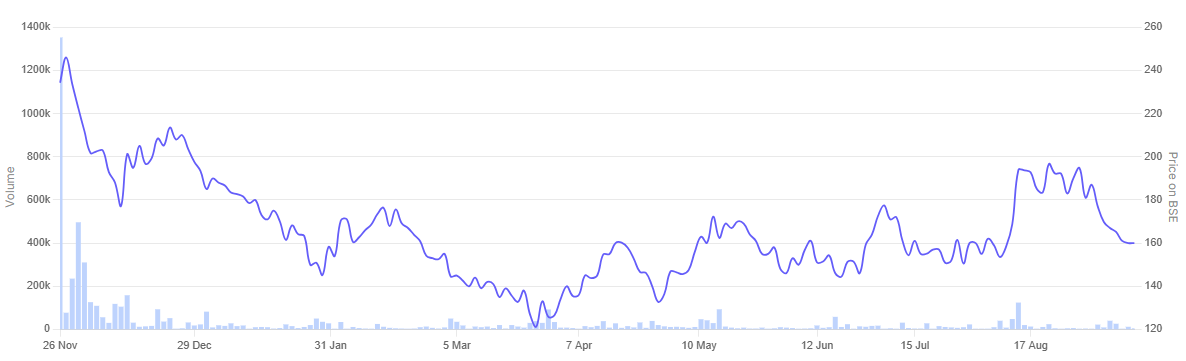
In the past year, the share price of Gallard Steel tumbled 31.7%.
Gallard Steel 1-Year Share Price Chart
#3 Kalyani Cast-Tech: Bridging Container Production with Rail Freight
Incorporated in 2012, Kalyani Cast Tech manufactures high quality castings and specialized cargo containers.
According to Screener.in Kalyani Cast-Tech recorded three-year sales and profit CAGRs of 33% and 23%, respectively. Both exceed the screen’s 10% threshold. ROCE of 27.7% also clears the return requirement. Its railway exposure spans castings, specialised containers and freight infrastructure.
Bridging Container Production with Rail Freight
The company makes containers for steel coils, slabs and sheets. Its product range also includes foldable containers and specialised containers for automobiles. These products support the movement of industrial cargo and broaden its role in the railway supply chain.
According to its FY26 annual report, container production began at the 144-acre Kutch campus after the financial year ended. On August 20, 2026, its first container trial train reached the newly commissioned Gati Shakti cargo terminal there. Subsidiary KMT Engineering operates the terminal. The train carried containers manufactured at Kalyani’s Rewari facility. This connects its manufacturing operations with rail freight handling.
Balance Sheet Strength, Debt-to-Equity, and Promoter Holdings
Standalone FY26 revenue increased 7.7% YoY to Rs 150 crore. Net profit rose 19.7% to Rs 17.1 crore. Operating margin was approximately 14%. Operating cash flow remained positive at Rs 19.38 crore, supporting another screening requirement.
Debt-to-equity was approximately 0.01 times. Debtor days stood at 80, against the screen’s limit of 150. However, collections slowed from 69 days in FY25.
Promoter ownership remained at 59.47% between September 2025 and June 2026. This satisfies the latest-period stability filter. The stake was nevertheless lower than 63.32% in March 2025.
The next test is converting the new facilities into regular production and freight volumes. FY26 sales growth was below the three-year CAGR. Past sales and profit growth therefore offer limited assurance about future returns. As an SME stock, Kalyani also carries liquidity risks. Half-yearly financial reporting provides fewer opportunities to assess execution and cash generation.
Kalyani Cast-Tech Financial Performance
| Metric | FY26 |
| Revenue | Rs 150 crore |
| Revenue growth | 7.7% YoY |
| Net profit | Rs 17.1 crore |
| Profit growth | 19.7% YoY |
In the past year, the share price of Kalyani Cast-Tech rallied 125.3%.
Kalyani Cast-Tech 1-Year Share Price Chart

Conclusion
These three SMEs show how railway investment reaches smaller suppliers of castings, components and cargo containers. Their growth, returns on capital and manageable debt explain their place in the screen. Each offers exposure to a different part of the railway supply chain.
The next test is execution. New facilities need regular orders and sufficient utilisation. Higher sales must also translate into cash collections. Steel costs, customer demand and payment cycles will influence whether these companies can sustain their margins. Past sales and profit growth should not be treated as forecasts.
Investors also need to account for the risks of the SME segment. Limited trading volumes can make exits difficult. Half-yearly reporting leaves longer gaps between financial updates. The screen provides a starting point for research. Valuation, cash generation and progress on expansion plans remain essential to assessing the investment case.
Three Railway-Linked SMEs: Growth and Operating Performance
| Metric | Neetu Yoshi | Gallard Steel | Kalyani Cast-Tech |
| Three-year sales CAGR | 82% | 49% | 33% |
| Three-year profit CAGR | 291% | 100% | 23% |
| FY26 operating margin | 31% | 22.4% | 14% |
| FY26 debtor days | 118 | 108 | 80 |
| FY26 operating cash flow (₹ cr) | 4.03 | 4.19 | 19.38 |
Cash flow figures are consolidated for Neetu Yoshi and Gallard Steel, and standalone for Kalyani Cast-Tech. Neetu Yoshi’s profit CAGR reflects a very small FY23 starting profit.
You can track how these are progressing by adding stocks to your watchlist.
Disclaimer:
Note: We have relied on data from www.Screener.in throughout this article. Only in cases where the data was not available, have we used an alternate, but widely used and accepted source of information.
The purpose of this article is only to share interesting charts, data points and thought-provoking opinions. It is NOT a recommendation. If you wish to consider an investment, you are strongly advised to consult your advisor. This article is strictly for educative purposes only.
Ekta Sonecha Desai has a passion for writing and a deep interest in the equity markets. Combined with an analytical approach, she likes to deep dive into the world of companies, studying their performance, and uncovering insights that bring value to her readers.
Disclosure: The writer and her dependents do not hold the stocks discussed in this article.
The website managers, its employee(s), and contributors/writers/authors of articles have or may have an outstanding buy or sell position or holding in the securities, options on securities or other related investments of issuers and/or companies discussed therein. The content of the articles and the interpretation of data are solely the personal views of the contributors/ writers/authors. Investors must make their own investment decisions based on their specific objectives, resources and only after consulting such independent advisors as may be necessary.