



India’s wood-products industry is already large, but the more interesting investment opportunity may lie in how wood-based materials are used inside Indian homes. Euromonitor estimates that demand for wood and wood products in India reached US$17.2 billion in 2024, while industry production stood at US$22.7 billion. The market remains highly fragmented: the top five companies accounted for only 4.2% of total production value in 2024, highlighting the long-term opportunity for organised manufacturers to gain share.
Plywood remains a major opportunity within that broader market. According to IMARC Group’s analysis, the India plywood market was valued at ₹24,785 crore in 2025 and is anticipated to attain a value of ₹39,190 crore by 2034, progressing at a CAGR of 5.22% during the forecast period of 2026–2034. The organised sector accounted for 62% of the plywood market in 2025, according to IMARC.
As urban households become more conscious of space utilisation, there is a growing need to extract greater functionality from every square foot through modular kitchens, wardrobes, storage units, TV units, partitions and multi-purpose furniture.
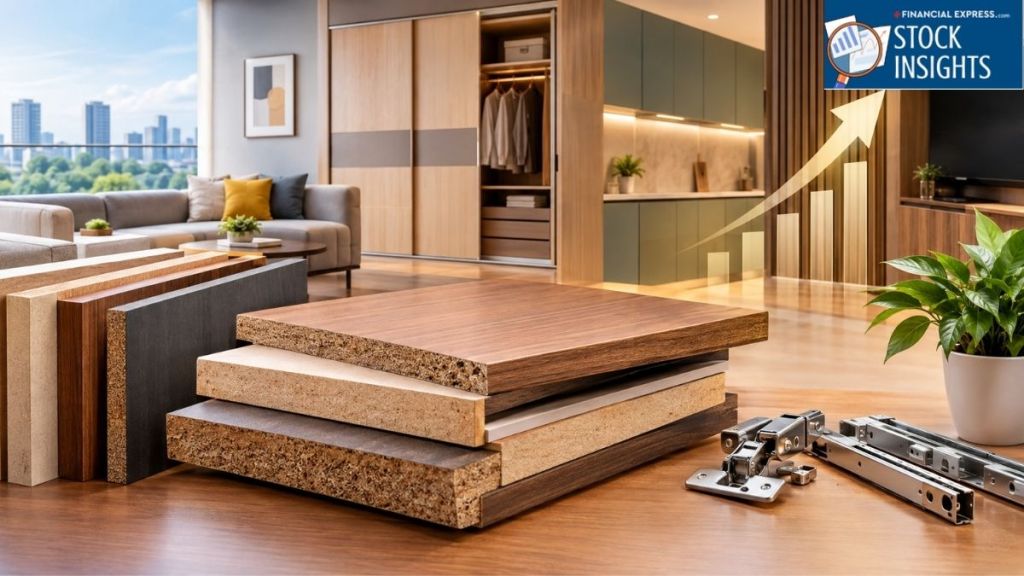
While plywood remains important for its strength and suitability for carcasses, structural applications and premium furniture, medium-density fibreboard (MDF) and particle board are better suited to several modular applications because they provide uniform surfaces and work well with factory-based processing and decorative finishes. Pre-laminated boards can further reduce the need for separate finishing work. Furniture fittings such as drawer slides, hinges and lift-up mechanisms complete the ecosystem.
Against this backdrop, two wood-sector stocks worth tracking are Greenply Industries and Century Plyboards.
Greenply Industries: Can MDF and Furniture-Linked Products Drive the Next Growth Cycle?
Greenply Industries Limited’s roots go back to 1984. The company subsequently incorporated Mittal Laminates Pvt. Ltd. in 1990, became a public limited company in 1994, and adopted the name Greenply Industries Limited in 1996.
Greenply had entered the MDF segment in 2021. The diversification into an engineered-wood category helped the company step into a portfolio directly relevant to furniture and interior applications. In 2023, the company entered the furniture-fittings segment through Greenply Samet Pvt. Ltd.
Greenply Industries currently has five manufacturing units at Tizit, Rajkot/Bamanbore, Kriparampur, Vadodara and Sandila, while its broader network covers 27 states and six Union Territories, 1,100+ cities, towns and villages, 3,000+ channel partners and 60 branches.
As of FY25, the company has a 22% market share in India’s organised plywood market.
MDF is becoming an increasingly important part of the Greenply story
Greenply Industries reported consolidated revenue of ₹724.9 crore in Q1 FY27, an increase of 20.7% YoY from ₹600.8 crore in Q1 FY26. On a sequential basis, however, revenue declined 6.6% QoQ from ₹776.2 crore in Q4 FY26.
Plywood and allied products generated ₹526.6 crore, up 16.0% YoY, while MDF revenue increased 32.8% YoY to ₹195.7 crore.
The more important signal for the space-utilisation thesis is the combination of MDF revenue and volume growth. MDF volumes increased 24.7% YoY to 57,805 cubic metres, indicating that the growth was supported substantially by higher underlying volumes rather than being driven only by pricing.
Even more relevant is the performance of pre-laminated boards. Revenue from pre-laminated boards increased 61.3% YoY to ₹42.9 crore. Since pre-laminated products are closely linked to ready-to-use and modular furniture applications, their faster growth suggests that Greenply is gaining exposure to a part of the wood market that is more closely aligned with changing interior-design preferences.
This creates a potentially important earnings lever.
If MDF volumes continue to grow faster than the traditional plywood business and higher-value pre-laminated products become a larger part of the mix, Greenply could gradually reduce its dependence on conventional plywood growth. But the key question remains: will this faster growth translate into sustained margin expansion and higher returns on the capital invested in the business?
Furniture fittings: an opportunity that has yet to become an earnings driver
Greenply’s direct exposure to furniture is through Greenply Samet Pvt. Ltd., its 50:50 joint venture (JV) focused on furniture fittings rather than finished furniture.
The JV generated ₹13.61 crore of revenue in Q1 FY27 on a 100% basis. However, the business remained loss-making: Greenply recognised a ₹5.7 crore share of the JV’s net loss, compared with a ₹5.4 crore share of loss in Q1 FY26 and ₹6.5 crore in Q4 FY26.
For readers, Samet should therefore be viewed as future optionality rather than an existing earnings contributor. The strategic logic is clear: if Greenply can participate in both the board-material and furniture-fittings portions of the modular-furniture ecosystem, its addressable opportunity becomes broader. But the investment case will require evidence that revenue can scale sufficiently to absorb costs and move the venture towards break-even.
Until that happens, Samet remains an earnings drag.
Financial performance: strong sales growth, but earnings conversion remains important
Greenply’s five-year financial performance shows a clear increase in scale, but earnings have been less consistent than sales.
| Particulars | FY22 | FY23 | FY24 | FY25 | FY26 |
| Sales (₹ in crores) | 1,563 | 1,663 | 2,180 | 2,488 | 2,739 |
| Operating Profit (₹ in crores) | 150 | 133 | 185 | 204 | 242 |
| Net Profit (₹ in crores) | 95 | 91 | 70 | 92 | 90 |
| EPS (₹) | 7.73 | 7.44 | 5.66 | 7.34 | 7.17 |
In Q1 FY27, consolidated profit after tax (PAT) was ₹37.6 crore, up 32.2% YoY from ₹28.5 crore and 21.3% QoQ from ₹31.0 crore. Based on reported revenue, consolidated net profit margin was about 5.2%, up from 4.7% in Q1 FY26 and 4.0% in Q4 FY26.
The margin and PAT improvement suggests recent revenue growth is starting to translate into better profitability. The sustainability of that improvement, especially as raw-material costs and newer-business losses evolve, will be more important than a single strong quarter.
Greenply’s stock performance and outlook
Greenply Industries performed quite well on the price chart. The last one-month and six-month returns stood at 3.8% and 46.74%, respectively. The year-to-date return stood at 7.54%.
Equirus Securities maintained a Buy recommendation with a ₹391 target price. The brokerage remained positive on volume-led growth and earnings visibility of Greenply after the Q1 performance. Post Q1 FY27, Anand Rathi also retained its Buy rating but increased its target price to ₹375 from ₹350.
Century Plyboards: Can Particle Board Turn Rapid Growth Into Profits?
Century Plyboards (India) Limited has expanded beyond its core plywood business into a broader portfolio of wood-based interior products, including laminates, veneers, doors, MDF, particle board and composite boards. The company’s direct move into the furniture-related domain is through Centuryply Furniture Fittings Limited, which Century Plyboards incorporated on 18 February 2025 as a wholly owned subsidiary specifically for manufacturing fittings and fixtures for furniture.
As of Q1 FY27, the company has a pan-India presence. Its manufacturing facilities are located in Joka, Guwahati, Kandla, Chennai, Karnal and Hoshiarpur. Its Roorkee and Badvel operations are managed through subsidiaries. The company follows a B2B distribution-led business model, supplying its products through trade partners to the wider market.
Talking about the distribution network, it has more than 4,161 dealers and 19,072 retailers, covering 27 states, seven Union Territories and 625 districts. Internationally, CenturyPly exports to 20 countries, with its products reaching markets across Asia, the Middle East, North America, South America, Europe, Africa and Oceania. The company also operates Century Arena experience centres for its decorative product portfolio.
Given the strong distribution network, the company has a market share of around 29% in India’s organised plywood sector.
Particle board could be the most direct play on the modular-furniture opportunity
Century Plyboards reported revenue of ₹1,561.38 crore in Q1 FY27, up 33.5% YoY from ₹1,169.36 crore in Q1 FY26 and 4.6% QoQ from ₹1,492.21 crore in Q4 FY26.
MDF revenue was ₹334.09 crore in Q1 FY27, up 28.9% YoY but down 6.2% QoQ. Volume increased 22.4% YoY to 102,951 cubic metres, while pre-laminated MDF volume increased 19.9% YoY to 19,873 cubic metres. Pre-laminated MDF revenue rose 22.5% YoY to ₹86.83 crore from ₹70.89 crore in Q1 FY26.
The MDF numbers indicate that Century is already participating meaningfully in the engineered-wood transition. But the particle-board business provides an even more direct link to the modular-furniture opportunity.
Particle-board revenue rose 156.6% YoY to ₹87.65 crore and 29.0% QoQ. Total volumes increased 155.7% YoY to 41,680 cubic metres, while pre-laminated particle-board volumes increased 103.0%. Pre-laminated particle-board revenue more than doubled to ₹55.35 crore, up 113.3% YoY.
Importantly, this was not merely a price-driven growth story. Particle-board revenue and volume both increased by roughly 156% YoY, suggesting that the sharp increase was overwhelmingly volume-led. That makes the growth more relevant to the structural demand thesis.
However, there is an important qualification.
Segment earnings before interest, taxes, depreciation and amortisation (EBITDA) turned positive at ₹2.91 crore, against a ₹1.28 crore loss in Q1 FY26.
The business has therefore moved from proving demand to proving profitability. Readers should track whether higher volumes can generate meaningful operating leverage and lift EBITDA margins in coming quarters. Rapid revenue growth by itself will not justify a premium valuation if incremental profits remain modest.
Financial performance: Century has built scale, but profitability has been cyclical
Over the last five financial years, Century has substantially increased its scale. However, profitability remained volatile.
| Particulars | FY22 | FY23 | FY24 | FY25 | FY26 |
| Sales (₹ in crores) | 3,027 | 3,647 | 3,886 | 4,528 | 5,397 |
| Operating Profit (₹ in crores) | 532 | 583 | 521 | 487 | 651 |
| Net Profit (₹ in crores) | 313 | 384 | 325 | 186 | 268 |
| EPS (₹) | 14.09 | 17.25 | 14.69 | 8.34 | 11.82 |
In Q1 FY27, consolidated PAT increased 57.4% YoY to ₹83.30 crore from ₹52.92 crore and rose 4.9% QoQ from ₹79.41 crore. Net profit margin was 5.34% of total income, versus 4.52% in Q1 FY26.
The Q1 performance is much better than the five-year profit figure. Revenue grew strongly, PAT grew faster than revenue and margins improved. But it is important to track whether this acceleration can continue once the benefits of newer capacity and the favourable base effects begin to normalise.
Century Plyboards’ stock performance and outlook
Century Plyboards has delivered a mixed performance on the price chart. The stock price fell by over 7.5% in the last one month, while over the past six months, the shares gained around 5.5%. On a year-to-date basis, the stock price declined by 13%.
Motilal Oswal retained its Buy rating with a target price of ₹893 after Q1 FY27. The brokerage expects the company’s leadership position and strong earnings growth to support the stock and values it at 33x FY28E P/E. However, it has flagged weakness in the plywood business as a key downside risk.
The Valuation Question: Is Growth Already Priced In?
| Company | P/E | Dividend Yield (%) | ROCE (%) |
| Century Plyboards (India) | 53.71 | 0.14 | 11.46 |
| Greenply Industries | 32.45 | 0.00 | 14.33 |
| Greenlam Industries | 64.92 | 0.17 | 8.12 |
| Stylam Industries | 33.32 | 0.00 | 26.58 |
Century Plyboards trades at a significant premium to Greenply. On the flip side, Greenply’s reported return on capital employed (ROCE) is higher than Century Plyboards. This does not automatically make Greenply the better investment, because valuation reflects expected future growth rather than only current returns.
Century’s premium needs to be supported by stronger and more durable earnings growth, particularly from particle board, MDF and other engineered-wood categories. Greenply, meanwhile, has a lower valuation hurdle but needs to demonstrate that its MDF growth, improving profitability and newer ventures can produce a stronger EPS trajectory.
India’s Wood-Products Boom Isn’t Without Its Cracks
The structural opportunity does not remove the industry’s risks.
- Volatile prices: Timber is one of the biggest cost components for wood-product manufacturers. Prices can change because of domestic availability, plantation cycles, weather, transport costs, import conditions and sourcing restrictions.
- Intense competition: Listed companies compete with a large number of regional and unorganised manufacturers, particularly in plywood and other traditional wood products. Smaller operators can compete aggressively on price, creating pressure on organised companies to balance market share with margins.
- Chemical and adhesive costs: Plywood and engineered-wood production requires chemical and adhesive inputs such as resins, formalin, phenol and melamine. These materials can be affected by crude-oil prices, chemical supply and geopolitical disruptions. Recent disruptions have already caused sharp increases in the prices of key chemicals used by plywood manufacturers, putting additional pressure on production costs.
- High compliance costs: Listed manufacturers must maintain product standards, testing, certifications, environmental compliance and other statutory requirements. These costs can be difficult to absorb when competitors operating at smaller scales face lower formal compliance expenses
- Distribution challenges: The Indian market is geographically dispersed and depends heavily on distributors, dealers and retailers. Maintaining an extensive network requires working capital, inventory management, incentives and credit support. Companies must also prevent channel inventory from becoming excessive because high dealer stocks can eventually lead to discounting and weaker company realisations.
The Investment Case Now Comes Down to Execution
For readers, the next phase is less about whether space-efficient living will drive demand and more about which company can convert that demand into sustainable earnings and returns. Greenply needs to show that faster-growing MDF and pre-laminated boards can improve its earnings mix, while Greenply Samet must move towards break-even before it can be treated as a meaningful growth driver. Century Plyboards faces a similar test with particle board: its rapid volume growth is encouraging, but readers need to see stronger margins and operating leverage.
Valuation will remain crucial. Century’s premium leaves less room for execution disappointments, whereas Greenply offers a lower valuation hurdle but must prove that its newer businesses can accelerate EPS growth. In both cases, quarterly volume growth, margins, cash generation, capacity utilisation and returns on incremental capital deserve closer attention.
It may be a good idea to add these stocks to your watchlist and keep track to see how they perform in time to come.
Disclaimer
Note: We have relied on data from www.Screener.in throughout this article. Only in cases where the data was not available, have we used an alternate, but widely used and accepted source of information.
The purpose of this article is only to share interesting charts, data points and thought-provoking opinions. It is NOT a recommendation. If you wish to consider an investment, you are strongly advised to consult your advisor. This article is strictly for educative purposes only.
Rishabh Sinha is a seasoned financial content creator with over 10 years of experience in BFSI domain. His portfolio spans over 20 of India’s most trusted financial brands. Rishabh brings depth, structure, and a reader-first approach to every piece he crafts.
Disclosure: The writer and his dependents do not hold the stocks discussed in this article.
The website managers, its employee(s), and contributors/writers/authors of articles have or may have an outstanding buy or sell position or holding in the securities, options on securities or other related investments of issuers and/or companies discussed therein. The content of the articles and the interpretation of data are solely the personal views of the contributors/ writers/authors. Investors must make their own investment decisions based on their specific objectives, resources and only after consulting such independent advisors as may be necessary.