


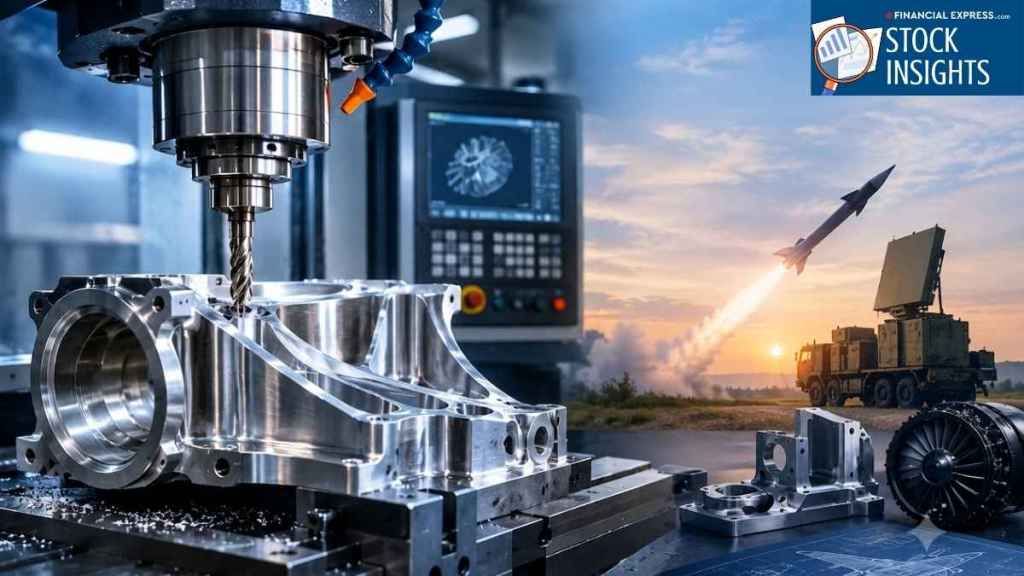

Aerospace and defence manufacturing leaves little room for error. Components used in aircraft, missiles, engines and other defence systems often require precision manufacturing, complex shapes, and consistent quality. This is where Computer Numerical Control (CNC) machines become important.
According to IMTEX 2025 data, India ranks 7th globally in machine tool consumption and 9th in machine tool production. This market is projected to grow from US$1.8 billion to US$3.5 billion (approximately ₹33,600 crore) by 2034.
A CNC machine uses computer-controlled instructions to operate cutting tools and shape materials such as aluminium, titanium, steel and alloys. Unlike conventional machining, CNC machines program tool movement digitally. This allows manufacturers to produce complex components repeatedly with high accuracy.
The relevance of CNC machining becomes clearer in aerospace manufacturing. Aircraft structures and engine components often involve precise machining. CNC machines manufacture components such as airframe parts, engine components, landing-gear parts, brackets, and structural components.
Defence manufacturing has similar requirements. Although applications vary, CNC machines manufacture components for missiles, radar systems, armoured vehicles, naval equipment, aircraft, and other defence platforms. This is also changing the type of CNC machines manufacturers need.
As defence and aerospace companies move towards more complex components, demand is shifting from basic machining equipment. For Indian machine-tool manufacturers, this creates a longer-term opportunity. The expansion of domestic aerospace and defence manufacturing means more components are being designed and produced within the country.
As the manufacturing base grows, the requirement for precision machining capacity is likely to grow alongside it. Against this backdrop, this article examines two CNC machine manufacturers.
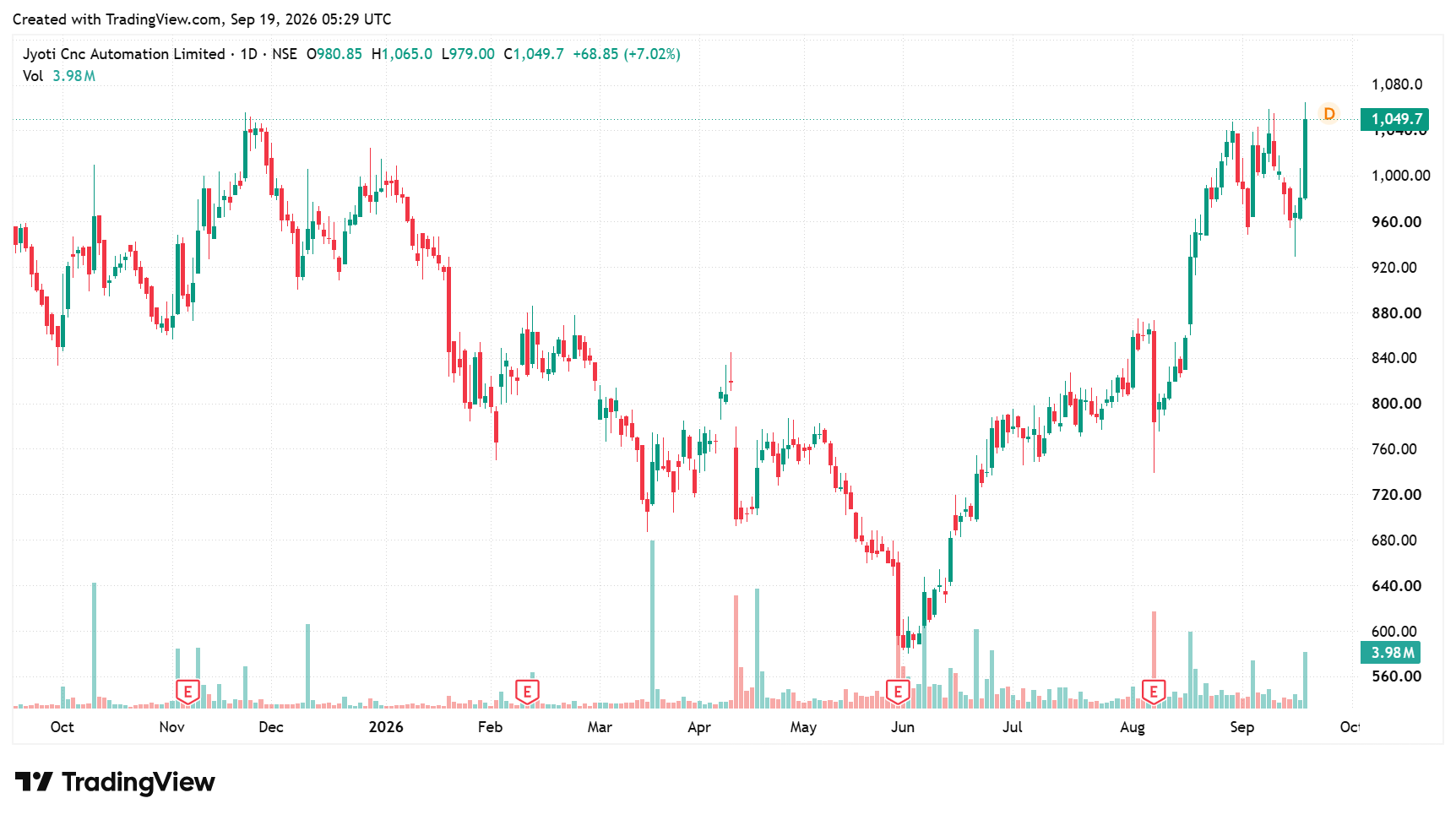
#1 Jyoti CNC Automation
Jyoti CNC Automation manufactures CNC metal-cutting machines. Jyoti CNC has installed over 140,000 CNC machines in 60+ countries worldwide. The company offers over 200 variants across 44 product verticals, ranging from entry-level turning and milling centers to high-end multi-axis and 5-axis machines.
Jyoti CNC serves diverse sectors. In Q1FY27, the aerospace and defense sector accounted for 37% of revenue, followed by auto and auto components (35%), general engineering (17%), electronic manufacturing services (6%), dies and molds (4%), and others (1%).
Order Book at ₹4,848 Cr: Aerospace Takes the Lead
As of 30 June, 2026, Jyoti CNC holds a total order book of ₹4,848 crore. Aerospace & defence (38%), general engineering (20%), auto & auto components (19%), and EMS (13%) lead the order book. Management expects full-year order intake to reach ₹2,500 crore to ₹3,000 crore. Of this, the company won ₹601 crore worth of orders in Q1FY27.
Jyoti CNC currently operates a base annual installed capacity of 6,000 CNC machines. In Q1 FY27, the plant operated at 86% capacity utilization. The company produced 5,550 machines in FY26 and expects to exceed 8,000+ machines in FY27. It is expanding capacity by 10,000 CNC machines, bringing total domestic annual capacity to 16,000 machines.
16,000-Machine Capacity Leap Powers Global Deals
The company targets full commissioning of this plant by the end of October 2026. Supported by the new capacity, total volume is projected to cross 8,000+ machines in FY27. The added capacity is the key reason behind FY27 guidance of 25-30% revenue growth. For aerospace components, Jyoti makes multi-axis machines, including
- GU 8: A 5-axis gantry-type machining center specifically developed for complex structural aerospace parts and tooling.
- Tachyon Beta: A compact, simultaneous 5-axis machine driven by linear motors for high-speed precision manufacturing.
- ATM 200: An inverted turning center catered to precision aerospace engineering.
Demand is driven by facility upgrades by Indian component suppliers. They are upgrading their facilities with Jyoti to manufacture parts for defense and commercial aerospace programs, including Airbus, Dassault, and Hindustan Aeronautics. Jyoti delivers advanced 5-axis centers to defense and aerospace clients across Europe, China, and Turkey.
Another demand driver is the mandate for promoting domestic defence manufacturing. This, coupled with import substitution, is accelerating demand for local CNC machine tools. Shifting manufacturing bases to India by global defence and aerospace players is also a tailwind for Jyoti CNC Business.
Huron Accounting Shift Masks 24% Topline Surge
Financially, the company’s revenue grew 24% year-on-year to ₹508.5 crore in Q1FY27, driven by 25.9% volume growth to 1,406 units and average realisation of ₹34.6 lakh. EBITDA (Earnings Before Interest, Tax, Depreciation, and Amortisation) surged 8.6% to ₹108.8 crore, with margins at 21.4%. Net profit fell 20% to ₹57.1 crore.
Profitability and margin fell due to a change in revenue recognition accounting methodology at the French subsidiary “Huron”. It moved away from the percentage-of-completion method and began booking revenue upon machine dispatch and receipt of end-user export certification. As a result, Huron deferred ₹35 crore in unbilled revenue and ₹20-22 crore in EBITDA.
France is investigating Huron for alleged export violations. This is a key risk to keep track of.
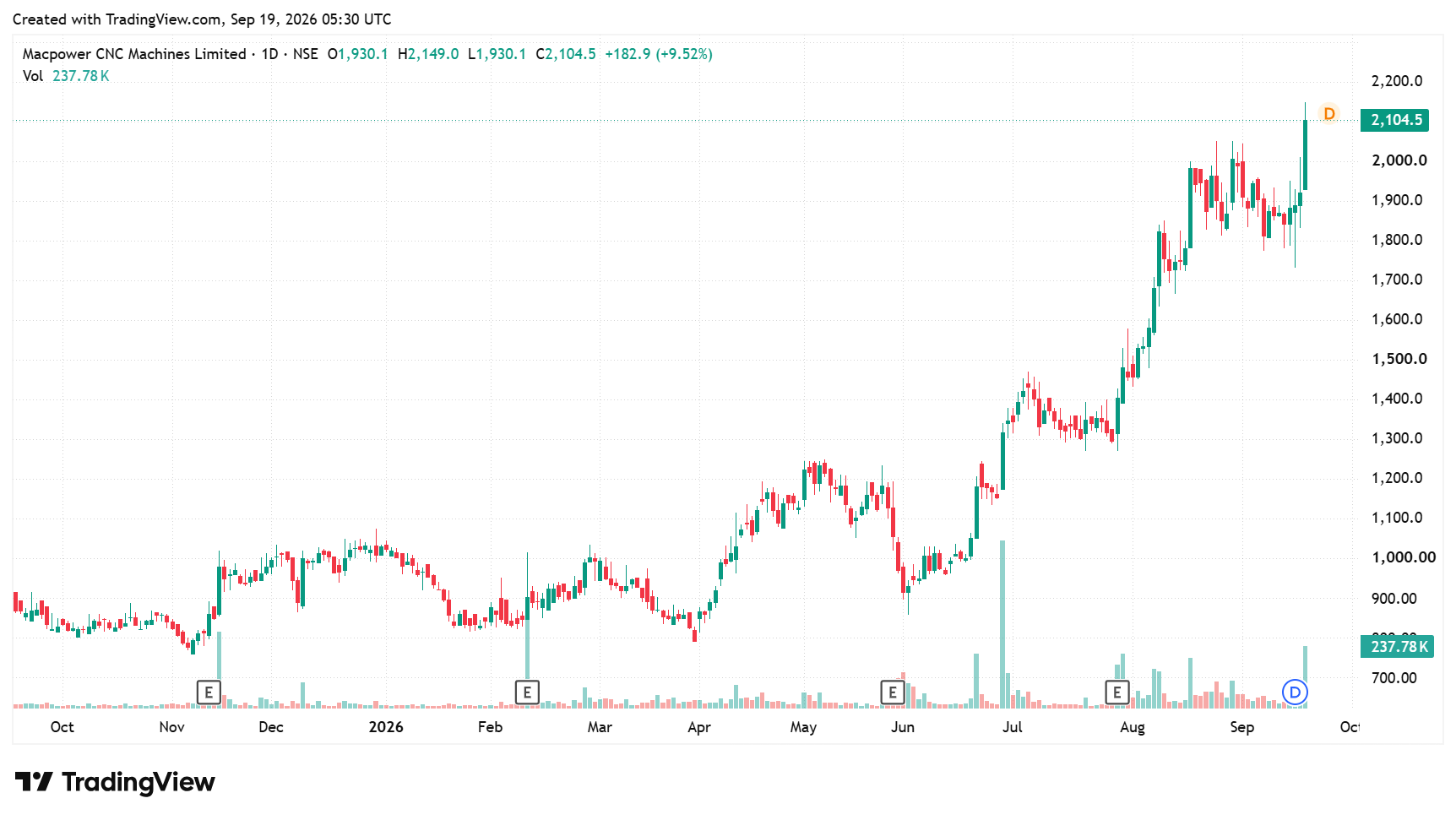
#2 Macpower CNC Machines
Macpower CNC Machines has expanded its presence in India’s defense and aerospace sector, supplying over 200 machines to 35 defense factories, including DRDO facilities. The company has delivered over 100 machines to 6 Aviation and Aerospace facilities, notably supplying major government organizations like HAL (for LCA Tejas Mk 1A aircraft) and ISRO (for Chandrayaan-3).
The company caters to around 3,000 manufacturing applications across multiple industries. The automobile sector accounts for around 20-25% of demand, followed by defence at 15-20%. Other key sectors include aerospace and aeronautics, pumps and motors, bearings, oil and gas, and EMS.
Macpower manufactures machines for aerospace and defence, including its AERO-5X 5-axis CNC machine, Horizontal Machining Centers, Double Column Machines, and Turn-O-Mill centers. The company’s current capacity stands at 2,500 machines per annum. Management aims to fully utilize this capacity, which could generate ₹460-475 crore in annual production value.
Premium NEXA Pivot Drives ₹475-Cr Production Target
Once the new plant is operational, growth could increase by 50-60%, supported by increased manufacturing capacity and greater product specialisation. NEXA category machines currently contribute around 27% of sales. Products include high-end machines such as double column machining centers, vertical turning lathes, horizontal machining centers, and 5-axis machines.
These machines cost significantly more than standard CNC machines. Standard machines are priced at around ₹20 lakh, NEXA machines around ₹70-80 lakh, and defence-related machines exceed ₹1 crore. Notably, a recent HAL machine order was priced at ₹1.5 crore. Management aims to increase the contribution of NEXA machines to 35% of revenue going forward.
₹456-Cr Order Book Backed by ₹1,043-Cr Active Bids
As of 30 June 2026, the order book stood at ₹456 crore. Higher-margin NEXA series machines account for 40% of the order book. It has also submitted bids totaling ₹1,042.9 crore. Of this, defence and aerospace bids stand at ₹304 crore.
To capitalise on the demand, the company has a strategic target of 5,000 machines per annum, with targeted completion within 12 months. To meet the quality standards required for defense and aerospace manufacturing, Macpower is building a 150,000 to 200,000 sq. ft. air-conditioned assembly facility.
This removes thermal expansion errors during assembly, reduces machine setup time, improves productivity, and meets quality requirements for defense partnerships and international joint ventures.
Profit Surges 110% as Q1 Margins Touch 16.2%
Financially, revenue grew 56.1% year on year to ₹95.2 crore in Q1FY27, driven by higher average realisation of ₹20.9-21.9 lakh per machine. EBITDA surged 94.8% to ₹15.4 crore while margin expanded by 322 bps to 16.2%. Net profit grew 110.1% to ₹9.6 crore. Management raised full-year FY27 revenue growth guidance to over 30%.
Execution Watch: Evaluating Bid Conversion and Balance Sheet Risk
Macpower has a higher Return on Capital Employed (ROCE) and Return on Equity (ROE) than Jyoti CNC. Valuation-wise, both companies trade at a premium to the industry median P/E multiple and their historical 5-year median valuation.
Particulars | Price-to-Earnings Multiple (X) | Return Ratios | ||
| Company | 3Y Median | ROE (%) | ROCE (%) | |
| Jyoti CNC | 74.2 | 72.7 | 18.2 | 21.3 |
| Macpower | 54.1 | 39.5 | 21.3 | 29.1 |
| Industry | 35.6 | 13.2 | 15.6 | |
| Source: Screener.in (As of 18 September 2026) | ||||
India’s shift towards domestic aerospace and defence manufacturing is creating a larger need for precision machining. CNC machines sit at the centre of this transition. Both Jyoti CNC and Macpower are increasing their presence in this segment. Jyoti CNC has greater exposure to aerospace and defence, while Macpower is expanding through defence factories, aerospace facilities, and higher-value NEXA machines.
Their growing order books and capacity expansion also point to increasing demand for advanced CNC equipment. However, the opportunity also requires strong execution. Capacity additions must translate into higher utilisation, while large bids must convert into orders. These companies could be worth keeping on your watchlist.
Disclaimer:
Note: Throughout this article, we have relied on data from http://www.Screener.in and the company’s investor presentation. We used an alternative, widely accepted source only when the data were unavailable.
The purpose of this article is only to share interesting charts, data points, and thought-provoking opinions. It is NOT a recommendation. If you wish to consider an investment, we strongly advise you to consult your advisor. This article is strictly for educational purposes only.
About the Author: Madhvendra has been deeply immersed in the equity markets for over seven years, combining his passion for investing with his expertise in financial writing. With a knack for simplifying complex concepts, he enjoys sharing his honest perspectives on startups, listed Indian companies, and macroeconomic trends.
A dedicated reader and storyteller, Madhvendra thrives on uncovering insights that inspire his audience to deepen their understanding of the financial world.
Disclosure: The writer and his dependents do not hold the stocks discussed in this article.
The website managers, their employees (s), and contributors/writers/authors of articles have or may have an outstanding buy or sell position or holding in the securities, options on securities, or other related investments of issuers and/or companies discussed therein. The articles’ content and data interpretation are solely the personal views of the contributors/ writers/authors. Investors must make their own investment decisions based on their specific objectives and resources, and only after consulting any independent advisors as necessary.