



Every technological revolution creates two kinds of winners. The first are easy to identify: they build the product that captures the public imagination, dominate headlines and become synonymous with a new industry. The second are less visible, supplying the infrastructure and components that allow that industry to scale.
The railway boom created demand for steelmakers, bridge builders and signalling companies alongside locomotive manufacturers. The internet created data centres, fibre networks and cloud infrastructure alongside websites. The smartphone revolution did the same for semiconductor, sensor and component manufacturers.
India’s space sector could be entering a similar phase. The Department of Space said in a press release on October 25, 2024, that India is targeting a US$44 billion space economy by 2033, up from around US$8.4 billion, with greater private participation and commercialisation playing a key role through the Indian National Space Promotion and Authorization Centre (IN-SPACe).
That 5x scale of ambition demands more than successful launches. It needs an industrial base capable of producing the specialised materials, electronics, subsystems and engineering equipment that space missions depend upon.
From Scientific Missions to Commercial Scale
For years, India’s space programme was primarily driven by scientific and strategic objectives. A US$44 billion industry cannot be built around a few government missions. Commercialisation has changed the equation. IN-SPACe has opened more areas of the aerospace sector to private participation, while NewSpace India Limited (NSIL) is helping monetise space technologies and transfer opportunities to industry.
The result is an ongoing shift in where the space economy is being built. The launch pad is crucial, but the bigger industrial opportunity is expanding towards the supply chain.
The Listed Prospect Is Further Down the Supply Chain
Some of the companies driving this transition are well known. Skyroot Aerospace and Agnikul Cosmos are creating private launch vehicles, Pixxel is building Earth observation expertise, while Dhruva Space and Digantara are working on satellite platforms and space situational awareness. But these businesses are privately held.
For public-market investors, the opportunity therefore lies one step further down the chain. The question is not which private company will eventually lead launches or satellite services, but which listed businesses are supplying the electronics expertise that every successful space programme will need.
That brings the focus to two less obvious parts of the ecosystem: advanced materials and mission-critical electronics. The first decides if a spacecraft can withstand the journey into space. The second establishes whether it can continue working once it gets there.
These aren’t as obvious as a rocket launch. But as India’s space goals move beyond individual missions to an industrial economy, they could become crucial parts of the value chain. So, we chose Mishra Dhatu Nigam Ltd. (Midhani) and Centum Electronics as they fit the focus of this article.
MIDHANI: Every Space Mission Begins with Materials
Before India can become a manufacturing hub for satellites, launch vehicles, or deep-space systems commercially, it must produce the specialised materials that make spacecraft. That challenge is even harder than creating ordinary industrial metals.
Spacecraft face violent launch shaking, extreme temperatures, radiation, and years of working in the vacuum of space. Materials in these systems must maintain their strength, avoid corrosion, and function perfectly in conditions where even the smallest failure can threaten an entire mission.
That’s why advanced metallurgy lies at the very foundation of the space economy. And MIDHANI fills this layer of India’s industrial ecosystem. The company manufactures titanium alloys, nickel-based superalloys, maraging steel, and other specialised materials used in cryogenic engines, launch vehicles, satellite assemblies, and strategic aerospace programmes.
Unlike common metal producers, MIDHANI does not compete on volumes alone. It vies on qualification, engineering expertise, and years of materials research. Developing a space-grade alloy is just the beginning. Getting it certified for aerospace applications, however, can take years. This requirement creates high entry barriers, making long-term customer relationships possible.
This expertise may become more valuable as India’s commercial space ecosystem expands. Every new launch vehicle, satellite platform, and propulsion system will need the same specialised materials, regardless of which private company builds them.
In many ways, MIDHANI is not simply a part of India’s space story. But it is helping build the industrial foundation on which that story will grow.
The numbers show a business moving beyond traditional metallurgy
MIDHANI’s financial performance indicates more than successful execution. It mirrors India’s increasing investment in strategic manufacturing.
Revenue for Q1 FY27 was ₹239 crores, growing ~40.46% YoY. The net profit excluding exceptional items was ₹16.31 crores, surging ~27% YoY. The earnings before interest, taxes, depreciation and amortisation (EBITDA) margins hovered between 15-20%, from June 2025 to 2026.
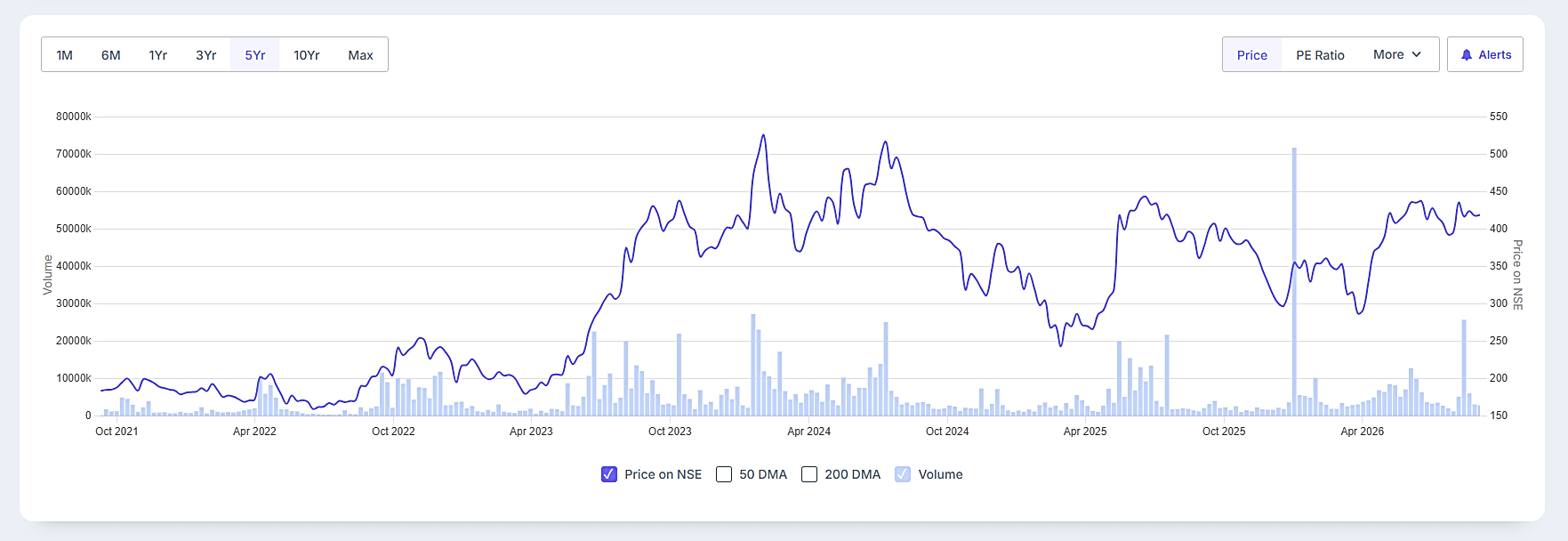
The Return on Equity (RoE) has remained between 8-10%, showing efficient capital allocation despite continued investments in specialised manufacturing facilities. Investors have recognised this, with the stock delivering a 17% compounded annual growth rate over the past five years.
Midhani 5-Year Share Price Trend
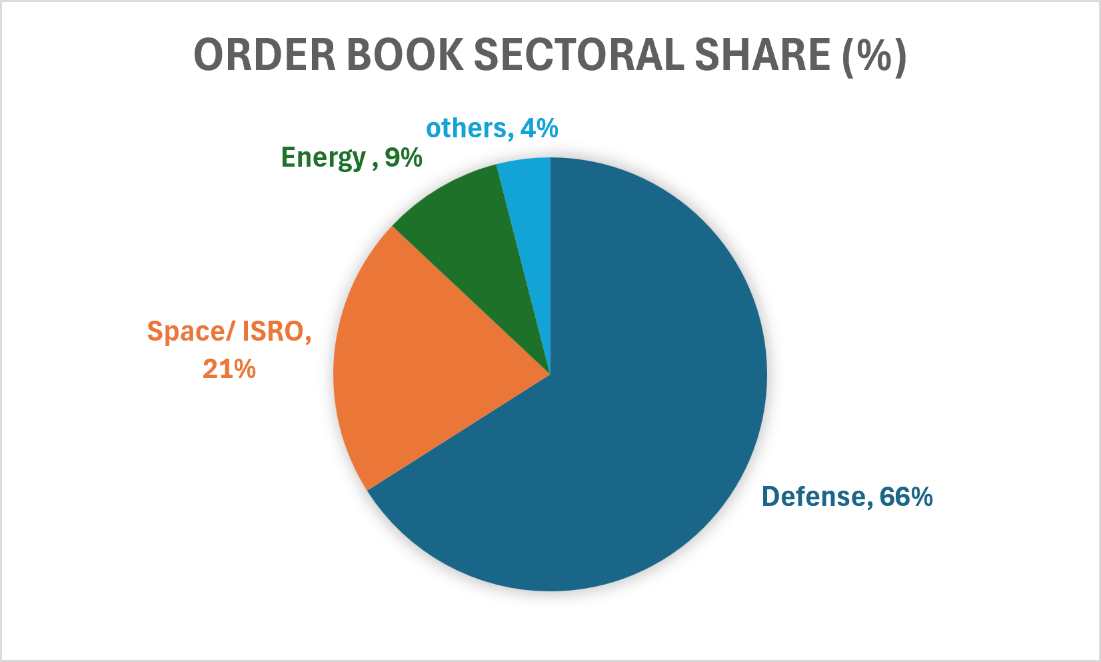
Perhaps the most promising development, however, is MIDHANI’s move up the value chain. The company is diversifying into titanium components, aerospace fasteners, superalloy castings, and other flight-qualified products. The growing order book of ₹2.3k crore shows this change.
Order Book Summary Q1 FY27
Such advancement could be just as significant as revenue growth itself.
Valuation
MIDHANI trades at a P/E of 58.32x, a discount compared to the sector median of 82.85x as of 5th Sept 2026. Whether the valuation grows, however, will depend on the company’s ability to continue growing earnings via value-added products rather than relying only on expanding production.
What investors should watch
As India’s commercial space ecosystem develops, investors should monitor the growth in aerospace and space-related revenues. Check if the operating margins and other ratios stay steady while capacity expansion and utilisation are underway.
Key risks
MIDHANI supplies materials to sectors with longer buying cycles and government-dependent project execution. Though the long-term opportunity seems promising, it may take several years before private space programmes contribute significantly to demand.
Advanced raw materials make space travel possible. Electronics make space missions useful. Every image transmitted from orbit, every navigation signal received on Earth, and every communication link established with a satellite relies on electronic systems designed to perform perfectly for years without the prospect of repair.
That brings us to the second layer of India’s industrial space ecosystem.
Centum Electronics: Building the Brain Behind Every Mission
Building a satellite is only half the challenge. Maintaining the momentum for the next decade is harder. Every space vehicle has complex systems that handle power, process data, connect with Earth, and run mission cargo.
Commercial electronics can be repaired on land, but these space systems must work continuously while enduring vibrations, emissions, and extreme heat fluxes in orbit. Reliability is not something a client desires. It is a mandatory requirement for qualification. That is where Centum Electronics has quietly built its expertise.
The company designs and manufactures avionics and power management modules. These products seldom attract headlines. But they are needed in electronic systems where failure could mean destruction or more. Private launch providers, satellite manufacturers and government agencies all demand the same level of engineering precision.
The numbers reflect a business moving up the engineering value chain
Better financial performance shows how the Indian space and strategic electronics ecosystem is maturing.
Q1 FY27 revenue grew 14.35% YoY to ₹ 204 crore. The net profit, though, fell 37% to ₹11 crore after exceptional items. A drop in Build-to-specification contribution to revenue squeezed profits.
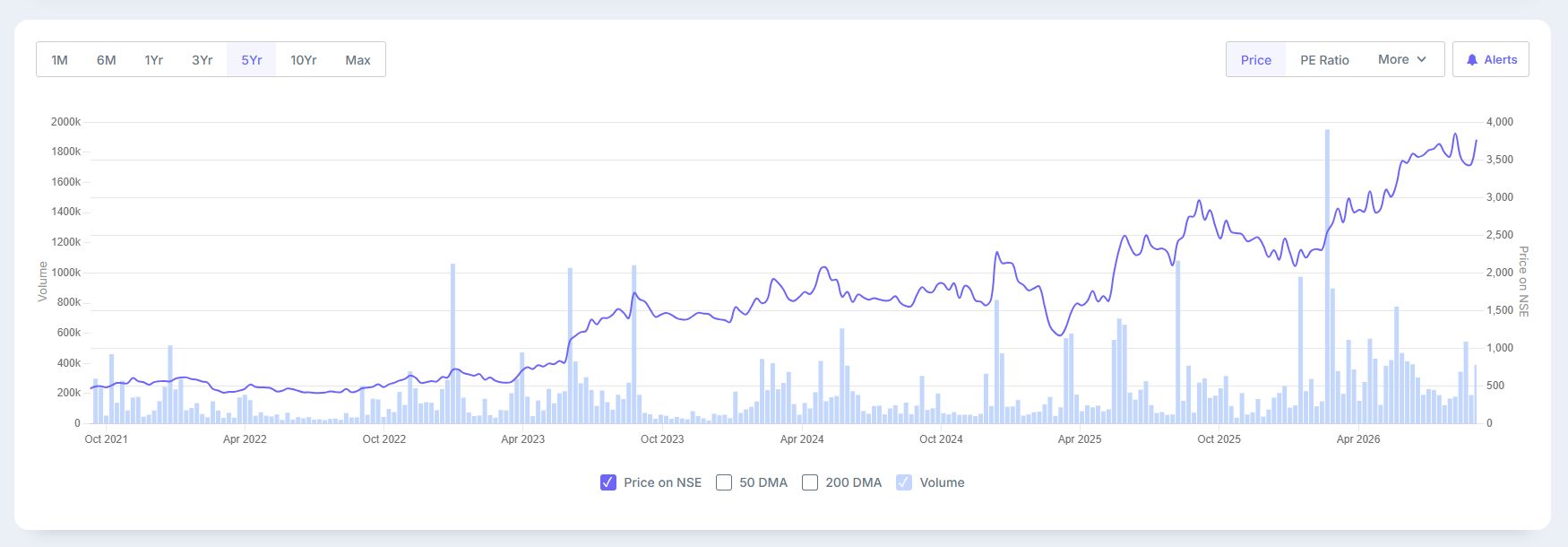
The EBITDA margins hovered around 12% and 16% between June 2025 and 2026. Return on capital employed (ROCE) was 25.5%. Investors rewarded this change with strong stock price appreciation of 49% CAGR over the past five years.
Centum Electronics 5-Year Share Price Trend
Moreover, the sectoral diversification showed the change in the company’s order pipeline.
Centum Electronics Order Pipeline
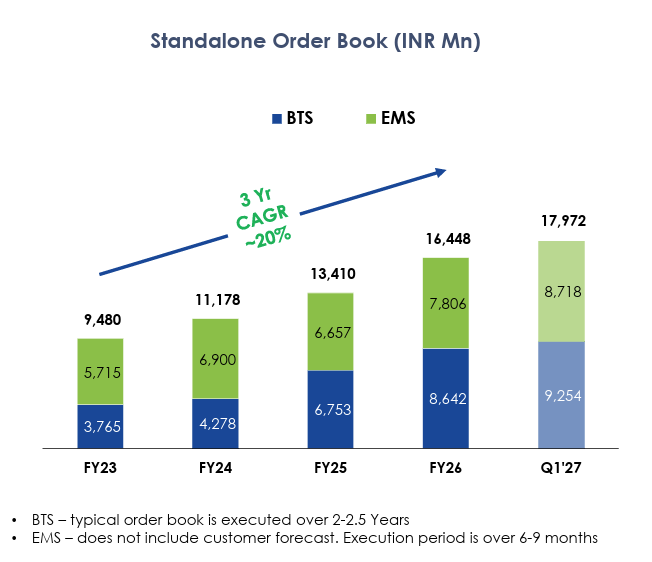
Unlike consumer electronics, aerospace and space programmes often extend over several years. Once eligible, such suppliers go through long development cycles, which makes the cost of switching high.
That makes Centum’s engineering capability, not its manufacturing capacity, its strongest competitive advantage.
Valuation
At around 63x P/E, Centum is not cheap in absolute terms. But peer comparisons change the picture. The aerospace and defence sector median is 80.7x P/E, which means Centum trades at a discount despite its exposure to high-dependability aerospace, defence and space electronics.
That discount suggests the market considers Centum a diversified electronics company rather than a pure-play aerospace and defence business. Steady earnings growth, better margins and a higher contribution from high-value aerospace and space programmes may allow the company to narrow some of that gap through fundamentals.
What investors should watch
Investors must look at the company’s expansion in space-related electronics revenue. They must also check for growth in order inflows as they ramp up project execution. Understand whether the ratios and cash flow generation are maintained.
Key risks
Centum runs in industries that require long qualification cycles and complex customer approval processes. Approval delays or customer schedules can mean short-term flux in quarterly performance.
Another challenge is execution. As the company expands into larger and more sophisticated programmes, maintaining product quality, delivery schedules and profitability will remain critical.
The Real Space Race Hasn’t Reached Orbit Yet
India’s ambition to build a US$44 billion space economy will almost certainly produce new launch companies, satellite operators and downstream technology businesses over the next decade.
Every mature industry in time develops its own supply chain. Automobiles created component producers. Semiconductors created equipment sellers. Renewable energy created inverter, transformer, and transmission companies. The space sector may not be any different.
Today, investors consider them defence companies, engineering firms, or speciality manufacturers. As commercial space activity gathers speed, that view could change.
The question, then, is not whether India will build more rockets. It is whether the market will ultimately stop valuing these businesses for what they do today and start pricing them for the role they’d probably play in the space economy. That difference may eventually decide where the next phase of wealth creation occurs.
Want to keep an eye on these businesses? Add them to your watchlist.
Disclaimer:
Note: We have relied on data from the May 2026 investor presentation, www.Screener.in, throughout this article. Only in cases where the data was not available have we used an alternate but widely used and accepted source of information.
The purpose of this article is only to share interesting charts, data points, and thought-provoking opinions. It is NOT a recommendation. If you wish to consider an investment, you are strongly advised to consult your advisor. This article is strictly for educative purposes only.
Archana Chettiar is a writer with over a decade of experience in storytelling and, in particular, investor education. In a previous assignment at Equentis Wealth Advisory, she led innovation and communication initiatives. Here, she focused her writing on stocks and other investment avenues that could empower her readers to make potentially better investment decisions.
Disclosure: The writer and her dependents do not hold the stocks discussed in this article.
The website managers, their employees (s), and contributors/writers/authors of articles have or may have an outstanding buy or sell position or holding in the securities, options on securities, or other related investments of issuers and/or companies discussed therein. The content of the articles and the interpretation of data are solely the personal views of the contributors/ writers/authors. Investors must make their own investment decisions based on their specific objectives, resources, and only after consulting such independent advisors as may be necessary.