


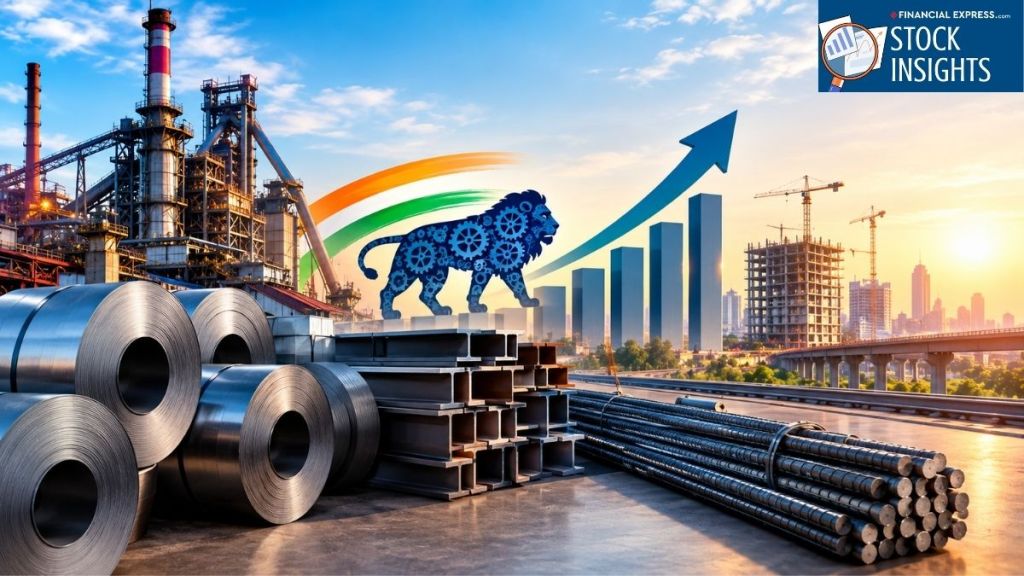

The steel industry, which plays a crucial role in the development of infrastructure / construction and production in other user industries, is a shining example of the Made-in-India story. The broader Indian steel industry has expanded production aggressively since the end of Covid and ranked as the fastest-growing globally between CY22 and CY25, a trend that continues into the current calendar year..
While steel is a crucial input for a range of industries, from autos to house construction, the expansion of domestic steel production over the past few years does not get much attention, especially from media.
To help readers get a greater insight into the domestic steel sector production expansion at the fastest pace globally, we looked at companies driving this growth and government policy measures.
Tata & JSW: The Private Sector Engines Behind India’s Steel Output
The growth in Indian steel production over the past few years has been thanks to large corporates like the Tata Group and JSW group, amongst others, which have looked beyond short-term sluggishness / constraints to growth of the domestic economy. Instead these groups have focused on partnering with the broader manufacturing sector with enhanced capacity over the next decade.
In addition, the steps taken by the government including the Production Linked Scheme (PLI) scheme for value-added products coupled with the imposition of 12% safeguard duty on the import of certain non-alloy and alloy steel flat products in April 2025 have also played a crucial role in aggressively growing steel production. The safeguard duty is expected to be in force for the next 3 years, and has also boosted the confidence of the domestic steel industry.
Outpacing China: How India Achieved 6.1% Growth in CY2026
Growth in steel production in India during the current calendar year, 2026, has been the fastest on a global basis on a y-o-y basis, on comparing the data among the top 5 steel producing nations (view table below).
The 5 leading steel producing nations in descending order during CY26 are – China, India, USA, Japan and Russia, according to the global steel industry body, http://www.worldsteel.org.
India has title of ‘Fastest growth in steel production in CY2026’
| Country | Steel production in million tons between January – July 2026 | % change y-o-y |
| China | 577 | -3.1 |
| India | 101.1 | 6.1 |
| USA | 50.2 | 6 |
| Japan | 47.3 | -0.3 |
| Russia | 38.1 | -6.1 |
Source – http://www.worldsteel.org
The 36M-Tonne Target: Tracking Tata and JSW’s Capacity Expansions
The fastest growth tag for the domestic steel industry in calendar year 2026 comes thanks to the recent expansion in steel capacities of the two leading players, Tata Steel and JSW Steel.
For instance, Tata Steel ended FY26 with a capacity of 36 million tonnes across its Indian and global operations. Its steel capacity in India was nearly 27.4 million tonnes at the end of FY26. A year earlier, FY25,Tata Steel’s total global capacity was nearly 35.3 tonnes with its Indian steel capacity at 26.6 million tonnes.
The inauguration of the Phase II expansion at Kalinganagar, Odisha during FY 26 helped Tata Steel to expand its flat products portfolio towards high-value sectors like automotive and defense during the current calendar year.
Meanwhile, JSW Steel’s domestic crude steel installed capacity of 36.4 million tonnes including 4.5 million tonnes through the JSW JFE Steel JV at the end of FY26.
A year earlier, JSW Steel domestic installed capacity was 34.2 million tonnes.
The company has benefited from 96% capacity utilization during FY26 coupled with enhanced output at its key Vijayanagar, Karnataka facility.
Indian steel companies have broadly benefited from strong demand from key industries like auto and construction sector, and that’s thanks to a number of policy measures taken by the central government and RBI to keep demand momentum amidst the Middle East crisis.
In contrast, steel production in China declined 3.1% during calendar year 2026 on account of weak demand from the key housing sector. In addition, with key steel consuming countries like USA, India and EU, amongst others, imposing tariffs on Chinese steel imports, it has curtailed production in that country.
A 9.6% Post-Covid CAGR: India’s Steel Resurgence vs. Global Peers
Post Covid, too, India has once again retained the tag of the fastest growth in steel production between CY22 and CY25. For instance, Indian steel production was 125.37 million tonnes during CY 22 and it had reached 165 million tonnes during CY25 (view table).
India marches ahead of peers in steel production growth
| Country | Steel production in million tons during CY22 | Steel production in million tons during CY25 | Compounded annual growth rate between CY22 and CY25 (% change) |
| China | 1017.9 | 960 | -1.9% |
| India | 125.37 | 165 | 9.6% |
| USA | 80.53 | 81.93 | 0.6% |
| Japan | 89.2 | 80.67 | -3.3% |
| Russia | 71.47 | 67.9 | -1.7% |
Source – http://www.worldsteel.org
The rapid growth in domestic steel output between CY22 and CY 26 was once again thanks to rapid capacity expansion of key players.
For instance, Tata Steel domestic steel capacity was 20.6 million at the end of FY22 and it reached 27.4 million tonnes at the end of FY26.
Similarly, JSW Steel’s domestic steel capacity was 27 million tonnes at the end of FY22 and it had reached 36.4 million tonnes including 4.5 million tonnes through the JSW JFE Steel JV at the end of FY26.
However, government-controlled SAIL’s steel capacity of 19 million tonnes at the end of FY22 was broadly similar to FY26 levels.
PLI Schemes and 12% Safeguard Duties: The Policy Moat for Domestic Producers
The government initiatives for the steel sector include the Production-Linked Incentive (PLI) Scheme of Specialty Steel and the Steel Import Monitoring System (SIMS) that are focused on promoting domestic output and reducing dependence on imports, respectively.
In July 2021, the PLI Scheme of Specialty Steel was launched, targeting to increase the local manufacturing of high-value steel and also generate employment.
The scheme encompassed five broad product lines – coated or plated steel products, high-strength/wear-resistant steel, specialty rails, alloy steel products and steel wires, and electrical steel. The scheme targets to generate 42 million tonnes of specialty steel annually by FY27.
Q1 FY27 Margins: JSW Steel’s 19.8% Operating Profit Leads the Pack
Steel companies benefited from higher steel prices coupled with higher output in the first quarter of FY27.
For instance, JSW Steel’s consolidated revenue from operations grew 9.8% y-o-y to Rs 47,364 crore. A tight check on costs helped JSW Steel’s consolidated operating profit margin rise 220 basis points y-o-y to 19.8%. Also, JSW Steel’s consolidated net profit rose 112.6% y-o-y to Rs 4,696 crore.
Similarly, strong performance of Tata Steel’s Indian operations helped consolidated net sales rise 14.3% y-o-y to Rs 60,794.3 crore, and its consolidated net profit also rose 18.8% y-o-y to Rs 2,385.2 crore.
Dalal Street Resilience: Tata, JSW, and SAIL Hold Near 52-Week Highs
Strong performance in the June 2026 quarter helped ensure strong investor interest in steel stocks and they have been one of the few sectors that have withstood the broad selling pressure witnessed on Dalal Street.
For instance, JSW Steel ended 0.5% higher on Monday at Rs 1,274, and it is not too far from its 52-week high of Rs 1,350.3 that was reached on 27 August, 2026.
Meanwhile, Tata Steel ended 0.6% lower at Rs 183.6, and it had reached its 52-week high of Rs 224.4 that was reached on 15 May, 2026.
And SAIL ended 1.9% lower at Rs 176.6 and it had reached a 52-week high of Rs 209.7 that was reached on 14 May, 2026.
The Efficiency Gap: Tata Steel’s 11.7% RoE Outshines PSU Rivals
Tata Steel has a consolidated return on equity (RoE) of 11.7%, according to Screener.in, while it is 10.2% for JSW Steel.
SAIL has a RoE of 6.6%.
Tata Steel marches ahead of rivals in efficiency
| Steel company | Return on Equity (in %) |
| Tata Steel | 11.7% |
| JSW Steel | 10.2% |
| SAIL | 6.6% |
Source- Screener.in
The Valuation Puzzle: Why SAIL Trades at a 42% P/E Discount to JSW
Tata Steel trades at a consolidated P/E of 19.4, according to Screener.in, and over the past 5 years, it has traded between 2.7 times and 183.2 times.
JSW Steel trades at a consolidated P/E of 26, and over the past 5 years, it has traded between 6.6 times and 73.6 times.
And SAIL trades at a consolidated P/E of 14.9, and over the past 5 years, it has traded between 2.3 times and 29.4 times.
SAIL trades at a discount of 23% to 42% to larger peers
| Steel company | Consolidated P/E (x) |
| Tata Steel | 19.4 |
| JSW Steel | 26 |
| SAIL | 14.9 |
Source – Screener.in
The domestic steel industry will continue to add capacity over the next few years, to leverage demand from key user industries. SAIL trades at a discount of 23% to 42% as its capacity expansion has broadly lagged peers.
Readers could add SAIL and other steel stocks to their watch list of stocks for 2026, and see if the performance matches expectations.
Disclaimer
Amriteshwar Mathur is a financial journalist with over 20 years of experience.
The writer and his family have no shareholding in any of the stocks mentioned in the article.
Disclaimer: The website managers, its employee(s), and contributors/writers/authors of articles have or may have an outstanding buy or sell position or holding in the securities, options on securities or other related investments of issuers and/or companies discussed therein. The content of the articles and the interpretation of data are solely the personal views of the contributors/ writers/authors. Investors must make their own investment decisions based on their specific objectives, resources and only after consulting such independent advisors as may be necessary.