



Welcome to the latest edition of Hidden Gems Weekly. In recent weeks, we examined a company that has spent 37 years making bead wire and building relationships with leading tyre makers, another that wants to move beyond meter boxes, one transforming from a traditional industrial manufacturer into a high-value engineering solutions provider and a company that wants to move beyond selling more machine tools to selling better ones. This week, we look at a company that has spent decades making the components most motorists never notice and is now trying to turn that manufacturing expertise into a much bigger business.
For years, Sandhar Technologies was the sort of company investors would come across only when they looked closely at the suppliers behind India’s two-wheeler industry. It makes locks, mirrors, wheel assemblies, sheet-metal parts, aluminium castings, cabins and other components, supplying vehicle manufacturers in India and overseas.
But Sandhar is now trying to become something more than a conventional auto-component supplier. It is putting money into aluminium die casting, sheet metal, cabins and fabrication and electric vehicle powertrain products, while its existing business continues to grow rapidly.
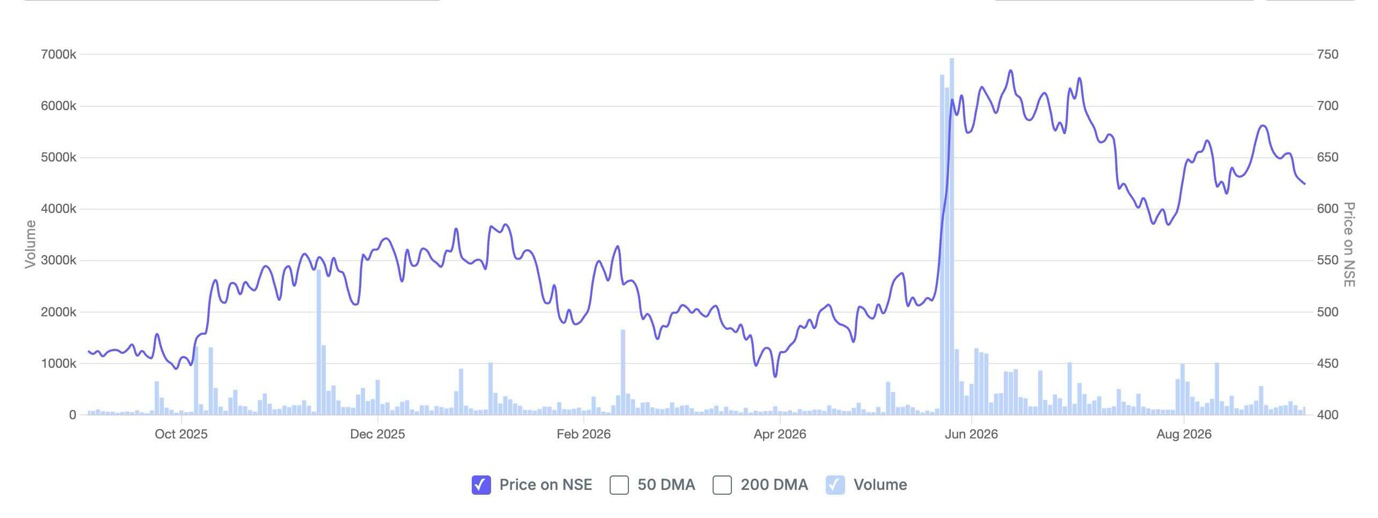
Sandhar Technologies 1-Year Share Price Chart
The interesting part is that some of these newer businesses are already producing revenue but very little profit. That makes Sandhar a bet not merely on India’s vehicle market, but on whether the capital being spent today can generate better returns tomorrow.
There is a useful parallel here with Uno Minda. Over the years, Uno Minda grew by adding more products, entering more vehicle categories and increasing the amount of content it could supply on each vehicle. It seems that Sandhar is trying something similar. However, it is still earlier in that journey.
The numbers look good, until you look below the surface
At first glance, there isn’t much to complain about in Sandhar’s latest numbers. Consolidated revenue in Q1 FY27 rose 26.77% to Rs 1,381.89 crore, up from Rs 1,090.09 crore a year earlier. EBITDA increased 15.23% to Rs 117.33 crore and profit before tax rose 40.84% to Rs 51.14 crore.
But there is a small catch. EBITDA grew much slower than revenue, which meant the EBITDA margin fell to 8.49% in Q1 FY27 from 9.34% in Q1 FY26.
Now, the company attributed some of the pressure to Rs 5.84 crore of additional minimum-wage costs in Haryana and Uttarakhand, Rs 7.50 crore of higher energy costs and Rs 7.41 crore of PBT losses from new projects that are yet to achieve meaningful volumes.
This is important because those new projects are central to Sandhar’s current strategy. The company is spending money today in the hope that these businesses will generate considerably more revenue and profit once they reach scale. In manufacturing, that can be a sensible strategy because fixed costs are incurred upfront and margins can improve once capacity utilization rises.
The trouble is that shareholders have to pay for the factories before the factories pay them back.
Sandhar is building a second growth engine
The traditional business is still doing quite well. FY26 consolidated revenue increased 24.91% to Rs 4,852.09 crore, while the underlying EBITDA margin improved to 10.57% from 10.29%.
The company’s India business has been growing faster than the overall automobile market. In Q1 FY27, India revenue excluding new projects rose 29.34% to Rs 1,122.71 crore, while EBITDA increased 8.55% to Rs 101.89 crore. The EBITDA margin for this part of the business was 9.08%, compared with 10.81% a year earlier.
That tells us something important. The pressure on margins is not coming only from the new projects; even the existing India business is dealing with higher input and employee costs. In Q1 FY27, material costs in the India business rose and employee expenses increased, both faster than revenue.
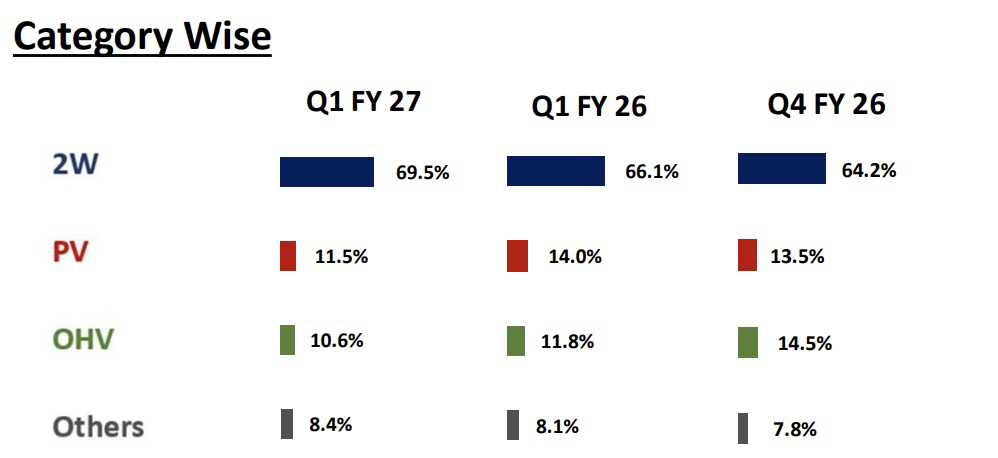
This makes the next phase of the story more interesting. Sandhar already has a large, fast-growing core business. The question is whether the company can use that base to build newer businesses without allowing the cost of expansion to keep a lid on margins.
That is really what the Rs 341 crore investment programme is about.
The Rs 341 crore question
Sandhar’s new projects are where the investment story gets more interesting. The company has four new India projects in their initial stages, involving Rs 341 crore of investment. They generated Rs 130 crore of revenue in Q1 FY27, but EBITDA was only Rs 0.88 crore and PBT was a loss of Rs 7.41 crore.
The projects are at different stages, with the Hosur aluminium die-casting business targeted for turnaround in Q4 FY27, Pune cabins and fabrication in Q3 FY27 and the Chennai sheet-metal and Haryana EV (electric vehicle) projects in FY28.
So Sandhar is already getting the revenue from these investments. The bigger question is when the profit will follow.
Aluminium die casting could be the bigger opportunity
Among the newer businesses, aluminium die casting deserves particular attention. Sandhar makes crankcases, cylinder heads, engine covers, hubs, clutch parts, chassis-supporting components and battery cases for two-wheelers and four-wheelers. Aluminium, zinc and magnesium die casting together account for 25% of product revenue.
The business gives Sandhar exposure to both conventional and electric vehicles. While products such as crankcases and cylinder heads serve traditional powertrains, battery cases can be used in EVs.
Sandhar is expanding this capacity. Its new aluminium die-casting facility at Avigna Industrial Park in Hosur is one of its largest casting facilities, with Phase I expected to start by the end of August 2026 and the project targeted for completion by March 2027.
The sheet-metal business offers another avenue for growth. Sandhar makes frames, swing arms, fuel tanks, panels, handlebars and wheel-rim assemblies for two-wheelers, while its fabrication business includes cabins, canopies, buckets, guards and hydraulic tanks for off-highway vehicles.
Phase I of the Chennai sheet-metal project has already started, with Phase II expected by March 2027. So the expansion is not about adding capacity for one product. Sandhar is building a broader portfolio of components used across two-wheelers, four-wheelers, EVs and off-highway vehicles.
The EV business is small, but the company wants it to grow
The electric vehicle business is another piece of this puzzle, although investors should not mistake it for a large business today.
Sandhar’s EV operations include battery chargers, motor control units and other powertrain-related products. The company has also developed smart locksets for electric scooters and other products through its in-house research and development centre.
The company spent Rs 15.33 crore on research and development during FY26, including Rs 4.90 crore of capital expenditure and Rs 10.43 crore of operating expenditure. It has developed products such as low-current and hybrid locksets for two-wheeler EVs, smart mirrors and immobiliser locksets.
The EV business is still in the investment phase. The company expects it to reach turnaround in FY28, which means investors should treat it as a future growth opportunity rather than assign a large valuation premium to it today.
That distinction is important. There is a big difference between having an EV business and having an EV business that generates meaningful profits.
Management has set a clear FY27 target
Management has guided to more than 15% revenue growth in FY27. It has described this as a conservative target and has excluded the potential benefit of price increases or price retrigger mechanisms from the guidance.
That is a fairly important target because Sandhar is coming off a year in which revenue grew almost 25%. The company is therefore not guiding to a dramatic acceleration. It is effectively saying that double-digit growth should continue even as the business absorbs the costs of its new investments.
Management has also retained its longer-term ambition of doubling revenue every three to four years. It has spoken of eventually reaching Rs 10,000 crore of revenue and around Rs 450 crore of PAT, along with a post-tax ROCE target of 15% to 20%.
These targets are important because they show what management expects the current investment programme to deliver. If the company moves towards them, the case for the expansion strengthens.
Capex will remain high
Getting there will require money. Sandhar invested Rs 173.05 crore in capital expenditure and investments in subsidiaries during FY26. Of this, Rs 72.15 crore went into equity shares of wholly owned subsidiaries and Rs 100.90 crore into property, plant and equipment, capital work-in-progress and other intangible assets.
Management expects FY27 capex to be in the Rs 275 crore to Rs 310 crore range. That includes spending on growth, maintenance and upgrading older facilities.
There is nothing inherently worrying about a manufacturing company spending heavily on capacity. The problem starts if the new capacity takes too long to generate sufficient profit, because the company then has to keep putting in capital without getting a proportionate increase in earnings.
That is why the return on capital employed (ROCE) number will be more important than the absolute amount of revenue generated by these projects.
Balance sheet and working capital need watching
The consolidated balance sheet has expanded alongside the business, with borrowings rising from Rs 924 crore in FY25 to Rs 1,148 crore in FY26. The consolidated debt-equity ratio stood at 0.86 in FY26, up from around 0.81 in FY25.
Debtor days increased from 52 to 62 and inventory days from 63 to 67, while the cash conversion cycle widened from 34 days to 36 days.
Operating cash flow fell to Rs 210 crore in FY26 from Rs 247 crore in FY25, while working capital consumed around Rs 199 crore, more than double the Rs 96 crore consumed a year earlier. Free cash flow was negative Rs 71 crore.
This is not unusual for a fast-growing manufacturer investing in new capacity. But if receivables and inventory continue to grow faster than revenue, the quality of that growth will come under greater scrutiny.
The overseas business is still a work in progress
Sandhar’s overseas business gives it a presence beyond India, with operations in Spain, Poland, Mexico and Romania. The business is largely focused on auto components such as aluminium die-cast parts and contributed 9.3% of consolidated revenue in Q1 FY27.
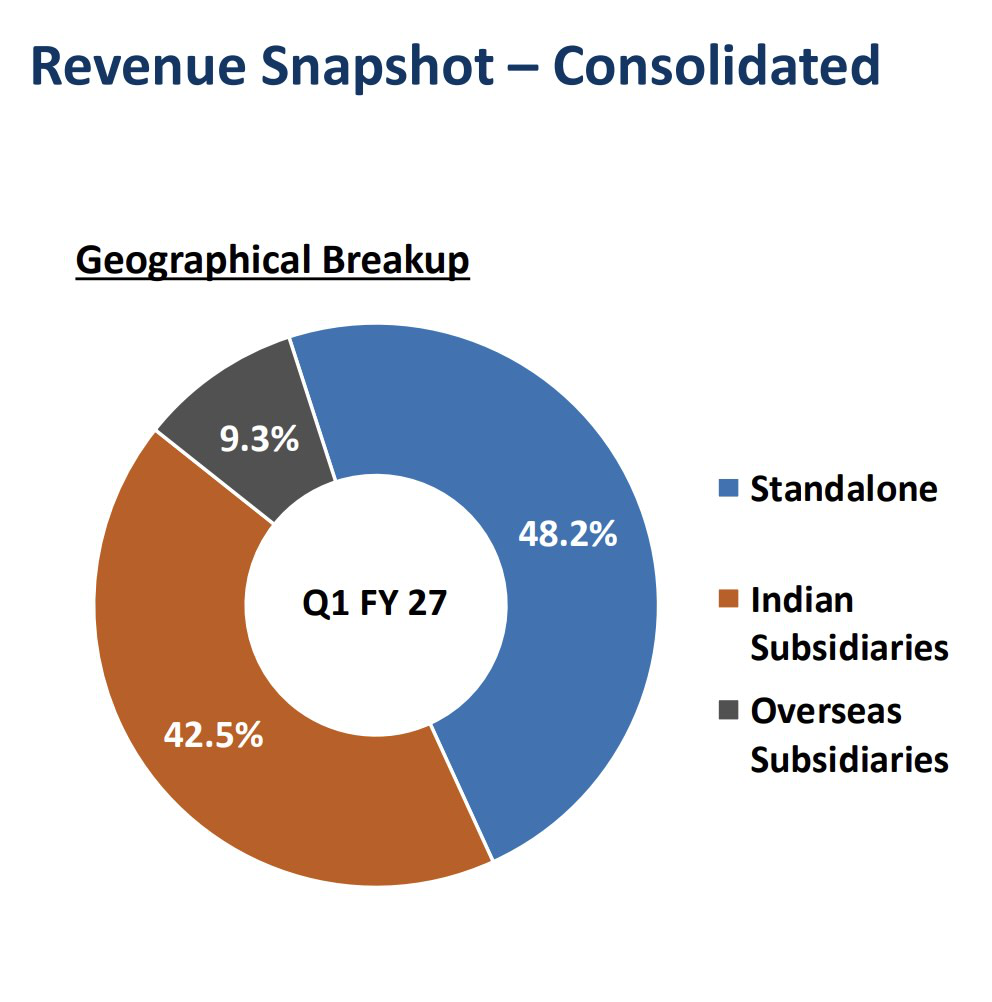
But for now, this is more a story of potential than profits. Revenue increased 4.74% to Rs 128.77 crore in Q1 FY27, while EBITDA jumped 186%, but the overseas subsidiaries still reported an EBT loss of about Rs 4.08 crore.
That is the odd thing about the overseas business. Sales are there, the factories are there and even EBITDA is improving. What is missing is the last step, turning all of that into a meaningful profit contribution.
Sandhar is therefore working on improving utilization, costs and pricing so that the overseas operations can become a more consistent contributor to the group. For now, investors should treat this as another part of the company’s turnaround story rather than a reason to pay a premium for the stock.
There is also a large goodwill number
One less obvious issue sits on the balance sheet. As of March 2026, Sandhar carried goodwill of Rs 771.40 crore on a consolidated basis, of which Rs 716.07 crore was allocated to the aluminium die-casting cash-generating unit. The company tested the goodwill for impairment and did not recognise any impairment because the estimated recoverable amount exceeded the carrying value.
There is no suggestion that an impairment is currently required. But the size of the goodwill is worth remembering because it represents an expectation that the acquired aluminium die-casting business will generate sufficient future cash flows.
If the business reaches the expected profitability levels, the goodwill will become less interesting. If the turnaround takes much longer than expected, it could become a more important issue for investors.
Returns are improving, but there is room to do better
Sandhar’s returns have improved, but they are not yet at the level that would make the stock an obvious high-ROCE story. Consolidated ROCE stood at around 12.3% and ROE (Return on Equity) at around 11.5% in FY26, while the company’s standalone ROCE was 17.59% and ROE was 14.60%.
The difference matters because Sandhar has several subsidiaries and newer businesses that are still ramping up. The real test now is whether the new investments can lift consolidated returns as they move towards profitability.
Valuation
At around Rs 650 a share, Sandhar was trading at roughly 19 times earnings. The valuation leaves some room for growth, but not for disappointment on margins or returns.
The upside rests on the new businesses turning profitable, overseas losses narrowing and ROCE moving towards management’s 15% to 20% target. The risk is that high capex and working capital keep cash flows under pressure while margins remain around current levels, leaving less room for the stock to rerate.
The real Sandhar story starts after the growth
Sandhar has already shown that it can grow, with revenue rising from Rs 2,909 crore in FY23 to Rs 4,852 crore in FY26. Q1 FY27 continued that momentum, with revenue up 26.77% and EBITDA up 15.23%.
The next test is whether the new capacity can deliver the returns management expects. The company is expanding into aluminium die casting, sheet metal, cabins and fabrication and EV products, while also trying to improve the economics of its existing businesses.
Management is targeting more than 15% revenue growth in FY27 and wants to double revenue every three to four years, with longer-term targets of Rs 10,000 crore revenue, around Rs 450 crore PAT and post-tax ROCE of 15% to 20%.
The factories are coming up and the revenue is growing. Now the profits and cash need to catch up.
If the new businesses turn profitable while the core business keeps growing, today’s margin pressure could prove to be the cost of building a much larger company. That is the part investors will need to watch.
Disclaimer:
Note: We have relied on data from www.Screener.in throughout this article. Only in cases where the data was not available, have we used an alternate, but widely used and accepted source of information.
The purpose of this article is only to share interesting charts, data points and thought-provoking opinions. It is NOT a recommendation. If you wish to consider an investment, you are strongly advised to consult your advisor. This article is strictly for educative purposes only.
Manvi Aggarwal has been tracking the stock markets for nearly two decades. She spent about eight years as a financial analyst at a value-style fund, managing money for international investors. That’s where she honed her expertise in deep-dive research, looking beyond the obvious to spot value where others didn’t. Now, she brings that same sharp eye to uncovering overlooked and misunderstood investment opportunities in Indian equities. As a columnist for LiveMint and Equitymaster, she breaks down complex financial trends into actionable insights for investors.
Disclosure: The writer and her dependents do not hold the stocks discussed in this article. The website managers, its employee(s) and contributors/writers/authors of articles have or may have an outstanding buy or sell position or holding in the securities, options on securities or other related investments of issuers and/or companies discussed therein. The content of the articles and the interpretation of data are solely the personal views of the contributors/ writers/authors. Investors must make their own investment decisions based on their specific objectives, resources and only after consulting such independent advisors as may be necessary.