




Welcome to the latest edition of Hidden Gems Weekly. In recent weeks, we examined a company that caters to two-wheelers, four-wheelers and off-highway vehicles, another that spent 37 years making bead wire and building relationships with leading tyre makers and one that wants to move beyond meter boxes, one transforming from a traditional industrial manufacturer into a high-value engineering solutions provider. This week, we look at a company that has spent decades making the components most motorists never notice and is now trying to turn that manufacturing expertise into a much bigger business.
Auto-component companies have a peculiar business model. They make things most people never think about, yet once a component gets into a vehicle, it can keep generating business for years. A cable connecting a gear lever to a gearbox does not sound like much of a business, but multiply it across thousands of vehicles and several customer programmes, and it starts looking rather different.
The interesting part begins when a company that has spent decades making such components decides that cables alone are not going to take it far enough. It then has to find products where the engineering is more complicated, the customer relationship is deeper and, hopefully, the margins are better.
Remsons Industries is attempting exactly that. The company has traditionally been known for control cables and related mechanical components. Still, its product basket now stretches to gear shifters, pedal systems, winches, lighting, sensors, tyre-mobility kits and products for railways and defence.
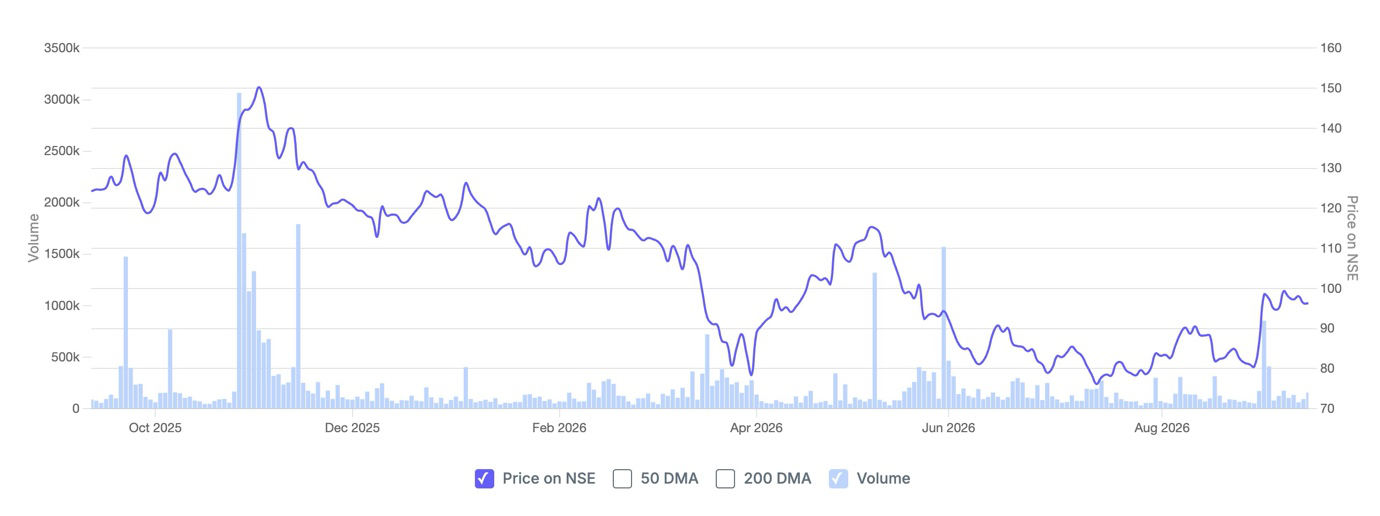
Remsons Industries 1-Year Share Price Chart
The numbers suggest that something is already happening. Consolidated revenue rose 24% to Rs 468.7 crore in FY26 from Rs 376.6 crore in FY25, while EBITDA grew 32% to Rs 49.5 crore and net profit after minority interest rose 26% to Rs 18.1 crore.
But there is a catch, and it is an important one. A company can become bigger without necessarily becoming a better business. For Remsons, the real test is whether moving into newer and more complex products can lift the profitability of the business along with its revenue.
Q1 FY27 offered a useful warning on that front. Revenue rose 20% year-on-year to Rs 119.7 crore, but EBITDA was almost flat at Rs 10.4 crore, pulling the EBITDA margin down to 8.7% from 10.6% a year earlier, while net profit after minority interest fell 21% to Rs 2.9 crore.
This is what makes Remsons more interesting than a simple small-cap auto-component growth story. The company is trying to change what it earns money from, not merely how much money it earns.
The old business is still doing the heavy lifting
The company has built its traditional business around automotive control cables, flexible shafts, gear-shift systems, push-pull cables and parking-brake mechanisms. It has also expanded its customer base beyond India, with exports forming an important part of the business.
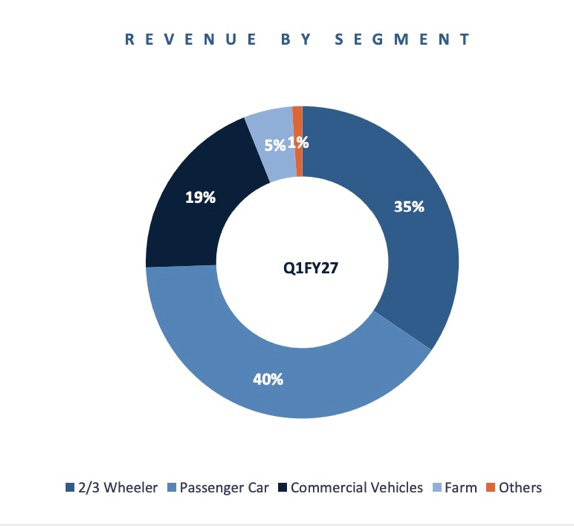
The revenue mix also shows how closely the business remains tied to the automotive cycle. In Q1 FY27, passenger cars and two-wheelers together accounted for 75% of revenue, while commercial vehicles contributed another 19%, leaving only a small share from farm and other segments.
There is nothing inherently wrong with remaining a component supplier. But there is a limit to how far a company can take this model if it remains dependent on relatively standard mechanical components. The bigger opportunity lies in supplying more complex assemblies and systems where the company can potentially earn better margins and become harder for customers to replace.
The harder part is improving the economics
The attraction of the diversification is not simply that Remsons can sell more products. A larger product basket is useful only if the newer businesses allow the company to earn more from each rupee of revenue.
There has already been some improvement in the underlying economics, but the recent numbers show that it is not a one-way journey. The operating profit margin had moved into double digits in recent years, but slipped in Q1 FY27 amid higher commodity costs.
Margin Contraction: The Immediate Q1 FY27 Reality Check
The June quarter therefore provides a useful reality check on the broader transformation. Revenue grew 20%, but EBITDA was almost flat, and the margin fell to 8.7% from 10.6% a year earlier.
Management attributed part of the pressure to higher commodity prices. The more important question for investors, however, is what happens when the newer programmes start contributing at scale, because that is when the promised improvement in product mix should begin showing up in margins rather than just in the presentation.
The order wins are beginning to change the mix
Remsons has disclosed a series of multi-year programmes that suggest it is getting deeper into the supply chains of larger customers.
One of the biggest is a Rs 300 crore, seven-year control-cable programme from Stellantis. The company has also won a Rs 60 crore, five-year commercial-vehicle programme for gear shifters with push-pull cables and a Rs 160 crore, 10-year programme from a global commercial-vehicle original equipment manufacturer for pedal-box assemblies.
There are other wins as well, including a Rs 12 crore exterior-lighting programme from a global multinational original equipment manufacturer and a Rs 30 crore, six-year hood-rod programme from a global commercial-vehicle original equipment manufacturer. These programmes broaden the product mix beyond traditional control cables.
The important point is not to assume that these numbers will immediately translate into revenue. These programmes run over several years, but they show that Remsons is moving into a broader range of products as production ramps up.
Railways offer another avenue for growth
The other interesting part of the diversification is that Remsons is moving outside automobiles. The company has set up a 30,000-square-foot locomotive facility at Chakan, with capabilities including CNC machining, sheet-metal fabrication and in-house testing and validation for railway standards.
The facility is expected to have revenue capacity of about Rs 50 crore, with Rs 5 crore already invested and full capacity planned over three years. The company is looking at freight and passenger rail equipment as well as locomotive solutions.
Management had earlier indicated that the railway business could eventually reach around Rs 150 crore of revenue over three to four years. For a company that currently generates Rs 469 crore of annual revenue, that would be large enough to materially change the overall business mix.
The catch is that railway products can take time to qualify. Testing, approvals and field trials can delay the point at which an order becomes meaningful revenue, so investors should not expect the railway opportunity to appear instantly in the profit and loss account.
Now the Rs 900-1,000 crore ambition makes sense
This is where the much-discussed revenue target comes in. In the latest available earnings call, management discussed a longer-term ambition of reaching Rs 900-1,000 crore of revenue by FY29/FY30, with about 60% coming from legacy businesses and 40% from newer businesses.
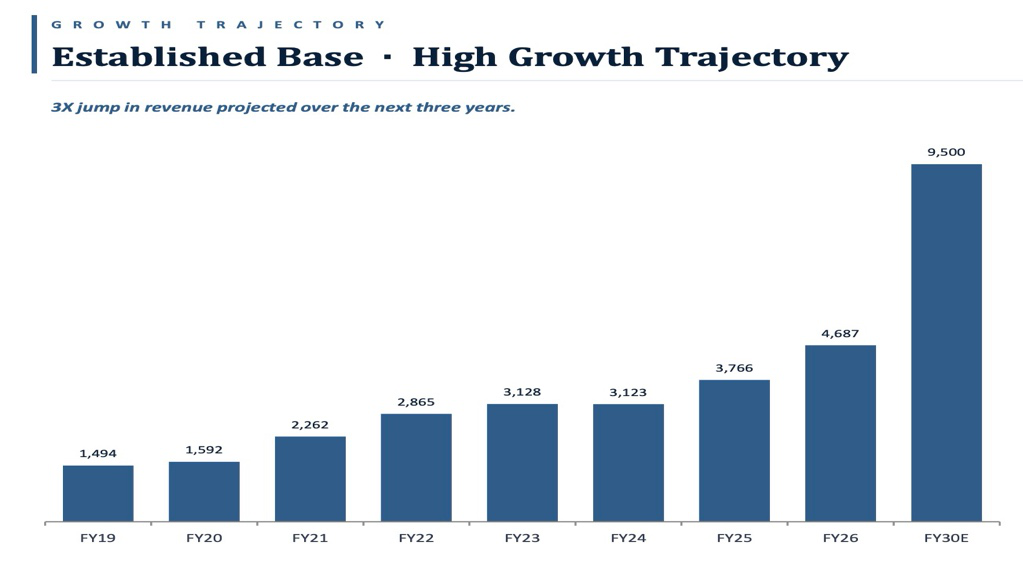
Management had guided for FY27 consolidated revenue of Rs 520-570 crore, without assuming any acquisition. On margins, management said they should improve steadily rather than jump, in response to a question about reaching 11-12%. This guidance was given before the Q1 FY27 results, so the next few quarters will show how much of it remains achievable.
Put against the current base of Rs 469 crore, the ambition implies roughly a doubling of revenue over several years rather than an overnight jump. The important part is that management does not expect all of the increase to come from the existing cable business.
The company has said that it wants to move towards higher-value products and systems, use partnerships and acquisitions to enter new categories and increase the contribution from businesses with better margins. The Q1 FY27 presentation also lays out planned capex of Rs 100 crore through FY30, while management had separately earmarked Rs 50-70 crore for a potential acquisition.
That brings us to the more interesting part of the target. The question is not merely whether Remsons can double its revenue, but whether it can do so while improving the profitability of every rupee of revenue it generates.
The real prize is the margin
Management has guided for EBITDA margins of 13-14% over two to three years, helped by a shift towards higher-value products and a better product mix. At Rs 950 crore of revenue and a 13.5% margin, EBITDA would be around Rs 128 crore, compared with Rs 49.5 crore in FY26.
That is the bigger opportunity here: if Remsons can grow revenue while expanding margins, profits could grow much faster than sales. But Q1 FY27 is a reminder that this is still a work in progress, with EBITDA margins falling to 8.7% from 10.6% a year earlier.
The balance sheet and working capital need watching
Balance Sheet Health: Debt Ratios and Inventory Pressures
The balance sheet gives Remsons some room to fund its expansion, but it is not something investors can ignore. Consolidated borrowings stood at about Rs 98 crore at March 2026, with net debt to equity at 0.57 times, while management has indicated that it wants debt to equity around 0.6-0.8 times and below 1 time.
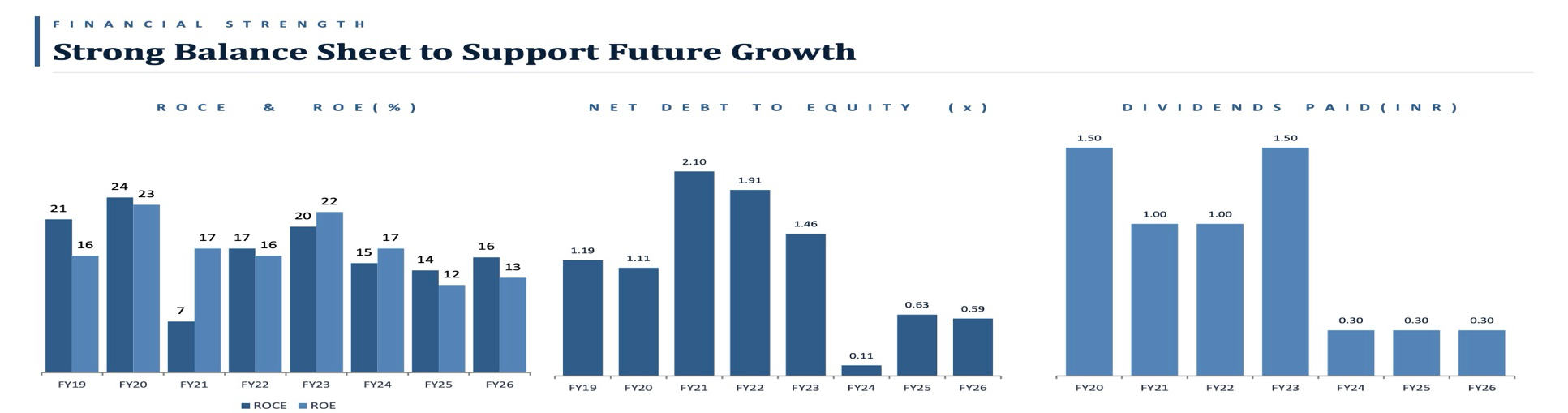
Cash generation improved sharply in FY26, with operating cash flow rising to Rs 60 crore from Rs 22 crore and free cash flow reaching Rs 28 crore. Working capital also improved, with working-capital days falling to 19 from 44, debtor days dropping to 59 from 74 and the cash-conversion cycle improving to 77 days from 112 days.
The pressure point is inventory, which stood at around Rs 79 crore, or 114 inventory days, in FY26. As Remsons adds capacity, new programmes and potentially acquisitions, a faster growth rate could require more cash to be tied up in inventory and receivables, leaving less room on the balance sheet if operating cash flow does not keep pace.
A new CEO arrives at an important point
There is also a management transition happening at a time when the business is trying to change its shape. Rahul Desai was appointed chief executive officer effective August 3, 2026, while Amit Srivastava’s resignation took effect at the close of September 4.
Desai brings more than three decades of automotive manufacturing experience and has spent more than 17 years in chief executive and senior leadership roles, including at Pinnacle Industries and CIE India.
The timing makes the appointment worth watching. Remsons is moving from a relatively focused component business towards a wider portfolio, and the new CEO will have to manage the less glamorous but very important parts of that transition, including capacity, customers, working capital, margins and capital allocation.
The stock has already started moving
The market has not been completely oblivious to the change. The stock rose from Rs 80.46 on August 27 to Rs 99.35 on September 4, a gain of about 23% in just over a week, although it remains well below its 52-week high of Rs 152.45.
The recent move suggests investors are looking ahead, but the stock has not yet been valued as though the transformation has already succeeded. At around Rs 99 a share, Remsons trades at about 20 times trailing earnings.
That valuation is reasonable if Remsons can sustain 20% plus revenue growth and eventually reach the 13-14% EBITDA margin management has discussed. It becomes much less comfortable if growth slows while margins remain around 9-10%, because investors would then be paying for an improvement that has yet to show up fully in the numbers.
The recent price movement itself should not be assigned a specific reason without evidence. The more useful takeaway is that expectations are now moving faster than earnings, which makes the stock increasingly sensitive to any sign that the transformation is taking longer than expected.
The small-cap risk should not be ignored
Remsons is not an SME-exchange stock, but its market capitalisation of around Rs 350 crore makes it a very small listed company. Stocks of this size can see sharp price movements, lower liquidity and bigger reactions to changes in earnings expectations.
There is also concentration risk in being a small supplier pursuing large automotive programmes. A delay in a customer programme, slower ramp-up or a manufacturing disruption can have a much bigger impact on quarterly numbers than it would for a large, diversified auto-component maker.
What could go wrong
The biggest concern is the gap between revenue growth and profitability. Q1 FY27 showed revenue rising 20% while EBITDA was almost flat, so the company still has to prove that its newer businesses can eventually deliver better economics.
The second concern is capital allocation. Remsons plans to invest in capacity and has discussed acquisitions, so investors will need to see whether the additional capital generates enough profit and cash flow.
Working capital could become another pressure point as the company expands, particularly in railways, where larger projects and longer payment cycles can tie up cash. Remsons already has debt on its balance sheet, so a faster expansion could stretch finances if receivables and inventory rise faster than operating cash flow.
The bottom line
Remsons is no longer simply a bet on automobile growth. It is increasingly a bet that a small component maker can use its customer relationships and manufacturing capabilities to move into more complex products, newer segments and higher-value systems.
The early evidence is encouraging: revenue has grown strongly, EBITDA has grown faster than revenue over the last few years, and the order pipeline includes sizeable multi-year programmes. But Q1 FY27 also showed that higher revenue does not automatically mean higher profits.
That leaves Remsons somewhere between the business it was and the one management wants it to become. Over the next two or three years, investors will need to see whether orders translate into revenue, margins move towards 13-14% and profits turn into cash without putting excessive pressure on the balance sheet.
The market may be beginning to pay for that transformation already. The real question is whether Remsons can make its financial statements catch up with the ambition.
Disclaimer:
Note: We have relied on data from www.Screener.in throughout this article. Only in cases where the data was not available, have we used an alternate, but widely used and accepted source of information.
The purpose of this article is only to share interesting charts, data points and thought-provoking opinions. It is NOT a recommendation. If you wish to consider an investment, you are strongly advised to consult your advisor. This article is strictly for educative purposes only.
Manvi Aggarwal has been tracking the stock markets for nearly two decades. She spent about eight years as a financial analyst at a value-style fund, managing money for international investors. That’s where she honed her expertise in deep-dive research, looking beyond the obvious to spot value where others didn’t. Now, she brings that same sharp eye to uncovering overlooked and misunderstood investment opportunities in Indian equities. As a columnist for LiveMint and Equitymaster, she breaks down complex financial trends into actionable insights for investors.
Disclosure: The writer and her dependents do not hold the stocks discussed in this article. The website managers, its employee(s) and contributors/writers/authors of articles have or may have an outstanding buy or sell position or holding in the securities, options on securities or other related investments of issuers and/or companies discussed therein. The content of the articles and the interpretation of data are solely the personal views of the contributors/ writers/authors. Investors must make their own investment decisions based on their specific objectives, resources and only after consulting such independent advisors as may be necessary.