




There are companies that shout their ambitions. And then there are companies that keep assembling their future one machine at a time until, almost accidentally, the numbers begin to look different.
BEW Engineering belongs to the second group.
Nothing about its business looks flashy.
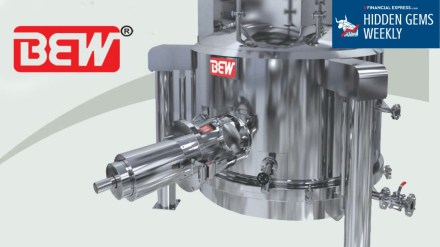
The company manufactures dryers, filter dryers, mixers and reactors for pharmaceutical and speciality chemical clients. This is equipment that never makes headlines but quietly supports the country’s most regulated industries. And in industrial India, importance usually compounds quietly.
The Baseline: A Quiet Year Before the Storm
To understand where the company might go, it is essential to know where it stands.
BEW ended FY25 with revenue of Rs 134.36 crore, earnings before interest, taxes, depreciation and amortization (EBITDA) of Rs 20.40 crore and an EBITDA margin of 15.18%. Profit after tax stood at Rs 12.16 crore.
These numbers look like typical SME manufacturing economics at first glance.
Nothing dramatic.
Nothing that screams inflection.
But industrial stories rarely reveal themselves in one year. They reveal themselves in what a company builds into its structure over time.
The Trigger: Why Doubling Capacity Changes the Game
The central trigger at BEW is surprisingly simple. The company hit about 90% capacity utilization at its existing plant. When a custom equipment manufacturer starts bumping into physical limits, decisions need to be made. Thus, BEW pushed ahead with an expansion that is now nearly complete.
Once the new facility stabilizes, capacity will almost double.
Management has kept the guidance deliberately realistic.
Revenues are expected to rise from Rs 134 crore in FY25 to about Rs 175 crore in FY26. Over the medium term, if demand cooperates, the expanded setup can support something closer to Rs 300 crore within two to three years. Margins, too, have a clear pathway. The company wants to gently move back toward a 20% EBITDA margin over the medium term, although FY26 will likely stay around 15% from 13% in H1FY26.
What makes this believable is not just the capacity itself but the tone. Management openly acknowledged that its internal ambition for FY26 was closer to Rs 200 crore but scaled it down to avoid overpromising.
Why Product Mix Matters More Than Scale
Filter dryers account for nearly 70% of BEW’s order book. This is the portion of the business where engineering intensity is high, certification requirements are strict and switching costs matter. Clients in pharmaceuticals and specialty chemicals do not change approved equipment partners casually. Once a company wins trust in this space, repeat business tends to follow. That gives it stickiness.
The order book itself reinforces the point. It stands at Rs 80 crore and management expects it to move toward Rs 150 crore by FY26. About 70% of this is filter dryers, another 20% is paddle and other dryers, and the rest is mixers and blenders. It is a focused mix.
Export demand shows the same pattern. Africa is gaining traction, and roughly 40% of revenue now comes from repeat customers. That is usually the clearest signal that the equipment works and that clients trust the company enough to come back.
Moreover, BEW carries ASME U and R stamp certifications, which open export markets and create a quality stamp that global buyers recognise. Exports are still a small slice of revenue but customers in the United States, Japan and Africa already exist.
Growth Without Hype: What The Long-Term Numbers Say
If you zoom out, a pattern emerges.
Over three years, the numbers remain steady with 11% sales growth and 29% profit growth. But the stock price tells a very different story. It is down 14% over three years and down 59% over the past year.
BEW Engineering Price Chart (Rs)


SME valuations often detach from business performance for long stretches, and BEW’s trajectory shows that.
Return on equity has been respectable. It averaged around 19% over three years. In the last year, it moderated to 12%. For an SME engineering company, this is not spectacular, but stable.
Balance Sheet: The “Cash Trap” Warning
The balance sheet is cautious, with modest debt and a plan to cut borrowings by about 20% as working capital improves.
The real strain sits elsewhere.
Debtor days shot up to 110 in FY25 from 39 the year before. Inventory days stayed high at 436. Days payable fell to 42.
The result is a cash conversion cycle that blew out to 504 days from 417 in FY24 and 241 in FY23.
Long cycles are part of the custom equipment business, but this level of stretch is not ideal. The company is growing, but cash is lagging. Until BEW pulls this cycle back toward historical levels, the expansion benefits will show up in revenue faster than in free cash flow.
The Management Bench And The Independent Directors
BEW’s promoters, with a 47.8% stake, remain deeply involved. But the operating team blends older manufacturing experience with younger engineering talent that has grown within the company.
More importantly, BEW’s board has six directors in total, three of whom are independent.
The SME Problem: A Good Business Can Still Have A Volatile Stock
Investors must remember this is still an SME-listed company.
Liquidity is thin.
Free float is small.
A single large order can distort quarterly numbers and a single delayed payment can stretch working capital. Customer concentration risk is real. Margins can swing based on the timing of dispatches.
The business is stronger than most in the SME bracket. The stock will likely remain more volatile than the business itself.
Valuation: The Market Is Still Pricing More Risk Than Reward
The valuation captures the hesitation clearly.
BEW trades at roughly 12 times earnings, a steep discount to its own five-year median multiple of about 30.
Some of the discount reflects the tough FY25 margin compression and the rise in inventory days.
Some of it reflects the broader risk pricing of SME stocks, where institutional ownership is limited and the market demands tangible evidence of execution before rerating.
If the expansion ramps smoothly, if inventory eases toward the 200-day target and if margins edge back toward the earlier range, this discount can close sharply. At the moment, the market is pricing the risks more aggressively than the potential.
Disclaimer:
Note: We have relied on data from www.Screener.in throughout this article. Only in cases where the data was not available, have we used an alternate, but widely used and accepted source of information.
The purpose of this article is only to share interesting charts, data points and thought-provoking opinions. It is NOT a recommendation. If you wish to consider an investment, you are strongly advised to consult your advisor. This article is strictly for educative purposes only.
Manvi Aggarwal has been tracking the stock markets for nearly two decades. She spent about eight years as a financial analyst at a value-style fund, managing money for international investors. That’s where she honed her expertise in deep-dive research, looking beyond the obvious to spot value where others didn’t. Now, she brings that same sharp eye to uncovering overlooked and misunderstood investment opportunities in Indian equities. As a columnist for LiveMint and Equitymaster, she breaks down complex financial trends into actionable insights for investors.
Disclosure: The writer and her dependents do not hold the stocks discussed in this article. The website managers, its employee(s) and contributors/writers/authors of articles have or may have an outstanding buy or sell position or holding in the securities, options on securities or other related investments of issuers and/or companies discussed therein. The content of the articles and the interpretation of data are solely the personal views of the contributors/ writers/authors. Investors must make their own investment decisions based on their specific objectives, resources and only after consulting such independent advisors as may be necessary.


