




India’s textile exporters are facing another round of uncertainty as trade negotiations between India and the United States have stalled once again.
Despite a framework agreement reached in February 2026, the two countries have yet to finalise a trade deal. According to a Reuters report dated 6 October 2026, negotiations have reached a standstill, with uncertainty over future tariffs remaining unresolved.
For India’s textile industry, the stakes are high. The US is a major export destination for Indian garments and home textiles. Higher tariffs could make Indian products less competitive against suppliers from other countries.
This could affect export orders, revenue growth and operating margins. Prolonged uncertainty could also make it harder for companies to plan production and investments.
However, not all textile exporters face the same level of risk.
Some companies depend heavily on American customers and manufacture primarily in India. Others have expanded their manufacturing operations across Africa, Southeast Asia and the Americas, offering some protection against India-specific tariffs.
The key question is whether overseas manufacturing, geographical diversification and pricing power can help these businesses protect their profitability.
To examine this, we shortlisted six listed textile exporters with substantial exposure to the US market. These companies differ in their business models, manufacturing locations and financial positions.
Their ability to withstand tariff pressures could therefore vary significantly.
Let’s take a closer look at these six textile exporters and assess how well they are positioned to navigate the renewed trade uncertainty.
#1 Gokaldas Exports: African Manufacturing Offers a Buffer Against US Tariffs
Gokaldas Exports is a leading apparel exporter supplying global fashion brands. According to its FY26 annual report North America contributed 77.9% of FY26 sales, making US tariff uncertainty a significant concern. However, its manufacturing operations in Kenya and Ethiopia provide alternative sourcing options.
The annual report further shows the company’s African manufacturing presence offers greater flexibility in serving American customers. Its Kenyan operations benefit from preferential US market access under the African Growth and Opportunity Act (AGOA).
The company is also seeing increased sourcing interest from American and European buyers. Its expertise in high-value outerwear positions it to compete for additional orders as global brands reassess their sourcing strategies.
Capacity Expansion Supports Growth, but Tariff Risks Remain
Gokaldas is expanding manufacturing capacity in Madhya Pradesh and Karnataka. Its second Madhya Pradesh unit is expected to approach full utilisation by Q4 FY27. African facilities could also increase production through additional shifts.
In FY26, consolidated revenue from operations rose 3.2% YoY to Rs 3,987.6 crore. However, net profit declined 36.8% to Rs 100.1 crore. US trade measures imposed an estimated Rs 97 crore in additional costs.
The company has yet to declare Q2 FY27 results. Its August earnings call indicated that orders for the quarter were already secured.
However, prolonged tariff uncertainty, rising freight costs and possible changes to African trade benefits could pressure margins despite geographical diversification.
Gokaldas Exports Financial Performance
| Metric | FY26 |
| Revenue | Rs 3,987.6 crore |
| Revenue growth | 3.2% YoY |
| Net profit | Rs 100.1 crore |
| Profit growth | -36.8% YoY |
Source: Gokaldas Exports FY26 Annual Report
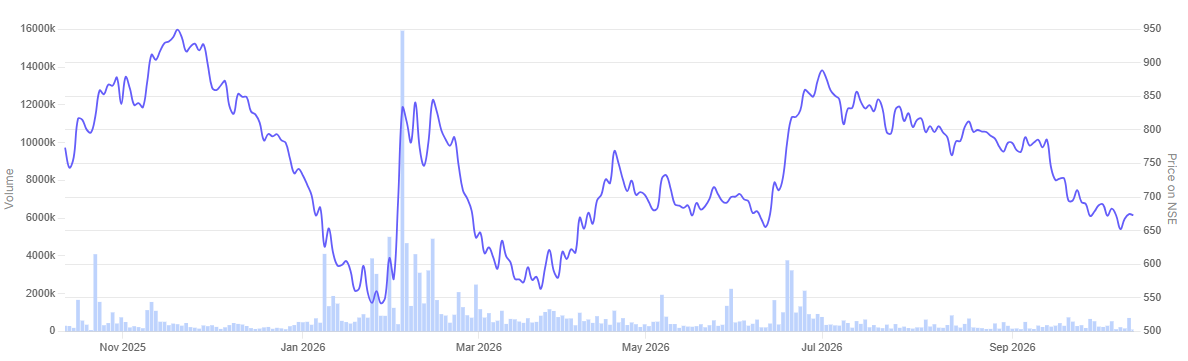
In the past year, the share price of Gokaldas Exports is down 12.4%.
Gokaldas Exports 1-Year Share Price Chart
Source: Screener.in
#2 Welspun Living: US Manufacturing Offers a Partial Hedge Against Tariff Pressures
Welspun Living is a major home textile exporter supplying towels, bed linen and other products to global retailers. According to its FY26 annual report, the US accounted for approximately 59% of FY26 business, making the company particularly exposed to tariff uncertainty.
However, its manufacturing facilities in Ohio and Nevada provide some protection against India-specific tariffs. The Nevada pillow facility commenced commercial production in FY26, while Ohio continues to scale operations. Management is targeting $60 million in US pillow revenue in FY27.
Geographical Diversification and Modernisation Support Recovery
The FY26 annual report also shows that non-US markets accounted for around 41% of business. The company is expanding its presence in the UK and Europe, supported by established retailer relationships and the India-UK trade agreement.
Welspun has also approved a Rs 121 crore modernisation project at Anjar to improve manufacturing efficiency.
In FY26, consolidated revenue declined 10.9% YoY to Rs 9,399.1 crore, while net profit fell 68% to Rs 204.4 crore. US tariffs affected demand, pricing and shipment volumes.
The company has yet to declare Q2 FY27 results. Its August earnings call indicated that flooding at the Vapi facility could disrupt Q2 operations, with recovery expected in subsequent quarters.
Despite overseas manufacturing and diversification, Indian towel and bed-linen exports remain vulnerable to prolonged tariff uncertainty.
Welspun Living Financial Performance
| Metric | FY26 |
| Revenue | Rs 9,399.1 crore |
| Revenue growth | -10.9% YoY |
| Net profit | Rs 204.4 crore |
| Profit growth | -68.0% YoY |
Source: Welspun Living FY26 Annual Report
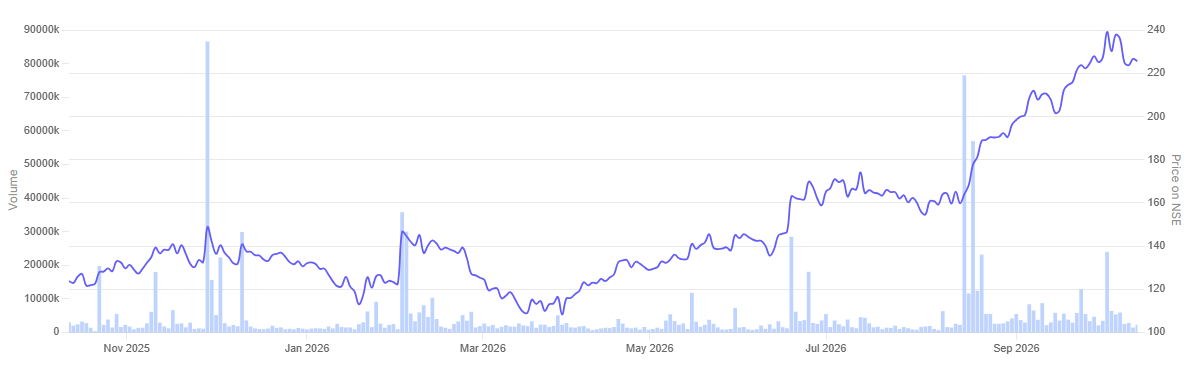
In the past year, the share price of Welspun Living rallied 82.7%.
Welspun Living 1-Year Share Price Chart
Source: Screener.in
#3 Indo Count Industries: US Manufacturing Offers a Partial Hedge Against Tariff Uncertainty
Indo Count Industries is a major home textile manufacturer specialising in bed linen and utility bedding. According to its FY26 annual report, the US accounted for approximately 70% of its core FY26 revenue, making tariff uncertainty a significant risk.
However, its American manufacturing operations provide some protection. The FY26 annual report also states that the company operates utility bedding facilities in Ohio, Arizona and North Carolina. The North Carolina plant began production in January 2026, taking annual US pillow capacity to 31 million units.
New businesses, including utility bedding and US brands, contributed Rs 792 crore in FY26, accounting for 19% of total revenue. This provides another growth avenue beyond traditional bed linen exports.
US Bedding Expansion and Non-US Markets Support Recovery
Management’s August 2026 earnings call outlined a Rs 1,500 crore FY27 revenue target for new businesses. It also expects non-US core revenue to grow over 20%, supported by opportunities in the UK and other markets.
In FY26, consolidated revenue from operations declined 0.2% YoY to Rs 4,141.3 crore. Net profit fell 49.3% to Rs 126.7 crore. Tariff-related costs, weaker core demand and higher depreciation and interest expenses weighed on profitability.
The company has yet to declare Q2 FY27 results. Management expects revised customer pricing to take effect from Q2. Meanwhile, its flood-affected Bhilad facility resumed normal operations on 17 September 2026.
However, Indian bed-linen exports remain vulnerable to renewed US tariffs. Overseas manufacturing provides only a partial hedge against further trade disruption.
Indo Count Industries Financial Performance
| Metric | FY26 |
| Revenue | Rs 4,141.3 crore |
| Revenue growth | -0.2% YoY |
| Net profit | Rs 126.7 crore |
| Profit growth | -49.3% YoY |
Source: Indo Count Industries FY26 Annual Report
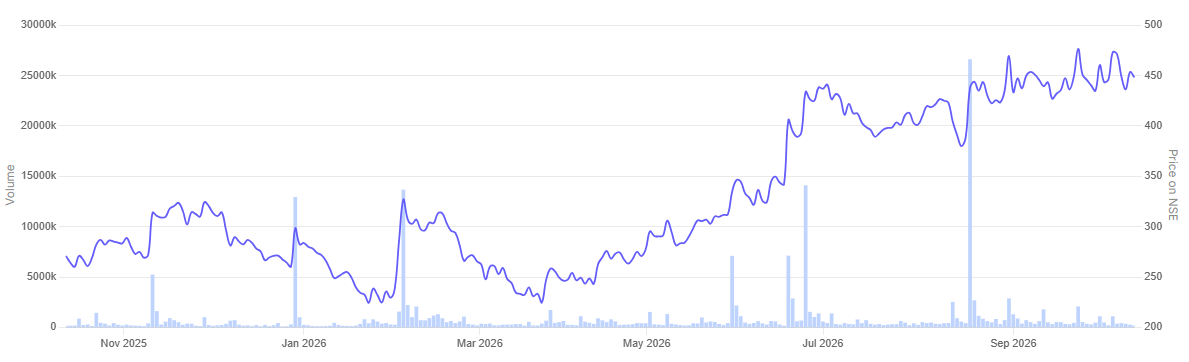
In the past year, the share price of Indo Count Industries rallied 64.9%.
Indo Count Industries 1-Year Share Price Chart
Source: Screener.in
#4 Pearl Global Industries: Global Manufacturing Footprint Offers Flexibility Against US Tariffs
Pearl Global Industries is a major apparel exporter supplying international fashion brands. According to its latest investor call transcript the US accounts for around 50% of its revenue, making trade uncertainty a key concern.
However, its manufacturing operations across India, Bangladesh, Vietnam, Indonesia and Guatemala allow customers to source from different countries. This reduces dependence on Indian production and provides flexibility against country-specific tariffs.
According to its September 2026 Investor Day transcript, geographical revenue concentration has declined from around 80% in FY21-22 to 50%.
Bangladesh Expansion Strengthens Global Sourcing Flexibility
The company inaugurated additional manufacturing capacity and a sustainable laundry facility in Bangladesh in September 2026. This increased group capacity to approximately 108 million garments annually. Management expects capacity to reach 115-116 million pieces by March 2027.
Expansion is also progressing in Bihar, while land acquisition in Vietnam has been completed.
According to its FY26 annual report, consolidated revenue grew 11.5% YoY to Rs 5,024.6 crore. Net profit increased 17% to Rs 270 crore, supported by improved product mix and operational efficiencies.
The company has yet to declare Q2 FY27 results. However, its September business update confirmed progress on overseas capacity expansion.
Despite diversification, US tariff uncertainty, rising wages and freight disruptions remain risks. Its Guatemala operations are also targeting breakeven only in FY27.
Pearl Global Industries Financial Performance
| Metric | FY26 |
| Revenue | Rs 5,024.6 crore |
| Revenue growth | 11.5% YoY |
| Net profit | Rs 270 crore |
| Profit growth | 17.0% YoY |
Source: Pearl Global Industries FY26 Annual Report
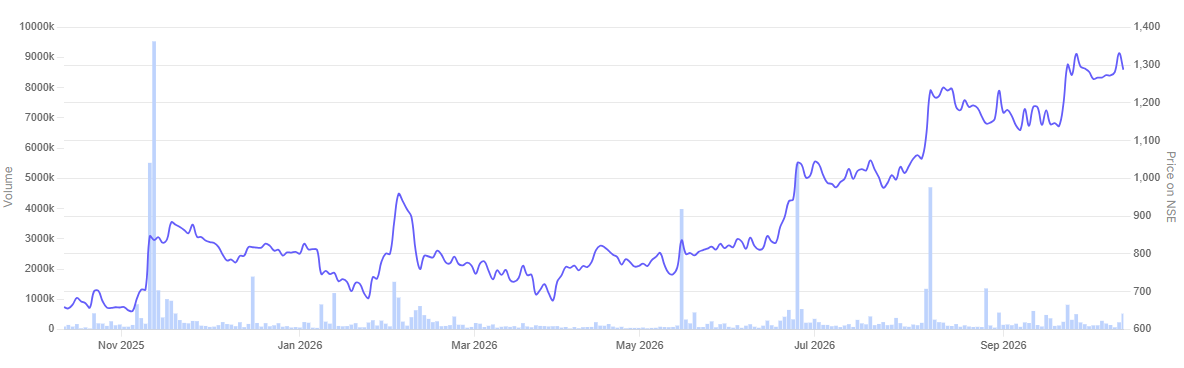
In the past year, the share price of Pearl Global Industries rallied 97.7%.
Pearl Global Industries 1-Year Share Price Chart
Source: Screener.in
#5 Himatsingka Seide: Diversification Beyond Home Textiles to Reduce US Tariff Exposure
Himatsingka Seide is an integrated textile manufacturer supplying bedding, towels and furnishing fabrics to global markets. According to its FY26 annual report, North America accounted for nearly 72% of FY26 consolidated product sales, exposing the company to US tariff uncertainty.
The annual report also states that the company is working to reduce this dependence. Its traditional sheeting business has faced pricing pressure, prompting a shift towards new product categories and domestic markets.
New Textile Verticals Aim to Reduce Market Concentration
The company is expanding into yarn, fabric and apparel solutions using existing manufacturing infrastructure. According to its August 2026 earnings call, yarn and fabric operations have commenced, while apparel production is planned for a later phase.
Management estimates annual revenue potential of around Rs 1,000 crore each from yarn and fabric solutions at full capacity. The transition is expected to require limited additional capital expenditure.
In FY26, consolidated revenue declined 9.5% YoY to Rs 2,515.1 crore, while net profit fell 18.5% to Rs 61.96 crore. However, EBITDA margins improved to 22.9% from 20.9%.
The company has yet to declare Q2 FY27 results. Management expects some revenue volatility during the transition.
However, high US exposure, pricing pressure in sheeting and debt of around Rs 2,550 crore remain key concerns. The benefits of diversification will depend on how quickly the new businesses scale.
Himatsingka Seide Financial Performance
| Metric | FY26 |
| Revenue | Rs 2,515.1 crore |
| Revenue growth | -9.5% YoY |
| Net profit | Rs 61.96 crore |
| Profit growth | -18.5% YoY |
Source: Himatsingka Seide FY26 Annual Report
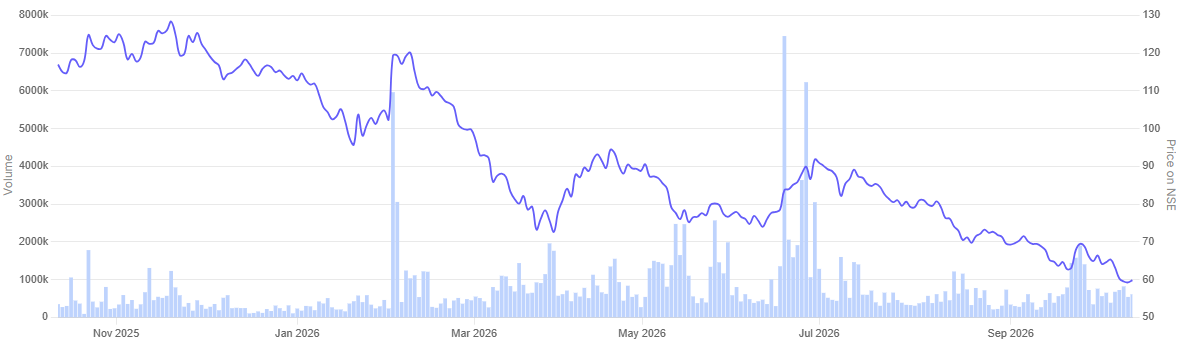
In the past year, the share price of Himatsingka Seide is down 48.7%.
Himatsingka Seide 1-Year Share Price Chart
Source: Screener.in
#6 Kitex Garments: Telangana Expansion Faces the US Tariff Test
Kitex Garments is a major infant and children’s apparel exporter. According to it FY26 annual report, exports accounted for 93.36% of FY26 sales, with the US among its key markets. This makes the company vulnerable to tariff uncertainty.
Its FY26 annual report also states that, Kitex is expanding into European and Australian markets to reduce US dependence. It has onboarded H&M for Europe and is pursuing additional international customers.
Telangana Expansion Holds the Key to Recovery
The company’s Warangal facility in Telangana commenced commercial production in FY26. Its larger Rs 3,550 crore Telangana investment plan also includes Sitarampur, where construction is expected to begin in the second half of FY27. Commissioning is targeted for FY29.
In FY26, consolidated revenue declined 32.1% YoY to Rs 666.9 crore. The company reported a net loss of Rs 13.2 crore, against a profit of Rs 135.7 crore in FY25. US tariffs, weaker demand and losses at its new manufacturing subsidiary affected profitability.
Kitex has yet to declare Q2 FY27 results. Its September annual report indicated that certification audits required for exports from Warangal had been completed.
However, expanding Indian manufacturing does not eliminate US tariff exposure. Recovery depends on fresh export orders, improving utilisation and containing costs at the new facilities.
Kitex Garments Financial Performance
| Metric | FY26 |
| Revenue | Rs 666.9 crore |
| Revenue growth | -32.1% YoY |
| Net profit/(loss) | Rs -13.2 crore |
| Profit growth | -109.7% YoY (swung to loss) |
Source: Kitex Garments FY26 Annual Report
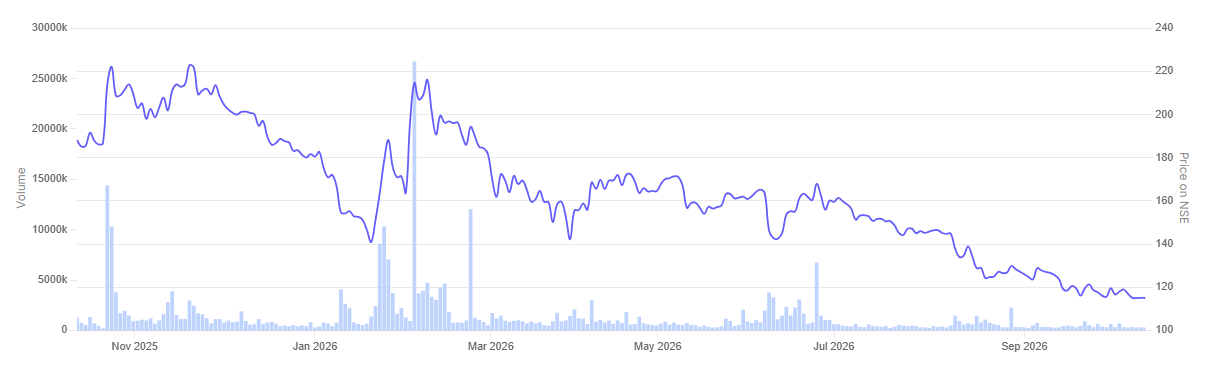
In the past year, the share price of Kitex Garments is down 38.6%.
Kitex Garments 1-Year Share Price Chart
Source: Screener.in
Conclusion
The renewed uncertainty surrounding the India-US trade deal has put textile exporters back under pressure. However, the impact is unlikely to be uniform across companies.
Exporters with manufacturing facilities outside India may have greater flexibility in managing country-specific tariffs. Others are focusing on geographical diversification, new product categories and capacity expansion to reduce their dependence on American customers.
However, these strategies come with challenges. Overseas manufacturing does not eliminate tariff risks, while new capacity requires sufficient orders and higher utilisation to become profitable. The sharp decline in profitability at some companies in FY26 shows how quickly trade disruptions can affect earnings.
For investors, the key factors to watch are progress on India-US trade negotiations, changes in export orders, pricing negotiations and operating margins. The upcoming Q2 FY27 results will also offer a clearer picture of how these exporters are navigating the uncertainty.
Ultimately, the ability to protect margins, retain customers and diversify revenue will matter more than export exposure alone.
Six Textile Exporters Facing the US Tariff Test: Growth and Operating Performance
| Metric | Gokaldas Exports | Welspun Living | Indo Count Industries | Pearl Global Industries | Himatsingka Seide | Kitex Garments |
| Three-year sales CAGR | 22% | 5% | 11% | 17% | -2% | 6% |
| FY26 ROCE | 7.65% | 6.26% | 8.19% | 19.9% | 8.8% | 1.59% |
| FY26 operating margin | 9% | 8% | 10% | 10% | 14% | 4.5% |
| FY26 debtor days | 55 | 51 | 45 | 30 | 173 | 68 |
Sources: Screener consolidated financial data for Gokaldas Exports, Welspun Living, Indo Count Industries, Pearl Global Industries, Himatsingka Seide and Kitex Garments.
You can track how these are progressing by adding stocks to your watchlist.
Disclaimer
Note: We have relied on data from www.Screener.in throughout this article. Only in cases where the data was not available, have we used an alternate, but widely used and accepted source of information.
The purpose of this article is only to share interesting charts, data points and thought-provoking opinions. It is NOT a recommendation. If you wish to consider an investment, you are strongly advised to consult your advisor. This article is strictly for educative purposes only.
Ekta Sonecha Desai has a passion for writing and a deep interest in the equity markets. Combined with an analytical approach, she likes to deep dive into the world of companies, studying their performance, and uncovering insights that bring value to her readers.
Disclosure: The writer and her dependents do not hold the stocks discussed in this article.
The website managers, its employee(s), and contributors/writers/authors of articles have or may have an outstanding buy or sell position or holding in the securities, options on securities or other related investments of issuers and/or companies discussed therein. The content of the articles and the interpretation of data are solely the personal views of the contributors/ writers/authors. Investors must make their own investment decisions based on their specific objectives, resources and only after consulting such independent advisors as may be necessary.