




India’s specialty chemicals sector is getting another shot at the China+1 opportunity. The first wave came in 2020-22, when pandemic-driven supply disruptions forced global buyers to explore alternatives to China. This time, the shift looks more structural. Global customers are diversifying suppliers, while Indian companies are moving up the value chain- from commodity chemicals to specialised molecules, contract manufacturing, and high-value applications.
In one of our earlier articles, we looked at how Indian specialty chemical manufacturers are supplying into some of the world’s fastest-growing industries. The opportunity is getting even broader across the specialty chemicals value chain.
Three small-cap specialty chemical companies sit at different points of this shift: Yasho Industries, Privi Speciality Chemicals, and Aether Industries. Their businesses are very different. Yasho makes rubber chemicals and aroma ingredients. Privi specialises in aroma and fragrance chemicals. And Aether is increasingly focused on contract manufacturing and specialised intermediates.
What connects them is the same structural shift: global customers are looking beyond China for reliable suppliers, and Indian chemical makers are growing more resilient.
#1. Yasho Industries: An Earnings Breakout with High Expectations
Yasho Industries is emerging as one of the sharper recovery stories in India’s specialty chemicals space. Its businesses have historically faced pricing pressure because of Chinese oversupply, making the recent improvement in earnings particularly significant.
What Does Yasho Industries Do?
The company manufactures specialty and performance chemicals used across industries such as rubber, lubricants, pharmaceuticals, food, and fragrances. Its portfolio includes rubber chemicals, antioxidants, lubricant additives, and aroma chemicals.
A Financial Turnaround in Operations
The annual numbers show that the recovery had already started in FY26, with revenue growing 23% and net profit more than quadrupling. But Q1FY27 marked a much sharper improvement, particularly in operating profitability.
Yasho Industries: Annual Financial Performance
| Period | FY25 | FY26 |
| Revenue from Operations (₹ crore) | 676 | 830 |
| YoY Growth (%) | – | 22.80% |
| EBITDA Margin (%) | 17.70% | 17.40% |
| Net Profit (₹ crore) | 6 | 25 |
In Q1FY27, consolidated revenue rose 55% YoY to ₹308 crore, while net profit expanded to ₹36 crore, coming off a depressed base of ₹3.6 crore in Q1FY26. During the quarter, Yasho generated 69% of its revenue from exports and 31% from India.
Yasho Industries: Quarterly Performance
| Period | Q1FY26 | Q1FY27 |
| Revenue from Operations (₹ crore) | 199 | 308 |
| YoY Growth (%) | – | 54.80% |
| EBITDA Margin (%) | 16.50% | 24.20% |
| Net Profit (₹ crore) | 3.6 | 36 |
The bigger change came at the operating level. As volumes recovered and pricing improved, (Earnings Before Interest, Tax, Depreciation, Amortisation) EBITDA margin expanded 770 basis points to 24.2% from 16.5% in Q1FY26. This operating leverage drove the sharp increase in profitability.
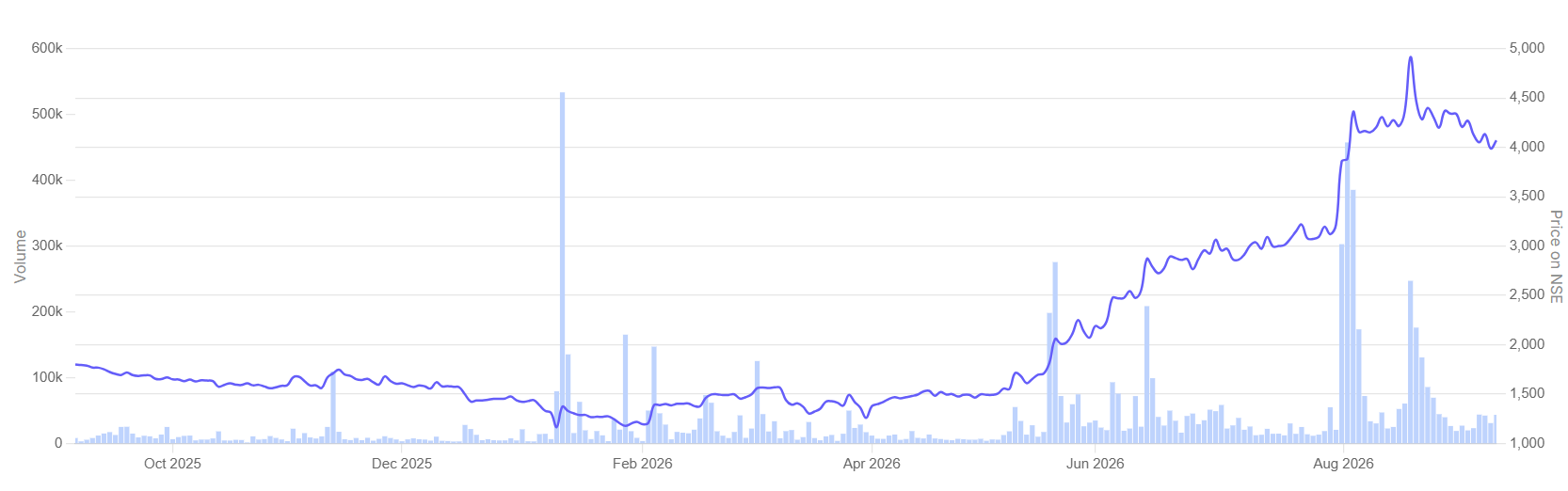
The company’s bank loan ratings were upgraded during the quarter by CRISIL and ICRA from BBB+ to A-, adding to positive sentiment around the stock. Yasho Industries stock has rallied nearly 125% over the last 12 months.
Yasho Industries: 1 Year Stock Price Chart
Aggressive Capex and Revenue Visibility
Management sees the current growth as structural rather than a temporary recovery. It is targeting 30-40% annual revenue growth over the next few years, with a goal of crossing ₹1,600 crore in revenue by FY28.
To support this growth, Yasho has doubled its FY27 capex plan to ₹250 crore, mainly to add new production blocks at its Pakhajan facility. Importantly, around 65% of the revenue potential from this new capacity is already backed by customer commitments, giving the company better visibility on future demand.
At the same time, Yasho still has room to increase output from its existing facilities. Plant utilisation is currently around 60-65%, and management expects it to reach about 75% by the end of FY27. This gives the company a near-term volume growth opportunity while the new capacity comes on stream.
Investor Holding: The company also has a well-known small-cap veteran investor, Ashish Kacholia, on its shareholder register. He currently holds a 2.08% stake in the company.
#2. Privi Speciality Chemicals: The Steady Compounder Scaling New Peaks
Unlike Yasho, Privi Speciality Chemicals is not an earnings-recovery story. It is a more established China+1 beneficiary, with a strong position in aroma and fragrance chemicals. It has strong relationships with some of the world’s leading fragrance, personal-care and FMCG companies.
The company is already operating at around 90% capacity utilisation, and its Q1FY27 numbers show the strength of the underlying business.
Privi Speciality: Annual Financial Performance
| Period | FY25 | FY26 |
| Revenue from Operations (₹ crore) | 2,101 | 2,564 |
| YoY Growth (%) | – | 22.00% |
| EBITDA Margin (%) | 22.30% | 25.80% |
| Net Profit (₹ crore) | 185 | 317 |
| YoY Growth (%) | – | 71.40% |
FY26 showed a clear improvement in profitability. Revenue grew 22%, but EBITDA margin expanded by more than three percentage points to 25.8%. As a result, net profit jumped 71% to ₹317 crore.
The momentum continued into Q1FY27, with profit growth significantly outpacing revenue growth while margins remained stable.
Privi Speciality: Quarterly Financial Performance
| Period | Q1FY26 | Q1FY27 |
| Revenue from Operations (₹ crore) | 559 | 666 |
| YoY Growth (%) | – | 19.20% |
| EBITDA Margin (%) | 24.80% | 24.60% |
| Net Profit (₹ crore) | 57.6 | 82.8 |
| YoY Growth (%) | – | 43.75% |
Consolidated revenue from operations rose 19% YoY to ₹666 crore, while net profit increased 44% to ₹82.8 crore. EBITDA margin remained broadly stable at 24.6%.
The key takeaway is that Privi is growing without sacrificing profitability, even as it operates at high capacity utilisation.
Improving Operational Efficiency
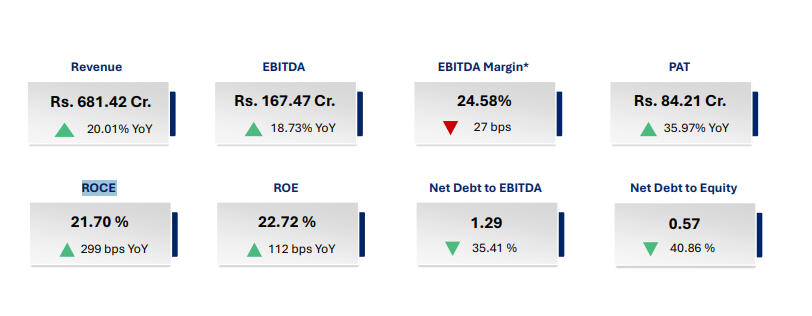
The more interesting part of the story is what is happening below the profit line. Privi has significantly improved its working capital cycle, down to 108 days from 141 days a year earlier. That has helped strengthen its return ratios, with Return on Capital Employed (ROCE) at 21.7% at the end of June 2026, expanding by 299 BPS. Net Debt to Equity also improved by 40.86% during the quarter to 0.57 times.
Privi is now entering its next phase of expansion. Management has laid out a “5K:1K” ambition- ₹5,000 crore of revenue and more than ₹1,000 crore of EBITDA over the next three to four years. The numbers, therefore, point to a business that is becoming more efficient while simultaneously expanding capacity and moving towards more specialised products.
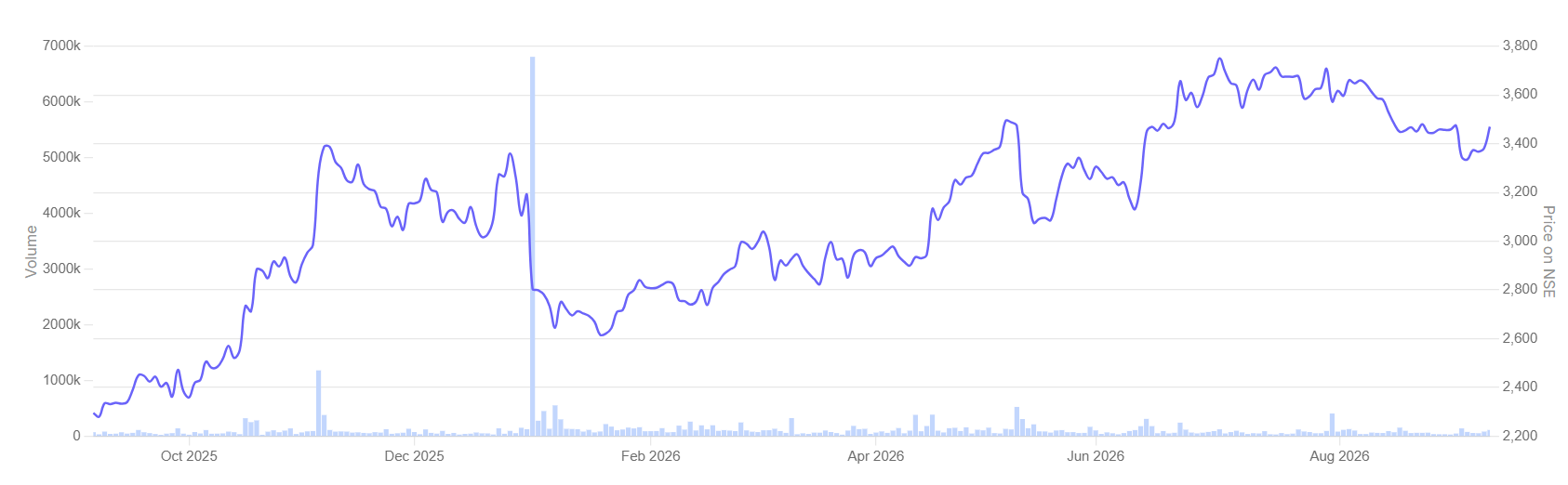
Privi Speciality: 1 Year Stock Price Chart
#3. Aether Industries: The Higher-value China+1 play
Aether Industries is playing a different version of the China+1 story. The company is increasingly moving away from more commoditised businesses towards contract manufacturing, where long-term customer relationships offer greater revenue visibility and better pricing power.
What Does Aether Industries Do?
Aether manufactures specialty chemicals and intermediates for pharmaceuticals, agrochemicals, electronics, oil and gas, and other industrial applications. Its product portfolio includes advanced intermediates, specialty chemicals, and performance chemicals, with the company increasingly developing products for high-growth areas such as semiconductors and AI hardware. The shift is already showing up in the numbers.
Aether Industries: Annual Financial Performance
| Period | FY25 | FY26 |
| Revenue from Operations (₹ crore) | 841 | 1,160 |
| YoY Growth (%) | – | 38.00% |
| EBITDA Margin (%) | 26.30% | 30.30% |
| Net Profit (₹ crore) | 158 | 220 |
| YoY Growth (%) | – | 39.24% |
FY26 was a strong year for Aether. Revenue grew 38%, while EBITDA margin expanded by four percentage points to 30.3%. Net profit also rose 39% to ₹220 crore. The improvement in margins is important as the company moves towards higher-value and contract manufacturing businesses.
The strong performance continued in Q1FY27, with revenue growing 27.3% and EBITDA margins improving further to 31.5%.
Aether Industries: Annual Quarterly Performance
| Period | Q1FY26 | Q1FY27 |
| Revenue from Operations (₹ crore) | 257 | 327 |
| YoY Growth (%) | – | 27.30% |
| EBITDA Margin (%) | 30.60% | 31.50% |
| Net Profit (₹ crore) | 47 | 62.7 |
| YoY Growth (%) | – | 33.40% |
Consolidated revenue rose 27.3% YoY to ₹327 crore in Q1FY27. EBITDA margin improved to nearly 31.5% and net profit increased 33% to ₹62.7 crore.
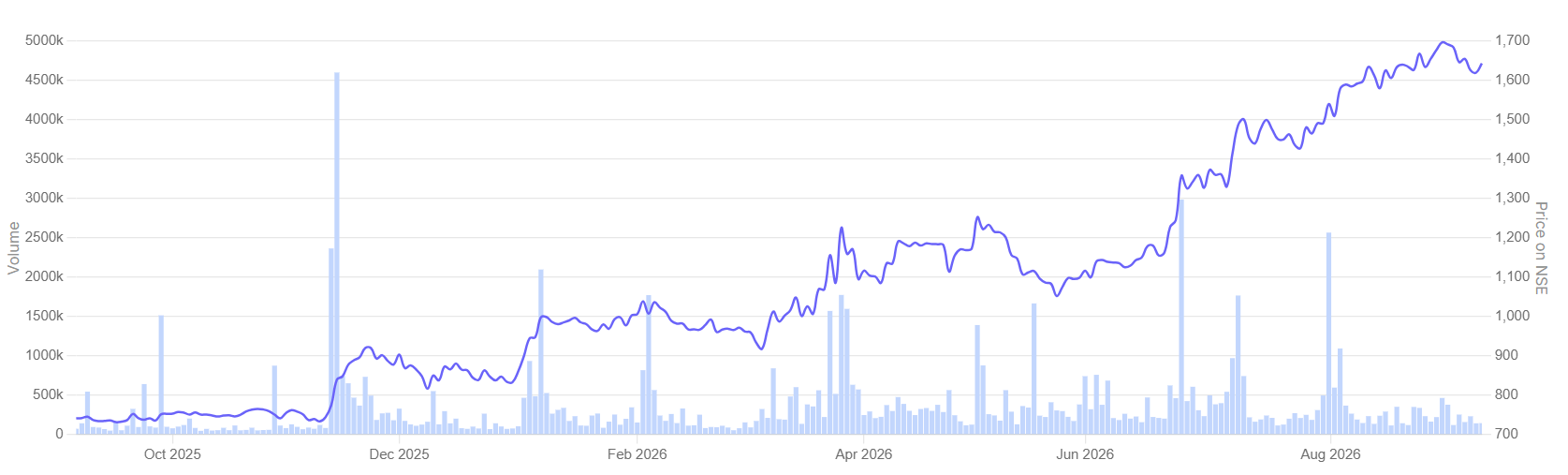
The bigger change, however, is in the business mix. Contract Exclusive Manufacturing (CEM) and Contract Research and Manufacturing Services (CRAMS) now contribute around 60% of Aether’s revenue, and management wants this share to reach 70% over the next two years. CEM itself generates EBITDA margins of around 28-30%, making the shift towards exclusive manufacturing important not just for revenue visibility but also for profitability. The optimism is also reflected in the stock, which has rallied more than 120% over the last year.
Aether Industries: 1 Year Stock Price Chart
Aether’s portfolio remains well diversified across sectors. The pharmaceutical and agrochemical sectors contributed 32.2% and 9.5%, respectively. The oil and gas sector contributed 31.4% to total revenue in Q1FY27.
CRAMS Pivot and Dow Collaboration Broaden Moat
It is also expanding into newer markets and targeting the semiconductor and AI supply chain. Developing specialty monomers and low-dielectric materials for high-speed PCBs used in 5G and AI hardware. In July 2026, Aether announced a multi-year exclusive research collaboration with Dow Chemical to develop manufacturing technologies for foundational silicones. The domestic market for these products is estimated at around $1 billion and is currently largely import-dependent.
This is what makes Aether different from its peers. It is not just benefiting from companies moving away from China; it is trying to enter more specialised applications where technical capabilities, customer approvals and long-term contracts can create stronger entry barriers.
Valuation: Three Very Different Bets
Valuation Trend
| Metrics | Trailing P/E | 5-yr Median PE | Industry PE |
| Yasho Industries | 94.0 | 40.1 | 29.39 |
| Privi Industries | 38.8 | 54.4 | |
| Aether Industries | 90.9 | 88.4 |
The three stocks are being valued on very different expectations. Yasho is the biggest re-rating story here. At 94x trailing earnings, it trades at more than twice its five-year median price-to-earnings of 40.1x and over three times the industry multiple of 29.4x. The market is already pricing in strong earnings growth and sustained margins. Any slowdown could therefore trigger a sharp de-rating.
Aether stock, too, looks expensive at 90.9x earnings. However, its P/E is close to its five-year median of 88.4x. The key question for investors is whether its CEM/CRAMS transition and new growth businesses can deliver the earnings growth needed to support this high multiple.
Privi looks more reasonably valued at 38.8x earnings compared to the two companies. It trades below its five-year median of 54.4x. That is notable given its 36% profit growth in Q1FY27 and return ratios above 20%.
The China+1 Opportunity is Getting More Selective
India’s specialty chemicals opportunity is moving into a more demanding phase. Global customers are still diversifying beyond China, but simply having export exposure is no longer enough. The bigger opportunity lies with companies that can win customer approvals, move into specialised molecules, and lock in longer-term contracts. Yasho, Privi and Aether represent three different ways to play that shift.
The common thread is clear: these companies are no longer competing only on cost. Their ability to build technical capabilities, deepen customer relationships and manufacture increasingly complex products could determine how much of the China+1 opportunity they ultimately capture.
For investors, the next few quarters will be important. Revenue growth alone will not be enough. Watch whether new capacity translates into volumes, whether margins hold as businesses scale, and whether customer commitments convert into recurring revenue. At current valuations, execution will matter as much as the opportunity itself. Add these stocks to your watchlist and monitor how they execute their growth plans.
Disclaimer:
Note: We have relied on data from www.Screener.in throughout this article. Only in cases where the data was not available, have we used an alternate, but widely used and accepted source of information.
The purpose of this article is only to share interesting charts, data points and thought-provoking opinions. It is NOT a recommendation. If you wish to consider an investment, you are strongly advised to consult your advisor. This article is strictly for educative purposes only.
Deepan Datta has spent over a decade studying stocks and mutual funds. His passion is to uncover interesting stories in the financial markets and share them through his writings with investors at large. He is focused on delivering clear, easy to understand and research-backed insights. Deepan began his career as a Research Associate at S&P Global, where he developed a strong foundation in financial research and data analysis.
Disclosure: The writer and his dependents do not hold the stocks discussed in this article.
The website managers, their employees (s), and contributors/writers/authors of articles have or may have an outstanding buy or sell position or holding in the securities, options on securities or other related investments of issuers and/or companies discussed therein. The content of the articles and the interpretation of data are solely the personal views of the contributors/ writers/authors. Investors must make their own investment decisions based on their specific objectives, resources and only after consulting such independent advisors as may be necessary.