



The aerospace industry is becoming more electronic, and India is starting to find a larger role in that shift. Aircraft, drones and defence platforms now carry more avionics, sensors, communication systems, power electronics and electronic warfare equipment. As the electronics content rises, so does the need for specialised manufacturing.
This is where India’s aerospace EMS opportunity is taking shape. The global aerospace and defence Electronics Manufacturing Services (EMS) market was valued at around $81.8 billion in 2025 and is expected to grow at about 5% annually through 2033. Meanwhile, the broader global EMS market is estimated at $648 billion in 2025 and could cross $1.1 trillion by 2034.
India is growing faster than the global EMS market. The domestic EMS industry, estimated at $65 billion in 2025, is projected to triple to $197.8 billion by 2032, as per P&S Intelligence. While consumer electronics has been a major driver so far, aerospace and defence are emerging as important areas for higher-complexity manufacturing.
Defence indigenisation, higher domestic procurement, and the government’s push to build electronics manufacturing capabilities are supporting the shift. India is also becoming part of the global China+1 supply-chain shift, giving local EMS companies an opportunity to work with global aerospace and defence OEMs.
For Indian aerospace EMS players, the opportunity therefore goes beyond assembling circuit boards. The addressable work extends to build-to-spec manufacturing, box-build assemblies, avionics, radar and electronic warfare systems, and other mission-critical applications. The opportunity is still developing.
But as India’s aerospace and defence manufacturing base expands, electronics could become a key area where domestic EMS companies move higher up the value chain. Against this backdrop, this article examines two EMS players with a presence in the aerospace and defence supply chain.
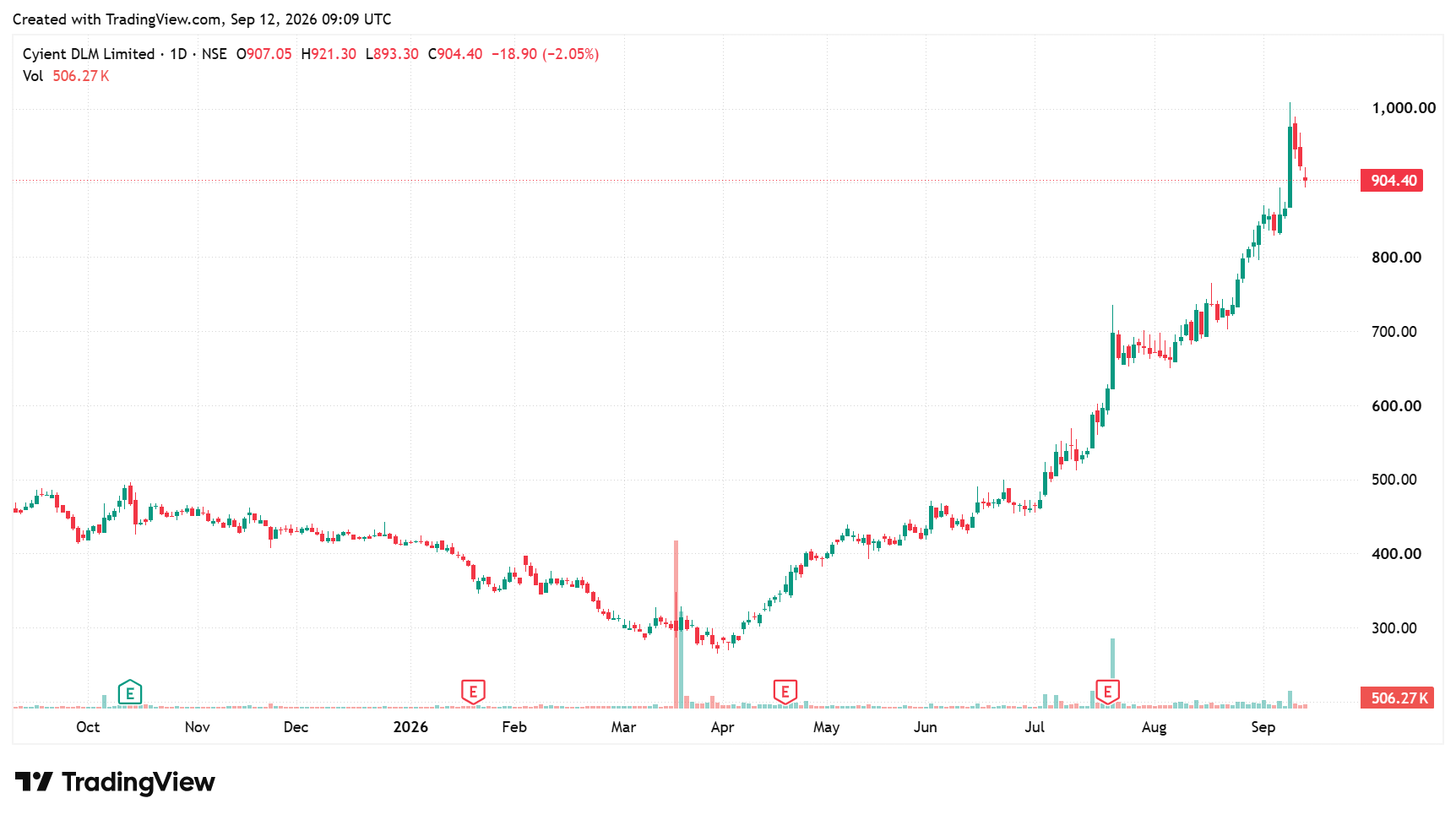
#1 Cyient DLM: Scaling Aerospace Through Engineering-Led EMS
Cyient DLM is an integrated Electronic Manufacturing Services (EMS) company. It provides EMS/Build-to-Print services, converting customer-provided product designs and specifications into production-ready electronic components, assemblies, and systems.
In build-to-specification manufacturing, the company provides engineering-led development from initial system architecture and design to prototyping, qualification, mass manufacturing and lifecycle support. Printed Circuit Board Assemblies are the core product and accounted for 48% of Q1FY27 revenue, followed by Box Builds (41%) and others (11%).
Aerospace to MedTech: Breaking Down the 42% Revenue Anchor
It operates across some of the fastest-growing industries today. The aerospace business contributes 42% of revenue. Within this, the company makes cockpit avionics, flight control electronics, and sub-assemblies for global aerospace firms like Honeywell, Thales, and Safran. Industrial accounts for 32%, followed by MedTech (16%), Defence (9%) and Automotive (1%).
In its medtech business, the company manufactures medical diagnostic devices, control boards, and consumer health equipment. In defence, it mainly produces radar subsystems, electronic warfare (EW) payloads, missile control electronics, and ITAR-compliant defence systems. It is also expanding into Robotics, Data Centers and Semiconductor Equipment.
Targeting 18% EBITDA: The FY30 Roadmap for Margins and Robotics
Management focuses on strengthening the four core industries: Aerospace, Defence, Industrial, MedTech, and Automotive. They operate at a benchmark EBITDA (Earnings Before Interest, Tax, Depreciation, and Amortisation) margin of 9-11%. The goal is to gradually expand into robotics and data centres by FY29, expanding the margin to 11-13% and further to 13-18% by FY30+.
Order Book Hits ₹2,599 Crore: 2-Year Visibility and 34% Topline Surge
Cyient DLM achieved its highest-ever order book of ₹2,598.9 crore in Q1FY27. This provides about two years of revenue visibility, based on FY26 revenue of ₹1,261 crore. Approximately 70% of new orders came from existing customers, deepening engagement. The remaining 30% came from new clients onboarded over the last 4-6 quarters.
The company’s revenue grew by 34.3% year-on-year to ₹373.8 crore. This was driven by strong growth across the Industrial (+90%), Aerospace (+40%) and Defence (+35%) businesses. EBITDA surged 56.2% to ₹39.3 crore, while margins expanded 147 bps to 10.5%. Net profit more than doubled to ₹16.3 crore.
EMS is currently the revenue driver, contributing 72% of Q1FY27 revenue and an order book of ₹871.8 crore. However, Build to Specification (28% of revenue) is growing fast due to strategic defence, aerospace and space programs. As a result, the management expects margins to expand by 250-300 bps over the next 12-18 months.
Operating Leverage at 60% Capacity: Scaling Honeywell, eVTOL, and Semis
Additionally, Cyient DLM’s current manufacturing capacity utilisation is 55-60%. This provides ample runway to execute the order book and increase new program volumes without significant capital expenditure. Increasing capacity utilisation can also provide operating leverage.
Regarding new programs, the company expects a significant increase in orders with Honeywell Aerospace over the next 18 months. Mass production of the Deutsche Aircraft D328eco program and a Japanese eVTOL aircraft platform is expected to begin in FY29. The company also expects revenue from its semiconductor business to increase over the next 6-12 months.
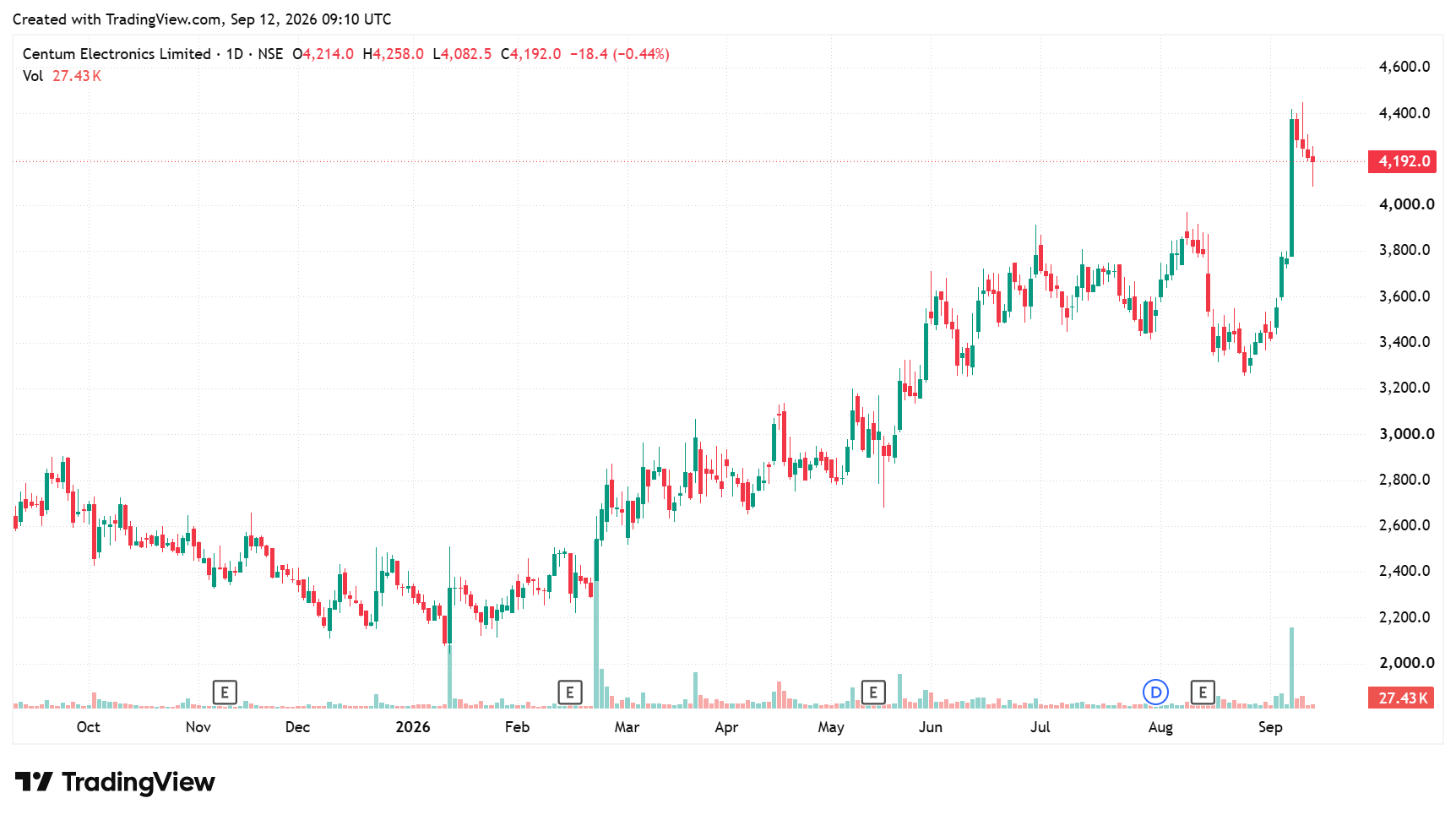
#2 Centum Electronics: Moving Up the Aerospace Electronics Value Chain
Centum Electronics is an Indian Electronics System Design and Manufacturing company. The company operates primarily through two complementary business lines: EMS accounts for 72% of standalone revenue, and Built-to-Specification accounts for 28%.
In EMS, the company provides full-scale manufacturing, including PCB assembly, complex box builds, system integration, and semiconductor equipment assembly. The built-to-specification business focuses on designing, qualifying, and manufacturing custom subsystems and systems for defence, space, and aerospace platforms.
Defence and Aerospace Anchor 54% Revenue as Q1 Topline Reaches ₹205 Crore
Revenue is currently driven by Defence, Space & Aerospace (54%), followed by Industrial & Energy (28%), Transportation & Automotive (11%), and Healthcare (7%). In Q1FY27, Centum standalone revenue grew 11% year-on-year to ₹204.8 crore. EBITDA stood at ₹23.1 crore, with margins at 11.3%. Net profit fell to ₹13.5 crore from ₹15 crore in Q1FY26.
Order Book Reaches ₹1,800 Crore: Securing 2-Year Visibility and 13% Margin Target
The standalone order book stood at ₹1,800 crore, offering strong visibility of around 2 years of revenue as per FY26 revenue of ₹973 crore. Management has guided for 25% revenue growth in FY27 with 13% EBITDA margins. Exports are expected to maintain a steady share of 50% to 55%+ of overall sales.
HAL AESA Radar and Space Payloads: Transitioning to 20% Margin Full Systems
Rather than supplying only components or sub-systems, Centum is moving up the value chain to full-system solutions in high-margin Build-to-Specification programs. Key developments include the Hindustan Aeronautics AESA Radar contract. The initial order is worth ₹67 crore, which could exceed ₹500 crore in the production phase.
Other projects include satellite tracking radar systems, Tactical Air Navigation systems with GRSE, and space-based intelligence payloads under the Space-Based Surveillance program. Within the EMS business, demand is supported by the global expansion in AI data centres and semiconductor manufacturing infrastructure.
The company is in preliminary discussions with international defence companies for large defence projects, particularly in electronic warfare. Centum closed and deconsolidated loss-making companies in France and Canada, resulting in a one-time gain of ₹94 crore. This could support profitability going ahead.
Let’s Look at the Key Q1FY27 Numbers:
| Parameter | Cyient DLM | Centum Electronics |
| Aerospace & Defence Revenue Exposure | 51% | 54% |
| Export as % of Revenue | 94% | 54% |
| Order Book | ₹2,599 crore | ₹1,800 crore |
| Order book / FY26 revenue | ~2.1x | ~1.9x |
| Q1FY27 Revenue Growth | 34.3% | 11.0% |
| EBITDA Margin | 10.5% | 11.3% |
| Key aerospace capabilities | Avionics, flight control electronics, sub-assemblies | Radar, aerospace systems, space payloads |
| Key growth trigger | Honeywell, eVTOL, Deutsche Aircraft | HAL AESA radar, space and defence programmes |
| Source: Q1FY27 Investor Presentation and Management Commentary | ||
Cyient DLM stands out for higher growth, a larger order book and greater export exposure. Centum, meanwhile, has slightly higher margins with deeper exposure to aerospace, defence and space systems.
The Capital Efficiency Gap: Decoupling Stretched Multiples
While Centum delivers a higher return on capital employed (ROCE) than Cyient DLM, it is still loss-making on a full-year basis. In contrast, Cyient DLM has a positive return on equity (ROE). Cyient management expects ROCE to improve as revenues scale.
Valuation-wise, both companies are trading at a premium to their 3-year historical EV/EBITDA multiple but at a discount to the Aerospace and Defence median multiple. Relatively, Cyient DLM and Centum trade at broadly similar valuation multiples, suggesting the market values the two companies closely.
Company | EV/EBITDA Multiple (X) | Return Ratios (%) | ||
| Company | 3Y Median | ROCE | ROE | |
| Cyient DLM | 41.7 | 30.3 | 9.9 | 7.5 |
| Centum Electronics | 41.9 | 27.3 | 25.5 | NA |
| Aerospace and Defence Industry | 47.9 | 14.5 | 11.7 | |
| Source: Screener.in (Data as of 11 September 2026) | ||||
India’s aerospace EMS opportunity is still developing, but both Cyient DLM and Centum are already positioned across the sector’s growing electronics value chain. Their order books provide visibility, while rising defence and aerospace programs could support further growth in the coming years.
Cyient enters this phase with stronger recent growth and profitability, supported by its large aerospace exposure and a ₹2,599 crore order book. Centum, meanwhile, has a higher exposure to Defence, Space and Aerospace and is moving towards Build-to-Specification programs, where margins can be higher.
The valuation gap between the two is also limited, with both trading at broadly similar multiples. This makes execution an important differentiator. For Cyient DLM, the focus will be on scaling its existing order book and improving capital efficiency. For Centum, the key is converting its aerospace and defence pipeline into profitable full-system programs.
As India expands its domestic aerospace and defence manufacturing base, the companies that can move beyond conventional EMS and build deeper engineering capabilities could capture a larger share of the opportunity. But these stocks are worth keeping on your watchlist.
Disclaimer:
Note: Throughout this article, we have relied on data from http://www.Screener.in and the company’s investor presentation. We used an alternative, widely accepted source only when the data were unavailable.
The purpose of this article is only to share interesting charts, data points, and thought-provoking opinions. It is NOT a recommendation. If you wish to consider an investment, we strongly advise you to consult your advisor. This article is strictly for educational purposes only.
About the Author: Madhvendra has been deeply immersed in the equity markets for over seven years, combining his passion for investing with his expertise in financial writing. With a knack for simplifying complex concepts, he enjoys sharing his honest perspectives on startups, listed Indian companies, and macroeconomic trends.
A dedicated reader and storyteller, Madhvendra thrives on uncovering insights that inspire his audience to deepen their understanding of the financial world.
Disclosure: The writer and his dependents do not hold the stocks discussed in this article.
The website managers, its employee(s), and contributors/writers/authors of articles have or may have an outstanding buy or sell position or holding in the securities, options on securities, or other related investments of issuers and/or companies discussed therein. The articles’ content and data interpretation are solely the personal views of the contributors/ writers/authors. Investors must make their own investment decisions based on their specific objectives and resources, and only after consulting any independent advisors as necessary.