




Every country in the world today is transitioning from fossil fuels to renewables, driven by climate change, energy security and economic volatility. It’s no longer optional; it’s absolutely necessary. Waaree Energies’ Annual Report states that global renewable capacity reached 4,448 gigawatts (GW) in 2024. A record 585 GW of renewable capacity was added globally in 2024, with solar and wind contributing 96.6% of this new capacity.
The Paris Agreement target requires tripling capacity to 11,174 GW by 2030. Domestically, India is one of the largest and fastest-growing global markets for renewable energy. The renewable energy sector is expected to grow at a CAGR of 8.1%, increasing from $23.9 billion in 2024 to $52.1 billion by 2033. Here, CAGR means Compounded Annual Growth Rate.
The Indian government aims to achieve 500 GW of non-fossil capacity by 2030, up from 250 GW in 2025. Non-fossil sources already contribute 50% to the country’s power mix, putting it on track to meet the target. Most of this growth will come from government policies such as Solar PV Manufacturing, PM-KUSUM, Solar Park, the battery storage initiative, the PM Surya Ghar Free Electricity Scheme, Rooftop Solar, etc.
This has provided a significant tailwind for companies in the green energy sector. This shift is already visible on Dalal Street. Several newly listed companies have already delivered strong returns. However, given the robust growth, there are no signs of abatement.
On similar ground, here are three such companies that stand to benefit from the shift.
#1 Waaree Energies: The “king of modules” with 50% Growth
Waaree Energies is engaged in the manufacturing of solar PV cells and modules. It is currently the largest solar module manufacturer in India, holding a 14.1% share in the country’s total module shipments. The company has a manufacturing capacity of 5.4 GW for solar cells and 18.7 GW for solar modules, as of 30 September 2025.
India’s largest solar module maker with a global footprint
Both these capacities are running at high capacity utilisation of 80-85%, reflecting strong demand. Waaree has manufacturing facilities in Gujarat, Uttar Pradesh and Texas, USA. The company has a global presence, spanning various business verticals and operating in over 25 countries. In India, it is present in 700 districts and has the largest retail network of over 2,800 touchpoints.
Waaree also manufactures modules in the USA, supported by the acquisition of Meyer Burger assets. Its operational capacity there stands at 2.6 GW. The company fulfils its US orders using a mix of modules manufactured in India and those manufactured at its US facilities. It is trying to minimise the impact of tariffs on India by sourcing cells from specific geographies.
A push toward full integration across the solar value chain
Its strategic focus is to become an integrated renewable energy player and the “energy transition major of choice.” To this end, the company has earmarked ₹250 billion for expansion, including for strategic acquisitions. The expenditures are expected to be back-end loaded, with most outflows expected in FY27 and FY28.
Waaree will use these funds to diversify into adjacent green energy segments to gain a larger share of wallet in the renewable power infrastructure market. This includes investment in the upstream portion of the solar value chain by pursuing capacities for ingots-wafers.
Stepping beyond modules into storage, electrolysers and power electronics
The 10 GW ingot-wafer capacity is expected to come on stream in FY27, with operations scheduled to begin in June 2028. This integration aims to secure the supply chain and enable the company to participate in 95%–100% of the domestic solar business. This facility is crucial to moving towards self-reliance.
Additionally, the company aims to expand its module capacity from 18.7 GW to 26.7 GW. A significant portion of this expansion is expected to be commercialised by early 2026. Cell capacity is expected to increase to 15.4 GW by FY27. The company also provides engineering, procurement, and construction (EPC) for solar power plants.
The Company is augmenting its capacity for Lithium-ion Storage Cells and BESS from 3.5 GWh to 20 GWh. This involves starting with assembly (packs) and quickly moving to cell manufacturing. It is increasing its Electrolyser manufacturing capacity from 300 MW to 1 GW. It approved an additional capex of ₹81.7 billion on 1 October 2025, for BESS, Electrolyser, and Inverter capacity expansion.
The Company is expanding its Inverter annual capacity from 3 GW to 4 GW. This involves proper electronic manufacturing and assembly, moving beyond mere assembly. The company entered the transformers sector via a strategic acquisition of a 64% stake in Kotsons. It also acquired a 76% stake in Racemosa Energy Meters, marking its entry into the smart meter business, a critical component of the renewable energy value chain.
Execution momentum reflected in strong financials and a deep order book
From a financial perspective, revenue in the first half of FY26 increased 51.2% year-on-year to ₹108.2 billion, driven by improved execution across projects. About 52% of revenue comes from the domestic market, with the remaining 48% from overseas. EBITDA rose 118.2% to ₹27.4 billion, resulting in a 770 basis points (bps) margin expansion to 25.3%.
Waaree Quarter Two Financials


As a result, net profit more than doubled to ₹16.5 billion, marking a 112.6% growth. EBITDA stands for earnings before interest, tax, depreciation, and amortisation. Waaree reaffirms its EBITDA guidance for the full FY26 to be in the range of ₹55-₹60 billion.
As of Q4FY25, Waaree’s order book stands at ₹470 billion, providing strong revenue visibility for the next three years.
#2 Premier Energies: The vertical integration bet (cells + modules)
Premier Energies is one of the earliest Indian companies to manufacture solar cells. It currently holds nearly 100% of the market share in solar cell exports to the US from India. The company has an installed capacity of 3.2 GW for solar cells and 5.1 GW for solar modules.
Mission 2028 and the push toward integrated solar manufacturing
Premier Energies has a highly ambitious outlook centred on its Mission 2028, which aims to reach 10 GW of integrated capacity and to transition into India’s leading provider of cleantech solutions with a diverse product portfolio. This expansion is ahead of its original target timeline.
The expansion strategy focuses on three main pillars: vertical integration within solar manufacturing, scale enhancement, and diversification into complementary allied products. It is scaling up its core solar component capacity, advancing its 10 GW target by about 18 months.
To this end, the planned TOPCon cell project located in Naidupeta, Andhra Pradesh, is being expanded from 4.8 GW to 7.0 GW. This scaling, combined with existing facilities, will result in a total cell line capacity of 10.6 GW by September 2026. Of this, 4.8 GW is targeted for completion by June 2026, and the remaining 2.2 GW by September 2026.
The expansion is driven by a strong demand outlook and is being executed at a nominal incremental cost. The incremental capex incurred for the 4.8 GW to 7 GW increase is about ₹5 billion, representing a 23% per-gigawatt capex saving. The expected cell efficiency targeted in the new TOPCon facility is over 25.2%. The facility is intended to be India’s largest single-location TOPCon cell line, housed in a single block.
Scaling beyond cells and modules with a broader cleantech portfolio
The company is also moving toward full backward integration. A 5.6 GW Module manufacturing plant is planned for Seetharampur, Telangana, with a target completion date of March 2026. The company is planning a 5 GW ingot-wafer manufacturing plant in Naidupeta, Andhra Pradesh, with a target completion date of December 2027.
The company is also venturing into solar inverters, aluminium frames, and battery energy storage systems solutions. A new inverter capacity of one million inverters is scheduled for completion by June 2026. Transformer capacity is expected to increase from 2.5 GVA to 16.7 GVA by April 2026. A 6 GWh BESS facility is also planned for commissioning by June 2026.
Strong financial performance
Revenue grew 20.3% year-over-year to ₹18.4 billion in the first half of FY26. Delays in deliveries due to excessive rainfall and reduced GST rates are among the factors impacting revenue growth. EBITDA grew 58.6% YoY to ₹64.5 billion, with margins expanding 560 bps to 30.5%.
Premier Energies Financials

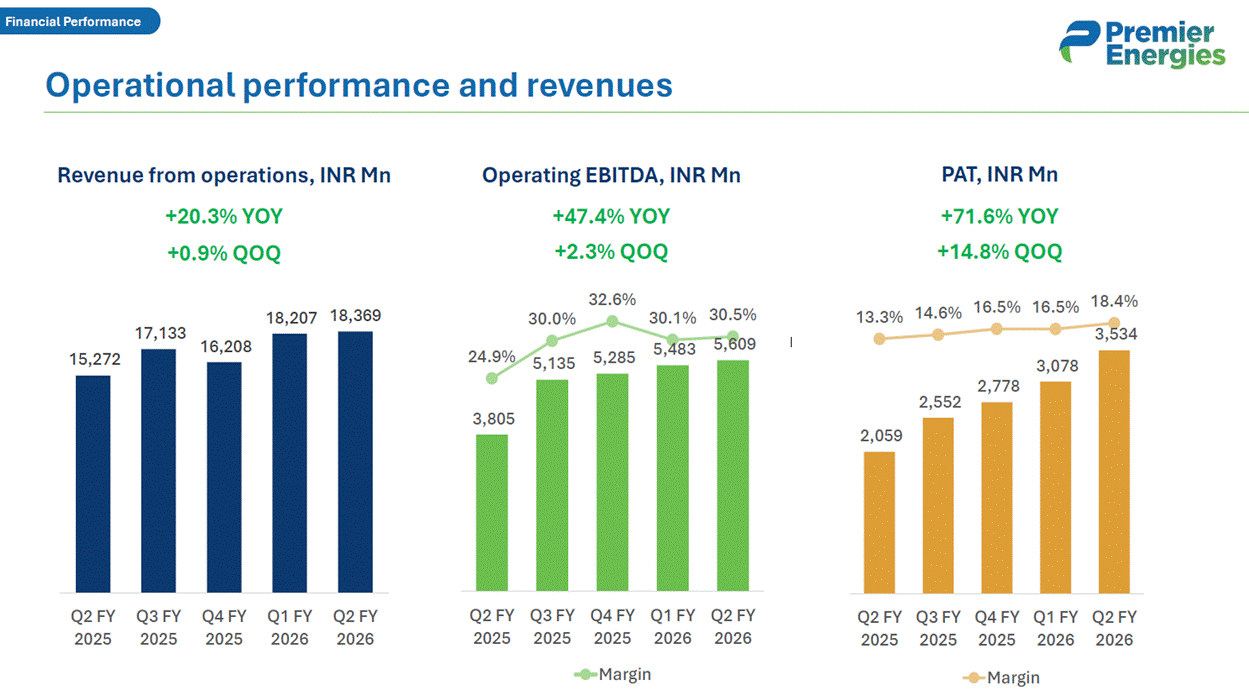
PAT increased 71.6% to ₹3.5 billion. The company expects these new businesses to contribute about 25% of group revenues. As of 30 September 2025, the order book stood at ₹132.5 billion. This provides about 2 years of revenue visibility.
#3 Acme Solar: The “storage first” play for grid stability
Acme Solar is one of the largest independent power producers of renewable energy. It has a portfolio of 7.4 GW spanning solar (43%), wind (2%), storage, hybrid and other projects (55%). In addition, the company also has 550 MWh of standalone BESS capacity.
Acme’s expanding renewable portfolio
Of this, 2.9 gigawatts (GW) is already operational, power purchase agreements (PPAs) have been signed for another 5.2 GW, and letters of award (LOAs) have been issued for an additional 2.2 GW. These contracts provide long-term stable cash flows contracted through a 25-year PPA at fixed tariffs with government-backed entities.
Acme has a diversified portfolio, with over 85% contracted to central offtakers, spanning new-age technologies such as Fully Dispatchable Renewable Energy (FDRE) and hybrid technologies. The majority of Acme’s operating portfolio is located in states with high resource potential.
Building scale in battery storage
The company is building BESS as a core part of its portfolio. ACME Solar’s total capacity stands at 7.4 GW, supported by 13.5 GWh of planned battery storage. Of this, 4.5 MW/13.5 GWh is already under construction, and the roadmap shows an existing storage pipeline of 13 GWh.
To this end, the company has placed big orders for BESS equipment, with installation scheduled to begin soon. ACME Solar placed an additional 2 GWh BESS order from leading global energy system suppliers in Q2 FY26, taking the total BESS ordered capacity to 5.1 GWh as of Q2 FY26.
The first phase of BESS delivery is scheduled to begin in December 2025 onwards. Phased commissioning of this ordered capacity is expected to commence in Q4 FY26. BESS is primarily utilised in Firm and Dispatchable Renewable Energy (FDRE) and standalone configurations, and is also leveraged for merchant operations.
The company plans to operate about 1 GWh of BESS on a merchant basis starting in Q4 FY26. This merchant operation is expected to deliver upside potential of around ₹1.7 billion in annual EBITDA, assuming an ₹5 difference between merchant power sold during peak hours and production costs.
To optimise future large-scale installations, ACME Solar operationalised a pilot BESS project. A 10 MWh BESS pilot project was operationalised in Rajasthan in October 2025, specifically for FDRE/Solar+BESS projects. An Energy Management System was also commissioned to automatically control BESS operations.
Acme Capacity Roadmap
Acme is targeting 10 GW of generation capacity and 15 GWh of BESS capacity by 2030. They will be tied to 15-year service agreements with their BESS vendors. These agreements include an annual maintenance fee and mandate on-ground personnel and reserves to guarantee specified availability and round-trip efficiency.
A Strong First-Half Performance
Acme reported a stellar performance in H1 FY26. Total revenue grew 86.6% year-on-year to ₹11.8 billion, driven by capacity additions and higher capacity utilisation. EBITDA grew 90.7% to ₹10.6 billion due to operating leverage, while margins expanded by 190 bps to 89.8%. As a result, PAT also grew sharply, rising from ₹170 million to ₹2,460 million.
Bottomline
Waaree and Premier have both seen a sharp improvement in profitability over the past year, as reflected in their return ratios. Premier stands out for efficiency, with Return on Capital Employed (RoCE) of 41.1% and Return on Equity of 53.6%, well ahead of Waaree.
Acme Solar sits at the other end of the spectrum, where uneven bottom-line movement has kept its return profile subdued, although the company expects RoCE to move towards the 14–15% range as execution stabilises.
| Company | P/E | Industry Median P/E | RoCE | RoE |
| Waaree Energies | 33.9 | 22.8 | 34.9 | 27.42 |
| Premier Energies | 36.7 | 41.1 | 53.6 | |
| Acme Solar | 27.1 | 27.1 | 8.4 | 7.6 |
From a valuation standpoint, Waaree and Premier continue to command a premium over the broader industry. Their market leadership, scale advantages and stronger earnings trajectory seem to justify part of this premium, especially in a sector where visibility is expanding. Acme Solar trades closer to the industry average, mirroring its relatively modest return profile and the need for consistent earnings.
Acme is trading in line with the industry. We have not considered their median valuation due to their short trading history. That said, all three companies are perfectly placed to ride the green energy wave. But it’s not without risk. Oversupply of solar power is expected to be a major threat to the entire sector.
Disclaimer
Note: Throughout this article, we have relied on data from http://www.Screener.in and the company’s investor presentation. Only in cases where the data were not available have we used an alternate, widely used, and accepted source of information.
The purpose of this article is only to share interesting charts, data points, and thought-provoking opinions. It is NOT a recommendation. If you wish to consider an investment, you are strongly advised to consult your advisor. This article is strictly for educational purposes only.
About the Author: Madhvendra has been deeply immersed in the equity markets for over seven years, combining his passion for investing with his expertise in financial writing. With a knack for simplifying complex concepts, he enjoys sharing his honest perspectives on startups, listed Indian companies, and macroeconomic trends.
A dedicated reader and storyteller, Madhvendra thrives on uncovering insights that inspire his audience to deepen their understanding of the financial world.
Disclosure: The writer and his dependents do not hold the stocks discussed in this article.
The website managers, their employees (s), and contributors/writers/authors of articles have or may have an outstanding buy or sell position or holding in the securities, options on securities or other related investments of issuers and/or companies discussed therein. The articles’ content and data interpretation are solely the personal views of the contributors/ writers/authors. Investors must make their own investment decisions based on their specific objectives and resources, and only after consulting any independent advisors that may be necessary.


