



India’s two-wheeler (2W) and three-wheeler (3W) industry is going through a technology shift that is creating a new opportunity for component suppliers. Integrated Starter Generator (ISG) technology is a good example. The number of 2W and 3W vehicles equipped with ISG increased from 51 lakh units in FY23 to 84 lakh units in FY26, taking its market penetration to around 35%.
This shift is also visible in the wiring harness market. As vehicles adopt more electronics, sensors, electrical systems and electrified powertrains, the wiring harness is becoming more complex and valuable. India’s domestic 2W wiring harness market is therefore expected to grow at a 14% CAGR between FY26 and FY31, significantly ahead of the growth in underlying vehicle volumes.
The opportunity is particularly higher in electric two-wheelers. While the ICE wiring harness segment is projected to grow at 8-10% during the period, the EV segment is expected to expand at a much faster 38-41% CAGR. This points to a broader trend: growth in India’s 2W and 3W component industry is increasingly driven by how much technology each vehicle carries.
Against this backdrop, this article looks at two recently listed auto ancillary companies with market leadership in Wiring Harness and Starter Generators.
#1 Dhoot Transmission: Harnessing 38% Market Share Across Two-Wheelers
Dhoot Transmission is one of India’s leading automotive Electrical and Electronics component manufacturers. Dhoot holds a 38% market share in India’s 2W wiring harness market. It is a top player across the 2W and 3W segments. Wiring harnesses represent Dhoot’s core product segment, accounting for 77% of revenue in FY26.
Electric Vehicle (EV) component revenue grew 79.2% year-on-year in the first quarter of FY27, increasing the share of EVs in the company’s revenue to 27%, up from 24% in FY26. Management expects EV revenue share to exceed 30-32% in the next 2-3 years. Rising EV revenue contribution augurs well for the company.
The 4x Value Multiplier: Capitalising on India’s Electric Shift
Electric two-wheelers require 2-3 times more wiring-harness content by value than entry-level ICE scooters. This is due to high-voltage systems, shielded cabling, and high-grade thermal connectors. This multiplier can reach up to 4x if ancillary products such as battery pack assemblies, chargers, switches, electronic controllers, and sensors are included.
Its non-wiring harness business is also doing well, with revenue growing 67.7% in the quarter. Growth is coming from battery pack assembly, electronic controllers, sensors, and automotive switches. Dhoot primarily supplies to leading original equipment manufacturers in the 2W and 3W segments.
Client Moats & Capacity: Scaling to 160 Lakh Units by June 2027
Key clients include Bajaj Auto (32% of FY26 revenue), TVS Motor (20%), Honda (11%), and Royal Enfield (4%). It recently added Hero MotoCorp to its customer base. Dhoot has committed approximately ₹1,000 crore in capex during FY24-26. It plans to invest ₹400 crore annually for the next two to three years.
The company is expanding its wiring harness capacity from 130 lakh units to 160 lakh units. This capacity will go live by June 2027. Its current capacity utilisation stands at around 75%. Dhoot has a 25% capacity buffer year-round to fulfil surging demand without supply disruptions.
Q1FY27 Balance Sheet: Topline Hits ₹1,446 Cr as IPO Turns Ledger Cash-Positive
The company’s revenue grew 49.7% year on year to ₹1,446.4 crore. Wiring harness business revenue surged 44.6% to ₹1,090 crore, while the balance came from the Non-Wiring Harness business. EBITDA (Earnings Before Interest, Tax, Depreciation, and Amortisation) rose 29% to ₹218.4 crore, with margins at 15.1%.
Net profit surged 37.8% to ₹132.7 crore. Management has maintained margin guidance of 15% to 16% for the full year. Management expects revenue growth of 25-30% for FY27. After receiving IPO proceeds in August 2026, the company moved to a net cash surplus of ₹1,000 crore.
#2 Sedamac Mechatronics
SEDEMAC Mechatronics designs and supplies control-intensive Electronic Control Units (ECUs) to major vehicle and industrial equipment manufacturers across India, the US, and Europe. The company develops all products entirely in-house without external technical collaboration.
How Sensorless Tech Dominates 90% of Topline
An ECU is an embedded electronic device that acts as the brain for specific functions in vehicles and equipment. The product is vital to the application. If the ECU does not function, the vehicle or machinery’s core operations will not work. Control-intensive ECUs account for 85% to 90% of the company’s revenue, making ECU sales volume the primary growth driver.
The company has sold over 130 lakh control-intensive ECUs cumulatively to date. It sold about 42 lakh control-intensive ECUs over the trailing twelve-month period.
From ICE to EV: Capturing 80% of India’s 2W ISG Volume Growth
Three of the four top two-wheeler manufacturers in India now utilise SEDEMAC’s sensorless Integrated Starter Generator ECUs. SEDEMAC accounted for 80% of the total Indian 2/3-wheeler ISG market volume growth in FY26. Notably, the same Sensorless Control (SLC) technology that powers SEDEMAC’s ISG controllers in fuel engines also powers Motor Control Units in EVs.
Standard EVs use physical position sensors in motors, which are prone to failures, especially in wheel-hub motors exposed to harsh conditions. SEDEMAC’s algorithm-driven sensorless commutation eliminates physical sensors, significantly boosting EV drive reliability. Notably, its ECUs are used on variants of 3 popular motorcycle models across 3 of the top 4 2W players.
Commercial Ramp-Up: Three Motorcycle Launches Slated for FY27
Production and dispatches were underway as of Q1FY27 for the first model. The second model launch was scheduled for Q2FY27 and the third model for Q4FY27. This could support volume growth.
The company launched main motor controllers for electric 2-wheelers and 3-wheelers in Q4FY25. The production of electric 2-wheeler motor controllers started in Q3FY26, with volume ramp-up ongoing in FY27. The company is also expanding into commercial EV platforms.
Revenue contribution from EV products increased from 0.3% in FY24 to 1.7% in FY25, and reached 7.4% in FY26. Being present in both fuel-powered and electric powertrains allows the company to stay protected regardless of how quickly the market shifts from petrol/diesel to electric vehicles.
Capacity Tripling & Q1FY27 Financials: Net Profit Surges 95% to ₹33 Crore
SEDEMAC is expanding its capacity to support its volume growth. This 120,000 sq. ft. facility is three times the size of the current primary plant. It serves as the primary plant for electronic control units, and dispatch is scheduled to begin in Q2FY27. The company has also reported strong financial performance.
Revenue grew 43% year-on-year to ₹310 crore in Q1FY27. EBITDA surged 31% to ₹60 crore with margins at 19.4%. Net profit surged by 95% to ₹33 crore. Semiconductor supply chain tightening and higher raw material costs slightly compressed the EBITDA margin in Q1FY27. Management expects margins to hold steady or improve going forward.
Execution Realities vs. Multiples
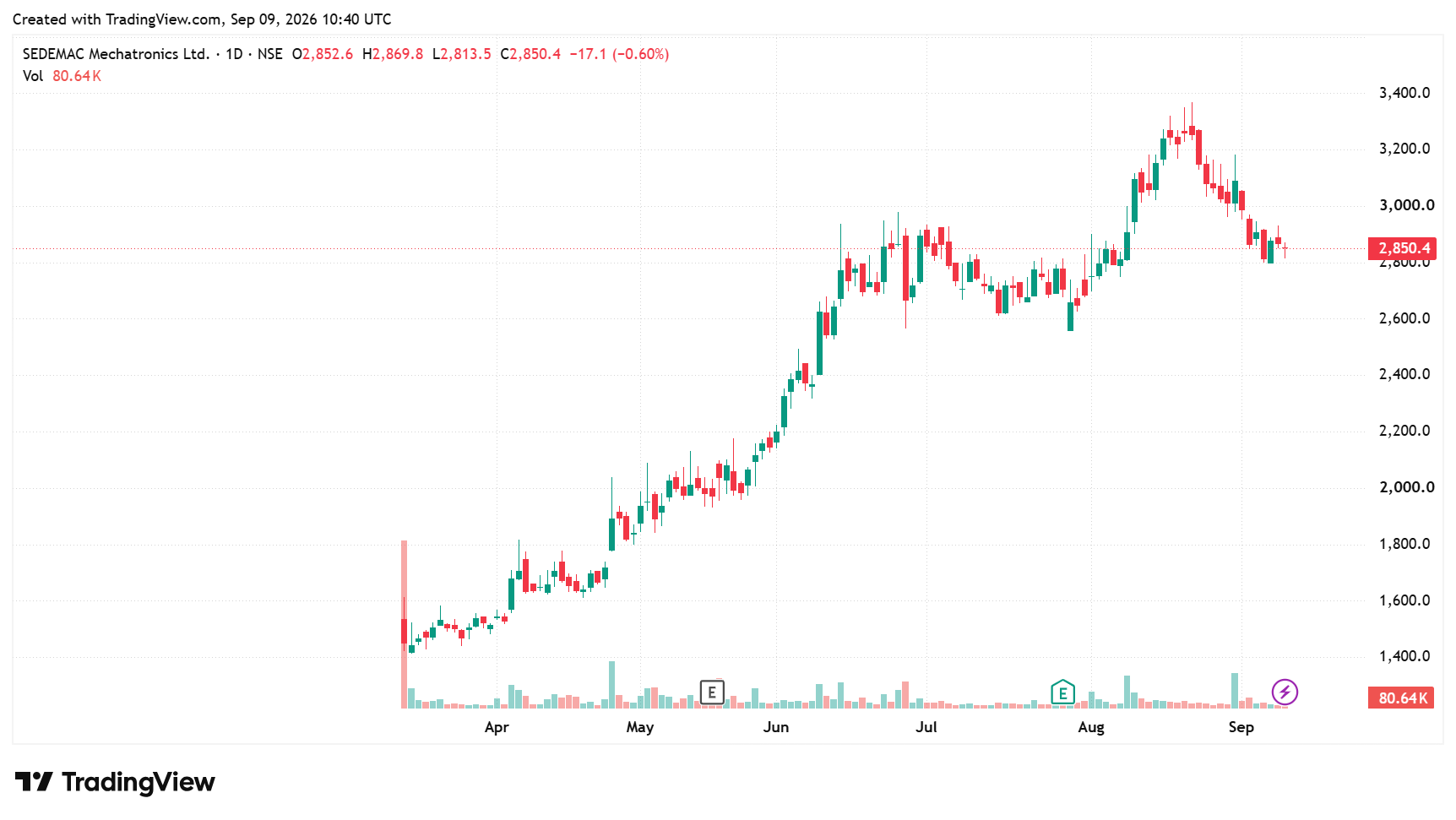
SEDAMAC boasts a higher Return on Capital Employed (ROCE) and Return on Equity (ROE) owing to its faster growth than Dhoot. Sedamac’s revenue and net profit have grown 35% and 69% over the last five years, respectively, compared with 29% and 65% for Dhoot. Valuation-wise, both the companies trade at a significant premium to the industry median.
| Peer Comparison (X) | ||||
Company | Price-to-Earnings Multiple | Return Ratios | ||
| Company | Industry | ROCE (%) | ROE (%) | |
| SEDAMAC | 107 | 29.3 | 35.3 | 26.9 |
| Dhoot | 71.9 | 29.3 | 24.4 | 24.0 |
| Source: Screener.in (Data as of September 09 2026) | ||||
Dhoot Transmission and SEDEMAC Mechatronics offer investors exposure to the rising technology content in India’s 2W and 3W industry. Both come with premium valuations. Dhoot benefits from its leadership in wiring harnesses and the rapid growth of EV-related content.
SEDEMAC, meanwhile, combines strong growth with higher margins, return ratios and exposure to both ICE and EV platforms. However, their valuations leave limited room for execution missteps. As both companies expand capacity and add new platforms, sustained volume growth and strong execution will be crucial to justify their rich multiples.
You could keep these names on your watchlist to track their execution.
Disclaimer:
Note: Throughout this article, we have relied on data from http://www.Screener.in and the company’s investor presentation. We used an alternative, widely used, and accepted source of information only when the data was unavailable.
The purpose of this article is only to share interesting charts, data points, and thought-provoking opinions. It is NOT a recommendation. If you wish to consider an investment, we strongly advise you to consult your advisor. This article is strictly for educational purposes only.
About the Author: Madhvendra has been deeply immersed in the equity markets for over seven years, combining his passion for investing with his expertise in financial writing. With a knack for simplifying complex concepts, he shares honest perspectives on startups, listed Indian companies, and macroeconomic trends.
A dedicated reader and storyteller, Madhvendra thrives on uncovering insights that inspire his audience to deepen their understanding of the financial world.
Disclosure: The writer and his dependents do not hold the stocks discussed in this article.
The website managers, its employee(s), and contributors/writers/authors of articles have or may have an outstanding buy or sell position or holding in the securities, options on securities, or other related investments of issuers and/or companies discussed therein. The articles’ content and data interpretation are solely the personal views of the contributors/ writers/authors. Investors must make their own investment decisions based on their specific objectives and resources, and only after consulting any independent advisors as may be necessary.