




Artificial intelligence (AI) is creating new opportunities for analytics companies. But a growing market does not automatically translate into higher profits. Companies still have to win clients, replace lost business and ensure that the money spent on new technology brings in enough revenue to justify the cost.
Latent View Analytics is trying to do just that. The company helps businesses use data to make decisions and is investing in AI capabilities while deepening its relationship with Databricks, a data and AI platform. The opportunity is clear. Whether it can turn that opportunity into sustained growth without sacrificing margins is less certain.
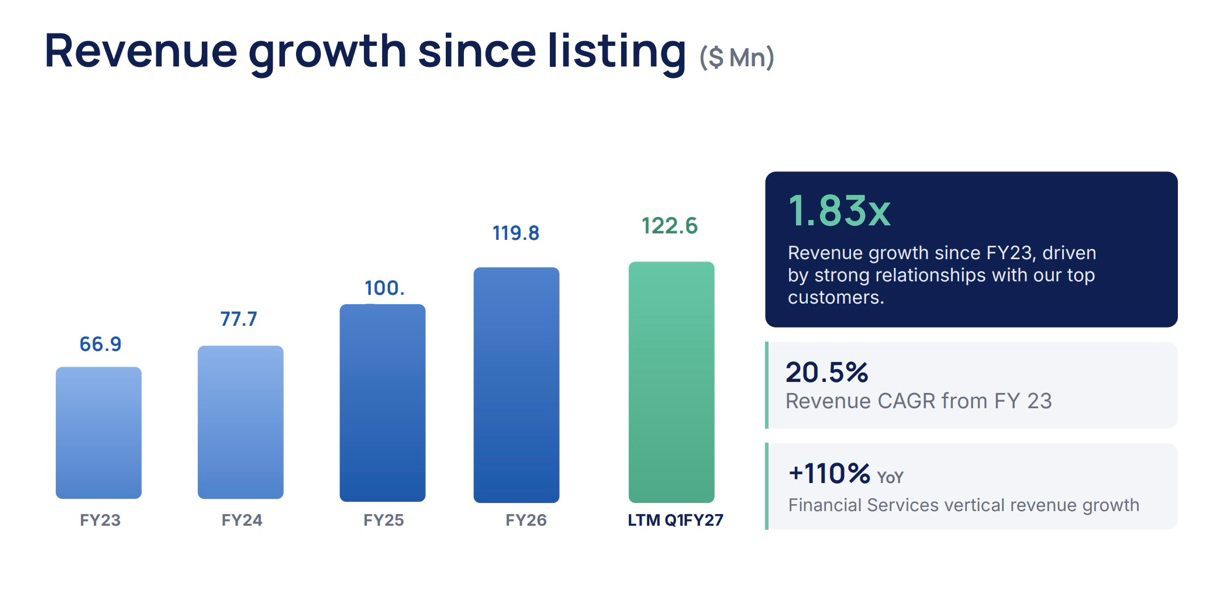
There are reasons to be optimistic. Latent View’s revenue grew 19.4% in US dollar terms in FY26, supported by growth in financial services and other non-technology businesses. Its Databricks-related business is also expanding, giving it another potential source of revenue as companies invest in data infrastructure and AI.
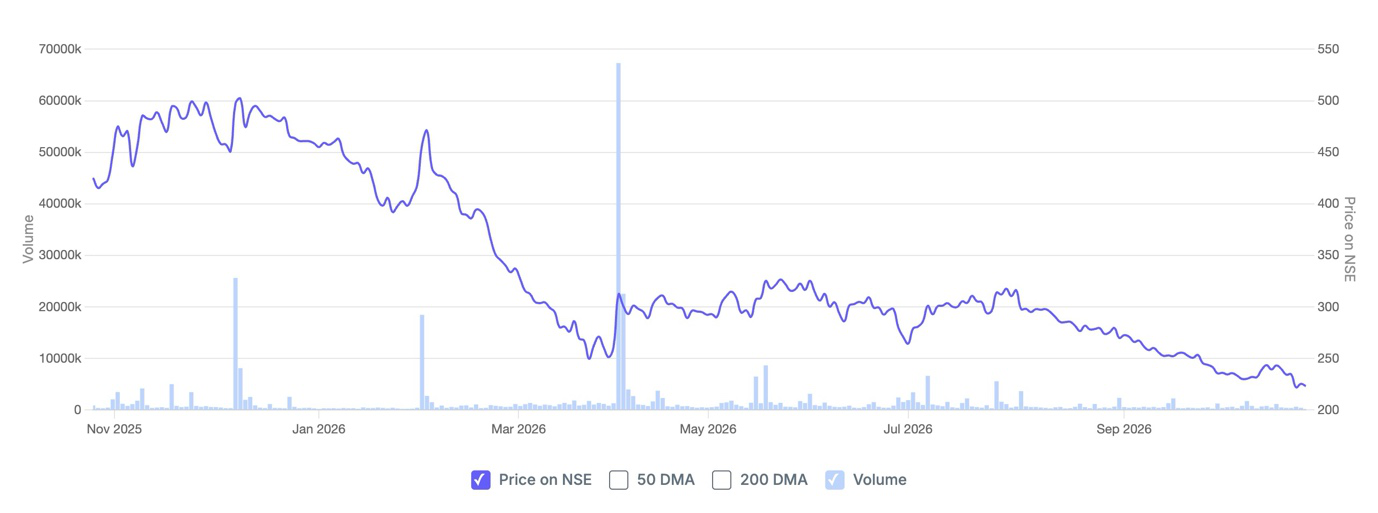
Latent View Analytics 1-Year Share Price Chart
A large technology client has reduced its business with Latent View, leaving the company with revenue to replace even as it continues to invest in AI, Databricks and senior talent. These investments may support future growth, but they also raise costs in the present. The company now has to demonstrate that new business can make up for what it has lost.
Investors are becoming less willing to overlook these challenges. At Rs 225.30 on 26 October 2026, the stock was down around 56.5% from its 52-week high of Rs 517.50. The key question is whether Latent View can turn the AI opportunity into profitable growth.
The challenge of replacing lost business
For a services company, losing a large client is not just a question of replacing revenue. It also leaves the company with employees and costs that were supported by that business. Finding another client takes time, while salaries and other expenses continue to be paid.
Navigating the Tech Vertical Slump
Latent View saw this problem play out in its technology vertical, which declined 9.5% sequentially in the March 2026 quarter. Vendor consolidation, project rationalisation and a large client’s decision to bring some work in-house contributed to the fall. The company expects the lost business to have an annualised revenue impact of around US$6.5 million to US$7 million in FY27.
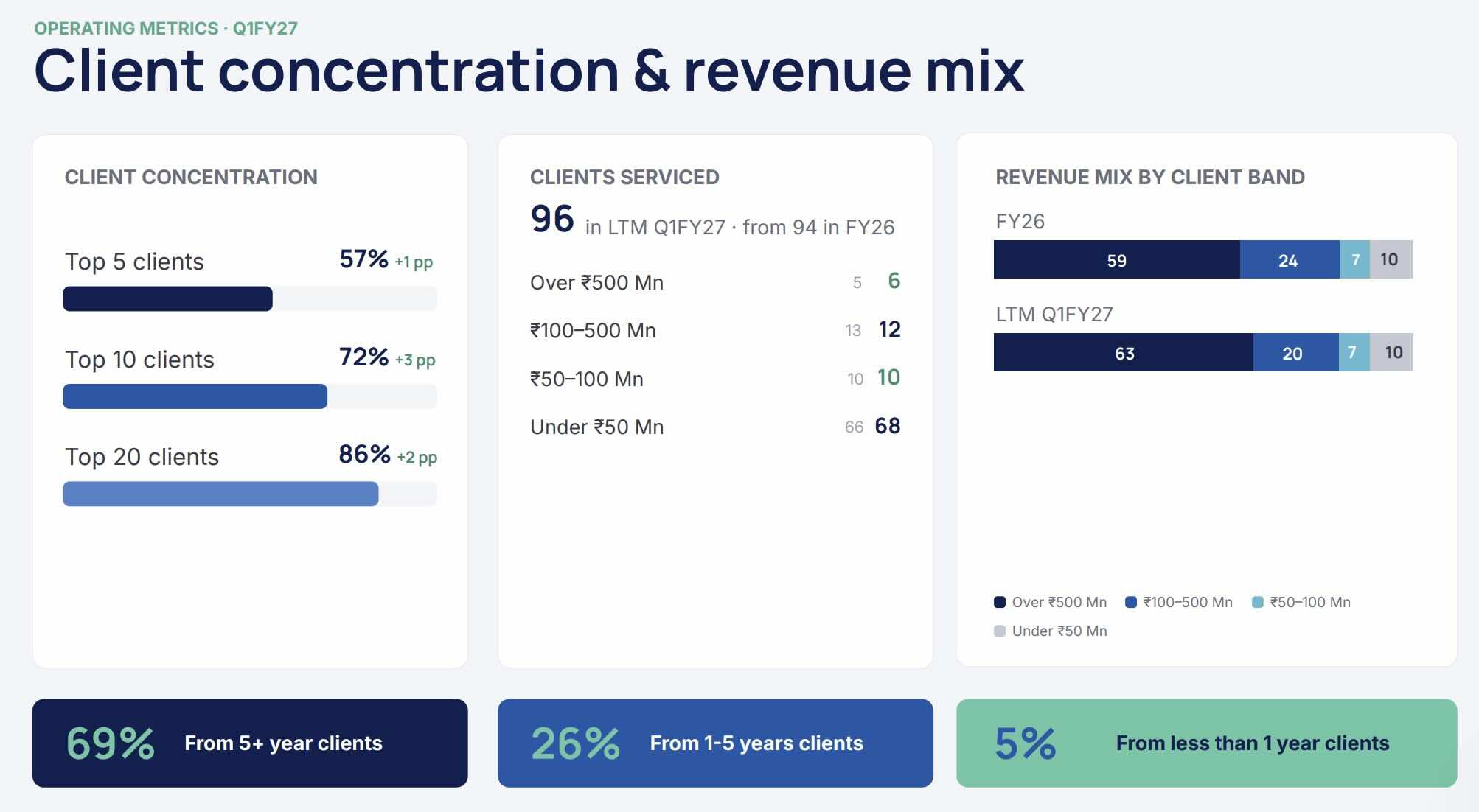
Management hopes to recover part of this through new AI-led deals and an improvement in technology spending. But new business does not arrive on a timetable that neatly matches the loss of old business. Until replacement revenue comes in, the company must contend with a gap between the costs it carries and the revenue it generates.
There is some support elsewhere in the business. Latent View’s non-technology segments grew around 41% in FY26, helped by demand from areas such as financial services. The question is whether this growth can continue at a pace that offsets weakness in technology. Diversification helps, but it becomes a real cushion only when it can absorb a setback in one of the larger businesses.
The Growth-Margin Paradox: Why More AI Means Less Profit
The case for Latent View rests partly on a simple proposition: as companies adopt AI, they will need help making their data usable, connecting systems and building applications that deliver business results. This creates work for analytics companies even when the underlying AI models are developed by someone else.
Latent View has been investing in these capabilities. Its FY26 commentary indicated that advanced AI accounted for about 49% of revenue when customer-facing AI implementations and AI embedded in workflows were combined. The company’s Q1 FY27 presentation reported AI-led revenue at around 35%, using a narrower definition. These figures are not directly comparable, but they suggest that AI-related work is already a meaningful part of the business.
The more difficult question is what this growth costs. Latent View has been investing in specialised employees, senior leadership and newer technology platforms. In the March 2026 quarter, its adjusted EBITDA margin fell to 24.1%, partly because of higher visa expenses and spending on AI and Databricks. In the June quarter, the margin declined further to 20.4%.
This is the tension in the AI opportunity. A company cannot afford to stand still while its clients change how they use technology. But investing ahead of demand means carrying costs before the revenue fully arrives. If new projects scale up, today’s spending could support tomorrow’s growth. If they do not, the company could end up with higher costs without a corresponding improvement in revenue.
AI demand, by itself, is therefore not enough to establish the strength of the investment case. Investors also need to see whether that demand translates into profitable business.
Databricks could become a bigger contributor
Latent View’s relationship with Databricks gives it another way to participate in the growth of AI. Companies preparing their data infrastructure for AI applications may need help with data engineering, platform integration and analytics. A services provider with the right skills and client relationships can benefit from this spending.
Latent View generated US$17.5 million in Databricks-related revenue in FY26, an increase of around 46% over the previous year. Management had indicated an ambition to grow this business by around 60% in FY27. If that happens, Databricks could make a larger contribution to the company’s overall growth.
AI and Databricks: Are they big enough to drive growth?
| Growth driver | Latest reported figure | What it tells investors |
| AI-led revenue | 35% of Q1 FY27 revenue | AI-related work is already a meaningful part of the business |
| Databricks-related revenue | US$17.5 million in FY26 | An established business with room to grow |
| Databricks revenue growth | Around 46% in FY26 | The business is growing faster than the company overall |
| FY27 revenue growth target | 12% in US dollar terms | Management is targeting more moderate growth |
There is, however, a difference between a fast-growing business and a fast-growing company. The overall result depends on how much the growing business contributes to revenue and whether it can offset weakness elsewhere. Strong growth in Databricks-related work may not be enough if the technology vertical continues to lose business or other segments slow down.
Latent View is also exploring acquisitions to strengthen its capabilities, particularly around data platforms. Its investment in Healtheon provides access to AI-led healthcare revenue cycle management opportunities. Acquisitions could add new capabilities and revenue, but they also require capital and management attention. Their value will ultimately depend on what they contribute to the business, not simply on whether they fit the AI theme.
The numbers tell a more complicated story
Latent View’s revenue rose to Rs 1,060 crore in FY26 from Rs 848 crore in FY25, an increase of around 25% in rupee terms. Operating profit margin, however, slipped from 23% to 22%. The company was growing, but it was not retaining a higher proportion of revenue as operating profit.
The Sequential Slowdown Warning
The June 2026 quarter showed a similar contrast. Revenue rose 21.6% year-on-year to around Rs 287 crore, but declined 0.6% sequentially in rupee terms. US dollar revenue fell 3.5% sequentially to US$30.3 million. The year-on-year comparison looks healthy, but the sequential numbers suggest that momentum had weakened.
Management has retained its FY27 target of 12% revenue growth in US dollar terms. This is more cautious than the 19% to 20% growth aspiration discussed earlier in 2026. The change reflects the challenge of replacing lost client revenue and dealing with uneven demand.
The consumer goods business could provide some relief. Management expected it to grow by more than 25% sequentially in the September 2026 quarter. If that rebound materialises, it would help restore growth. But one strong quarter would not settle the larger question of whether the business can sustain its growth rate while absorbing the loss of a major client.
The margin trend is equally important. Revenue growth can look impressive on paper, but investors ultimately need to know whether it produces better operating returns. Latent View’s recent results show that this relationship is under pressure. The company needs new business, but it also needs that business to generate enough revenue to cover its growing investment in talent and technology.
Cash Cushions and CapEx Realities
Latent View’s balance sheet gives it some room to deal with these challenges. Cash flow from operations increased to Rs 165 crore in FY26 from Rs 130 crore in FY25, while free cash flow rose to Rs 142 crore from Rs 115 crore. At the end of FY26, reserves stood at Rs 1,735 crore and borrowings were just Rs 33 crore.
Low borrowings reduce the risk of financial pressure while the company invests in new capabilities. Strong cash generation also gives it the option to pursue acquisitions without relying heavily on debt. These are meaningful positives in a period when revenue growth and margins are under pressure.
But a strong balance sheet cannot replace a weak operating trend indefinitely. Investors are buying the future earnings power of the business, not simply its ability to fund another year of investment. The important question is whether the money being spent today will generate enough additional revenue and profit in the years ahead.
The Valuation Trap: Does a 56% Haircut Make it a Buy?
At around Rs 225, Latent View traded at approximately 23.5 times earnings and 13.6 times enterprise value to EBITDA. Its price-to-earnings multiple was well below its five-year average of around 54.7 times.
The stock’s valuation has fallen as investors have become less confident about its growth. The loss of a large client, slower sequential revenue growth and falling margins have raised questions about whether Latent View can sustain its earlier performance.
A lower multiple does not automatically make the stock cheap. Latent View must replace lost revenue, grow its AI and Databricks businesses and recover margins before investors have reason to pay a higher multiple. Until the numbers show progress on these fronts, the lower valuation may be justified.
What could change the outlook?
Latent View has an opportunity to benefit from spending on AI, data infrastructure and analytics. Its Databricks business is growing, non-technology segments have helped offset weakness in technology, and the balance sheet gives it room to invest. These are real strengths, not merely promises about a future technology cycle.
The problem is that the company must turn these strengths into consistent financial performance. The large-client reduction has created a revenue gap, sequential US dollar revenue declined in Q1 FY27, and margins have weakened as the company invests in new capabilities. Its 12% US dollar revenue growth target for FY27 will depend on whether new business can make up for these pressures.
The next results should provide evidence on the consumer goods recovery, the direction of the technology vertical and the effect of continued investment on margins. Until then, the central question is not whether AI will create opportunities for analytics companies. It is whether Latent View can capture enough of those opportunities, at the right economics, to make up for the business it has lost.
Disclaimer
Note: We have relied on data from www.Screener.in throughout this article. Only in cases where the data was not available, have we used an alternate, but widely used and accepted source of information.
The purpose of this article is only to share interesting charts, data points and thought-provoking opinions. It is NOT a recommendation. If you wish to consider an investment, you are strongly advised to consult your advisor. This article is strictly for educative purposes only.
Manvi Aggarwal has been tracking the stock markets for nearly two decades. She spent about eight years as a financial analyst at a value-style fund, managing money for international investors. That’s where she honed her expertise in deep-dive research, looking beyond the obvious to spot value where others didn’t. Now, she brings that same sharp eye to uncovering overlooked and misunderstood investment opportunities in Indian equities. As a columnist for LiveMint and Equitymaster, she breaks down complex financial trends into actionable insights for investors.
Disclosure: The writer and her dependents do not hold the stocks discussed in this article. The website managers, its employee(s) and contributors/writers/authors of articles have or may have an outstanding buy or sell position or holding in the securities, options on securities or other related investments of issuers and/or companies discussed therein. The content of the articles and the interpretation of data are solely the personal views of the contributors/ writers/authors. Investors must make their own investment decisions based on their specific objectives, resources and only after consulting such independent advisors as may be necessary.