




The Order Book Reality: Why Profit Lines Are Masking the Truth
One number decides a shipbuilder’s future, and it is not the profit line. It is the order book. A yard can post a record year while quietly running out of work, because today’s profit comes from ships ordered years ago.
The market looks to be missing that with two Indian yards. Mazagon Dock Shipbuilders closed at Rs 2,280 on 18th September 2026, roughly 40% below the record high of Rs 3,778 it touched in May 2025.
Cochin Shipyard closed at Rs 1,398, more than 53% below its peak of about Rs 2,979. Both have been profitable every year since FY15, and both compounded for five-year holders at 78% and 50% a year.
The fall has come at an odd moment. In September 2025 the Cabinet cleared a Rs 69,725 cr package for shipbuilding, including a Rs 25,000 cr Maritime Development Fund and a Rs 19,989 cr scheme to lift national capacity to 4.5 million gross tonnes a year. This week Mazagon Dock signed two agreements to anchor greenfield clusters. The policy money is arriving exactly as prices sink. Let us look at what each yard carries.
#1 Mazagon Dock Shipbuilders: India’s Best Yard Is Running Low on Work
Mazagon Dock Shipbuilders traces its roots to 1774 and has been government-owned since 1960. From its Mumbai yard it has delivered 801 vessels since then, including the Navy’s stealth frigates, destroyers and Kalvari-class submarines. It is the only Indian yard building submarines at scale, and at Rs 91,971 cr the most expensive shipbuilder on the market by some distance.
The operating record is excellent. Return on capital employed is 36%, return on equity 29.2%. Borrowings were Rs 447 cr against a net worth of about Rs 9,755 cr at end-FY26, so debt is close to irrelevant. On almost any screen, this looks the better of the two.
Mazagon Dock’s Shrinking Backlog: Only 1.4 Years of Visibility Left
Here is the problem. In its Q1 FY27 investor presentation filed with the exchanges, Mazagon Dock disclosed an order book of Rs 18,218 cr as on 30th June 2026, against Rs 20,535 cr at 31st March. That is an 11% fall in three months. Go back further and it gets starker: the backlog was around Rs 49,700 cr at the end of FY21.
Set that Rs 18,218 cr against FY26 revenue of Rs 13,006 cr and you get about 1.4 years of work in hand. The company has not lost contracts.
It delivered against them faster than it replaced them, which is a compliment to the workshop and a warning to the shareholder. The Project 17A frigate programme alone accounts for Rs 7,587 cr of what remains, and the presentation notes the balance includes spares and pending work on vessels already handed over.
Quality of Profit: The Cash Flow Disconnect at Mazagon
| Financial Year | FY21 | FY22 | FY23 | FY24 | FY25 | FY26 | 5-Yr CAGR |
| Sales/Rs Cr | 4,048 | 5,733 | 7,827 | 9,467 | 11,432 | 13,006 | 26% |
| EBITDA/Rs Cr | 226 | 441 | 801 | 1,416 | 2,093 | 2,268 | 59% |
| Net Profit/Rs Cr | 514 | 611 | 1,119 | 1,937 | 2,414 | 2,578 | 38% |
Source: Screener.in
EBITDA here is operating profit before other income. Those growth rates are real, but two things sit underneath them. Other income of Rs 1,139 cr in FY26 made up about 35% of pre-tax profit.
That is interest on a large pile of customer advances, not money earned building ships. More important, FY26 cash from operations was negative Rs 2,654 cr and free cash flow negative Rs 2,828 cr. The advances that fed the interest income are flowing back out as older projects close. Contingent liabilities stand at Rs 28,181 cr, normal for defence work but not small.
Capex Gambles and the Project 75I Submarine Swing Factor
The response has been aggressive. On 16th September 2026 the company told the exchanges it had agreed to anchor a greenfield cluster at Dighi in Maharashtra, targeting 1.2 million gross tonnes a year. Two days later it filed a second for a similar cluster at Dugarajapatnam in Andhra Pradesh. Press reports put the planned investment at roughly Rs 15,000 cr per site, though the BSE filings confirm only the anchor role and the tonnage target.
Take those numbers at face value and the yard has signalled capex intent of about Rs 30,000 cr, roughly three times its net worth, in the same year operating cash flow turned sharply negative. It also bought 51% of Sri Lanka’s Colombo Dockyard, its first overseas purchase, for around Rs 237 cr.
The swing factor remains the submarines. Management expects the Project 75I contract and a follow-on Kalvari order, together worth well over Rs 1 lakh crore. If they land, the backlog problem disappears overnight. If they slip another year, the yard converts a shrinking book at a rising cost base.
Valuation Reality Check: Pricing in Perfection for Mazagon Dock
The share price of Mazagaon Dock Shipbuilders was about Rs 125 in September 2021 and as of closing on 18th September it was Rs 2,280. That is a jump of 1,724% in 5 years. However, as on 18th September, the stock is trading at a discount of 40% from its all-time high of Rs 3,778.
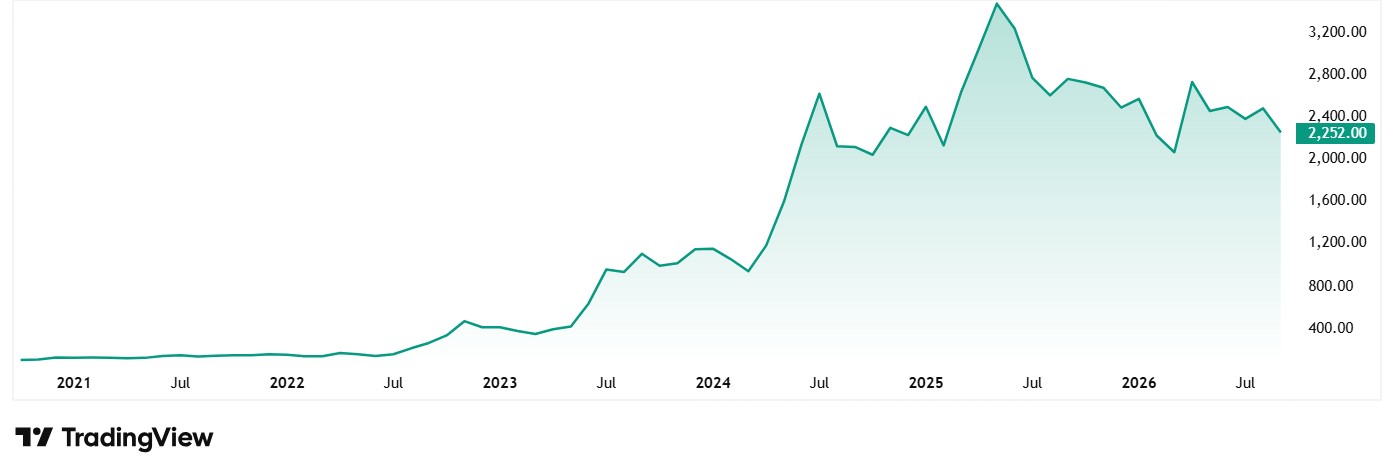
The stock trades at a PE pf 32x against the current industry median of 47x. The 10-year median PE of the stock is 29x which is same as the industry median for the same period. That multiple sits slightly below its own average of recent years, unusual for a defence name. Government holding fell from 84.83% to 81.22% after an offer for sale in the June 2025 quarter.
#2 Cochin Shipyard: Five Years of Work, Falling Margins
Incorporated in 1972, Cochin Shipyard is India’s largest commercial yard and builder of the aircraft carrier INS Vikrant. It runs shipbuilding, ship repair and an international repair facility at Willingdon Island. The government holds 67.91%, down from 72.86% after a December 2024 stake sale. Market value is Rs 36,779 cr, well under half of Mazagon Dock’s.
During its September 2026 investor call, which was disclosed to the exchanges, the company placed its unexecuted order book at about Rs 22,000 cr. It has also been declared lowest bidder for five next-generation survey vessels worth roughly Rs 5,000 cr, taking the book to about Rs 27,000 cr on award. The split is roughly Rs 11,900 cr defence, Rs 7,200 cr commercial exports, Rs 1,600 cr domestic commercial and Rs 1,200 cr ship repair.
Against FY26 revenue of Rs 4,308 cr, that is over five years of cover. The smaller company has more work booked than the bigger one, in a far more diversified mix.
Funding Expansion Through Borrowed Money
| Financial Year | FY21 | FY22 | FY23 | FY24 | FY25 | FY26 | 5-Yr CAGR |
| Sales/Rs Cr | 2,819 | 3,190 | 2,330 | 3,645 | 4,528 | 4,308 | 9% |
| EBITDA/Rs Cr | 727 | 635 | 273 | 885 | 886 | 692 | -1% |
| Net Profit/Rs Cr | 610 | 587 | 334 | 813 | 843 | 643 | 1% |
Source: Screener.in (Standalone)
EBITDA is operating profit before other income. Read that table honestly. Sales grew 9% a year, operating profit shrank slightly, and net profit is flat over five years. Part of that is the base: FY21 was the yard’s best operating margin year in the series at 26%. Part of it is that FY26 went backwards, revenue down 5% and profit down 24%.
The June 2026 quarter continued the slide. Revenue fell about 7% to Rs 910 cr and net profit dropped 28% to Rs 136 cr. Other income of Rs 403 cr in FY26 propped up 46% of pre-tax profit, a heavier reliance than at Mazagon Dock.
Cochin Shipyard’s borrowings jumped from Rs 501 cr in FY25 to Rs 1,575 cr in FY26, about 27% of net worth. Interest cost doubled to Rs 98 cr. Cash from operations was negative Rs 1,253 cr, free cash flow negative Rs 1,391 cr. Inventory days stretched to 425 from 324. The yard is building a new dry dock and the repair facility, so some of this is deliberate. But it is funded with borrowed money in a year profit fell.
Joint Ventures and Boardroom Lapses at Cochin Shipyard
Two exchange filings this month matter. On 9th September 2026 the board approved a 50:50 joint venture with Drydocks World Dubai, part of the DP World group, to run the Kochi repair facility. It moves across on a slump sale valued at Rs 1,800 cr, with Rs 900 cr coming to Cochin Shipyard in cash and Rs 900 cr in JV equity. The agreement was signed on 11th September. That cash is not trivial against a Rs 36,779 cr market value, and repair work carries better margins than building.
The blemish sits on the same exchange website. On 9th September the board recorded comments on fines of roughly Rs 9.7 lakh each from BSE and NSE for the June 2026 quarter, for not having enough independent directors and for improperly constituted audit and nomination committees.
Similar penalties were levied for the December 2025 and March 2026 quarters. Director appointments rest with the government, a fair defence, and the sums are tiny. But four quarters of the same lapse is a board short-staffed for a year.
Market Disconnect: Why is Cochin Trading at 62x PE?
The share price of Cochin Shipyard Ltd was about Rs 180 in September 2021 and as of closing on 18th September 2026 it was Rs 1,398 which is a jump of 676% in 5 years. However, that is a discount of 53% from its all-time high of Rs 2,979.
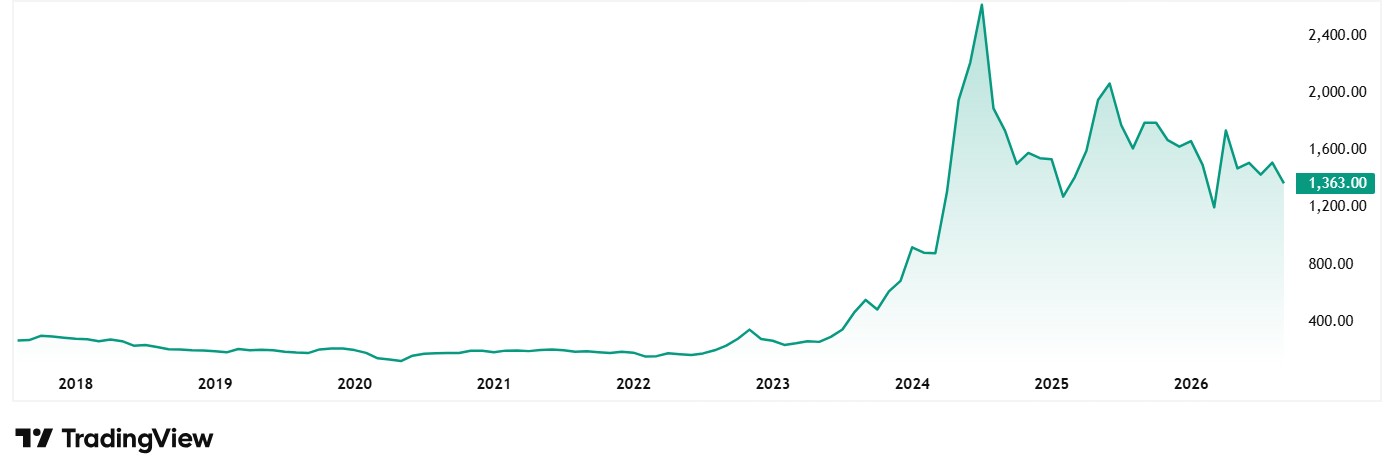
The stock is trading at a PE of 62x against the industry median of 47x. The 10-year median for the stock is 14x while the industry median for the same period is 29x. The listed shipbuilding universe is only five names deep, making any industry median close to meaningless.
Paying for Margins vs. Paying for Visibility
Strip away the noise and the comparison is stark. Mazagon Dock is valued at five times its order book and has 1.4 years of work booked. Cochin Shipyard is valued at 1.7 times its order book and has over five years booked. Yet Mazagon Dock trades at 32 times earnings and Cochin Shipyard at 62 times.
The market is paying up for the yard with the better margins and the thinner book, and discounting the one with the fuller book and the weaker margins. Both positions are defensible. Mazagon Dock earns three times the return on capital, and a single submarine contract would change its arithmetic completely. Cochin Shipyard’s visibility is worth little if it converts that work at falling margins and rising debt.
What neither price reflects is that both yards are spending heavily, both have turned cash-flow negative, and both depend on government decisions they do not control. The Rs 69,725 cr package is real money, but it is a decade-long programme, not a quarterly earnings boost.
The next four quarters should settle it. For Mazagon Dock, watch whether the submarine orders are signed. For Cochin Shipyard, watch the survey vessel award and whether margins steady. Anyone comparing the two on price alone is reading the wrong column. A sensible step would be to add these stocks to a watchlist and follow the order book disclosures each quarter.
Disclaimer
Note: We have relied on data from www.Screener.in and www.trendlyne.com throughout this article. Only in cases where the data was not available, have we used an alternate, but widely used and accepted source of information, including filings made available on the BSE website.
The purpose of this article is only to share interesting charts, data points and thought-provoking opinions. It is NOT a recommendation. If you wish to consider an investment, you are strongly advised to consult your advisor. This article is strictly for educative purposes only.
Suhel Khan has been a passionate follower of the markets for over a decade. During this period, He was an integral part of a leading Equity Research organisation based in Mumbai as the Head of Sales & Marketing. Presently, he is spending most of his time dissecting the investments and strategies of the Super Investors of India.
Disclosure: The writer and his dependents do not hold the stocks discussed in this article.
The website managers, its employee(s), and contributors/writers/authors of articles have or may have an outstanding buy or sell position or holding in the securities, options on securities or other related investments of issuers and/or companies discussed therein. The content of the articles and the interpretation of data are solely the personal views of the contributors/ writers/authors.