



India’s fertiliser requirement rose to 677.18 lakh metric tonnes (LMT) in FY2025-26 from 649.43 LMT a year earlier, while imports of finished fertilisers reached 28.2 million tonnes worth more than US$14.5 billion. The wider import bill, including raw materials used in domestic production, exceeded US$27 billion. These figures expose a structural vulnerability: manufacturers can sell more fertiliser without gaining greater control over the inputs needed to produce it.
For readers, Gujarat State Fertilizers & Chemicals (GSFC) and Rashtriya Chemicals and Fertilisers (RCF) offer two different ways to examine whether backward integration can improve manufacturing economics. The opportunity lies not simply in adding capacity, but in converting control over inputs, energy and production processes into lasting operating advantages.
GSFC: From Fertiliser Production to a Chain of Linked Industrial Chemicals
GSFC manufactures fertilisers and industrial chemicals. Its product portfolio includes agricultural nutrients and products used in industries such as textiles, engineering plastics, pharmaceuticals, agrochemicals and surface coatings. Its portfolio includes caprolactam, Nylon-6, melamine, sulphuric acid, anhydrous ammonia and other chemical intermediates. This combination gives the company opportunities to use internally manufactured inputs across related production processes while selling chemicals into markets beyond agriculture.
The Captive Chemical Chain: Where Integration Can Create Value
GSFC’s clearest example of backward integration is its production of hydroxylamine sulphate solution for captive use in caprolactam manufacturing. Caprolactam is an input for Nylon-6, which serves textile, industrial yarn and engineering-plastic markets. By operating across these stages, GSFC can participate in more than one part of the value chain.
The advantage, however, depends on the economics of the chain. If the selling price of caprolactam falls relative to benzene and other production costs, margins can contract even when the company manufactures certain intermediates internally.
During its February 2026 earnings call, management reported that the caprolactam–benzene spread had narrowed to US$495 per tonne from US$588 per tonne. This illustrates why integration should be assessed alongside product spreads, plant utilisation and the cost of externally purchased feedstock.
Sulphuric Acid-V: A Commissioned Project With Two Potential Benefits
GSFC commissioned its Sulphuric Acid-V project in January this year. The project adds sulphuric acid production capacity and generates steam that can be used at the company’s Vadodara complex.
Its potential benefits extend beyond replacing externally purchased acid. Captive acid availability can support the production of fertilisers such as ammonium sulphate and ammonium phosphate sulphate, while using generated steam elsewhere in the complex can improve energy utilisation.
The key distinction is between installed capacity and realised savings. Readers need to establish how much additional acid is consumed internally, how much external procurement is displaced, and whether the steam generated reduces other energy costs.
Sikka’s Acid Plants: A New Step Towards Phosphatic Fertiliser Integration
In October 2026, the GSFC board approved a phosphoric acid plant with a planned capacity of 600 metric tonnes per day (MTPD) and a sulphuric acid plant of 1,800 MTPD at its Sikka unit in Jamnagar, Gujarat. The proposal includes associated utilities and supporting infrastructure and is explicitly part of the company’s backward integration strategy.
Phosphoric acid and sulfuric acid are important inputs for phosphatic fertilisers and the project is of strategic importance. Production of these at Sikka could reduce GSFC’s dependence on purchased acid and also give it better control over the availability of inputs for its fertiliser operations.
HX Sulphate Crystals: An Import-Substitution Proposal to Recheck
GSFC commissioned its new 20 MTPD hydroxylamine sulphate crystal plant at Vadodara in October 2024. Built using in-house technology, the plant comprises two 10 MTPD production trains and expands GSFC’s capacity to serve demand for HX Crystal, a product used in agrochemical and pharmaceutical intermediates. The expansion supports import substitution and product-mix flexibility. In FY2025–26, GSFC reported record annual sales and export volumes for HX Crystal, indicating the product’s growing contribution to its industrial-products business.
Melamine and Industrial Customers: Diversification Beyond Agriculture
GSFC sells melamine under the Gujlamine brand. The chemical is used in laminates, plywood-related products, coatings and other industrial applications. Its published customer information includes names such as Century Laminates, Greenply Industries, Asian Paints and Kitply Industries among melamine customers. Other customer listings include businesses in automotive components and related industrial markets. These relationships show the breadth of GSFC’s industrial reach.
Q1FY27: Stronger Chemical Earnings, but Not Proof of a Permanent Advantage
GSFC’s Q1FY27 results provide a useful operating baseline before the next quarterly disclosure. Industrial products sales reached ₹635 crore, up 15% year on year, while segment earnings before interest and tax (EBIT) increased to ₹116 crore from ₹25 crore a year earlier.
Management attributed the improvement mainly to higher caprolactam sales and a wider caprolactam–benzene spread, which increased to US$816 per tonne from US$540 per tonne. The figures show how the industrial chemical business can benefit when selling prices and feedstock economics move favourably. They do not establish that backward integration alone caused the improvement.
GSFC’s Share Price: A Low Valuation Must Be Tested Against Execution
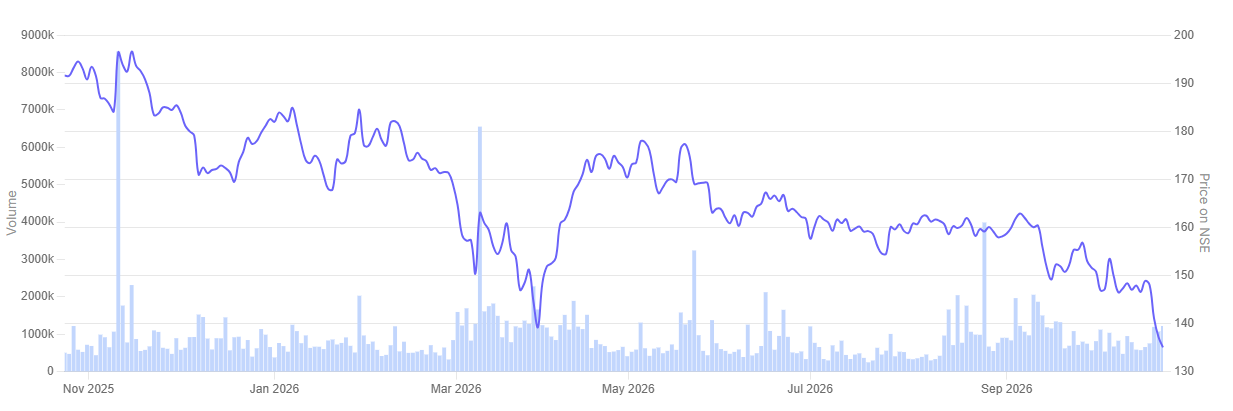
GSFC closed at ₹135.02 on the National Stock Exchange (NSE) on 23 October 2026. The share had declined 22.7% over six months and 30% over 52 weeks. Its trailing price-to-earnings (P/E) ratio was 7.89, while the dividend yield was approximately 3.7%.
For readers, the central question is whether GSFC can turn its connected chemical chain and proposed acid capacity into more stable production economics across market cycles. The share-price decline alone does not answer it.
RCF: Building Control Over Fertiliser Manufacturing and Energy Costs
Rashtriya Chemicals and Fertilizers is a government-controlled fertiliser and chemicals manufacturer operating major production facilities at Trombay in Mumbai and Thal in Maharashtra. Its portfolio includes urea, complex fertilisers, speciality fertilisers and industrial chemicals. RCF’s investment case differs from GSFC’s: its most relevant initiatives combine additional domestic fertiliser capacity with efforts to reduce energy consumption and diversify feedstock sources.
Thal’s NPK Expansion: More Domestic Capacity, Not Complete Self-Sufficiency
RCF is developing a new complex fertiliser plant at Thal with capacity of 1,200 MTPD on a diammonium phosphate (DAP) basis. The plant is designed to manufacture different grades of nitrogen, phosphorus and potassium (NPK) fertilisers according to market requirements. The company has awarded the lump-sum turnkey contract to Larsen & Toubro, with an estimated project cost of ₹1,494.33 crore. Commissioning is scheduled for March 2027.
The project could allow RCF to meet more demand through its own manufacturing facilities rather than relying on externally sourced finished complex fertilisers. That may improve supply flexibility and provide greater control over product availability.
However, this is primarily a capacity-expansion project, not proof of full backward integration. The new plant will still require the necessary raw materials and intermediate inputs.
Thal’s Ammonia Revamp: Measuring the Value of Every Unit of Energy
RCF’s ammonia plant revamp at Thal uses technology supplied by Topsoe. The estimated capital cost is approximately ₹1,308 crore, with completion expected by July 2027. The project targets energy savings of 0.40 gigacalories (Gcal) per metric tonne of ammonia at current production levels.
Talcher: Replacing One Feedstock Exposure With a Different Production Route
The Talcher Fertilisers project in Odisha is RCF’s most ambitious example of changing the feedstock route for fertiliser production. The joint venture, Talcher Fertilisers Limited, involves RCF, GAIL, Coal India and Fertiliser Corporation of India. Its proposed complex includes an ammonia plant with a capacity of 2,200 MTPD and a urea plant of 3,850 MTPD. It is designed to use domestic coal gasification rather than rely on natural gas as the principal feedstock for the ammonia and urea chain. RCF identifies December 2027 as the expected commissioning date.
Energy Recovery, Biomass and Water: Supporting the Core Manufacturing Chain
RCF’s investment in production efficiency extends beyond ammonia. The company has reported gas turbine generators with heat-recovery steam generators at Trombay and Thal, as well as improvements to its Trombay Ammonia-V plant. Its sustainability disclosures have associated the combined gas-turbine and heat-recovery arrangements with an expected reduction in carbon dioxide emissions of around 28%.
RCF also commissioned a briquette-fired boiler at Thal in May 2025. Biomass briquettes can replace some fossil-fuel use in steam generation, while the company’s reported 5.71-megawatt-peak solar capacity across Trombay and Thal supplies electricity for captive consumption.
Q1FY27: High Input Costs Explain Why Integration Matters
In Q1 FY27, standalone revenue from operations was ₹3,585.71 crore. The segment breakdown was:
| Segment | Q1FY27 Revenue |
| Fertilisers | ₹2,567.80 crore |
| Industrial chemicals | ₹708.16 crore |
| Trading | ₹306.11 crore |
| Total | ₹3,585.71 crore |
Manufacturing accounted for most of RCF’s operating revenue, while trading remained a separate contributor. However, trading revenue does not indicate greater control over production inputs. In Q1FY27, material consumption stood at ₹1,734.60 crore and power and fuel expenses at ₹1,162.73 crore, highlighting the importance of procurement and energy efficiency.
The fertiliser segment reported a loss of ₹150.30 crore before tax and interest, while industrial chemicals generated ₹300.47 crore and trading contributed ₹20.66 crore. These segment results show stronger contributions from industrial chemicals than fertilisers during the quarter.
RCF Share Price: Will Capital Spending Deliver Better Returns?
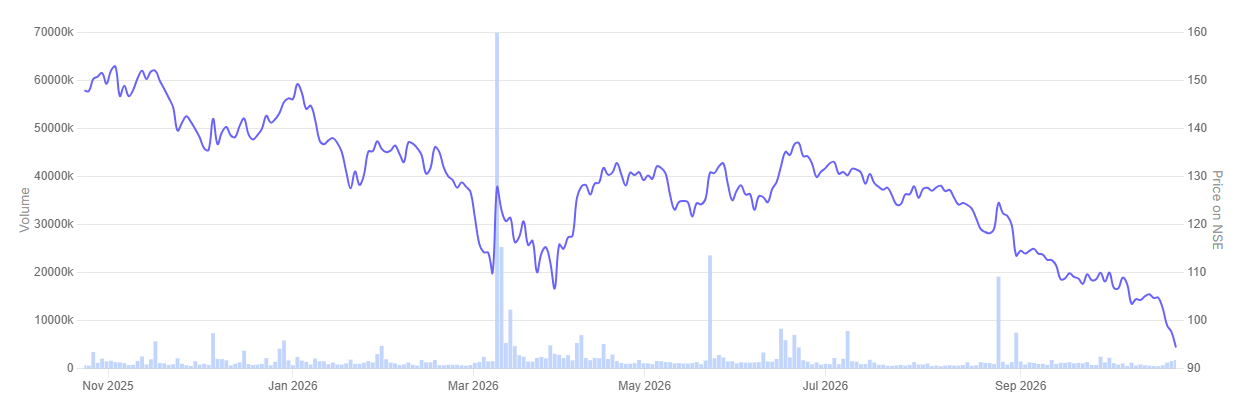
On 23 October 2026, RCF closed at ₹94.39 on the NSE. The stock fell about 28% over six months and 37% over one year. Its P/E ratio was 12.06 and its dividend yield was 2.5%. For readers tracking RCF stock price movement, the key consideration is the balance between the capital committed today and the operational benefits that may emerge later.
The Cost of Self-Reliance
Backward integration cannot eliminate India’s dependence on international fertiliser supply chains. Manufacturers continue to face exposure to natural gas, ammonia, phosphoric acid, phosphate rock, sulphur and potash, depending on their production mix. Establishing domestic facilities for every input may be technically difficult or commercially uneconomic.
Capital intensity is another constraint. Ammonia plants, acid plants, chemical intermediates and fertiliser complexes are capital intensive in terms of equipment, utilities, safety systems and pollution controls. These projects can take years to finish, locking up capital before any of the intended benefits are realised. Debt-funded expansion can increase interest expenses, while equity funding can dilute existing shareholders.
Another challenge is energy availability. Natural gas is a key raw material for the production of ammonia and urea. The import dependence of India on liquefied natural gas exposes the manufacturers to global price fluctuations and supply shocks. RCF’s proposed coal-based Talcher complex illustrates an alternative route, although coal gasification brings its own technology, operating and capital-cost risks.
The Real Test: Can Self-Reliance Earn Its Cost?
For readers, the broader lesson is that industrial self-reliance creates value only when it improves the quality of earnings, not merely the scale of operations. The strongest businesses will be those that can turn operational control into dependable cash generation without stretching their balance sheets.
Readers should also distinguish between projects that protect existing operations and those that create genuinely new sources of demand. In cyclical industries, a favourable earnings year can make valuations appear deceptively attractive, while a downturn can expose the true cost of expansion.
The bigger question, therefore, is not which company is building more, but which can earn an adequate return on every rupee committed across the cycle.
It may be a good idea to add these stocks to your watchlist and keep track to see how they perform in time to come.
Disclaimer
Note: We have relied on data from www.Screener.in throughout this article. Only in cases where the data was not available, have we used an alternate, but widely used and accepted source of information.
The purpose of this article is only to share interesting charts, data points and thought-provoking opinions. It is NOT a recommendation. If you wish to consider an investment, you are strongly advised to consult your advisor. This article is strictly for educative purposes only.
Rishabh Sinha is a seasoned financial content creator with over 10 years of experience in BFSI domain. His portfolio spans over 20 of India’s most trusted financial brands. Rishabh brings depth, structure, and a reader-first approach to every piece he crafts.
Disclosure: The writer and his dependents do not hold the stocks discussed in this article.
The website managers, its employee(s), and contributors/writers/authors of articles have or may have an outstanding buy or sell position or holding in the securities, options on securities or other related investments of issuers and/or companies discussed therein. The content of the articles and the interpretation of data are solely the personal views of the contributors/ writers/authors. Investors must make their own investment decisions based on their specific objectives, resources and only after consulting such independent advisors as may be necessary.