



Welcome to the latest edition of Dividend Hunter. In recent weeks, we have analysed companies where strong cash flows could translate into consistent dividends. In our previous edition, we covered a reinsurance company with a 52% market share offering a 3.9% dividend yield.
This week, in our Dividend Hunter series, we discuss a Mini-Ratna Category-I public sector enterprise that has grown its earnings at a compounded rate of 18% over the past five years and offers a dividend yield of 5%. The company distributes over 50% of its net profit as dividends.
The company operates across a diverse set of businesses, including industrial packaging, logistics infrastructure, greases and lubricants, and travel and vacations. Some key growth opportunities are also linked to structural trends such as the expansion of third-party logistics and e-commerce parcel volumes, rising demand for transformer oils and lubricants across power, automotive, railway, and defence, and sharp growth in domestic travel.
The company we are talking about is Balmer Lawrie.
Balancing Payouts: Why Profit Growth Outpaced Dividends
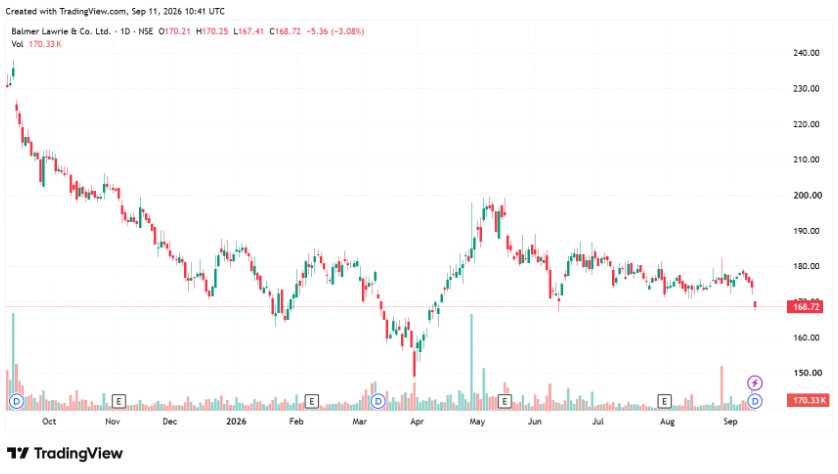
Balmer Lawrie paid a per-share dividend of ₹8.5 in FY26, translating into a dividend yield of 5% at the current price of ₹168. The company’s payout is supported by consistent profit, cash inflows from joint ventures and associates, accumulated reserves and a formal Dividend Distribution Policy.
However, the key question for dividend investors is whether Balmer Lawrie can maintain this payout while growing its earnings and investing in its business. Balmer Lawrie has maintained a consistent dividend payout over the past five years. The dividend per share increased from ₹6.50 in FY22 to ₹8.50 in FY24 and has remained at that level since then.
| Financial Year | Dividend/Share | Net Profit | Payout Ratio |
| FY22 | ₹6.50 | ₹134.0 crore | 82.9% |
| FY23 | ₹7.50 | ₹168.0 crore | 76.3% |
| FY24 | ₹8.50 | ₹236.0 crore | 61.6% |
| FY25 | ₹8.50 | ₹259.3 crore | 56.1% |
| FY26 | ₹8.50 | ₹270.3 crore | 53.8% |
| Source: Screener.in, Annual Report | |||
More importantly, the company has grown its profits faster than its dividend. Net profit grew from ₹134 crore in FY22 to ₹270.3 crore in FY26 – a doubling of profits over this tenure. This has brought the payout ratio down from 82.9% to 53.8% over the same period. Across the entire share base, this translates to an annual dividend commitment of approximately ₹145.5 crore.
Core Earnings Engine: Standalone Revenue Crosses ₹2,700 Crore
The primary driver of the dividend is the company’s core earning capacity across its diversified business units. During FY21-26, the company’s consolidated revenue grew at a 12.1% CAGR to ₹2,706 crore, while net profit grew 18.6% to ₹270 crore. This profit is fueled by diversified earnings across multiple business segments.
Travel and vacation (₹125.3 crore), logistics services (₹79.5 crore), greases and lubricants (₹76.0 crore), industrial packaging (₹52.6 crore), and logistics infrastructure (₹33.7 crore) led the profit before tax. Dividends are paid out of actual cash rather than paper profits, and Balmer Lawrie’s cash flow generation expanded significantly during the year.
Cash Generation: Operating Inflows Surge 85% in FY26
The company’s cash from operating activity stood at ₹289 crore in FY26. This represents an 85% jump from consolidated operating cash flow of ₹156 crore in FY25, underscoring a significant improvement in cash conversion efficiency across the Group. Of this, the company spent net ₹64 crore on CapEx, down from ₹66 crore in FY25.
Subtracting CapEx from operating cash flow yields a consolidated free cash flow of ₹225 crore in FY26, which is 2.5x the FY25 free cash flow of ₹90 crore. The company has generated positive free cash flow in eight of the last 10 years. FY22 was an exception, as higher working capital requirements absorbed cash and resulted in negative free cash flow.
| Financial Year | Operating Cash | Net CapEx | Free Cash Flow |
| FY22 | ₹2.0 crore | -18.0 crore | -16.0 crore |
| FY23 | ₹208.0 crore | ₹50.0 crore | ₹158.0 crore |
| FY24 | ₹274.0 crore | ₹52.0 crore | ₹222.0 crore |
| FY25 | ₹156.0 crore | ₹66.0 crore | ₹90.0 crore |
| FY26 | ₹289.0 crore | ₹64.0 crore | ₹225.0 crore |
| Source: Screener.in, Annual Report | |||
₹408-Crore Cash Cushion: Why Balance Sheet Liquidity Protects Payouts
The company also maintains a strong liquidity position. As of 31 March 2026, it had ₹408 crore in bank term deposits and ₹33.8 crore in cash and cash equivalents. Retained earnings stood at ₹1,583.4 crore, providing an additional financial cushion.
The DIPAM Benchmark: Why Balmer Lawrie’s 53.8% Payout Exceeds Government Norms
Together, these reserves and liquid assets give Balmer Lawrie considerable flexibility to meet its capital requirements while maintaining its dividend payouts. The Dividend Distribution Policy also provides visibility of consistent payouts. Department of Investment and Public Asset
Management guidelines state that Central Public Sector Enterprises may strive to pay a dividend based on the higher of 30% of profit or 4% of net worth. Balmer Lawrie paid around 53.8% of its net profit as dividends in FY26, well above the minimum threshold.
If the company continues to grow profitability at a pace similar to its historical track record while maintaining a similar payout ratio, its dividend per share could grow over time. However, the actual payout will depend on the company’s cash requirements, capital expenditure and other factors considered under its dividend policy.
Segment Breakdown: Travel and Logistics Lead Core PBT
However, weak profitability could also hamper the payout. The company has multiple earnings triggers and growth catalysts. Its Travel and Vacations business provides complete corporate travel management, air ticketing, holiday packages, and visa services. It serves government bodies, public sector units, and retail customers.
This segment has emerged as a major growth engine, with ticketing volumes up 15% year-on-year, while registrations on the government employee travel portal rose 25%. Domestic tourism is expanding rapidly through government schemes like Swadesh Darshan 2.0, PRASHAD, and UDAN. This expands booking demand deeper into Tier-2 and Tier-3 cities.
Beyond Freight: Rail Logistics & High-Margin Defence Contracts
In the asset-light logistics business, it handles international freight forwarding, customs clearance, surface transport, project logistics and specialised supply chain solutions. Balmer Lawrie has entered rail logistics by transporting finished steel products for clients like SAIL.
The company is also bidding for heavy-lift transport projects in the defence, petrochemicals, and engineering sectors, which is driving profit growth. Additionally, expansion into domestic 3PL warehousing services provides regular recurring fee income.
Logicold Expansion: 37% Revenue Growth Unlocks Cold Chain Scale
The company operates Container Freight Stations in Nhava Sheva, Chennai, and Kolkata, along with a Multi-Modal Logistics Hub in Visakhapatnam. The Cold Chain division operates five temperature-controlled warehouses (TCW) under the brand LOGICOLD. The commercialisation of Vijayawada TCW drove a 37% revenue growth in cold chain operations in FY26.
A new TCW facility is being built in Kolkata to meet demand in eastern India. The Gati Shakti cargo terminal near Jawaharlal Nehru Port Authority and the proposed Free Trade Warehousing Zones will add new revenue sources.
The Greases and Lubricants division manufactures and markets industrial greases, automotive lubricants, and specialty compounds under the brand “Balmerol.” It undertakes contract manufacturing for major international and domestic lubricant brands. Management states that these are the fastest-growing and highest-margin sub-segments.
The company is currently commercialising synthetic lubricants, Calcium Sulphonate, Polyurea, and non-lithium greases to lower import dependency on volatile lithium raw materials. Overall, the division achieved a 10% volume growth in FY26. In Industrial Packaging, as a domestic market leader, it manufactures industrial steel drums and barrels.
It packages products for the lubricants, chemicals, agrochemicals, transformer oils, and food pulp industries. The company is shifting to higher-margin, value-added barrels such as internally painted barrels (up 27%), lacquered barrels (up 10%), and necked-in drums. The company is also expanding into export markets, unlocking new customer accounts.
The Dividend Hunter Verdict
Balmer Lawrie’s dividend story is supported by more than its 5% yield. The company has doubled its net profit from ₹134 crore in FY22 to ₹270 crore in FY26, while free cash flow reached ₹225 crore during the year. The payout ratio also fell from 82.9% in FY22 to 53.8% in FY26, indicating profits grew faster than dividends.
The company also maintains a strong liquidity position, with ₹408 crore in bank term deposits and ₹33.8 crore in cash and cash equivalents as of March 2026. Its ₹1,583 crore of retained earnings provides an additional financial cushion. The company has generated positive free cash flow in eight of the last 10 years, further supporting its ability to fund dividends.
Valuation: Is Balmer Lawrie Trading at a Discount?
Valuation also offers some comfort. Balmer Lawrie trades at a Price-to-Earnings (P/E) multiple of 10.3x, below its five-year median of 13.2x and the diversified industrial sector multiple of 13.9x. The company’s return ratios are also healthy, with Return on Capital Employed at 14.6% and Return on Equity at 13.7%.
Recent performance provides another reason to keep this stock on your watchlist. Revenue increased 10% year-on-year to ₹749 crore in the June 2026 quarter, while net profit rose 6% to ₹71 crore. This indicates that the company’s earnings are continuing to grow. The company will need to sustain this growth pace for the dividend story to strengthen further.
However, readers should not assume that rising profits will automatically translate into higher dividends. The dividend has remained at ₹8.5 per share since FY24, and future payouts will depend on cash requirements, capital expenditure and the company’s investment plans.
Disclaimer
Note: Throughout this article, we have relied on data from http://www.Screener.in and the company’s investor presentation and conference call. We used an alternative, widely accepted source of information only when the data were unavailable.
The purpose of this article is only to share interesting charts, data points, and thought-provoking opinions. It is NOT a recommendation. If you wish to consider an investment, we strongly advise you to consult your advisor. This article is strictly for educational purposes only.
About the Author: Madhvendra has been deeply immersed in the equity markets for over seven years, combining his passion for investing with his expertise in financial writing. With a knack for simplifying complex concepts, he enjoys sharing his honest perspectives on startups, listed Indian companies, and macroeconomic trends.
A dedicated reader and storyteller, Madhvendra thrives on uncovering insights that inspire his audience to deepen their understanding of the financial world.
Disclosure: The writer and his dependents do not hold the stocks discussed in this article.
The website managers, their employees (s), and contributors/writers/authors of articles have or may have an outstanding buy or sell position or holding in the securities, options on securities, or other related investments of issuers and/or companies discussed therein. The articles’ content and data interpretation are solely the personal views of the contributors/ writers/authors. Investors must make their own investment decisions based on their specific objectives and resources, and only after consulting any independent advisors as necessary.