


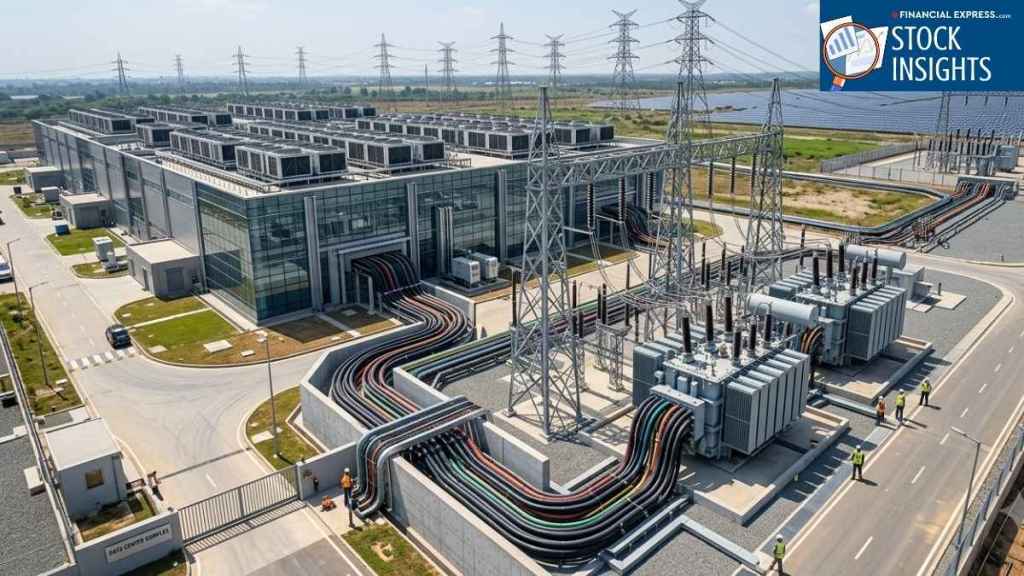

India’s data centre buildout is driving demand for something that often gets less attention: the power and cables needed to keep these facilities running. Data centres consume large amounts of electricity and require a reliable, around-the-clock power supply. As more capacity comes online, demand for renewable power and supporting cables is also expected to increase.
India’s data centre sector is expected to attract more than US$100 billion (around ₹9.5 lakh crore) in cumulative investment by 2027, according to estimates cited by CBRE. Further, as per the Ministry of Power, Electricity demand from the sector is expected to surge more than 13X, from around 1 GW (as of December 2025) to 13.6 GW by FY32.
This expansion has created strong opportunities across the data centre value chain. Renewable energy suppliers will be needed to meet the growing electricity demand, while cable players will be required to connect new capacity to the grid. This brings two different parts of the power ecosystem into focus.
One operates on the renewable power side, supplying large commercial consumers, while the other provides the cables and electrical infrastructure needed to support this growing demand.
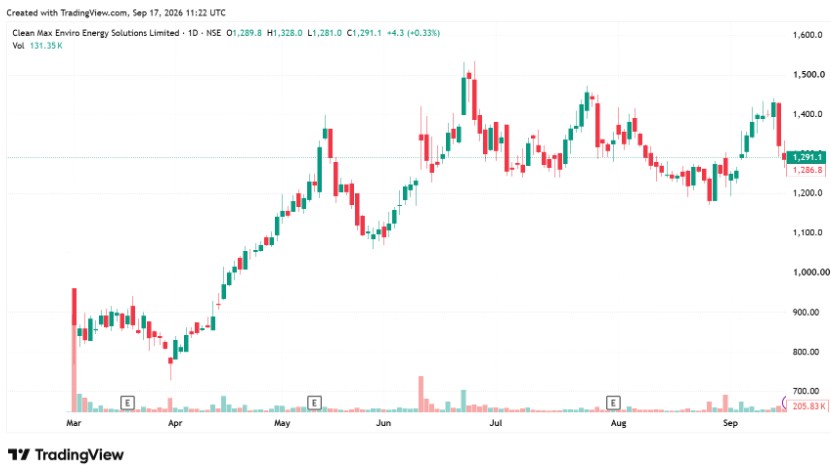
#1 Clean Max Enviro Energy: Powering data centres with renewable energy
CleanMax Enviro Energy Solutions is a leading renewable energy provider. The company exclusively supplies renewable energy to commercial and industrial (C&I) clients. It has an international footprint spanning India, the UAE, Bahrain and Thailand. Its total portfolio is 6,831 megawatts (MW), split between built (4,174 MW) and under construction (2,657 MW).
About 81.2% of its business volume comes from high-credit AA/AAA-rated corporates. About 75% to 80% of new contracted volumes every year are repeat orders from existing corporate clients. The company operates through two primary Renewable Energy business models: Power Sales (6.0 GW capacity) and Energy Services (0.8 GW).
Power Sales vs Energy Services: Dissecting the 6.8 GW Asset Base
In power sales, CleanMax develops, owns, and operates offsite wind, solar, and hybrid (wind-solar) power plants. It sells electricity directly to corporate buyers. These power sales are backed by long-term power purchase agreements (PPAs) with a weighted average tenure of 23 years and an average tariff of ₹3.9-4 per unit.
In energy services, clients invest their own capital and retain asset ownership. CleanMax performs construction work and books revenue upfront. The company then oversees long-term operations and maintenance (O&M) and also earns regular annuity revenue. CleanMax’s contracted portfolio is split across two core demand engines: Data Centres and Industrial.
Hyperscale Alliances: Inside the 10x Surge Across Meta, Amazon, and Apple
CleanMax holds an estimated 14% market share in India’s C&I green power space, making it a recognised market leader. It commands a 35%+ market share of the clean energy contracted by global hyperscalers in India. The data centres & AI segment accounts for 1,852 MW of its total contracted renewable energy power sales capacity (6,003 MW).
Within data centres & AI, the company has grown contracted capacity 10x between March 2024 and March 2026. It directly contracts clean power with global tech hyperscalers, including Meta, Amazon, Apple, and Google. CleanMax also serves large data centre operators such as NTT, STT, Equinix and Iron Mountain.
CleanMax contracts with hyperscalers using Environmental Attribute Purchase Agreements or Virtual Power Purchase Agreements. Under these structures, it receives a net tariff of around ₹3.7-4.0/kWh (kilowatt-hour) per unit. This price is fully insulated from merchant spot market price drops during solar hours.
The ₹40,000-Crore Capex Equation: Powering 10 GW of AI Workloads
Management estimates that every 1 GW of data centre IT load requires approximately 1.4 to 1.5 GW of round-the-clock power. Meeting this demand requires 6 GW of renewable generation capacity along with battery storage. This represents a ₹40,000 crore capital investment per GW of IT load.
Management further stated that, based on industry estimates, India will add 5 to 10 GW of data centre capacity over the next 5-7 years. Supplying 75% of this addition will require 30 to 60 GW of new renewable energy installations across the country. As a market leader, CleanMax is well positioned to benefit from this demand.
In general, for C&I with State Transmission Utility and city-based data centres (such as Mumbai, Bengaluru, Chennai), the average contract size is around 13 MW, with peak individual deals reaching 150 MW. Large-scale Central Transmission Utility-connected projects catering to hyperscalers average 200 MW to 250 MW per deal.
BESS Integration: Factoring the ₹3.50/kWh Peak-Hour Storage Premium
To meet the consistent uptime requirements of AI workloads and data centres, CleanMax is integrating battery energy storage systems (BESS) into its project offerings. CleanMax has greenlit its first BESS investment for its STU platform in Rajasthan and recently signed MOUs with three clients for storage-backed power agreements.
The company estimates that providing BESS-as-a-service to shift daytime solar power to evening peak hours adds approximately ₹3.00-3.50+ per kWh above standard generation costs.
Financially, the company reported a robust set of numbers for Q1FY27. Revenue grew 107% year-on-year to ₹832.3 crore during the quarter, driven by power sales (+47%) and services (+627%).EBITDA (Earnings Before Interest, Tax, Depreciation, and Amortisation) grew 68% to ₹494 crore. Net profit stood at ₹55.2 crore against a loss of ₹16.6 crore in Q1FY26.
Looking ahead, management targets a minimum reported EBITDA of ₹3,000 crore in FY28, up from ₹1,295 crore in FY26. CleanMax plans to commission at least 1.5 GW of new Power Sales operational capacity in FY27. This will bring operational power sales capacity to at least 4.6 GW by April 2027. This would be key to the FY28 EBITDA guidance.
#2 Diamond Power: Building the cables behind data centre growth
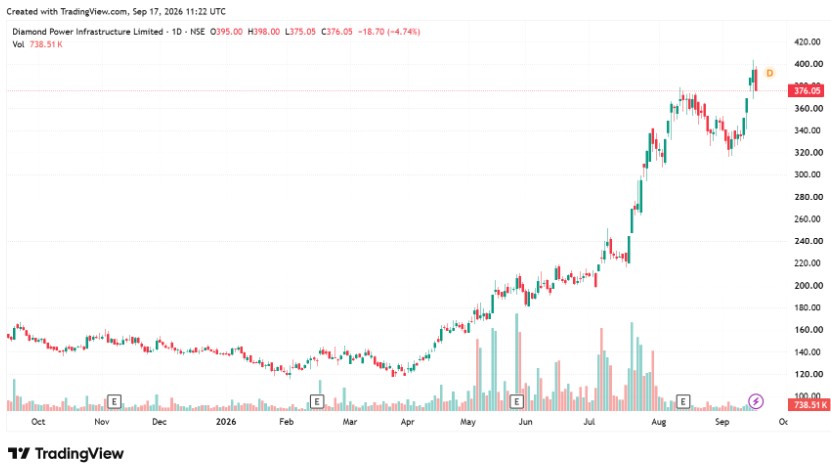
Diamond Power Infrastructure is an integrated manufacturer of power transmission and distribution equipment. The company manufactures power cables (ranging from 1.1 kV low voltage to extra-high voltage (EHV) up to 400 kV) and overhead conductors. Its facilities span the entire value chain, from in-house aluminium rod mills to finished EHV power cables.
The ₹435-Crore Foothold: Capturing 10% of Hyperscale Capex
Wires and cables account for 8% to 10% of data centre project capital expenditures. These data centre projects require specialized medium voltage (MV) and EHV intake feeders, redundant supply systems, and specialized fire-resistant cable construction. To capture this demand, it has
established a dedicated business development vertical to engage with data centre developers.
As of 11 August 2026, Diamond Power held ₹435 crore in dedicated data centre cable orders. This order represents 11.8% of its total executable order book of ₹3,687.6 crore. Management notes that this ₹435 crore order is, to its knowledge, the largest publicly disclosed cable order won by an Indian manufacturer in the data centre segment.
Margin Re-engineering: The Transition to 14% High-Tension Cables
The company aims for MV and EHV cables to represent 50% to 55% of revenue by FY28. In Q1 FY27, MV and EHV cables reached 58.8% of total revenue. High-tension cables carry significantly higher margins (EBITDA margins of 14%+) compared to low-voltage cables (8-9%).
Data centre cable sales are expected to contribute approximately ₹750 crore in revenue before March 2027. The management has set an internal target of at least ₹1,000 crore in data centre orders by March 2027 and ₹1,500 crore in FY28. Backed by this expected order book, Diamond Power expects the data centre business to consistently account for 20% of revenue.
Brownfield Pivot: Repurposing Rod Mills for ₹1,880-Cr Copper Capacity
To meet demand, Diamond Power is converting an existing rod mill and legacy conductor plant into a modern low-voltage (LV) power and control cable facility. It will be specifically designed for copper LV cables used in data centres. At full utilization, the plant will add 42,000 km of LV capacity, with a revenue potential of close to ₹1,880 crore.
FY27 Guidance Reality Check: Executing ₹2,800 Cr of Deliveries
Financially, revenue grew 129% year on year to ₹689.9 crore in Q1FY27. EBITDA surged 172% to ₹84.6 crore, while margin expanded by 196 bps to 12.3%. Net profit grew 191% to ₹58.5 crore. Going forward, management has guided for ₹4,300-4,500 crore of revenue in FY27. Of the order book, ₹2,800 crore is scheduled for delivery by March 2027.
Diamond Power entered FY27 with a baseline capacity utilisation of 34% for power cables and 20% for overhead conductors. Management expects cable and conductor utilization to reach 50-52% and 40% by FY27. The company targets 60% capacity utilization for both products in FY28. A gradual increase in utilization could be a key trigger for the company’s broader outlook.
Balance Sheet Showdown: Capital Intensity vs Working Capital Cycles
Diamond Power boasts a strong Return on Capital Employed (ROCE) vis-a-vis CleanMax, whose substantial net debt is tied up in assets under construction. Additionally, the higher initial investment, interest, and depreciation costs of renewable energy projects initially reduce return ratios. Return ratios may improve as expansion begins to pay off.
Valuation-wise, both companies trade at a premium to the industry median price-to-earnings multiple. Although Diamond Power’s valuation is currently at a discount to its historical median multiple, that median was recorded when its earnings were depressed.
Particulars | Price-to-Earnings Multiple (X) | Return Ratios | |||
| Company | 3Y Median | Industry | ROE (%) | ROCE (%) | |
| CleanMax | 96.4 | NA | 20.5 | 1.8 | 6.2 |
| Diamond Power | 121.0 | 152.4 | 24.6 | NA | 24.2 |
| Source: Screener.in (As of 17 September 2026) | |||||
The companies discussed in this article are approaching this opportunity differently. One focuses on supplying clean power to data centres. The other is supplying the cables required to support their power infrastructure.
CleanMax already has a sizeable portfolio of contracted data centres and AI projects. Contracted capacity has also increased significantly over the past two years. Its growth will depend on converting this pipeline into operating capacity while managing the capital required for expansion.
Diamond Power, meanwhile, has built a sizeable data centre cable order book and is increasing its exposure to higher voltage cables. This could be supported by increased capacity utilization, which could support its revenue and margin mix. Any slowdown in data centre construction could be a big risk for both companies.
These companies could be worth keeping on your watchlist.
Disclaimer
Note: Throughout this article, we have relied on data from http://www.Screener.in and the company’s investor presentation. We used an alternative, widely accepted source only when the data were unavailable.
The purpose of this article is only to share interesting charts, data points, and thought-provoking opinions. It is NOT a recommendation. If you wish to consider an investment, we strongly advise you to consult your advisor. This article is strictly for educational purposes only.
About the Author: Madhvendra has been deeply immersed in the equity markets for over seven years, combining his passion for investing with his expertise in financial writing. With a knack for simplifying complex concepts, he enjoys sharing his honest perspectives on startups, listed Indian companies, and macroeconomic trends.
A dedicated reader and storyteller, Madhvendra thrives on uncovering insights that inspire his audience to deepen their understanding of the financial world.
Disclosure: The writer and his dependents do not hold the stocks discussed in this article.
The website managers, their employees (s), and contributors/writers/authors of articles have or may have an outstanding buy or sell position or holding in the securities, options on securities, or other related investments of issuers and/or companies discussed therein. The articles’ content and data interpretation are solely the personal views of the contributors/ writers/authors. Investors must make their own investment decisions based on their specific objectives and resources, and only after consulting any independent advisors as necessary.