



A few months ago, India’s abrasive industry was barely on investors’ radar. The industry produces the abrasive materials and tools used to cut, grind, polish, and finish everything from metals to engineering components.
The lack of investor attention was not because the industry was unimportant. Rather, it faced a bigger threat from outside India. Cheap Chinese imports of bonded and coated abrasives, along with fused minerals, kept margins under pressure. That equation is now changing.
China Removes Export Support
From April 2026, China withdrew its 13% export VAT rebate on abrasives and ceramics. Chinese exporters now have to either pass on the higher cost through prices or absorb it themselves. For Indian manufacturers, that means they could narrow the pricing gap with Chinese imports.
Since then, abrasive stocks such as Carborundum Universal, Wendt India, and Grindwell Norton have seen strong gains, putting the sector firmly on investors’ radar.
But the more interesting opportunity lies beyond this immediate benefit. These companies are increasingly moving up the value chain towards technical ceramics, super abrasives, and advanced materials. These products have applications across semiconductors, EVs, defence, and aerospace. Here, customers care less about the lowest price and more about precision, reliability, qualification, and performance.
This creates two very different opportunities for Indian abrasives companies. A near-term margin benefit in commodity products and a longer-term growth opportunity in engineered materials.
#1. Carborundum Universal: The Ceramics Pivot
Carborundum Universal (Carborundum) is part of the Murugappa Group and manufactures abrasives, ceramics, refractories, and electro-minerals.
While China’s incentive reset is going to give some pricing cushion, Carborundum’s longer-term opportunity lies in moving towards higher-value applications such as semiconductors, solid oxide fuel cells (SOFCs), and aerospace and defence components.
Carborundum Universal: Segment-wise Revenue
| Business Segment | Q1FY26 | Q1FY27 | YoY Growth |
| Abrasives | 508 | 610 | 20.14% |
| Ceramics | 300 | 349 | 16.33% |
| Electrominerals | 405 | 473 | 16.77% |
| Others | 43 | 36 | -16.28% |
In Q1FY27, consolidated sales rose 16.9% YoY to ₹1,411 crore. But the bigger signal is in ceramics, where management expects to achieve revenue growth of 23% to 25% in FY27, while maintaining consolidated ceramics margins of 20.5% to 21%.
The segment is already operating at healthy profitability, contributing more profit than the Abrasives business despite generating lower revenue. During the quarter, ceramics delivered a profit-before-interest-and-tax margin of nearly 21%, the highest across all three business segments and broadly in line with the margin range management is targeting for FY27.
Carborundum Universal: Segment-wise Profit Before Interest and Tax
| Business Segment | Q1FY26 | Q1FY27 | YoY Growth |
| Abrasives | 11.4 | 39.6 | 247.4% |
| Ceramics | 74.9 | 74.5 | -0.56% |
| Electrominerals | 4.4 | 22.0 | 400.0% |
| Others | -2.0 | -2.8 | -40.0% |
Carborundum has also maintained its ₹400 crore annual capex guidance for FY27. A significant part of this investment is aimed at specialised capabilities, including components for semiconductor wafer fabrication equipment and engineered ceramics.
The key difference is the nature of these products. Unlike conventional abrasives, advanced ceramics often involve stringent qualification requirements, precision, and long customer approval cycles. If Carborundum can scale these applications, the business could gradually become less dependent on the pricing dynamics of conventional abrasives.
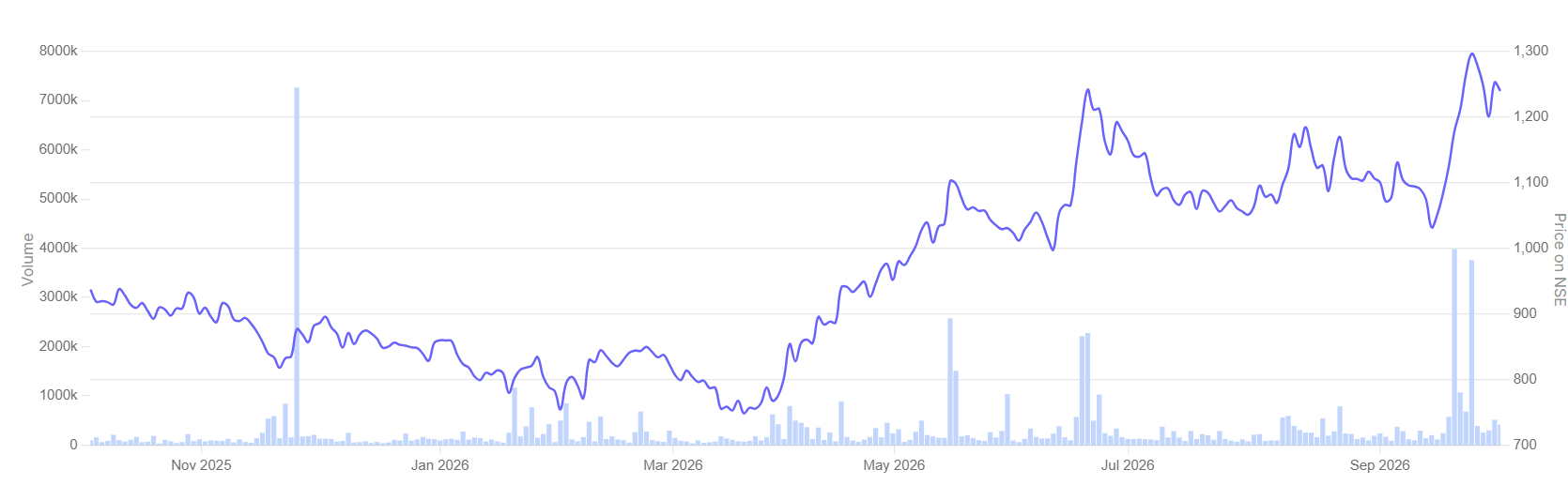
Carborundum Universal: 1 Year Stock Price Chart
#2. Wendt India: Carborundum’s High-precision Super Abrasives Engine
Carborundum Universal does not manufacture high-precision super abrasives directly. It captures this lucrative, high-barrier segment entirely through its 37.5% promoter stake in its associate, Wendt India. Earlier, 3M subsidiary Wendt GmbH held a 37.5% promoter stake in Wendt India, along with Carborundum. It exited the company in May 2025.
Subsequently, Wendt acquired global ownership of the “Wendt” brand and trademarks, which gave it greater control over its international expansion. This has helped Wendt India to establish a new wholly-owned subsidiary in Germany. It has acquired the necessary technology to manufacture, sell, and service peripheral grinding machines across European and global markets.
Wendt India: Segment-wise Revenue
| Business Segment | Q1FY26 | Q1FY27 | YoY Growth |
| Super Abrasives | 36.0 | 41.6 | 15.5% |
| Machines and Accessories | 4.33 | 15.3 | 253.3% |
| Precision Components | 6.5 | 7.6 | 16.9% |
| Others | 5.0 | 6.5 | 30.0% |
Super Abrasives have become an indispensable part of modern manufacturing. They are primarily used in high-precision, heavy-duty industries where tight tolerances and extreme material hardness are standard. Their applications can be found in the automotive industry, aerospace, semiconductors, and electronics.
Wendt India: Segment-wise Profit Before Interest and Tax
| Business Segment | Q1FY26 | Q1FY27 | YoY Growth |
| Super Abrasives | 6.3 | 7.6 | 20.6% |
| Machines and Accessories | -3.3 | -1.5 | 54.5% |
| Precision Components | 0.7 | 0.8 | 14.3% |
| Others | 0.4 | 0.8 | 100.0% |
For Wendt India, the Super Abrasives segment is the core of the business and also the profit engine. In Q1FY27, the segment’s revenue rose nearly 15% YoY to ₹41.6 crore, while profit before interest and tax increased nearly 21% to ₹7.6 crore. This translated into an EBIT margin of nearly 18%, highlighting the segment’s strong underlying economics.
The Machines & Accessories division, which includes the new German subsidiary, is also showing early signs of improvement. After reporting a net loss of ₹10.08 crore in FY26 and becoming a significant drag on consolidated profit, the division’s revenue surged nearly 250% YoY to ₹15.3 crore in Q1FY27. Its loss also narrowed by around 55% during the quarter.
The contrast is important. Wendt’s high-margin Super Abrasives business continues to provide a stable earnings base, while the loss-making Machines & Accessories division is beginning to show signs of operating leverage.
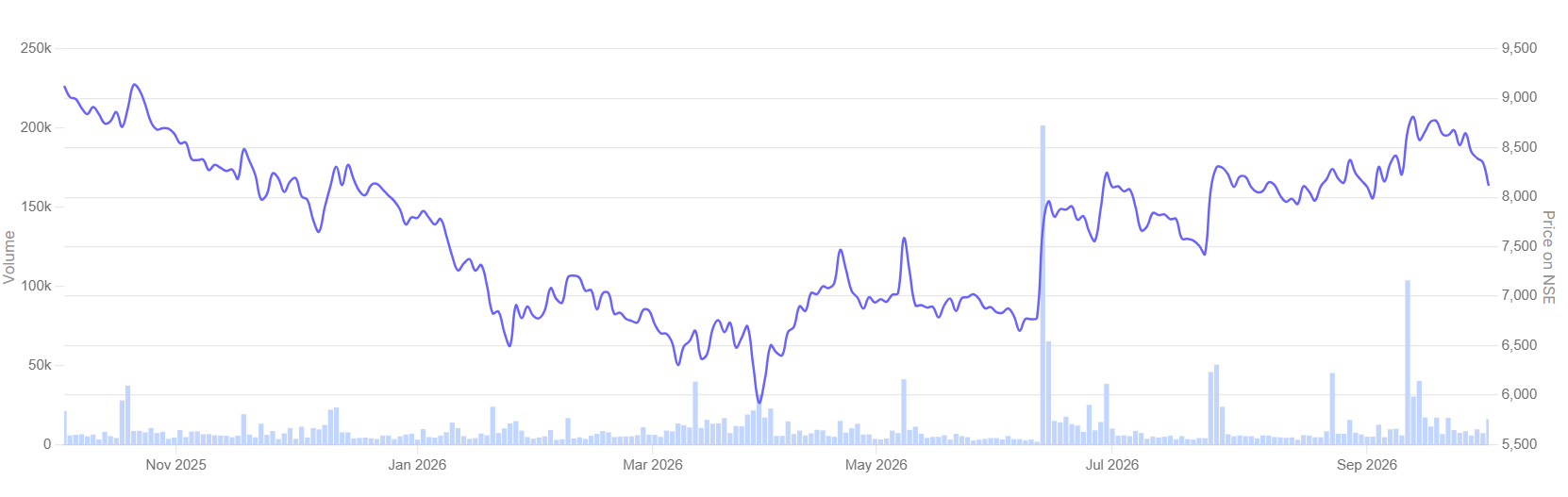
Wendt India: 1 Year Stock Price Chart
#3. Grindwell Norton: The Silent Advanced Materials Proxy
Grindwell Norton’s story is gradually moving beyond conventional abrasives. While the China pricing reset has provided some near-term support to its traditional abrasives business, the more important shift is happening in Ceramics & Plastics (C&P).
Grindwell Norton: Segment-wise Revenue
| Business Segment | Q1FY26 | Q1FY27 | YoY Growth |
| Abrasives | 351.6 | 386.9 | 10.0% |
| Ceramics & Plastics | 297.9 | 353.9 | 18.8% |
| Digital Services | 50.9 | 58.8 | 15.5% |
| Others | 10.9 | 12.7 | 16.5% |
The numbers show the divergence. Between FY20 and FY26, C&P revenue grew at a 17.3% CAGR, more than twice the 8.4% CAGR of the abrasives business. More importantly, C&P is already contributing more to profits. In the June 2026 quarter, the segment generated ₹75 crore in profit, compared with ₹49 crore from abrasives, even though abrasives still had a slightly higher revenue base.
Grindwell Norton: Segment-wise Profit Before Interest and Tax
| Business Segment | Q1FY26 | Q1FY27 | YoY Growth |
| Abrasives | 45.2 | 49.0 | 8.47% |
| Ceramics & Plastics | 51.9 | 75.0 | 44.49% |
| Digital Services | 14.3 | 14.1 | -1.43% |
| Others | 1.7 | 2.4 | 41.2% |
That points to a change in the quality of growth. C&P is increasingly exposed to specialised applications such as EV tapes, single-use biopharma tubings, and advanced silicon carbide solutions used in semiconductor equipment. These are markets where product specifications, customer qualification and application know-how matter more than commodity pricing.
If that mix shift continues, Grindwell’s earnings profile could become less dependent on the traditional abrasives cycle and increasingly linked to advanced materials. The market’s ability to recognise that transition could ultimately matter more than the near-term benefit from higher Chinese import prices.
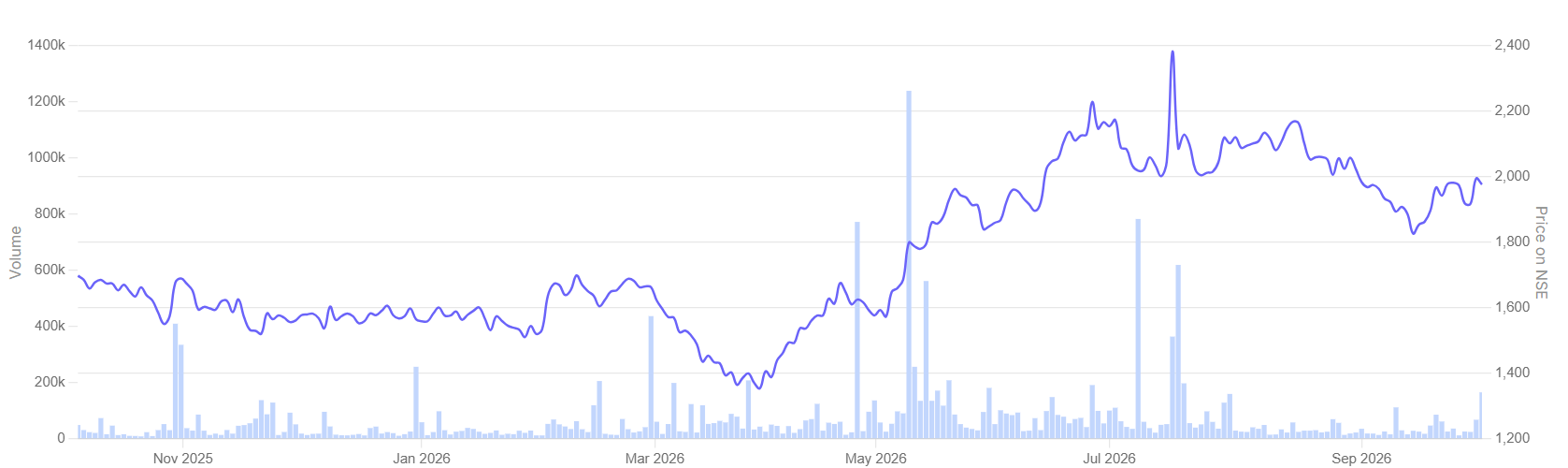
Grindwell Norton: 1 Year Stock Price Chart
Valuation: The Old Multiples May Not Tell the Full Story
The China-led opportunity has already been partly reflected in valuations. Carborundum Universal trades at a P/E of 94.2x, significantly above its five-year median of 55.8x and the industry P/E of 69.9x. Wendt India is similarly valued at 95.8x earnings, against its five-year median of 57x.
P/E Trends
| Metrics | P/E | 5-yr Median | Industry PE |
| Carborundum Universal | 94.2 | 55.8 | 69.9 |
| Wendt India | 95.8 | 57.0 | |
| Grindwell Norton | 50.1 | 61.8 |
However, comparing current valuations with historical multiples needs some context. The five-year median includes a period when Chinese exporters benefited from a 13% export VAT rebate, keeping Chinese products competitive and putting pricing pressure on Indian manufacturers. With that incentive gone, the competitive landscape has changed, and the market appears to be assigning a higher earnings potential to Indian abrasive makers
There is another reason why historical multiples may not be a perfect benchmark. The companies are gradually moving up the value chain. These businesses typically offer higher margins, stronger entry barriers, and exposure to faster-growing end markets such as semiconductors, aerospace, defence and EVs. If this mix continues to improve, the earnings profile of these companies could look structurally different from what it was five years ago.
Therefore, premium valuations of all three companies cannot be assessed against their historical averages. The question is now no longer whether the abrasives industry has a structural opportunity: it does. The question is whether Carborundum, Wendt and Grindwell can grow earnings fast enough to justify the re-rating already priced into their stocks. Add these stocks to your watchlist and monitor how they execute their growth plans.
Disclaimer:
Note: We have relied on data from www.Screener.in throughout this article. Only in cases where the data was not available, have we used an alternate, but widely used and accepted source of information.
The purpose of this article is only to share interesting charts, data points, and thought-provoking opinions. It is NOT a recommendation. If you wish to consider an investment, you are strongly advised to consult your advisor. This article is strictly for educational purposes only.
Deepan Datta has spent over a decade studying stocks and mutual funds. His passion is to uncover interesting stories in the financial markets and share them through his writings with investors at large. He is focused on delivering clear, easy-to-understand, and research-backed insights. Deepan began his career as a Research Associate at S&P Global, where he developed a strong foundation in financial research and data analysis.
Disclosure: The writer and his dependents do not hold the stocks discussed in this article.
The website managers, their employees (s), and contributors/writers/authors of articles have or may have an outstanding buy or sell position or holding in the securities, options on securities or other related investments of issuers and/or companies discussed therein. The content of the articles and the interpretation of data are solely the personal views of the contributors/ writers/authors. Investors must make their own investment decisions based on their specific objectives, resources and only after consulting such independent advisors as may be necessary.