

Few Indian companies have managed to quadruple their profits in five years while keeping debt almost irrelevant to the balance sheet. Mazagon Dock Shipbuilders is one of them, and after years of being viewed largely through the lens of warships and submarines, this defence player now appears to be preparing for a much bigger role in India’s shipbuilding industry.
The latest developments make that shift hard to ignore. In September, Mazagon Dock signed an MoU to become the anchor shipyard for a proposed greenfield shipbuilding industrial cluster at Dighi in Maharashtra, targeting an annual capacity of at least 1.2 million gross tonnes. Days later, it signed another MoU with National Shipbuilding and Heavy Industries Park-AP for a greenfield shipyard at Dugarajapatnam in Andhra Pradesh, also targeting at least 1.2 million gross tonnes of annual capacity.
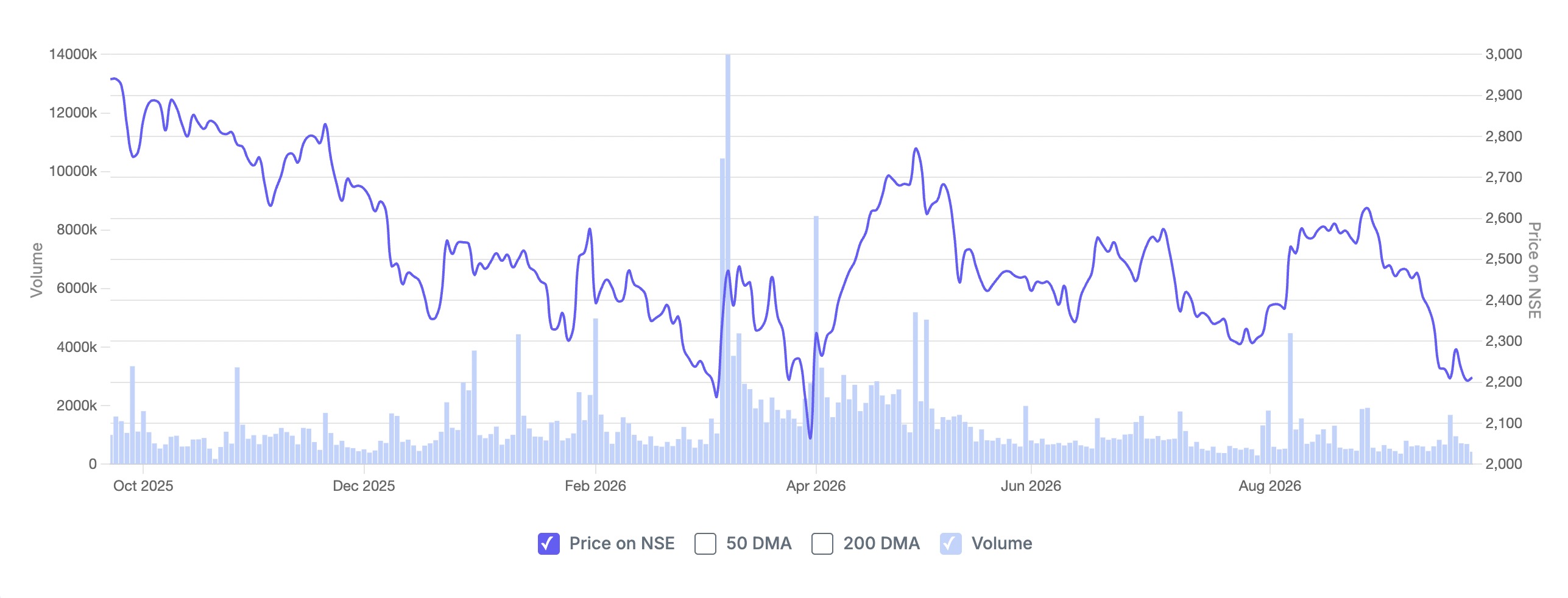
Mazagon Dock Shipbuilders 1-Year Share Price Chart
proposed facility is aimed at commercial vessels such as tankers, bulk carriers, container ships and liquefied natural gas carriers.
For years, the central question around Mazagon Dock was when the next big submarine order would arrive. That question has not disappeared, but it is no longer enough to explain the company. The more interesting question now is whether one of India’s leading naval shipbuilders can use its existing capabilities, balance sheet and the country’s push to revive commercial shipbuilding to become a much larger maritime company.
The company has already done the hard part
The starting point is important because this is not a turnaround story. Mazagon Dock has already built a highly profitable business by completing some of India’s most complex naval programmes.
Between FY21 and FY26, consolidated revenue rose from Rs 4,048 crore to Rs 13,006 crore, an increase of more than three times. Net profit rose even faster, from Rs 514 crore to Rs 2,578 crore, while operating profit increased from Rs 226 crore to Rs 2,268 crore. The operating margin, which was just 6% in FY21, reached 17% in FY26.
The numbers tell two very different stories
| Metric | FY21 | FY26 | June 2026 | Change |
| Revenue | Rs 4,048 cr | Rs 13,006 cr | — | +221% |
| Net profit | Rs 514 cr | Rs 2,578 cr | — | +401% |
| Operating margin | 6% | 17% | — | +11 percentage points |
| Order book | Rs 49,744 cr | Rs 20,535 cr | Rs 18,218 cr | -63%* |
| Order book / FY revenue | 12.3x | 1.6x | 1.4x | Sharp decline |
Source: Company annual reports and investor presentation; consolidated financial data.
The company has also completed major naval programmes. All four P15B destroyers have been delivered, while the fourth P17A stealth frigate, Mahendragiri, was delivered to the Indian Navy on April 30, 2026. The company’s Q1FY27 investor presentation also shows continuing work on Coast Guard vessels, submarines, offshore projects and multipurpose hybrid-powered vessels.
That matters because building a large shipyard is not simply a matter of pouring concrete and installing cranes. The real asset is the ability to manage complicated vessels, suppliers, technology partners, customers and long production cycles. Mazagon Dock already has that experience.
This time, the expansion is real
The change in Mazagon Dock’s strategy is no longer something investors have to infer from old management commentary. It is now showing up in actual projects.
In September, the company signed an MoU to become the anchor shipyard for a proposed greenfield shipbuilding industrial cluster at Dighi. Just days later, it signed another MoU with National Shipbuilding and Heavy Industries Park-AP for a greenfield shipyard at Dugarajapatnam in Andhra Pradesh. Both projects are designed around large-scale shipbuilding capacity.
The Dugarajapatnam project is particularly significant. According to reports, Mazagon Dock plans to invest around Rs 15,000 crore over five to seven years in the greenfield yard, which is expected to have an initial design capacity of 1.2 million gross tonnes a year. The proposed yard will focus on commercial vessels including tankers, bulk carriers, container ships and LNG carriers.
This is a much bigger ambition than simply adding another naval programme to the order book. Mazagon Dock is effectively trying to create a second business around commercial shipbuilding while retaining its position in naval vessels and submarines. And that is where the story gets interesting.
The company is not making this move because its existing business has stopped working. It is doing so after a period in which revenue, profits and returns have all risen sharply. The question is whether the next phase can produce the same combination of growth and profitability that the naval business has delivered.
But there is a catch
The ambition is getting bigger at precisely the point when Mazagon Dock’s existing order book is getting smaller. The order book stood at Rs 49,744 crore in FY21. By the end of FY26, it had fallen to Rs 20,535 crore and by June 2026, it stood at Rs 18,218 crore. In other words, the backlog has fallen by more than 50% in five years, even as revenue and profits have reached record levels.
What is actually sitting in the Rs 18,218 crore order book?
| Programme | Balance order book | Share of total |
| P17A stealth frigates | Rs 7,587 cr | 41.6% |
| ONGC projects | Rs 2,774 cr | 15.2% |
| Coast Guard vessels | Rs 2,649 cr | 14.5% |
| P75 Kalvari submarines | Rs 1,678 cr | 9.2% |
| Air Independent Propulsion (AIP) | Rs 1,542 cr | 8.5% |
| Submarine refit | Rs 492 cr | 2.7% |
| Multipurpose hybrid vessels | Rs 695 cr | 3.8% |
| SCI Platform Supply Vessel | Rs 367 cr | 2.0% |
| P15B destroyers | Rs 283 cr | 1.6% |
| Others | Rs 151 cr | 0.8% |
| Total | Rs 18,218 cr | 100% |
Source: Mazagon Dock Q1FY27 investor presentation, order-book position as of June 30, 2026.
This does not mean the company’s current business is running out of work tomorrow. The June order book still includes P17A frigates, Coast Guard vessels, P75 Kalvari submarines, submarine refit work, ONGC projects and other contracts. It also includes pending work and supplies of spares relating to vessels that have already been delivered.
The more interesting point is what happens after these programmes are completed. Mazagon Dock is now planning capacity for a much larger future business, but a significant part of that future business is not yet sitting in the order book.
That is the new Mazagon Dock story. The company is no longer simply waiting for the next naval order. It is building for a future in which it expects to have many more orders.
India wants more ships. That is the bet
The logic behind this strategy is fairly straightforward. India has a large coastline, a substantial energy import bill and a significant requirement for commercial vessels. Yet Indian shipbuilders have historically captured only a small part of global commercial shipbuilding compared with the large yards of China, South Korea and Japan.
The government is now trying to make domestic shipbuilding more competitive through policy support and incentives. That creates an opportunity for an established player such as Mazagon Dock, particularly because the company already has shipbuilding infrastructure, engineering capabilities and relationships with suppliers.
The Dugarajapatnam project, for example, is being planned as a broader commercial shipbuilding and ship-repair ecosystem. The proposed yard is expected to have a design capacity of 1.2 million gross tonnes a year, with the ability to build large commercial vessels.
But there is a catch. A shipyard is only an asset when somebody is willing to pay it to build ships.
That is why the next phase of the story will depend on orders as much as capacity. Building a bigger yard can increase the addressable market, but it can also increase capital requirements before the revenue arrives.
For Mazagon Dock, this distinction is particularly important because the company is moving from a business where a large part of demand is linked to the Indian government and naval programmes into a commercial market where competition, pricing and customer behaviour can be very different.
The financials are still doing the heavy lifting
For now, there is little in the recent financial performance to suggest that the core business has lost momentum.
In Q1FY27, consolidated revenue rose 12.1% year-on-year to Rs 2,943 crore. Operating profit increased 48%, while the operating margin improved to 15.2% from 11.5% in the same quarter last year. Net profit rose 21.7% to Rs 550 crore.
The full-year numbers tell an even stronger story. FY26 revenue increased 13.8%, while net profit rose 6.8% and operating profit increased 9.7%. The operating margin, however, moderated to 17.4% from 18.1%.
The margin movement is worth watching because Mazagon Dock is entering projects with different economics. Naval programmes have historically delivered attractive margins as they progress towards completion, while newer projects can have a different cost structure and profitability profile.
This is why simply applying Mazagon Dock’s historical margins to a much larger commercial shipbuilding business would be premature. Commercial shipbuilding is a different business, with different competitive pressures and potentially different returns.
The company therefore has two things to prove over the next few years. It has to show that it can fill the additional capacity, and it has to show that the new business can earn attractive returns on the capital invested.
But profit is not the same as cash
This is where the numbers become more interesting. Cash generated from operations was negative Rs 2,654 crore in FY26, compared with positive Rs 2,102 crore a year earlier. Free cash flow was also negative.
Part of this reflects the nature of shipbuilding. Large projects involve customer advances, milestone payments, inventory and working-capital movements, so reported profit does not necessarily translate into operating cash in the same year.
Still, investors should pay attention to this number because the company is now contemplating large investments. If working capital absorbs cash while capital expenditure rises, the balance sheet could gradually look different from the exceptionally comfortable position investors have become accustomed to.
The working-capital numbers provide another clue. Debtor days increased to about 73 days in FY26 from roughly 60 days a year earlier, although inventory days fell sharply to around 131 days from nearly 298 days. The resulting working-capital position remains manageable, helped by a long payable cycle, but cash conversion deserves more attention as the business expands.
For a company considering thousands of crores of fresh investment, cash generation will matter almost as much as reported profit.
The balance sheet gives Mazagon Dock room to make the bet
The good news is that Mazagon Dock is starting this expansion from a position of financial strength. At the end of FY26, borrowings were only around Rs 447 crore, against reserves of about Rs 9,553 crore. Return on equity stood at 29.2%, while return on capital employed was 36%.
That is an important advantage when a company is contemplating large investments. A highly leveraged shipbuilder would have much less room to build capacity ahead of orders.
Mazagon Dock, by contrast, has the balance sheet to make a long-term bet. The question is not whether it can afford to invest, but whether the capital eventually earns returns comparable with those generated by its existing business.
That distinction will become increasingly important as the commercial shipbuilding strategy moves from MoUs and planned capacity towards actual investment and orders.
The submarine story still matters
None of this means the submarine story has disappeared. Project 75I remains one of the major potential additions to Mazagon Dock’s future order book, while additional Kalvari-class submarines could also add visibility. The company’s current order book already contains Rs 1,678 crore of balance work related to P75 Kalvari submarines, according to its June 2026 investor presentation.
This is where investors need to separate two very different things. Existing orders support current revenue, while potential naval programmes support the future growth narrative.
That distinction matters because a large submarine programme could materially change the order-book picture. But until an order is actually awarded, it remains a potential source of future revenue rather than part of today’s contracted backlog.
The same logic applies to exports. Mazagon Dock has been exploring opportunities beyond the domestic market, but the financial impact of such opportunities should only be considered once they translate into actual contracts.
What is the market paying for?
Mazagon Dock is no longer a cheap stock simply because its share price has fallen. The stock was trading around Rs 2,200-2,300 in September 2026, well below its 2025 peak. Yet the valuation remains substantial at roughly 32 times earnings. That is alongside return on capital employed of 36% and return on equity of 29.2%.
The market is also assigning value to the possibility of larger naval orders, commercial shipbuilding and the new capacity being planned. That is not difficult to understand. A company with Mazagon Dock’s balance sheet, naval capabilities and potential access to a new commercial shipbuilding cycle can command a premium valuation.
But a premium valuation also means there is less room for disappointment. If new naval orders arrive and the commercial shipbuilding projects begin attracting meaningful orders, the current decline in the order book could eventually look like a temporary gap between two growth cycles. If orders take longer to arrive, investors may become more focused on the capital being invested than on the opportunity that capital is supposed to create.
The real Mazagon Dock question
For a long time, the Mazagon Dock story was relatively simple. India needed submarines and warships, and Mazagon Dock was one of the few companies capable of building them.
That story has worked extremely well. Revenue has more than tripled between FY21 and FY26, net profit has risen fivefold, and the company has delivered a series of large naval programmes while maintaining a strong balance sheet.
Now the story is changing. Mazagon Dock wants to remain a major naval shipbuilder while building a second leg around commercial ships. The September announcements at Dighi and Dugarajapatnam are important because they show that this is no longer just a theoretical discussion about what the company could eventually become.
But the market will eventually demand evidence.
The company needs to turn capacity into orders, orders into revenue and revenue into cash. It also needs to show that commercial shipbuilding can generate attractive returns without diluting the economics that made the naval business so valuable in the first place.
That is what makes Mazagon Dock interesting at this stage. The first phase of the story was about proving that the company could build complex ships and make money. The second phase is about proving that it can build a much bigger business around them.
Disclaimer
Note: We have relied on data from www.Screener.in throughout this article. Only in cases where the data was not available, have we used an alternate, but widely used and accepted source of information.
The purpose of this article is only to share interesting charts, data points and thought-provoking opinions. It is NOT a recommendation. If you wish to consider an investment, you are strongly advised to consult your advisor. This article is strictly for educative purposes only.
Manvi Aggarwal has been tracking the stock markets for nearly two decades. She spent about eight years as a financial analyst at a value-style fund, managing money for international investors. That’s where she honed her expertise in deep-dive research, looking beyond the obvious to spot value where others didn’t. Now, she brings that same sharp eye to uncovering overlooked and misunderstood investment opportunities in Indian equities. As a columnist for LiveMint and Equitymaster, she breaks down complex financial trends into actionable insights for investors.
Disclosure: The writer and her dependents do not hold the stocks discussed in this article. The website managers, its employee(s) and contributors/writers/authors of articles have or may have an outstanding buy or sell position or holding in the securities, options on securities or other related investments of issuers and/or companies discussed therein. The content of the articles and the interpretation of data are solely the personal views of the contributors/ writers/authors. Investors must make their own investment decisions based on their specific objectives, resources and only after consulting such independent advisors as may be necessary.


