



There is no denying that the investment opportunity around the naval defence build up gets almost all the attention. But perhaps, there is an alternate maritime capex opportunity that may be smaller than a destroyer and closer to the port – but exciting nevertheless. Tugs, workboats and pilot boats, all smaller boats in comparison, are directly tied to vessel handling, harbour operations, pilotage and offshore support, making port traffic and shipbuilding capacity relevant demand indicators. India’s ports handled more than 1.59 billion tonnes of cargo in FY2024-25. Major ports alone handled 915.17 MT in FY26, registering 7.06% year-on-year growth and surpassing their 904 MT target.
The policy backdrop has also changed materially. Under the Shipbuilding Financial Assistance Policy, 288 contracts covering 456 vessels worth ₹19,748 crore had received in-principle approval by March 2026, with tugs specifically included among the eligible vessel categories. The government has since approved a ₹69,725-crore shipbuilding package, including ₹24,736 crore for the Shipbuilding Financial Assistance Scheme, ₹25,000 crore for the Maritime Development Fund and ₹19,989 crore for the Shipbuilding Development Scheme. The latter aims to expand India’s shipbuilding capacity to 4.5 million gross tonnes annually.
For harbour craft, this matters because these vessels are generally smaller, have shorter construction cycles and serve recurring port and coastal requirements. Against this backdrop, two listed names come into focus: Knowledge Marine & Engineering Works and Cochin Shipyard.
#1 Knowledge Marine & Engineering Works: The Higher-Purity Harbour-Craft Bet
Knowledge Marine & Engineering Works Limited (KMEW) operates across port ancillary crafts, shipbuilding and repair, and dredging. Its vessel business covers conventional tugs, hybrid tugs, Green Tug Transition Programme (GTTP) tugs, pilot boats, speed patrol boats, mooring boats, service boats and multi-utility workboats.
Its shipbuilding activity includes construction of small and specialised marine crafts, while the company also undertakes repair and refit of marine vessels. Its broader port-services capabilities include hydrographic surveys, pilotage and patrolling.
Q1 FY27 Shows Where The Earnings Are Actually Coming From
KMEW delivered a sharp improvement in Q1 FY27, with consolidated revenue from operations rising to ₹115.41 crore, up 138.2% YoY and 70.7% QoQ. Consolidated profit after tax (PAT) rose to ₹62.75 crore from ₹11.08 crore in Q1 FY26 and ₹23.53 crore in Q4 FY26.
However, the 54.4% Q1 PAT margin should not be treated as a sustainable run-rate. Management has indicated a more normal operating-margin range of 35-40%, with the quarter benefiting from unusually strong dredging execution.
The biggest change was the business mix. Dredging and ancillary services generated ₹104.41 crore of segment revenue in Q1 FY27, up 286.9% YoY and 52.8% QoQ. Shipbuilding contributed ₹21.22 crore versus zero in Q1 FY26 and ₹11.26 crore in Q4 FY26, with earnings before interest and tax (EBIT) of ₹3.41 crore.
This matters for the maritime-capex thesis because KMEW’s current earnings are still being driven primarily by dredging rather than by the construction of tugs and workboats. The shipbuilding opportunity is therefore a forward-looking growth engine, not yet the dominant earnings contributor.
Strong Order Book But Its Composition Matters More
As per the August 2026 earnings call, KMEW had an order book of over ₹1,300 crore, of which dredging was ₹240 crore, charter and hire was ₹850 crore and shipbuilding was ₹240 crore. The company also had an additional ₹200-crore inter-company order book placed with Knowledge Shipyard for Green Tugs and patrol boats.
The company had 10 accommodation boats, 10 work boats, four cutter-suction dredgers, two 60-tonne bollard-pull green tugs and 10 hybrid-electric passenger ferries under its broader ongoing project portfolio. Separately, it was building three tugs and two boats for captive use and about 42 vessels for third parties.
The order-book mix therefore shows that the immediate earnings base remains broader than shipbuilding, even as vessel construction becomes an increasingly important future growth driver.
Saphale Could Change The Earnings Mix
KMEW is undertaking roughly ₹1,000 crore of capex over the next 1.5 years, with about ₹250 crore earmarked for green tugs and green vessels, ₹450 crore for dredging and the balance for shipyard and shipbuilding operations.
Phase I of the Saphale shipyard is expected to become operational by the end of FY27, with capacity for 14 vessels annually in Phase I and 18 vessels after completion of all phases.
This is arguably the most important structural change in KMEW’s investment case. The company is moving from owning and chartering marine assets towards building a dedicated manufacturing platform that can support a larger shipbuilding order pipeline.
Management has indicated that the yard is already being positioned for orders over the next two financial years. It is therefore important to track order intake, vessel values, yard utilisation and execution margins as the Saphale facility ramps up.
₹1,000 Crore Capex Makes Funding A Key Monitor
Debt remains an important investor monitor. By March 2026, consolidated borrowings stood at about ₹222.1 crore against cash and cash equivalents of ₹73.6 crore, implying net borrowings of roughly ₹148.4 crore. The debt to equity is at 0.39x.
FY26 operating cash flow was negative at ₹200.4 crore, largely reflecting substantial deployment into other financial assets, while investing cash outflow was ₹104.4 crore, including ₹119.1 crore of property, plant and equipment purchases.
The issue is therefore not simply whether KMEW has enough orders. It is whether the company can fund a ₹1,000-crore expansion programme while keeping leverage and cash conversion under control. This becomes particularly relevant because the proposed capex is several times FY26 revenue of ₹256 crore.
Five-Year Numbers: Growth Has Been Strong, But The Base Is Changing
| Particulars | FY22 | FY23 | FY24 | FY25 | FY26 |
| Sales (₹ in crores) | 61 | 202 | 164 | 201 | 256 |
| Operating Profit (₹ in crores) | 32 | 69 | 50 | 78 | 97 |
| Net Profit (₹ in crores) | 21 | 48 | 31 | 50 | 79 |
Source: Screener.in
The five-year numbers establish a strong historical earnings base, but the next phase will be more capital intensive. The key test is whether earnings can scale alongside the new asset base rather than merely alongside the order book.
The Stock Has Already Priced In A Lot Of Growth
Source: Screener.in
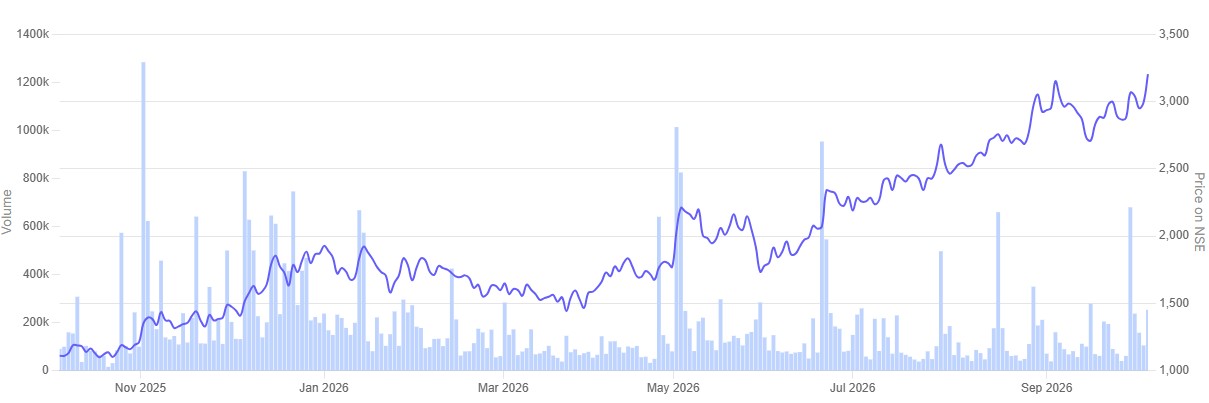
KMEW surged around 71% in the past six months and about 70% over the 52-week period. The stock was trading at a Price-to-Earnings (PE) ratio of 58.6x.
On 5 October 2026, KMEW closed at ₹2,992.50 on the National Stock Exchange (NSE). The price was already ₹492.50 above Nuvama Institutional Equities‘ ₹2,500 target price issued with its Buy rating on 23 December 2025.
That valuation makes execution more important than the headline growth rate. At roughly 59x earnings, the market is already assigning a substantial premium to KMEW’s future expansion.
#2 Cochin Shipyard: The Scale Play With A Smaller Thematic Bet
Cochin Shipyard Limited (CSL) has a growing presence in the tug segment through conventional high-bollard-pull vessels and battery-electric green tugs. Its wholly owned subsidiary, Udupi Cochin Shipyard Limited, has built and delivered 62-tonne and 70-tonne bollard-pull tugs under the Government’s Approved Standard Tug Design and Specifications (ASTDS).
CSL is also moving into electric harbour tugs. Beyond tugs, its shipbuilding portfolio includes tankers, product carriers, bulk carriers, passenger vessels and defence vessels. Ship repair is its other major business.
Q1 FY27 Reveals A Margin Problem, Not An Order-Book Problem
CSL reported consolidated revenue from operations of ₹1,094.21 crore in Q1 FY27, up 2.40% YoY but down 26.28% QoQ. PAT fell 19.37% YoY and 45.22% QoQ to ₹151.45 crore.
Material consumption rose 39.44% YoY to ₹453.26 crore, finance costs more than doubled to ₹25.36 crore and operating margins weakened.
Shipbuilding revenue was ₹700.04 crore, up about 59.5% YoY, while ship-repair revenue was ₹394.17 crore, down 37.4% YoY.
The important takeaway is that CSL’s revenue growth is currently not translating into comparable profit growth. The shift towards shipbuilding, combined with higher material and finance costs, has put pressure on profitability.
Management’s indication that EBITDA margins could moderate towards around 14% in FY27 and FY28 makes margin recovery a more important stock trigger than simply adding new orders.
The Tug Pipeline Is Real, But Small Against The Backlog
CSL’s tug portfolio has moved beyond conventional harbour craft. The company has orders for 70-tonne bollard-pull tugs and battery-electric green tugs from Polestar Maritime, while it has also secured an order from Svitzer, Denmark, for four fully electric 70-tonne bollard-pull harbour tugs, with an option for four additional vessels.
In February 2026, CSL said its group order book included 17 ASTDS tugs and six green tugs. The confirmed orders establish that the tug business has moved beyond an experimental stage; the more important question is how material this business can become relative to CSL’s much larger existing backlog.
But the scale needs to be kept in perspective.
As of the latest company presentation, the order book was about ₹21,900 crore, including ₹1,600 crore of domestic commercial orders and ₹7,200 crore of export commercial orders, alongside ₹11,900 crore of defence orders and ₹1,200 crore of ship-repair orders.
Tugs therefore remain a strategically relevant but financially smaller component of CSL’s overall order book.
Green Tugs Give CSL A Policy-Backed Growth Lane
CSL’s electric-tug opportunity aligns with the Government’s Green Tug Transition Programme. The programme’s second phase envisages at least 30% of the operational tug fleet at major ports becoming ASTDS-GTTP compliant by the end of 2030, subject to the life or charter period of existing vessels.
CSL has already secured two 60-tonne battery-electric tug orders from Polestar for deployment at JNPA under GTTP.
That gives CSL a visible route into a policy-led replacement cycle rather than relying solely on discretionary commercial orders. The opportunity could broaden as major ports replace or add harbour craft.
Commercial Expansion Is The More Important Long-Term Variable
A major Q1 FY27 development was the incorporation of Green Maritime Propulsion Pvt Ltd, a 40%-owned joint venture with HBL Engineering, focused on electric mobility and energy-storage technologies for maritime applications.
CSL is also pursuing a 23% stake in Conoship International Holding B.V., Netherlands, to access coastal-shipping and inland-waterway opportunities in India and Europe.
With these initiatives, CSL is trying to build capabilities around the wider commercial-maritime ecosystem. However, their eventual earnings contribution is still unproven and should not be capitalised into valuation prematurely.
Balance Sheet Is Better, But Leverage Has Started Moving
Consolidated debt-equity rose to 0.21x in Q1 FY27 from 0.03x in Q1 FY26 and 0.19x in Q4 FY26. CSL generated ₹284.21 crore of consolidated operating cash flow in FY26 versus ₹171.59 crore in FY25.
CSL still enters the maritime-capex cycle with substantially greater scale and stronger operating cash generation than KMEW, although the rise in debt-equity warrants monitoring as project and working-capital requirements increase.
Five-Year Numbers: Scale Is Not The Same As Earnings Momentum
| Particulars | FY22 | FY23 | FY24 | FY25 | FY26 |
| Sales (₹ in crores) | 3,190 | 2,330 | 3,645 | 4,528 | 4,308 |
| Operating Profit (₹ in crores) | 635 | 273 | 885 | 886 | 692 |
| Net Profit (₹ in crores) | 587 | 334 | 813 | 843 | 643 |
Source: Screener.in
The five-year record shows that scale has not translated into a straight-line earnings trajectory: both operating profit and net profit declined in FY26 despite the company’s large order pipeline.
The Share Price Has Corrected, But Earnings Need To Catch Up
Source: Screener.in
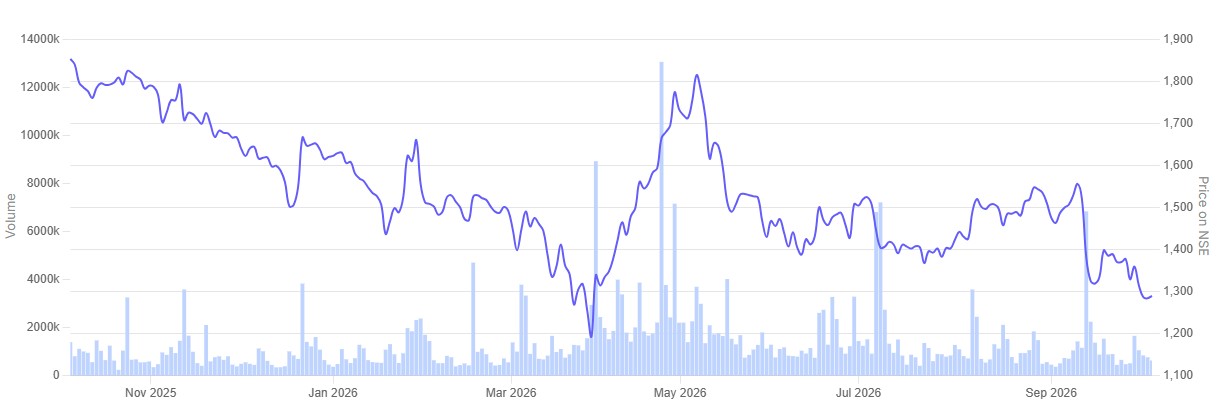
Cochin Shipyard has not fared well on the price chart. The stock fell over 9.5% in the last six months and around 31% over 52 weeks. It was trading at a PE of 57.1x. On 5 October 2026, the stock closed at ₹1,283.80 on the NSE.
In September, ICICI Securities downgraded Cochin Shipyard from Buy to Hold and set a target price of ₹1,590 per share after management indicated that EBITDA margins could moderate towards around 14% in FY27 and FY28. The target represented potential upside of around 23.9% from the 5 October closing price.
The correction has therefore not removed the valuation challenge: the share price has fallen, but the PE remains elevated because the earnings base has also weakened.
The Maritime Boom Still Has A Few Obstacles
Green tugs require specialised propulsion systems, batteries and supporting infrastructure, while shipyards need fabrication capacity, dry docks, equipment and working capital before higher revenue arrives. This makes cash conversion particularly important for smaller companies such as KMEW. A rising order book accompanied by rising borrowing does not necessarily create shareholder value unless the incremental return on capital remains attractive.
Another roadblock is execution concentration. Harbour craft may be smaller than destroyers, but a tug or specialised workboat still requires design approval, propulsion integration, equipment sourcing, classification, testing and delivery. Delays can push revenue recognition and tie up working capital. For larger yards such as CSL, the risk is compounded by a much wider portfolio spanning defence, commercial ships, repairs and exports.
Last but not least, the green-tug opportunity will not arrive uniformly. The GTTP provides a clear policy direction, but actual procurement will depend on tendering, vessel replacement schedules, port requirements and the economics of owning versus chartering vessels.
Before You Board the Maritime Trade
The next move is to stop treating the tug and workboat theme as a broad sector bet and instead define what evidence would justify staying invested, adding exposure or stepping aside. For KMEW, the key trigger should be whether the new shipyard begins translating capacity into profitable, cash-generating business rather than simply expanding the asset base. Any deterioration in working-capital discipline would deserve equal weight.
For Cochin Shipyard, readers should look for a sustained improvement in profitability before assuming that its large backlog will translate into stronger shareholder returns. Readers should also separate confirmed commercial wins from longer-term opportunities that remain dependent on tenders, replacement cycles or customer decisions.
The practical approach is therefore to track execution milestones, cash conversion, margin direction and fresh order quality each quarter, while maintaining valuation discipline. If operating performance fails to keep pace with expectations, the maritime story alone may not be enough to support the investment case.
It may be a good idea to add these stocks to your watchlist and keep track to see how they perform in time to come.
Disclaimer
Note: We have relied on data from www.Screener.in throughout this article. Only in cases where the data was not available, have we used an alternate, but widely used and accepted source of information.
The purpose of this article is only to share interesting charts, data points and thought-provoking opinions. It is NOT a recommendation. If you wish to consider an investment, you are strongly advised to consult your advisor. This article is strictly for educative purposes only.
Rishabh Sinha is a seasoned financial content creator with over 10 years of experience in BFSI domain. His portfolio spans over 20 of India’s most trusted financial brands. Rishabh brings depth, structure, and a reader-first approach to every piece he crafts.
Disclosure: The writer and his dependents do not hold the stocks discussed in this article.
The website managers, its employee(s), and contributors/writers/authors of articles have or may have an outstanding buy or sell position or holding in the securities, options on securities or other related investments of issuers and/or companies discussed therein. The content of the articles and the interpretation of data are solely the personal views of the contributors/ writers/authors. Investors must make their own investment decisions based on their specific objectives, resources and only after consulting such independent advisors as may be necessary.