



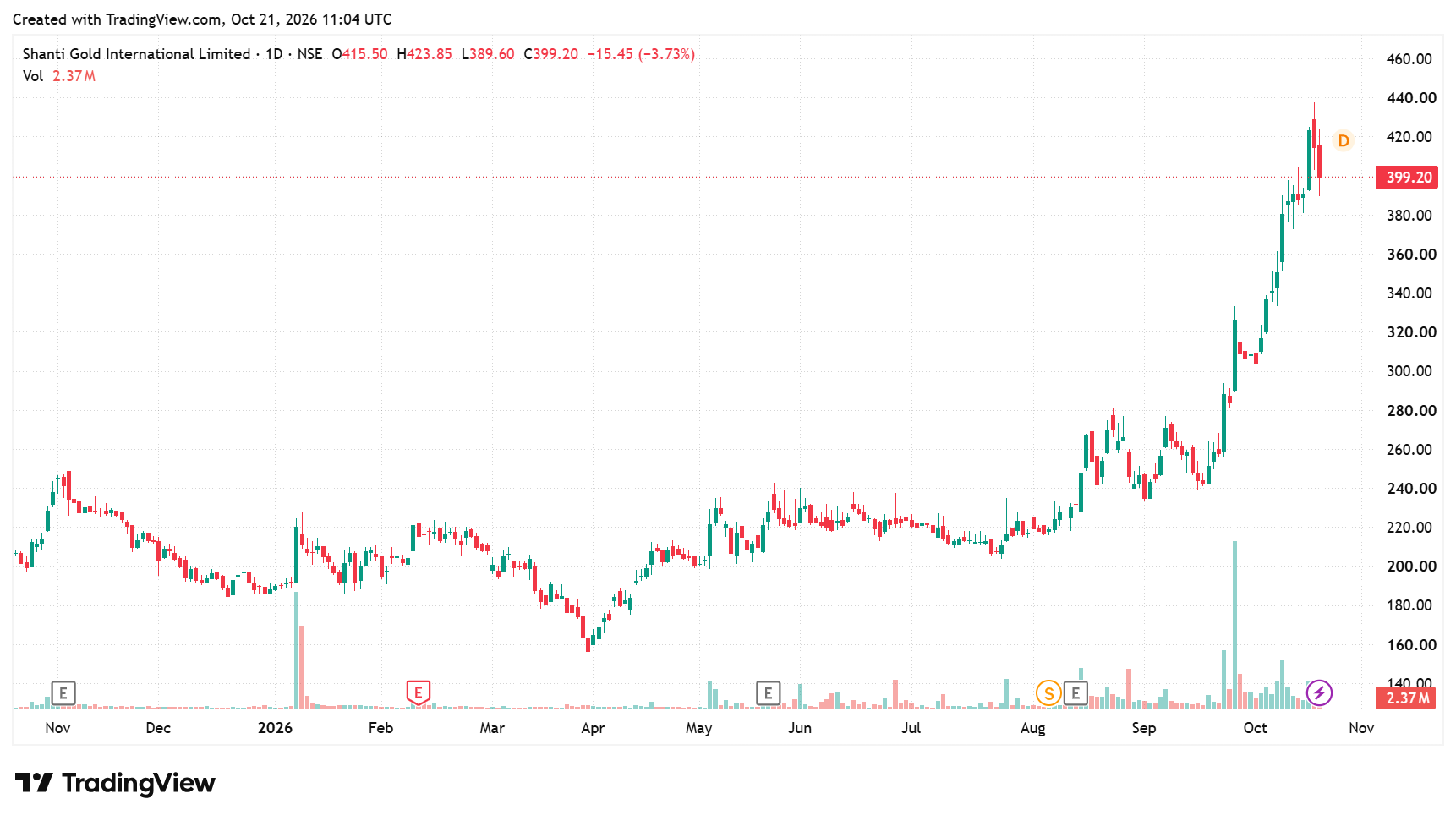
India’s B2B jewellery manufacturers are catching market attention. Sky Gold has surged around 200% in 2026 so far. Meanwhile, other B2B jewellery manufacturers have also seen sharp gains. Shringar House of Mangalsutra rose nearly 50% in October till date, while Shanti Gold gained 109.5% in 2026 so far.
The trend points to growing interest in companies that manufacture jewellery for retail chains rather than sell directly to consumers. The difference lies in the business model. B2C jewellers like Titan Company and Kalyan Jewellers need showrooms, retail staff and marketing to reach customers. B2B manufacturers, on the other hand, can grow by supplying multiple jewellery retailers.
They can focus on production, design and order execution without having to build an extensive retail network. The timing also matters. Organised jewellers are projected to increase their share of India’s jewellery market from 35.2% in CY23 to 59.7% by CY29. As these retailers open more stores and refresh their collections, their need for reliable manufacturing partners could rise.
For B2B jewellery manufacturers, this offers an opportunity to benefit from the expansion of organised retail without bearing the full cost of running consumer-facing stores. Against this backdrop, let’s look at three lesser-known small-cap jewellery companies that could benefit from this shift.
#1 Shanti Gold: Doubling Capacity to Feed India’s Mega-Retailers
Shanti Gold International (market cap: ₹3,000 crore) is an Indian B2B gold jewellery manufacturer serving large organised retail chains, regional retailers, and international markets. It specialises in Cubic Zirconia (CZ) casting and studded gold jewellery (70-75% of its product sales mix) and plain gold jewellery (25-30%).
Order-Book Expansion: Tapping North India and High-Margin Turkish Designs
The company is now expanding into high-volume machine-made plain gold jewellery and value-added categories such as Turkish and designer jewellery. Shanti Gold serves major national and regional brands including Kalyan Jewellers, Joyalukkas, Lalithaa Jewellery and Bhima Jewellers.
Shanti Gold has an installed capacity of 6,700 kg per annum after commissioning an additional 4,000 kg per annum. The company is adding another 1,200 kg of annual capacity, bringing total capacity to 7,900 kg per annum once the Jaipur facility becomes operational. The company expects to bring this capacity online by December 2026.
It is scaling value-added sub-categories such as Turkish jewellery and introducing high-volume machine-made plain gold jewellery. Management is also expanding into North Indian markets where it does not yet have access. Shanti Gold delivered strong Q1FY27 performance.
Sales volume reached 522.1 kg, up 61.6% year-on-year from 323.0 kg in Q1 FY26. Deeper engagement with existing organised retail clients, the rollout of new designs and entry into new domestic markets such as Northern India supported growth. As a result, revenue from operations jumped 144.7% to ₹716.38 crore. Net profit doubled to ₹50 crore.
Guidance vs Delivery: Can 30-40% Volume Run-Rate Sustain 8% EBITDA Margins?
Looking ahead, the management estimates revenue of ₹3,500 crore in FY27, comprising 50-60% value growth and 30-40% volume growth. Management expects the 30-40% volume growth trajectory to be sustainable over the next 3 to 4 years. Management expects sustainable EBITDA margins to settle in the 7.5-8.0% range.
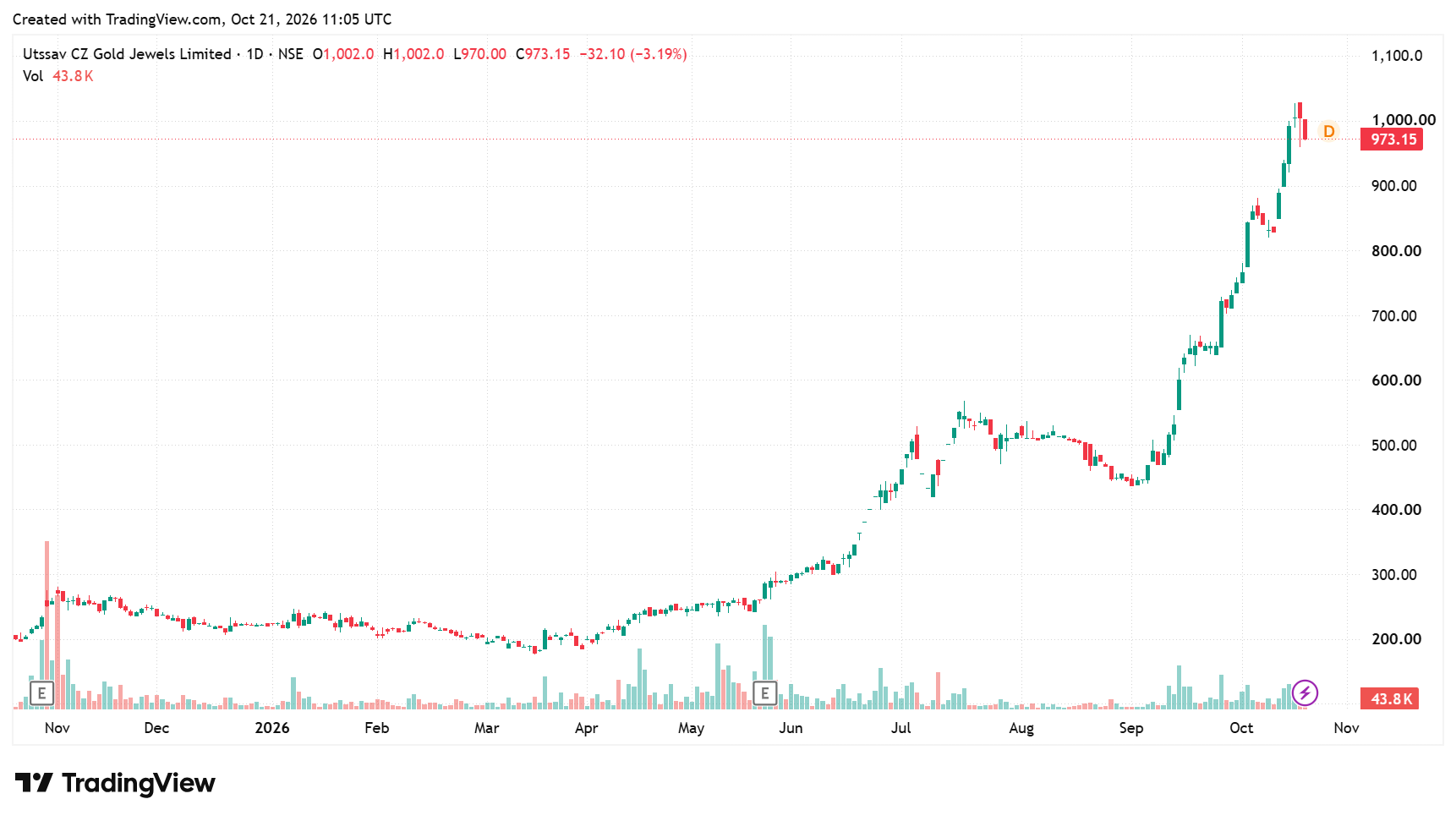
#2 Utssav CZ Gold Jewels: High Margins and Global Ambitions at a Premium P/E
Utssav CZ Gold Jewels (market cap: ₹2,350 crore) is a well-known Indian B2B jewellery manufacturing company. The company specialises in lightweight CZ gold jewellery, rose gold jewellery, plain gold casting and diamond jewellery. Its product portfolio includes a design library of over 70,000 and 300,000 CAD creations.
The company operates across 23 Indian states and two Union Territories and serves a network of 430+ retailers and distributors. Utssav maintains strong long-term relationships with an 85%+ repeat business rate, while onboarding 112 new B2B clients in FY26 alone. It operates a 100% integrated in-house manufacturing process.
Capex Runway: Targeting 7,500-Kg Capacity as Peak Utilization Hits 90%
The company currently has an installed capacity of 2,000 to 2,500 kg per annum. Current capacity utilisation averages 65% and reaches up to 90% during peak festive/wedding seasons. Utssav is looking for a new, larger plant to scale total annual production capacity to 6,000-7,500 kg. The company is targeting to onboard 100-200 new B2B clients in FY27.
The company expects 60% revenue growth and 35-40% volume growth in FY27. Management expects sustainable long-term EBITDA margins of 7-8% and net profit margins of 4-4.5%. Management aims to grow annual revenue to ₹4,000-5,000 crore by 2030. Utssav is expanding into natural diamond and lab-grown diamond to diversify revenues and tap emerging segments.
The Dubai & Lab-Grown Gateway: Mapping the ₹5,000-Crore FY30 Ambition
Management aims to increase annual revenue from the diamond segment to more than ₹200 crore within 2 to 3 years (currently 2%). The company is also establishing a presence in Dubai, a global gold trading hub. Management expects the export share of revenue to jump from 1-2% to 10-20%. It is also expanding into Singapore, Malaysia, Australia and the US.
The company reports half-yearly financial results (for periods ending September and March). The company delivered significant top-line and bottom-line growth during FY26. Revenue from operations increased 78.7% year-on-year to ₹1,157.5 crore. EBITDA increased 132.3% to ₹93.7 crore, while margins expanded 187 bps to 8.1%. Net profit grew 135.7% to ₹59 crore.
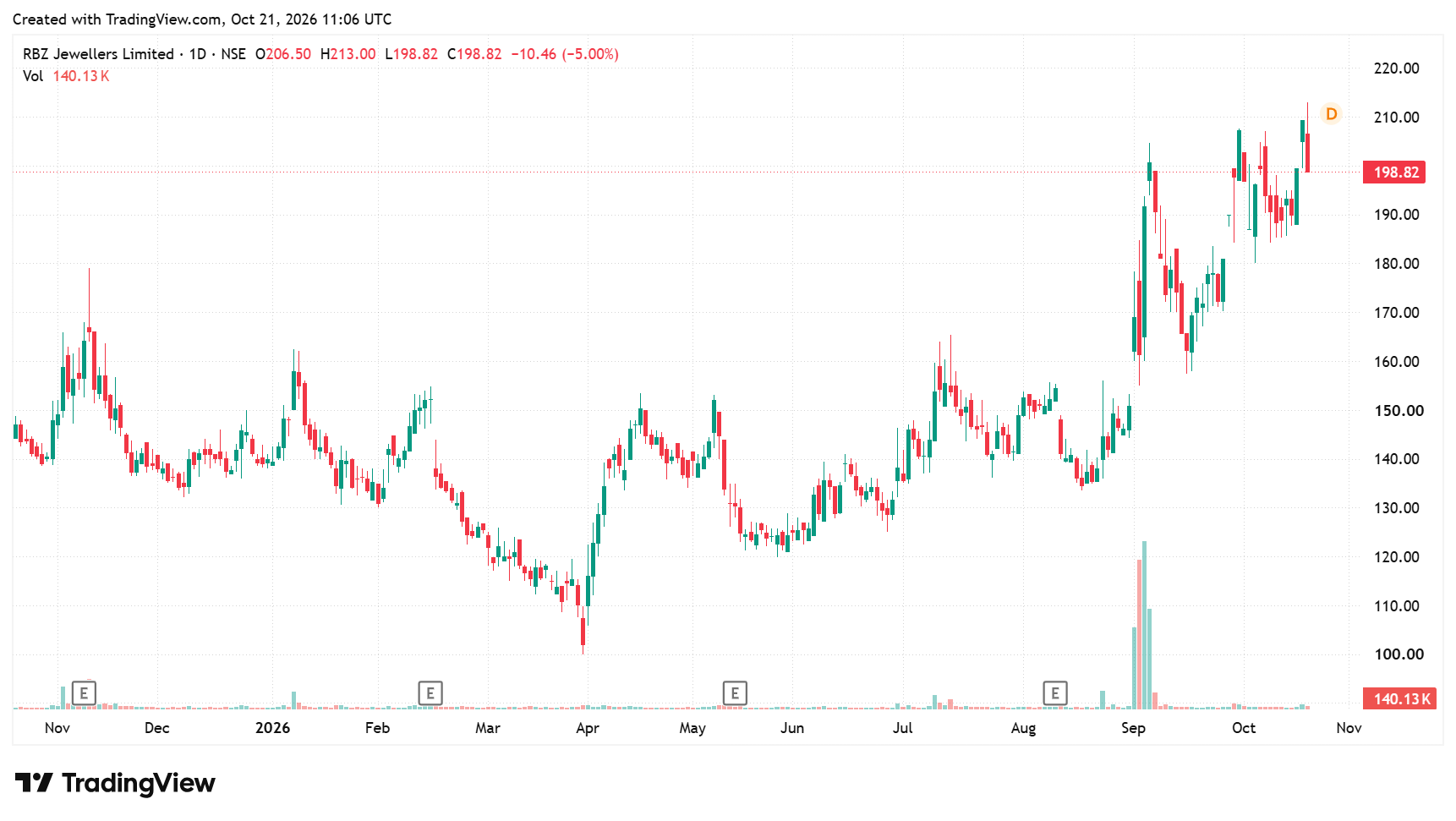
#3 RBZ Jewellers: The Hybrid Play Pivoting from Wholesale to High-Margin Retail
RBZ Jewellers (market cap: ₹796 crore) is one of India’s leading organized gold jewellery manufacturers. The company supplies customized gold jewellery to national and regional retail chains across 20 states and 72+ cities in India.
The Titan & Senco Pipeline: Supplying 1% of Organised Wholesale Gold
It serves a network of about 190 retail partners and commands 1% market share of India’s organised wholesale gold jewellery market. RBZ is not a pure-play B2B player.
The company also provides manufacturing services for major corporate jewellery brands. This B2B model accounted for 52% of total gold volumes sold in FY26. RBZ also operates a retail brand “Harit Zaveri Jewellers.” Management has scaled the retail brand from an annual turnover of ₹24 crore in FY21 to ₹408 crore in FY26.
Asset-Light Sweet Spot: Unlocking 85% Festive Peak on Existing Factory Lines
RBZ serves prominent retail brands including Titan, Malabar Gold & Diamonds, Senco Gold, and PNG Jewellers. RBZ Jewellers operates a wholly-owned manufacturing plant located on the Sarkhej-Gandhinagar Highway in Ahmedabad. The facility has an annual production capacity of over 2,000 kg of gold jewellery.
The plant is currently operating at about 50% capacity. During peak wedding and festival seasons, utilization increases significantly to 70-80% (and sometimes 85-90%). Management’s goal is to maximize the utilization of existing capacity without requiring significant capital expenditure on factory expansion.
The 75% Retail Transformation: Why Showroom Capex Is Squeezing Margins
RBZ is pivoting aggressively toward high-margin B2C retail brand. The company plans to open 7 new showrooms across Gujarat over two financial years. Capex break-even for new stores is expected within one year or less. Over the next 3 to 5 years, management targets shifting its revenue mix toward 75% retail and 25% B2B.
Financially, revenue rose 59.8% year-on-year to ₹120.8 crore in Q1FY27, driven by 8.1% volume growth. B2B business contributed 35.8% to revenue, B2C (64.2%). EBITDA surged by 37.7% to ₹17.9 crore, while margin shrank 238 bps to 14.8%. Net profit still grew 28% to ₹9.1 crore. Management expects the debt-to-equity ratio to remain below 1:1 (0.8:1) by the end of FY27.
Valuation Check: Why Return Ratios Vary Widely Across the Trio
Shanti Gold leads the return ratios chart, with a return on capital employed (ROCE) of 33.9% and return on equity (ROE) of 38.1%. Utssav CZ Gold Jewels also reports healthy returns, with a ROCE of 28.8% and ROE of 36.4%. RBZ Jewellers, meanwhile, has relatively lower return ratios, with ROCE at 22.0% and ROE at 20.1%, broadly in line with the industry median.
In terms of valuation, Utssav CZ Gold Jewels trades at 39.9x earnings, significantly above the industry median of 21.0x. Shanti Gold (16.5x) and RBZ Jewellers (14.0x) trade below the industry median. This suggests that Utssav commands a higher valuation premium, while the other two companies trade at relatively lower multiples.
| Valuation Comparison (X) | |||
| Company | Price-to-Earnings Multiple | ROCE (%) | ROE (%) |
| Shanti Gold | 16.5 | 33.9 | 38.1 |
| Utssav CZ | 39.9 | 28.8 | 36.4 |
| RBZ Jewellers | 14.0 | 22.0 | 20.1 |
| Industry | 21.0 | 21.9 | 21.4 |
| Source: Screener.in (Data as of October 21 2026) | |||
The shift towards organised jewellery retail is creating opportunities for B2B manufacturers, but the benefits will depend on their ability to scale production, retain retail clients and manage working capital. Shanti Gold and Utssav CZ Gold Jewels are expanding capacity, broadening their product portfolios and adding new clients to support growth.
RBZ Jewellers, meanwhile, is looking to increase its retail presence while making better use of its existing manufacturing capacity. Valuations, however, tell a different story for each company. Shanti Gold and RBZ Jewellers trade below the industry median P/E multiple of 21x, while Utssav CZ Gold Jewels commands a premium.
Keep these stocks on your watchlist to see how they tap into upcoming demand.
Disclaimer
Note: Throughout this article, we have relied on data from http://www.Screener.in and the company’s investor presentation. Only in cases where the data were unavailable have we used an alternative, widely accepted and widely used source of information.
The purpose of this article is only to share interesting charts, data points, and thought-provoking opinions. It is NOT a recommendation. If you wish to consider an investment, you are strongly advised to consult your advisor. This article is strictly for educational purposes only.
About the Author: Madhvendra has been deeply immersed in the equity markets for over seven years, combining his passion for investing with his expertise in financial writing. With a knack for simplifying complex concepts, he enjoys sharing his honest perspectives on startups, listed Indian companies, and macroeconomic trends.
A dedicated reader and storyteller, Madhvendra thrives on uncovering insights that inspire his audience to deepen their understanding of the financial world.
Disclosure: The writer and his dependents do not hold the stocks discussed in this article.
The website managers, its employee(s), and contributors/writers/authors of articles have or may have an outstanding buy or sell position or holding in the securities, options on securities, or other related investments of issuers and/or companies discussed therein. The articles’ content and data interpretation are solely the personal views of the contributors/ writers/authors. Investors must make their own investment decisions based on their specific objectives, resources, and only after consulting such independent advisors as may be necessary.