




India’s consumption story is changing in a subtle but important way. As disposable incomes rise, consumers are not just buying more. They are also moving up the value chain, choosing better brands, higher-quality products and experiences that were once considered aspirational. Look at what happened in the alcohol industry.
Sales for Radico Khaitan, one of the industry’s leading and fastest-growing players, grew at a 24% CAGR over the last three years, while profit grew 41%. The stock, meanwhile, delivered a 260% return (52% CAGR) in the last three years. The reason is simple.
Premiumisation can change a business’s economics. Higher realisations and better margins can make profits grow much faster than sales, creating room for earnings growth. LG Electronics India is also driving growth through premiumisation. The theme is not isolated. Titan Company has been a major beneficiary of India’s premiumisation shift for over a decade, with its watches, jewellery and eyewear businesses riding consumers’ shift toward branded products.
This premiumisation is creating opportunities across several other consumer durable categories. Watches are emerging as one of them. Watches are becoming a marker of personal style, status, and wealth. The numbers are beginning to reflect this shift. India’s watch market is estimated at US$ 4.19 billion in 2025 and could reach US$ 7.52 billion (around ₹71,000 crore) by 2031.
The luxury end is seeing an even more interesting shift. Swiss watch exports to India have jumped 35% from 2023 to 2025, even as demand weakened in major global markets. With import duties on Swiss watches gradually heading towards 0% by 2031, India’s premium watch opportunity could get even larger.
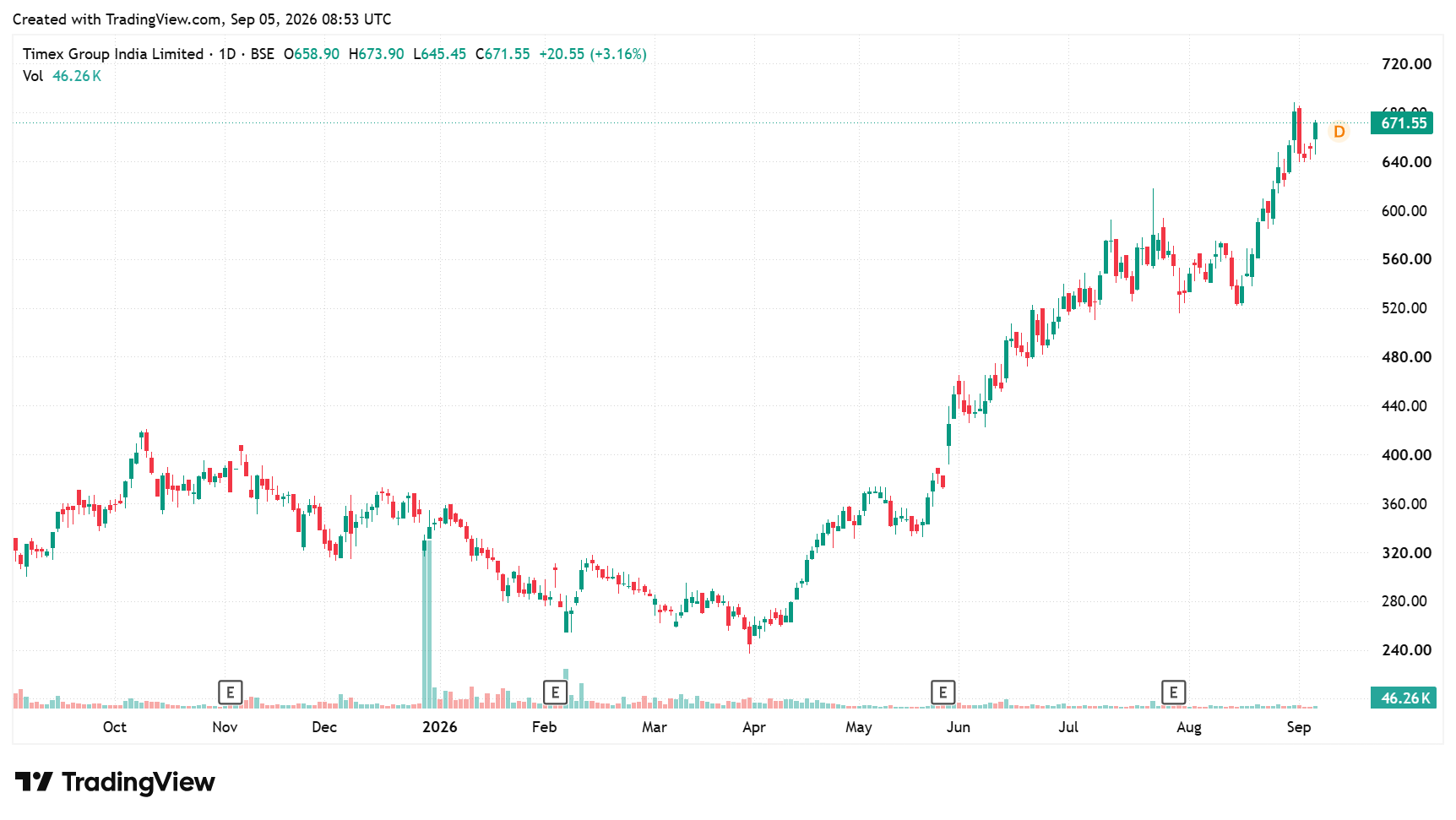
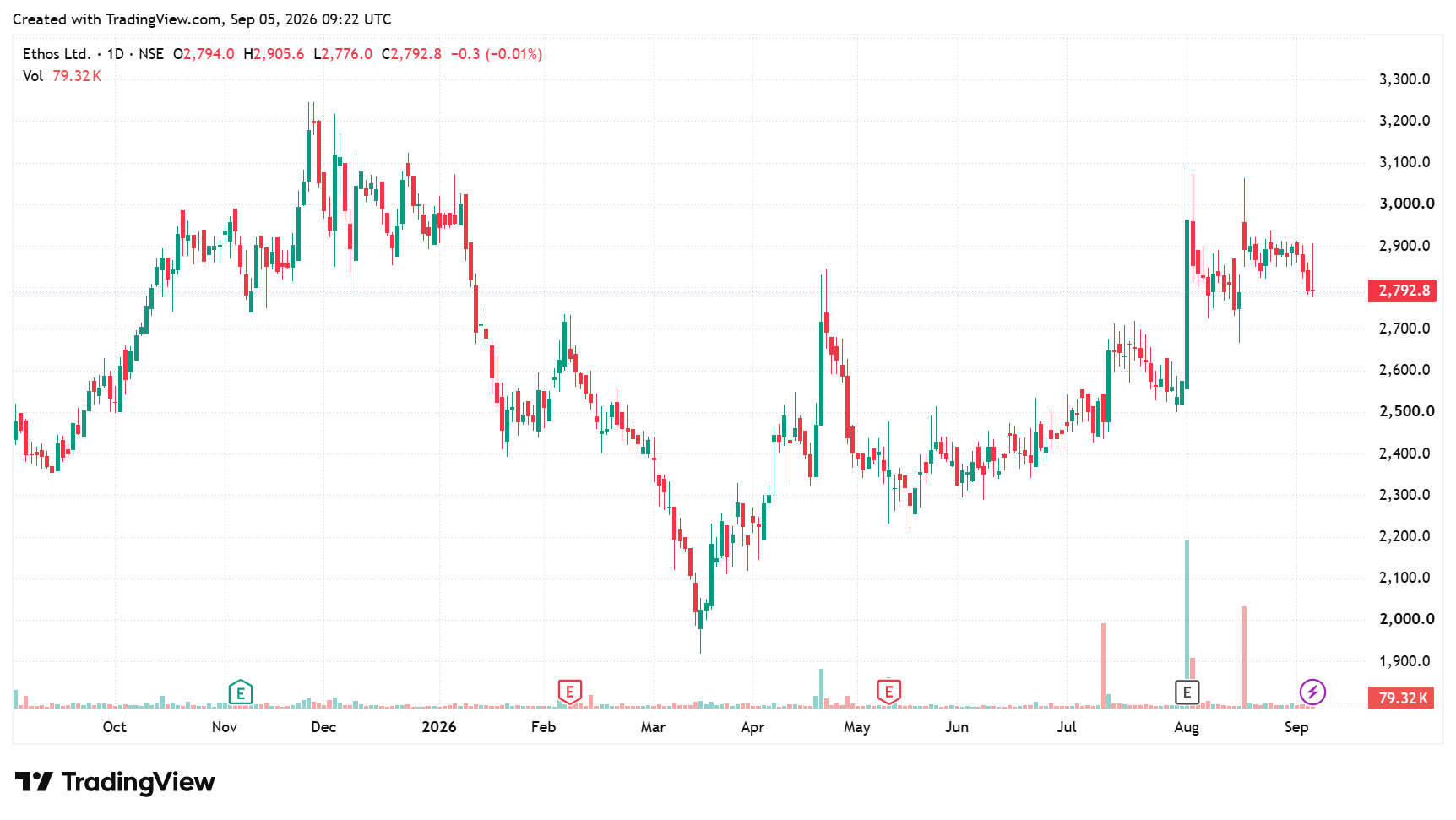
This is where two retailers have started to make their mark. One has delivered a 420% return in the last 3 years, while the other has returned 76% during the period. As premiumisation gathers pace, their expanding presence across premium and luxury watch retail gives them a direct play on the rising appetite for higher-value watches in India.
#1 Timex Group India: Premium Brands Driving Margin Expansion
Timex Group India is a major player in India’s watch and lifestyle market. It sells watches ranging from mass-market models (starting around ₹500) to luxury watches (exceeding ₹200,000). Its flagship brand is Timex, alongside youth-focused brands like Helix and TMX.
The company also distributes global brands including Guess, Versace, Philipp Plein, Nautica, and Aston Martin. Guess is Timex’s largest licensed brand, contributing 17.5% of total revenue, up from 3-4% a few years ago. The company sells almost 3 lakh units of Guess watches annually.
It sells its watches across India through 6,000+ multi-brand outlets, exclusive brand stores (like Timex World and Just Watches), department stores, and e-commerce and quick-commerce platforms. It operates a state-of-the-art manufacturing and assembly plant in Baddi, Himachal Pradesh, with an annual production capacity of about 60 lakh watches.
Asset-Light Retail Expansion: Scaling to 300 Stores on Zero Corporate Capex
Timex plans to scale its exclusive Timex World and Just Watches stores from 41 to 300 in the medium term. Its standalone stores operate under the Franchisee-Owned Franchisee-Operated (FOFO) model, requiring zero corporate capex to expand retail. This enabled Timex to achieve a strong 81.5% Return on Capital Employed (ROCE) in FY26.
Its net revenue grew 48.4% year-on-year to ₹798.6 crore in FY26, driven by high-ASP (Average Selling Price) led by partner brands like Guess (grew 51% in FY26), Versace (grew 48% in FY26), and newly launched Aston Martin. EBITDA (Earnings Before Interest, Tax, Depreciation, and Amortisation) grew 126.9% to ₹108.8 crore with margins at 13.6%, up 470 bps.
Financial Inflection: High-ASP Licensing Expands FY26 EBITDA Margins to 13.6%
Net profit more than doubled to ₹75 crore from ₹31 crore in FY25. Historically, over the past four years, Timex’s revenue has grown at a 32% CAGR, while operating costs have increased at a CAGR of only 21%. EBITDA margins have also expanded to 13.6% in FY26 from just 2.9% in FY22. As volumes rise, operating leverage should support margins, alongside other key factors.
This was reflected in Q1FY27 performance. Revenue in Q1FY27 increased 29.6% year-over-year to ₹219.5 crore. EBITDA increased 63.0% to ₹35.8 crore, while margin expanded 330 bps to 16.3%. Consequently, net profit increased 66.7% to ₹25 crore.
Structural Margin Drivers: EFTA Swiss Tariffs and the Royalty Cap Mechanics
A big tailwind would be the gradual reduction (3.1% annually) of Swiss import customs duties from 22% to 0% by January 2031. This tailwind could boost margins for Swiss-made watches if the company decides to absorb the benefit. The company is also planning to manufacture Guess watches in India from next year. This would help expand both the margin and volumes.
Additionally, Timex normally pays a 6% royalty fee on every licensed fashion watch (like Guess or Versace) it sells. However, it has a special contract that caps liability in a single year. This maximum limit is fixed as a percentage (4.9% to 5.99%) of the previous year’s sales.
Once Timex hits that limit, royalties drop to 0% on incremental watches sold for the rest of that year. In FY26, the company hit this limit in February. Timex is projected to hit the limit in December this year. This means it would get even more months of completely royalty-free sales, keeping profits much higher.
#2 Ethos: Luxury Portfolio Driving Premiumisation Growth
Ethosis India’s leading luxury and premium watch and lifestyle retailer. As of August 2026, its network has expanded to 103 boutiques across 34 cities. The company has a portfolio of 85+ global luxury watch and lifestyle brands. Notably, Ethos holds 64 exclusive brand partnerships in India, creating a massive competitive moat and driving higher average selling prices.
Ethos partners with many of the world’s most renowned watchmakers across various segments, including heritage brands such as Jacob & Co., H. Moser & Cie., Bovet, Hublot, Jaeger-LeCoultre, Panerai, IWC Schaffhausen, Zenith, Speake-Marin, and Trilobe. Other luxury and premium brands include Omega, Tudor, Breitling, Longines, and Rado.
Premiumisation Engine: ASP Expands to ₹2.26 Lakh on 33% 5-Year Compounding
The company’s focus on premiumisation has led to consistent growth in Average Selling Price (ASP). ASP has increased to ₹2,26,000 in Q1FY27, up from ₹1,49,000 in FY22. Over the last five years, revenue grew at a 33% CAGR to ₹1,612 crore in FY26. Meanwhile, net profit grew at 82% CAGR to ₹96 crore. The momentum continued in Q1FY27.
Q1FY27 Performance: 13.2% Same-Store Sales Growth Accelerates Operating Leverage
Revenue from operations increased 33.3% to ₹461.7 crore, driven by 13.2% same-store sales growth. This implies that revenue is growing not just from opening new stores, but from higher-volume transactions in existing boutiques. EBITDA surged 44.1% to ₹74.8 crore as margin expanded by 119 bps to 16.2%. Net profit surged 52.6% to ₹29 crore.
Tier-II Expansion & Lifestyle Moats: The Roadmap to 10x Scale by 2032
Ethos aims to grow its business 10x by 2032. To achieve this, it is expanding into Tier II/III cities. It recently entered Ranchi, Jodhpur, Srinagar, Kanpur, Agra, and Faridabad. It has 64 exclusive brand partnerships across India, from a total portfolio of over 85 brands. Competitors cannot replicate these relationships, which provide it with pricing power and differentiation.
The company has also ventured into luxury lifestyle: jewellery, accessories, and travel. It has partnered with Messika (a French fine jewellery brand), Rimowa (a luggage brand), Faberge, Fabbrica Pelleterie Milano, D1 Milano, and Unimatic. This new segment provides diversification and opens up additional avenues for growth.
The company’s pre-owned luxury watch business, Second Movement, aims to tap the growing pre-owned market. Ethos estimates that India’s pre-owned luxury watch market is growing even faster, at a CAGR of around 11%. To counter the lack of trust, it provides certified authenticity, service and technical expertise and an omnichannel ecosystem.
The Valuation Divergence: Ethos’s Multiple Discount vs Timex’s 158% ROE Premium
Timex boasts a higher Return on Capital Employed (ROCE) than Ethos. Timex’s greater reliance on FOFO stores, compared to Ethos’s company-owned and company-operated model, along with sharp increases in margins and profitability, has boosted return ratios.
Valuation-wise, both players trade at a significant premium to the industry median. However, the Gems, Jewellery and Watches industry is heavily dominated by jewellery companies, making the industry median a less meaningful benchmark for watch players.
That’s why a comparison with their own historical multiples and each other provides a better perspective. Accordingly, Ethos trades at a discount to both its historical median multiple and Timex, while Timex trades at a premium to its own historical median.
| Peer Comparison (X) | ||||
Company | Price-to-Earnings Multiple | Return Ratios | ||
| Company | 3Y Median | ROCE (%) | ROE (%) | |
| Ethos | 70.8 | 75.2 | 10.4 | 7.7 |
| Timex | 75.8 | 62.9 | 82.8 | 158.0 |
| Industry | 17.9 | 21.9 | 20.9 | |
| Source: Screener.in (Data as of September 04 2026) | ||||
The watch opportunity is becoming harder to ignore, but the two players offer very different stories. Timex has seen revenue grow at a 32% CAGR over four years, while EBITDA margins have expanded to 13.6% in FY26. Its FOFO-led expansion and rising contribution from higher ASP brands such as Guess and Versace could support further operating leverage.
Ethos, meanwhile, has built an 85+ brand portfolio and 64 exclusive partnerships. ASP has been on a consistent uptrend, with revenue growing at a 33% CAGR over five years. So both are growing at a faster growth rate. Lowering of duties on Swiss watches could act as a tailwind.
Nonetheless, you could keep these names on your watchlist to track their execution.
Disclaimer:
Note: Throughout this article, we have relied on data from http://www.Screener.in and the company’s investor presentation. We used an alternative, widely used, and accepted source of information only when the data was unavailable.
The purpose of this article is only to share interesting charts, data points, and thought-provoking opinions. It is NOT a recommendation. If you wish to consider an investment, you are strongly advised to consult your advisor. This article is strictly for educational purposes only.
About the Author: Madhvendra has been deeply immersed in the equity markets for over seven years, combining his passion for investing with his expertise in financial writing. With a knack for simplifying complex concepts, he enjoys sharing his honest perspectives on startups, listed Indian companies, and macroeconomic trends.
A dedicated reader and storyteller, Madhvendra thrives on uncovering insights that inspire his audience to deepen their understanding of the financial world.
Disclosure: The writer and his dependents do not hold the stocks discussed in this article.
The website managers, its employee(s), and contributors/writers/authors of articles have or may have an outstanding buy or sell position or holding in the securities, options on securities, or other related investments of issuers and/or companies discussed therein. The articles’ content and data interpretation are solely the personal views of the contributors/ writers/authors. Investors must make their own investment decisions based on their specific objectives and resources, and only after consulting any independent advisors as may be necessary.