




Every credit cycle has a point before the story becomes obvious. UBS, a global financial services firm, believes personal loans could be approaching that point in India.
In fact, as per the RBI data, credit to the personal loan segment recorded a YoY growth of 16.2% in July 2026, as compared with 11.9% a year ago. The acceleration is already visible.
The thesis rests on three factors: unsecured household leverage has remained broadly flat over the past three years, asset quality across lenders is healthy, and liquidity is abundant in the system, with lenders taking a more risk-on stance. Together, these factors create a favorable starting point for another leg of unsecured credit growth.
As Gold Loans Slow, Personal Loans Could Benefit
Against this backdrop, another shift is worth watching. Gold loans have benefited from the sharp rise in gold prices, allowing borrowers to raise more money against the same collateral. But the momentum may already be moderating. RBI data show that bank credit against gold jewellery decelerated in July 2026. If gold prices stabilise from here, the collateral-value tailwind could weaken further. UBS believes some borrowers who turned to gold loans as an alternative source of credit could then shift back towards conventional personal loans.
That could redirect some credit demand towards personal loan lenders. Bajaj Finance remains the obvious benchmark in this space. But for investors looking beyond the established name, the more interesting question is which other lenders are already positioned to benefit from this shift. Three NBFCs stand out, but for very different reasons.
#1. Poonawalla Fincorp: Calibrated Transition, Multiple Growth Engines
Poonawalla Fincorp offers direct exposure to a revival in retail credit, but it is not a pure-play unsecured lender. The company has built a more balanced franchise, with 53% of its book secured.
Personal and consumer loans are still an important growth engine. At the end of Q1FY27, Prime Personal Loans accounted for 9% of AUM and Instant Consumer Loans accounted for another 19%. Together, they contributed 28% of the company’s ₹67,054 crore AUM. The rest comprised Loan Against Property (28%), mid-market loans (15%), business loans (11%), pre-owned car finance (8%), and other segments.
That mix gives Poonawalla room to benefit if personal loan demand picks up. There is already evidence of operating leverage. Prime Personal Loan disbursals reached around ₹537 crore a month in Q1FY27, while Net Interest Income (NII) rose 84% year-on-year to ₹1,415 crore.
Poonawalla Fincorp: Financial Performance
| Period | Q1FY26 | Q1FY27 | YoY Growth (%) |
| Net Interest Income (₹ crore) | 768 | 1,415 | 84.2% |
| Operating Profit (₹ crore) | 325 | 785 | 141.5% |
| Net Profit (₹ crore) | 63 | 308 | 388.9% |
| Cost-to-Income Ratio (%) | 57.70% | 44.60% | 1,310 bps |
| GNPA (%) | 1.84% | 1.37% | 47 bps |
| ROA (%) | 0.68% | 1.98% | 130 bps |
In Q1FY27, NIM expanded to 9.10%, while the cost-to-income ratio fell by 1,310 bps. This helped net profit surge nearly 390% YoY to ₹308 crore. Importantly, asset quality has improved alongside the growth, with gross NPA (GNPA) falling to 1.37%.
Management is targeting an exit Return on Assets (ROA) of 3.0% to 3.5% by June 2028, implying an improvement of more than 100 bps from the 1.98% reported in Q1FY27. Scaling personal loans is expected to be one of the high-margin growth engines supporting that improvement.
The next test is whether credit costs remain contained as the newer personal-loan book gets larger and has more time to mature. A strong starting point is useful, but early growth in a credit cycle does not tell us how these loans will perform after borrowers have had more time to repay them.
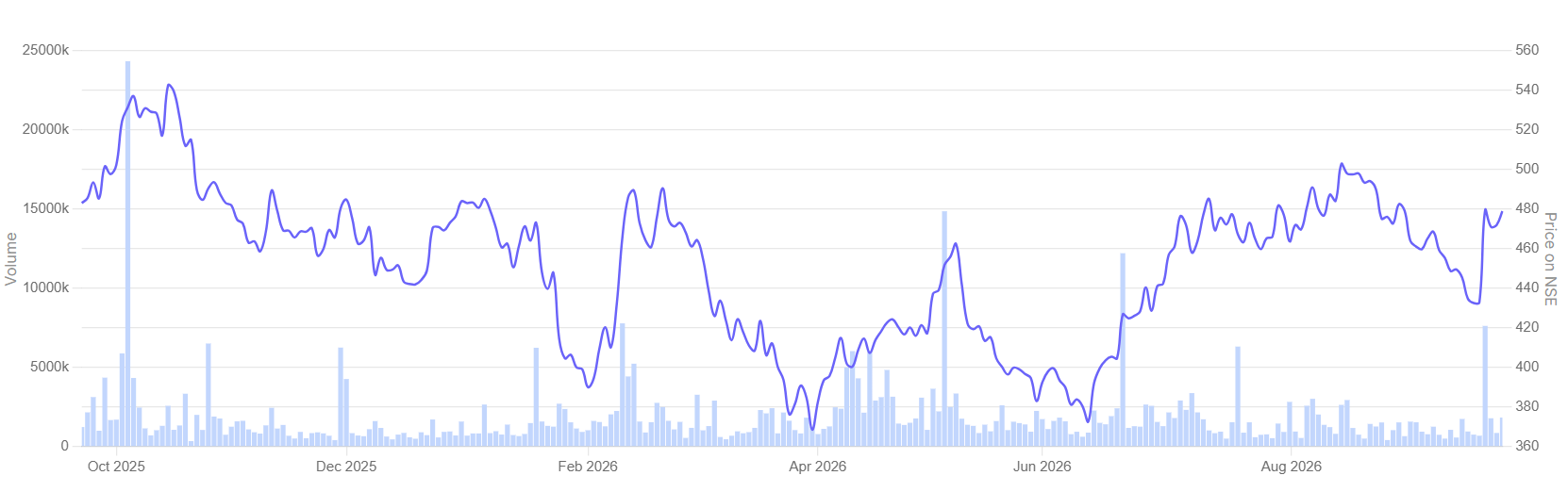
Poonawalla Fincorp: 1 Year Stock Chart
#2. Tata Capital: Scale With an Unsecured Growth Lever
Tata Capital offers a different way to participate in the unsecured credit theme. Unlike Poonawalla, where personal and consumer loans form a larger part of the book, Tata Capital is using unsecured lending as a growth and margin lever within a much larger, diversified franchise.
Tata Capital: Financial Performance
| Period | Q1FY26 | Q1FY27 | YoY Growth (%) |
| Net Interest Income (₹ crore) | 2,866 | 3,571 | 24.6% |
| Operating Profit (₹ crore) | 2,291 | 2,835 | 23.7% |
| Net Profit (₹ crore) | 990 | 1,547 | 56.3% |
| Cost-to-Income Ratio (%) | 36.80% | 36.40% | 40 bps |
| GNPA (%) | 2.10% | 1.90% | 20 bps |
| ROA (%) | 1.8% | 2.3% | 50 bps |
In Q1FY27, Tata Capital’s consolidated AUM grew 22% YoY to ₹2.91 lakh crore (28% excluding the legacy Motor Finance business). Profitability improved alongside growth, with net profit rising 56% to ₹1,547 crore and ROA reaching 2.3% (2.5% excluding Motor Finance).
Credit cost also fell to 1% during the quarter from 1.6% a year earlier. The combination of faster growth, improving profitability, and lower credit costs matters, as these do not always move together during periods of credit expansion.
Within unsecured lending, personal-loan disbursals grew 73% YoY, while overall unsecured retail disbursals increased 50%. Yet unsecured retail loans account for only 10.3% of net AUM.
That small starting base cuts both ways. It limits the immediate impact of unsecured lending on Tata Capital’s overall credit profile. Still, the rapid growth means the segment could become a more meaningful contributor to incremental earnings over time. The key question is whether credit costs in this portfolio remain contained as it scales.
For Tata Capital, therefore, personal loans are less a standalone growth story and more an additional growth and margin lever within a diversified balance sheet. That makes its exposure to the theme different from Poonawalla’s.
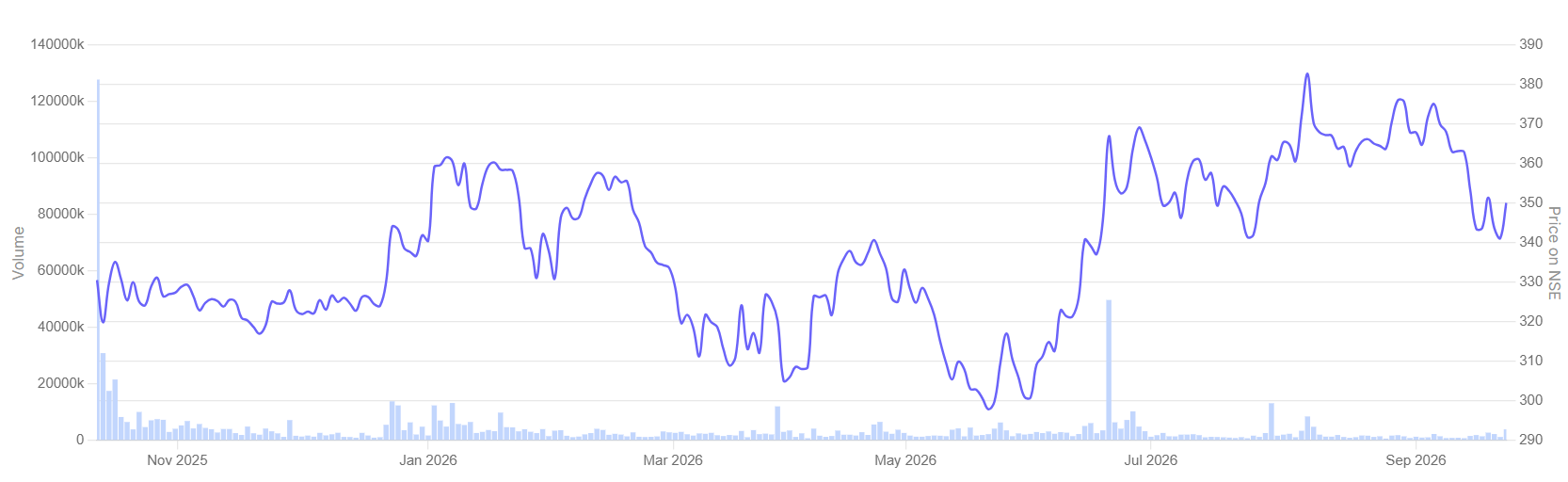
Tata Capital: 1 Year Stock Chart
#3. Aditya Birla Capital: Fast Growth, Tighter Underwriting
Aditya Birla Capital (ABCL) has the fastest-growing personal and consumer loan book among the three, but it is also tightening its underwriting as the portfolio scales.
Aditya Birla Capital: Financial Performance of NBFC Segment
| Period | Q1FY26 | Q1FY27 | YoY Growth (%) |
| Net Interest Income (₹ crore) | 1,859 | 2,377 | 27.9% |
| Net Profit (₹ crore) | 689 | 927 | 34.5% |
| Net Interest Margin (%) | 5.97 | 6.07 | 10 bps |
| Cost-to-Income Ratio (%) | 28.72 | 31.81 | -309 bps |
| ROA (%) | 2.25% | 2.39% | 14 bps |
In Q1FY27, overall NBFC AUM grew 28% YoY to ₹1.67 lakh crore, while ROA improved to 2.39%. Personal and consumer loan AUM grew 41% to ₹23,267 crore, taking its share of the total book to 14%. Including unsecured business loans, unsecured lending now accounts for around 25% of AUM.
So far, faster growth has not translated into weaker asset quality. ABCL has been recalibrating its underwriting cohorts over the past 18-24 months, removing segments that fall outside its risk parameters. More than 95% of its personal and consumer loans have been lent to borrowers with a credit score of 700+.
Gross Stage 2 assets, or loans overdue by 31 to 89 days, and Gross Stage 3 assets (loans overdue by more than 90 days) have reduced to 1.1% and 1.3%, respectively, in its personal and consumer lending portfolio. The portfolio continues to generate strong yields of 16.2%, and management wants to take this to 18-19%.
For ABCL, therefore, the key question is not simply whether unsecured lending can grow faster. It is whether tighter underwriting can preserve asset quality while the company pushes towards higher portfolio yields and stronger returns.
The Bigger Question: Is this a Healthier Credit Cycle?
The bigger question is whether India is entering another unsecured credit cycle from a healthier starting point.
UBS’s thesis rests on contained household leverage, supportive liquidity and healthy asset quality. The moderation in gold-loan growth adds another potential source of personal-loan demand if some borrowers shift back towards unsecured credit.
But the quality of this cycle will only become clearer with time. The important indicators are not just disbursement growth or AUM growth, but what happens to early delinquencies, credit costs, and returns as newer loans mature.
That makes the three lenders different propositions. Poonawalla is more directly exposed to personal and consumer lending. Tata Capital is using unsecured credit as an incremental growth lever, while Aditya Birla Capital is growing its higher-yielding unsecured portfolio at a faster pace.
The common thread is simple: the opportunity is not just to grow unsecured lending, but to do so without allowing growth to outrun underwriting discipline. Add these stocks to your watchlist and monitor how they execute their growth plans.
Disclaimer:
Note: We have relied on data from www.Screener.in throughout this article. Only in cases where the data was not available, have we used an alternate, but widely used and accepted source of information.
The purpose of this article is only to share interesting charts, data points, and thought-provoking opinions. It is NOT a recommendation. If you wish to consider an investment, you are strongly advised to consult your advisor. This article is strictly for educational purposes only.
Deepan Datta has spent over a decade studying stocks and mutual funds. His passion is to uncover interesting stories in the financial markets and share them through his writings with investors at large. He is focused on delivering clear, easy-to-understand, and research-backed insights. Deepan began his career as a Research Associate at S&P Global, where he developed a strong foundation in financial research and data analysis.
Disclosure: The writer and his dependents do not hold the stocks discussed in this article.
The website managers, their employees (s), and contributors/writers/authors of articles have or may have an outstanding buy or sell position or holding in the securities, options on securities or other related investments of issuers and/or companies discussed therein. The content of the articles and the interpretation of data are solely the personal views of the contributors/ writers/authors. Investors must make their own investment decisions based on their specific objectives, resources and only after consulting such independent advisors as may be necessary.