



India’s data center expansion is creating demand far beyond servers and computing equipment. Behind every new facility is a network of pipes, spools and specialized hoses that carry cooling fluids and connect critical systems. As computing density rises, these components are becoming an increasingly important part of data center infrastructure.
The ₹2-Lakh-Crore Runway: Liquid Cooling Rewires Data Center Hardware
As per Cushman & Wakefield, India had around 1.8 gigawatts (GW) of data center capacity as of mid-2026. This is expected to expand nearly 6X to around 10.5 GW over the next five years. The scale of this build-out is reflected in planned industry investment. ICRA estimates that data center players could invest ₹2-2.3 lakh crore over the next 7-10 years.
This creates a sizeable opportunity for value-chain suppliers of specialized infrastructure components. Among the many products required to build and operate these facilities, stainless steel piping systems and specialized hoses are also seeing demand. Both products form an important part of the cooling infrastructure inside data centers.
Against this backdrop, this article looks at two players that are positioned to benefit from this emerging demand for data center infrastructure. One is expanding into value-added stainless steel spooling. Meanwhile, another is already benefiting from growing demand for piping systems, hoses and skid assemblies for liquid cooling applications.
#1 Venus Pipes and Tubes: Expanding into high-value data center pipe spooling
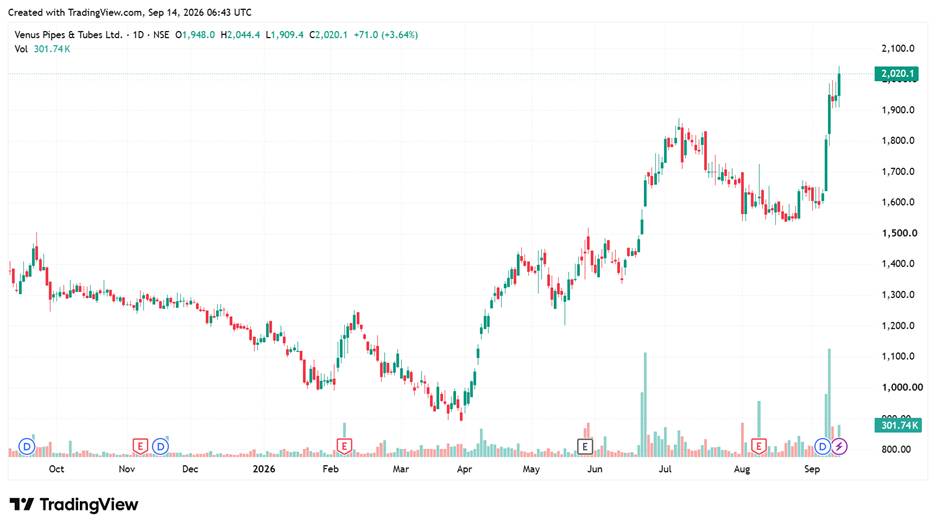
Venus Pipes & Tubes is expanding into the data center segment as part of its forward integration strategy into engineered piping solutions. Stainless steel spools and pipes are used for cooling applications in data centers. The piping is installed inside the data center building and carries cooling fluid from the Cooling Distribution Unit (CDU) to the server racks.
The Data Center Pivot: Unlocking ₹210-Cr Spooling Revenue
Just as pre-engineered buildings replaced structural steel, pipe spooling reduces on-site installation time and reduces project completion risk for clients. Spooling allows Venus to consume its own manufactured welded pipes, seamless pipes, and fittings in-house. This enables higher value addition and realization than selling standalone pipes.
Management therefore expects pipe spooling to deliver higher realization and stronger EBITDA (earnings before interest, taxes, depreciation, and amortization) margins than standalone pipes. Venus is investing ₹70 crore to set up a pipe spooling facility with an asset turnover ratio of more than 3x on this spooling capex. This implies a peak expected revenue of ₹210 crore.
Order Book Dynamics: ₹185-crore LOI Anchors FY27 Expansion
The spooling facility is on track to go live by Q3FY27. The plant is expected to contribute 5% of revenue in FY27 and 10-15% in FY28. The company has also secured a Letter of Intent (LOI) of ₹185 crore from a large data center company to supply stainless steel pipe spools. The total order (excluding this LOI) stands at over ₹600 crore.
Looking ahead, management has targeted 20% revenue growth for FY27 from FY26’s ₹1,167 crore. Total volume growth across seamless pipes, welded pipes, fittings, and spooling is projected to exceed 15% in FY27. The company expects to double its revenue by FY29 or FY30 (or even sooner).
As higher-margin value-added offerings like spooling scale, management targets pushing overall EBITDA margins to 18-19% over the next two years. Management aims to maintain export contribution above 30% of total revenue. This is supported by the export share of the current order book, which stands at over 40% to 45%.
Earnings Check: High Depreciation Dampens 16% Topline Surge.
Financially, the company reported an all-time high quarterly revenue of ₹320.5 crore in Q1FY27, up 16% year-over-year. EBITDA increased 14.7% to ₹51.5 crore, while margin stood at 16.1%. However, net profit grew only 6.5% to ₹26.4 crore because depreciation rose 38.5% and finance costs rose 15.3%.
#2 Aeroflex Industries: Building integrated cooling solutions for data centers
Aeroflex Industries manufactures an end-to-end Secondary Fluid Network (SFN) for data centers. It combines stainless steel piping systems, precision metal hoses, and metallic expansion joints to ensure leak-free coolant distribution. This includes rack-to-SFN flexible hose assemblies used for fluid connections between server racks and the cooling network.
Cooling Infrastructure: The ₹32-Cr Skid Segment Scaling to 15,000 Units
SFN Skid Assemblies generated ₹32.4 crore in Q1FY27, accounting for 23% of total revenue. The company delivered 1,040 skids during the quarter, up from 571 skids in Q4FY26 and 46 skids in Q3FY26. Aeroflex sells skids for ₹1.1 lakh to ₹5.5 lakh per skid, depending on the floor design and technical specifications.
Management estimates that approximately 40 skids go into 1 MW of liquid-cooled IT load. To capitalize on the demand, the company has increased its annual capacity from 6,000 skids to 9,000 skids, and plans to reach 15,000 skids by Q3FY27. Management expects capacity utilization to reach 60-65% by Q4FY27, with a monthly run-rate of around 750 skids.
It is also expanding its annual capacity of stainless-steel flexible hose from 175 lakh meters to 200 lakh meters by Q3 FY27. The company targets 80% capacity utilization, up from around 65%. Management estimates the flexible hose vertical to generate revenue of ₹650-675 crore at peak utilization.
Margin Anatomy: Assembled Hoses Target 25% Blended EBITDA
Bare flexible hose sales yield margins of 16-20%, whereas assembled products generate higher margins of 22-26%. Skid assembly margins align with the company’s blended margin. This aligns with the management’s target of achieving a 25% EBITDA margin over the next few years. Consolidated EBITDA margin stood at 23.04% in Q1FY27.
Management says Aeroflex is positioned to capture demand from India’s announced 9+ GW data center pipeline, led by players like Reliance Jio, Adani, Nxtra, STT GDC, and Yotta. Aeroflex is an early mover in India, with few direct domestic competitors supplying complete SFN skids.
It is also an approved supplier to a leading global thermal management provider. Aeroflex exports hose assemblies and is taking international skid orders in the US and Europe. This allows Aeroflex to participate in global hyperscale data center deployments directly. Exports accounted for 58% of revenue in Q1FY27, of which 57% came from the Americas and 33% from Europe.
Q1 Earnings Surge: Net Profit Up 162% on Hyperscale Export Demand
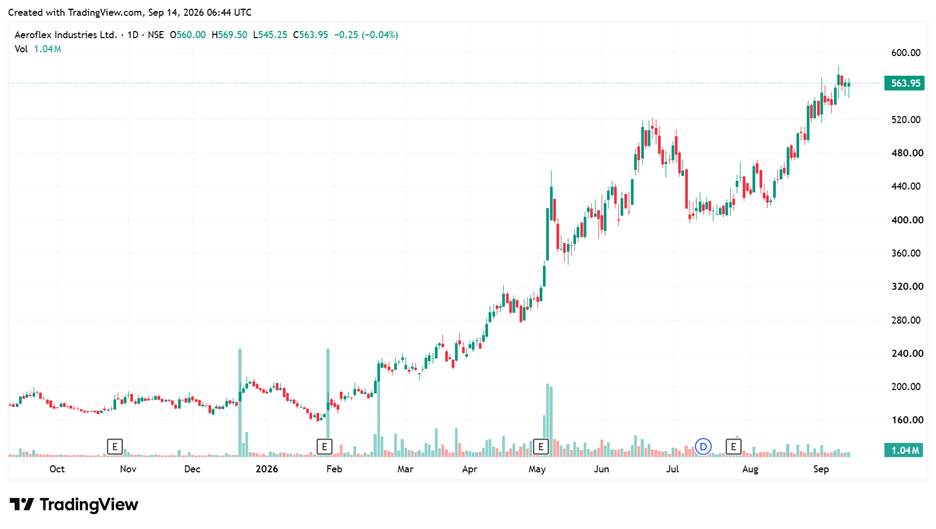
Financially, Aeroflex achieved its highest-ever quarterly performance in Q1 FY27. Revenue grew 72.4% year-on-year to ₹145.4 crore, driven by SFN liquid cooling skid assemblies. EBITDA more than doubled, surging by 116.4% to ₹33.5 crore, while margin expanded by 468 bps to 23%. As a result, net profit grew 162.2% to ₹18.8 crore.
Execution Watch: Evaluating Bid Conversion and Balance Sheet Risk
Venus Pipes stands out for its strong Return on Capital Employed (ROCE) and Return on Equity (ROE), followed by Aeroflex. Valuation-wise, both companies trade at a premium to the industry median P/E multiple and their historical 3-year median valuation. Venus’s current valuation looks moderate, while Aeroflex’s multiples factor in strong growth ahead.
| Particulars | Price-to-Earnings Multiple (X) | Return Ratios | ||
| Company | 3Y Median | ROE (%) | ROCE (%) | |
| Aeroflex | 111.0 | 50.6 | 14.1 | 18.9 |
| Venus Pipes | 40.3 | 32.5 | 17.0 | 21.3 |
| Industry | 21.7 | 11.3 | 13.3 | |
| Source: Screener.in (As of 11 September 2026) | ||||
The data center opportunity is still early for both companies. But their positioning is different. Venus is taking a more measured route, using its existing stainless steel manufacturing capabilities to move into higher-value pipe spooling. The ₹185 crore data center LOI provides an initial validation of this strategy. The new facility could gradually improve revenue mix and realizations.
Aeroflex, on the other hand, already has a strong presence in liquid cooling, with skid assembly becoming a significant revenue driver. Its growing skid capacity, international recognition, and integrated cooling offerings give it a more direct opportunity in data center development. Sharp earnings growth in Q1FY27 also shows the potential of this business.
However, maintaining growth momentum will remain the primary test. Further, Venus needs to demonstrate that its spooling investment can scale profitably, while Aeroflex needs to convert its large pipeline into sustained orders without compromising margins. That said, these companies could be worth keeping on your watchlist.
Disclaimer
Note: Throughout this article, we have relied on data from http://www.Screener.in and the company’s investor presentation. We used an alternative, widely accepted source only when the data were unavailable.
The purpose of this article is only to share interesting charts, data points, and thought-provoking opinions. It is NOT a recommendation. If you wish to consider an investment, we strongly advise you to consult your advisor. This article is strictly for educational purposes only.
About the Author: Madhvendra has been deeply immersed in the equity markets for over seven years, combining his passion for investing with his expertise in financial writing. With a knack for simplifying complex concepts, he enjoys sharing his honest perspectives on startups, listed Indian companies, and macroeconomic trends.
A dedicated reader and storyteller, Madhvendra thrives on uncovering insights that inspire his audience to deepen their understanding of the financial world.
Disclosure: The writer and his dependents do not hold the stocks discussed in this article. The website managers, their employees (s), and contributors/writers/authors of articles have or may have an outstanding buy or sell position or holding in the securities, options on securities, or other related investments of issuers and/or companies discussed therein. The articles’ content and data interpretation are solely the personal views of the contributors/ writers/authors. Investors must make their own investment decisions based on their specific objectives and resources, and only after consulting any independent advisors as necessary.